Real Estate Bookkeeping: The Complete Guide for Rental Property Investors in 2026

If you own rental properties and you’re still reconciling spreadsheets at 11 PM in March, you already know the problem. Real estate bookkeeping isn’t just tedious — when it’s done wrong, it’s expensive. Misclassified expenses, missed deductions, incorrect depreciation start dates, commingled funds across LLCs — every one of those errors either costs you money at tax time or costs you money in CPA hours cleaning up the mess. Sometimes both.
The average rental property investor doesn’t have a revenue problem. They have a systems problem. And the difference between a portfolio that runs clean year-round and one that produces a surprise bill in April almost always comes down to whether the bookkeeping was built right from the start.
This guide covers everything: how to structure your real estate bookkeeping system, what a monthly routine actually looks like, which financial reports matter and why, the tax strategies your books need to support, the mistakes that quietly cost investors thousands, and how AI-powered platforms are changing what’s possible. Whether you’re managing two units or two dozen, by the end of this you’ll have a complete picture of what a proper system looks like — and exactly how to build one that scales.
Real Estate Bookkeeping Is Its Own Discipline — Here’s Why Generic Tools Fail
Most investors who struggle with their books aren’t failing because they’re disorganized. They’re failing because they’re using tools that were never designed for what they’re doing. A spreadsheet built for a freelancer, or accounting software designed for a retail business, has no concept of what it means to own a fourplex in Nashville, a duplex in Phoenix, and a single-family in Columbus — each in its own LLC, each with its own mortgage, each at a different phase of the investment lifecycle.
Real estate bookkeeping is the ongoing practice of tracking income, expenses, assets, and liabilities across a property portfolio — at the property level, not just the business level. That distinction matters more than most people realize. When your books are organized at the entity level only, you can tell whether “Irongate Holdings LLC” made money. What you can’t tell is whether the property on Ridgecrest Boulevard is actually profitable or quietly dragging down everything else in the entity. Property-level tracking is the difference between data and insight.
It’s also worth separating bookkeeping from accounting, because investors often conflate the two. Bookkeeping is the daily and monthly work of recording transactions — categorizing income, logging expenses, reconciling bank accounts, and keeping the ledger current. Accounting is what happens with that data: interpreting the numbers, preparing financial statements, advising on tax strategy, filing returns. Both matter. But bookkeeping is the foundation. If the foundation is wrong, everything built on top of it — including your CPA’s work — is compromised.
The reason generic software fails investors specifically comes down to what it doesn’t understand. IRS Publication 527 establishes a specific framework for residential rental property — one that covers depreciation schedules, the treatment of rental income and expenses, passive activity rules, and the handling of security deposits. General-purpose accounting software doesn’t know what a Schedule E is. It doesn’t have a concept of a depreciation start date tied to “placed in service” status. It doesn’t distinguish between a repair and a capital improvement in any way that maps to IRS rules. And according to IRS Topic 414, rental income and expense reporting requires a level of specificity that off-the-shelf tools simply aren’t configured to deliver.
There’s also the problem of investment phases. A property you’re rehabbing before it goes on the rental market has entirely different bookkeeping requirements than a stabilized rental generating monthly income. A fix-and-flip has different tax treatment than a buy-and-hold. The costs you incur during acquisition — inspections, title fees, transfer taxes — need to be capitalized into the property’s cost basis, not expensed. Generic software doesn’t understand phases, and it certainly doesn’t understand the real estate-specific IRS forms that different phases produce. As explored in detail in the RealBooks post on why spreadsheets fall short for rental property management, the risks of the wrong tool go far beyond inconvenience — they reach directly into your tax liability.
The real-world consequence of using the wrong tools shows up in three ways. First, expenses get assigned to the wrong property, making property-level performance analysis useless. Second, deductions get missed — especially depreciation-related ones — because the system isn’t structured to surface them. Third, your CPA spends billable hours untangling categorization errors instead of doing the strategic tax work you’re actually paying them for. Bookkeeping for real estate isn’t a generic task. It’s a specialized discipline that requires a purpose-built approach.
Now that the discipline is defined and the failure modes of generic tools are clear, the logical next step is building a system that works — starting with the structural decisions every investor needs to make before recording their first transaction.
Building a Real Estate Bookkeeping System That Actually Works
A proper real estate bookkeeping system isn’t a folder of receipts and a bank statement. It’s a structured financial architecture — with the right accounts, the right separation, and the right level of property-level granularity to support everything from monthly P&L reviews to Schedule E preparation. Getting the structure right at the start is the single highest-leverage decision you’ll make in your bookkeeping setup.
The foundation of any bookkeeping system is the chart of accounts — the organized list of every account category used to classify financial transactions. For a real estate investor, that chart looks meaningfully different from what a retail business or service company would use. On the income side, you need accounts for rental income, late fees, pet fees, laundry income, and any other revenue streams your properties generate — ideally one income account type that can be tagged per property, not separate accounts for each address. On the expense side, the key categories include mortgage interest, property taxes, insurance, repairs and maintenance, property management fees, utilities, landscaping, advertising, professional fees, and depreciation. Your asset accounts include the properties themselves (at cost basis), accumulated depreciation, and any escrow or reserve balances. Your liability accounts include the mortgage balances outstanding and — critically — security deposits held, which are a liability because that money belongs to your tenants until conditions for its use are met.
One of the most consequential early decisions is bank account structure. Every LLC should have its own dedicated business checking account. This isn’t optional. Commingling personal funds with business funds, or mixing funds across multiple entities, is the fastest way to pierce the corporate veil your LLC structure is supposed to provide. Beyond the legal risk, it makes property-level bookkeeping essentially impossible — you can’t accurately attribute expenses to specific properties or entities if the money is all moving through the same account. One entity, one account. Full stop. The RealBooks guide on managing finances across multiple LLCs walks through exactly how to structure this without losing your mind.
Within each entity, transactions need to be tagged to specific properties. Not just “Ridgeline Properties LLC” — but “317 Ridgecrest Blvd” or “1204 Maple Court.” This property-level tagging is what transforms your books from a general ledger into an operating system for your portfolio. It’s what makes Schedule E preparation automatic instead of a twelve-hour manual exercise in April. It’s what lets you see, at any moment, which properties are generating real cash flow and which ones are quietly underperforming. Property management accounting at this level of granularity isn’t just good practice — it’s the difference between managing your portfolio and guessing at it.
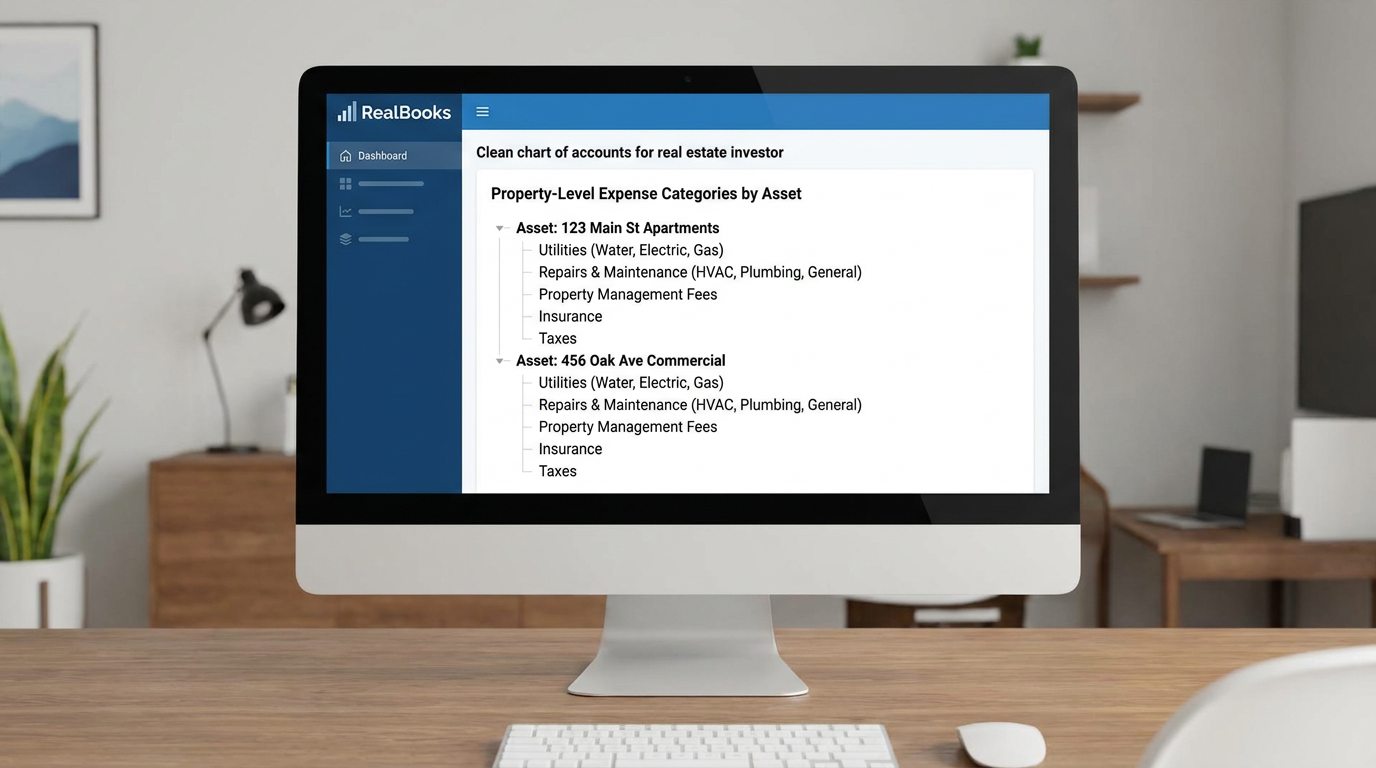
When you own properties across multiple LLCs — a common structure for liability protection and tax planning — each entity needs its own complete ledger, chart of accounts, and set of financial statements. But you also need a consolidated view that rolls all entities up into a unified portfolio picture. Without that unified view, you can manage individual trees but you can’t see the forest. Your lender, your partners, and your own investment decisions all require that consolidated perspective.
Another structural decision that must be made at the system level, not at tax time, is the separation of operating expenses from capital improvements. A repair is deductible in the year it’s incurred. A capital improvement is added to the property’s depreciable basis and recovered over 27.5 years. These two categories look similar in the field — both involve a contractor, a check, and a property — but they have dramatically different tax treatment. Getting the distinction right requires understanding the IRS framework for repairs versus capital improvements before expenses hit your ledger, not after. And for investors building out or renovating properties, the financial framework that separates acquisition, renovation, and rental phases is exactly the kind of structure that keeps the books clean throughout the lifecycle of each asset.
With the right accounts, the right bank structure, and the right separation of expense types built into your system, you’ve created the infrastructure. What turns infrastructure into results is the consistent monthly process that keeps it current — and that’s where most investors drop the ball.
The Monthly Bookkeeping Routine That Keeps Your Portfolio Clean Year-Round
The most important thing to understand about real estate bookkeeping is that it is not a tax season activity. It is a twelve-month practice. The investors who show up to April with clean, reconciled books and a ready-to-file Schedule E didn’t do anything heroic in March — they built a monthly routine in January and kept it going. That routine is what this section is about.
The core goal of monthly bookkeeping is simple: your books should be current, accurate, and audit-ready every single month. Not approximately current. Not mostly categorized. Fully reconciled, properly categorized, and reflecting the true financial picture of every property in your portfolio. When you maintain that standard every month, tax preparation becomes a reporting exercise. When you don’t, it becomes an archaeological dig.
Start each new month by reconciling all bank accounts against your ledger for the prior month. Every transaction that posted — every rent payment received, every contractor invoice paid, every insurance premium, every mortgage payment — should already be in your books and assigned to the correct property. Bank reconciliation is the process of confirming that what your bank shows and what your ledger shows are in perfect agreement. If they’re not, you find the discrepancy now, when it’s one month old, instead of in December, when it’s buried under eleven months of subsequent transactions.
Categorize every expense correctly, every month. The distinction between a repair and a capital improvement — the one that can mean a full current-year deduction versus depreciation spread over 27.5 years — needs to happen at the time of categorization, not at year end. Getting that call right requires knowing the IRS standard: is this expense restoring the property to its original condition (repair) or adapting, bettering, or restoring it in a way that adds value or extends its useful life (capital improvement)? Monthly categorization keeps this distinction clean. Year-end reclassification is messy, error-prone, and expensive in CPA time.
Receipt capture is part of the monthly routine, not a year-end project. Every expense needs documentation — a photo of a receipt, a forwarded email confirmation, a downloaded bank statement PDF. Every document needs to be stored and linked to the correct property and expense category. The IRS doesn’t require receipts for expenses under $75 in some contexts, but for rental property deductions, documentation is always the safer practice. An expense you can’t document is a deduction you can’t defend.
Run property-level profit and loss statements every month. This is not optional, and it’s not a quarterly exercise. Each property should show its own income and expenses so you can see — clearly, on a monthly basis — which ones are actually performing and which ones are consuming more cash than they’re generating. This is the core of portfolio management accounting, and it’s only possible if your books are current and organized at the property level.
Don’t forget to reconcile security deposits held as a liability each month. This is one of the most commonly missed items in landlord bookkeeping. When a tenant pays a security deposit, that money doesn’t belong to you — it belongs to them until conditions for its use are met. It should sit in your books as a liability, not as income. When you apply a deposit against damages or return it to the tenant, the liability is cleared accordingly. Getting this wrong creates income reporting errors and potential compliance issues under state landlord-tenant laws.
Monthly rental property bookkeeping also supports the other financial obligation that trips up investors who aren’t paying attention: estimated quarterly taxes. If your portfolio is generating taxable income, you owe estimated payments to the IRS four times per year — April 15, June 16, September 15, and January 15. The only way to make accurate estimated payments is to know, with reasonable certainty, what your taxable income looks like through the prior quarter. That requires current, accurate books. As the RealBooks mid-year financial checkup guide demonstrates, investors who review their finances mid-year consistently make better estimated tax decisions and avoid underpayment penalties. And IRS Topic 414 is clear: rental income is taxable in the year received, and proper tracking is not optional.
The monthly routine isn’t glamorous, but it’s the engine of everything else. When it runs consistently, the financial reports your portfolio produces become genuinely useful. And those reports are exactly what the next section covers.
The 6 Financial Reports Every Serious Real Estate Investor Needs
Clean books are not the end goal — they’re the means to an end. The end goal is financial clarity: knowing which properties are performing, how much cash your portfolio is actually generating, what your net worth looks like, and what your CPA needs to minimize your tax bill. That clarity comes from a specific set of financial reports. Not just one. Not just “a P&L.” All six.
The Property-Level Profit & Loss Statement is the most operationally important report in your stack. It shows rental income minus all operating expenses for a single property over a given period. The reason you need this at the property level — not just the entity level — is that blended numbers lie. A portfolio that looks profitable in aggregate might be carrying one or two properties that are quietly losing money, subsidized by the winners. Monthly property-level P&Ls expose that immediately and give you the data to make decisions: raise rents, reduce management costs, sell the underperformer, or refinance. This is the report that turns bookkeeping into portfolio management.
The Portfolio-Level P&L is the consolidated view across all properties and all entities. This is what your lender wants to see when you apply for a new acquisition loan. It’s what a potential partner or buyer needs to evaluate your portfolio. It’s also what you need to understand the overall financial trajectory of what you’re building. The portfolio P&L only means something if the individual property P&Ls underneath it are accurate — which is why property-level granularity is foundational, not optional.
The Cash Flow Statement is the report that investors most often confuse with the P&L — and the confusion is costly. Your P&L shows net income: revenue minus expenses, including non-cash items like depreciation. Your cash flow statement shows how much money actually moved. It includes loan principal payments (which don’t appear on a P&L because they’re not expenses), capital expenditures (which may be capitalized rather than expensed), and financing activity. A property can show net income on a P&L while generating negative cash flow if the debt service is high. The cash flow statement is the real pulse of your portfolio, and it’s the number that tells you whether you can afford to scale.
The Balance Sheet is a snapshot of your financial position at a point in time. Assets — properties at cost, accumulated depreciation, cash, accounts receivable — minus liabilities — mortgage balances, credit lines, security deposits held — equals your net worth. Lenders use your balance sheet to evaluate creditworthiness. You should use it to track portfolio equity growth over time and inform refinancing decisions. Running a balance sheet quarterly is good practice. Running one before any major capital event — a cash-out refinance, a new acquisition, a 1031 exchange — is essential.
The Schedule E Preparation Report is the tax-facing version of your property-level P&L. IRS Schedule E (Form 1040) is where rental income and expenses are reported for each property on your personal tax return. If your books are clean, organized at the property level, and properly categorized throughout the year, this report should generate itself. If they’re not, your CPA will spend hours recreating it manually — at your expense. Real estate accounting software designed for investors should produce a Schedule E-ready summary automatically. That’s the bar.
The Depreciation Schedule is the report that surprises most investors when they realize how much money is sitting in it. Every property has a depreciable basis. Every capital improvement extends or adds to that basis. The depreciation schedule shows accumulated depreciation to date, the current-year deduction, and the remaining depreciable basis on every asset in your portfolio. It’s particularly critical in 2026 given the cost segregation and bonus depreciation landscape under the OBBBA — because the components of a property that qualify for accelerated depreciation need to be tracked separately from the 27.5-year structure. For a deep dive into how this works in practice, the RealBooks rental property depreciation guide is required reading. And for understanding the investment performance metrics these reports feed into, the breakdown of cap rate versus cash-on-cash return shows how financial reports translate into investment decisions.
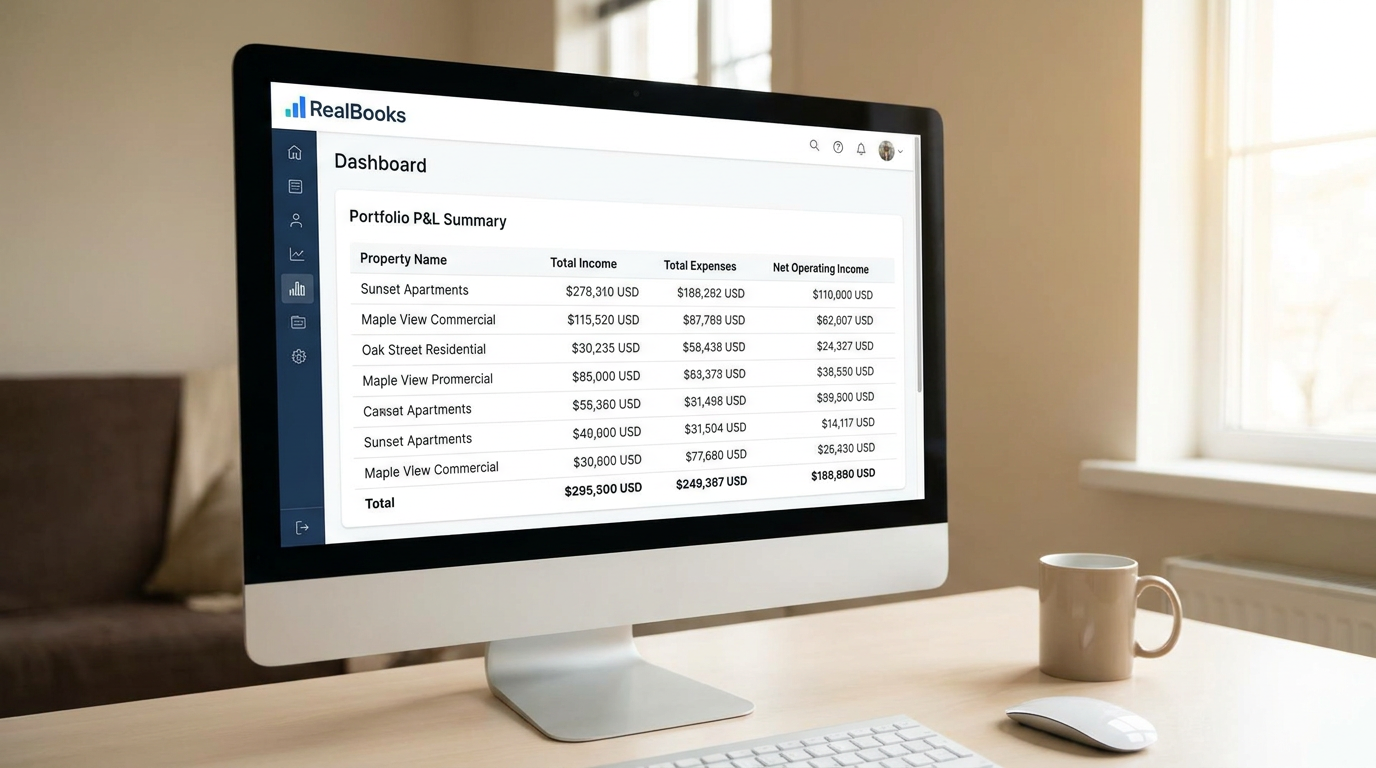
These six reports are only as valuable as the tax strategy that uses them. And for real estate investors in 2026, that strategy is more powerful — and more bookkeeping-dependent — than it has ever been.
Tax Strategy Starts in Your Books: Depreciation, Cost Segregation, REPS, and the OBBBA
The most consequential thing a real estate investor can do with clean books isn’t file an accurate return. It’s build a tax strategy that dramatically reduces what they owe. That strategy — depreciation, cost segregation, Real Estate Professional Status, 1031 exchanges, and the provisions of the One Big Beautiful Bill Act — is not something you construct in April. It’s something you build all year long, in your books, one correctly categorized transaction at a time.
Depreciation is the foundational tax benefit of real estate investing, and it starts with getting the basis right. Under IRS Publication 527, residential rental property is depreciated over 27.5 years using straight-line depreciation. The depreciable basis is the purchase price of the property minus the value allocated to land — because land doesn’t depreciate. A $350,000 purchase with $50,000 attributable to land has a depreciable basis of $300,000, yielding approximately $10,909 in annual depreciation. That’s a non-cash deduction that directly reduces taxable income. Getting the basis calculation right from day one matters enormously — because a mistake in year one compounds across 27.5 years of returns.
Cost segregation is how investors accelerate that depreciation legally and significantly. A cost segregation study reclassifies components of a building — flooring, cabinetry, landscaping, electrical systems, parking areas — into asset classes with shorter recovery periods: 5 years, 7 years, or 15 years instead of 27.5 years. That reclassification front-loads depreciation deductions dramatically, producing large write-offs in the early years of ownership when the time value of those deductions is highest. A traditional cost segregation study from an engineering firm runs $3,000 to $7,000 for a residential property — costs that RealBooks absorbs as a built-in platform capability. The complete guide to cost segregation for real estate investors covers who qualifies and what the numbers actually look like.
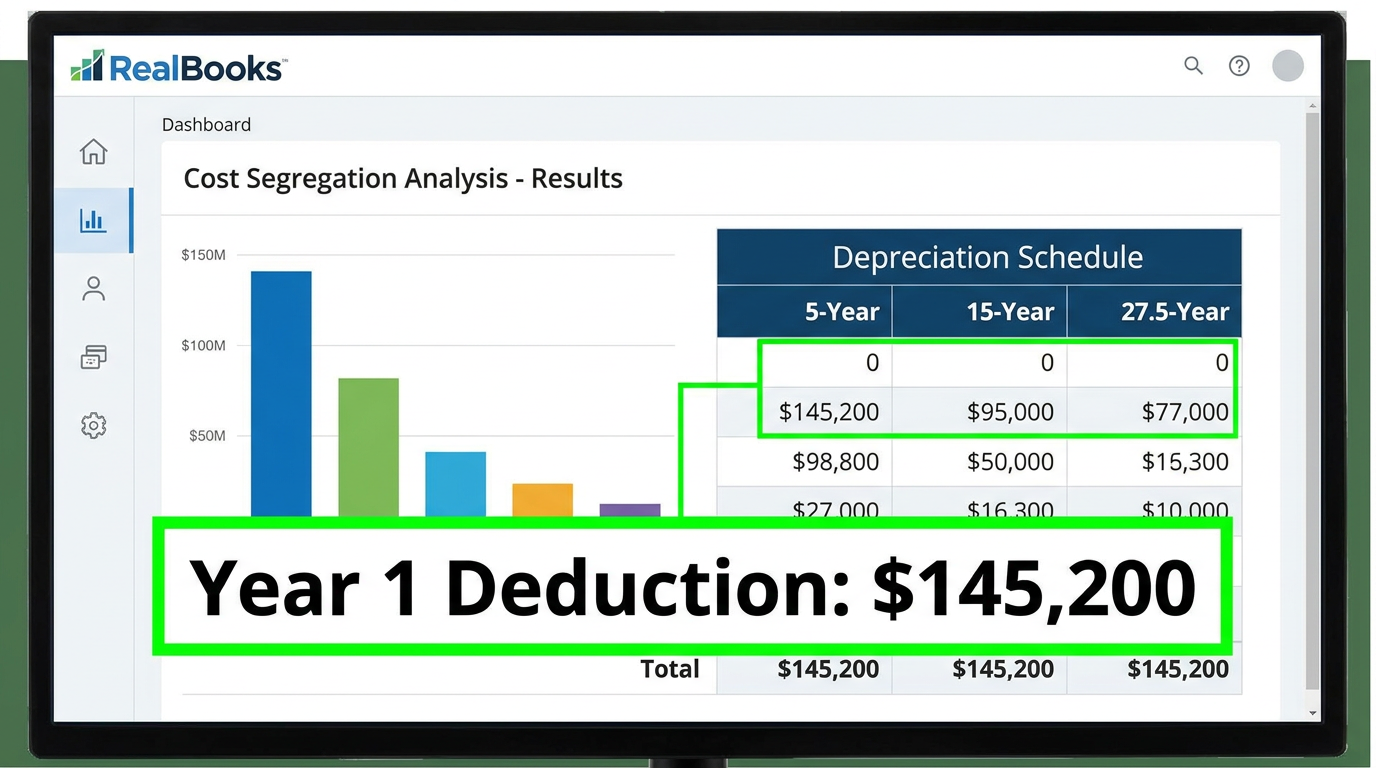
100% Bonus Depreciation under the OBBBA transforms cost segregation from a powerful tool into an extraordinary one. The One Big Beautiful Bill Act, signed into law on July 4, 2025, as Public Law 119-21, permanently restores 100% bonus depreciation for qualified property placed in service after January 19, 2025. This means the 5-year and 15-year components identified in a cost segregation study — components that would previously have been depreciated over their respective recovery periods — can now be fully deducted in the year they’re placed in service. The practical implication is significant: a $400,000 property where a cost segregation study identifies $80,000 in 5-year property could produce an $80,000 deduction in Year 1, rather than roughly $16,000 per year over five years. For investors who have been waiting for this provision to return to full strength, the OBBBA delivers it permanently. The full breakdown of how the OBBBA changes bonus depreciation and Section 179 is worth reading alongside this section.
“The permanent restoration of 100 percent bonus depreciation is a big deal — allowing businesses and investors to immediately deduct the full cost of qualifying assets rather than spreading those deductions over years.” — Tax Foundation, July 2025
Real Estate Professional Status (REPS) is one of the most powerful — and most misunderstood — tax elections available to investors. Under the passive activity rules, rental losses are generally classified as passive losses, which can only offset passive income. REPS breaks that rule. To qualify, you must meet two tests: you spend more than 750 hours per year in real property trades or businesses in which you materially participate, and more than 50% of your total personal service time is in those activities. When you qualify, your rental losses become non-passive — they can offset W-2 income, business income, and other non-passive income. For a high-income investor with significant rental losses, REPS can produce six-figure tax reductions in a single year. But it requires contemporaneous documentation: time logs, activity records, and evidence of material participation. That documentation lives in your bookkeeping system. Claiming REPS without the records to support it is a serious audit risk, as detailed guidance from the IRS in Publication 925 makes clear.
1031 Like-Kind Exchanges allow investors to sell a property and defer capital gains taxes by rolling the proceeds into a replacement property within a defined timeline — 45 days to identify the replacement, 180 days to close. The bookkeeping requirements for a 1031 exchange don’t begin when you sell. They begin when you buy. You must maintain an accurate cost basis record for the relinquished property — including every capital improvement made over the holding period — because that basis determines the deferred gain. You must also track the adjusted basis of the replacement property, which carries forward the deferred gain. A 1031 exchange executed without careful basis records is a 1031 exchange waiting to become a tax problem. The full 1031 exchange rules guide covers the mechanics and documentation in depth.
The Qualified Business Income (QBI) Deduction, made permanent under the OBBBA, allows pass-through entity owners to deduct up to 20% of qualified business income. For rental property investors operating through LLCs taxed as pass-throughs, this deduction can be meaningful — but it requires your books to clearly reflect qualified business income, separate from non-qualifying income streams. And the Section 179 expensing limit, raised to $2.5 million under the OBBBA (with a phase-out threshold of $4.0 million), expands the immediate expensing available for qualifying improvements — another reason the separation of capital improvements from operating expenses needs to happen in your books from day one. For a full inventory of deductions available in 2026, the RealBooks guide to every tax deduction real estate investors can claim is the companion resource.
None of these strategies operate in isolation from your books. Each one depends on data — accurate data, organized at the property level, maintained year-round. The investors capturing the maximum benefit from the OBBBA provisions aren’t doing it because they have better CPAs. They’re doing it because their books are clean enough for those strategies to be executed correctly. Knowing the strategy is only half the equation. The other half is avoiding the mistakes that undermine it.
The 7 Most Common Real Estate Bookkeeping Mistakes (and What They Actually Cost)
These aren’t theoretical errors. They’re the specific mistakes that experienced investors — people who know what they’re doing in the field — make in their books. Each one has a real cost, either in missed deductions, audit exposure, or wasted CPA time. Understanding them is the first step to preventing them.
The first mistake is commingling personal and business funds. Using a personal bank account to pay a contractor, or moving money between properties without proper documentation, does two damaging things simultaneously: it erodes the legal protection your LLC structure is supposed to provide, and it makes property-level expense tracking unreliable. When a court or the IRS looks at your books and sees personal and business transactions flowing through the same account, the LLC becomes much easier to pierce. The structural fix — one dedicated business account per entity, full stop — is laid out clearly in the multi-LLC financial management guide.
The second mistake is misclassifying repairs as capital improvements, or capital improvements as repairs. This error cuts both ways. A capital improvement categorized as a repair inflates your current-year deductions and creates an audit flag — the IRS looks for exactly this pattern. A repair categorized as a capital improvement means you’re depreciating something over 27.5 years that you could have deducted today. The IRS distinction between the two isn’t always obvious, which is why understanding the difference before expenses hit your ledger matters so much.
The third mistake is starting depreciation from the wrong date. Depreciation begins when a property is “placed in service” — the date it’s ready and available for rent, not the date you closed on it, and not the date the first rent check arrived. An investor who starts depreciation on the closing date instead of the placed-in-service date creates years of overstated deductions. An investor who waits until rent is first received creates years of understated ones. The placed-in-service date is a fact, not a judgment call, and it needs to be recorded correctly when the property is set up in your books.
The fourth mistake is missing cost basis adjustments. Every capital improvement you make to a rental property increases its depreciable basis. An investor who completes $30,000 in kitchen and bathroom upgrades after acquisition and fails to record those improvements as basis adjustments has understated their annual depreciation deduction and — more significantly — overstated their taxable gain when they eventually sell. Basis tracking is cumulative and consequential. The rental property depreciation guide walks through how basis adjustments work in practice.
The fifth mistake is treating all renovation costs the same. This is especially common with fix-and-flip investors who lump all rehab expenses into a single “renovation” account. But the tax treatment of rehab costs depends entirely on what the property is: inventory costs for a flip are treated differently than capital improvements for a rental, which are treated differently than repairs on a stabilized asset. Each flows to a different tax form, at a different time, with different implications. The three-phase financial framework for fix-and-flip investors addresses exactly how to separate these categories correctly from the moment you acquire the property.
The sixth mistake is failing to document REPS hours. Many investors claim Real Estate Professional Status on their returns without maintaining the contemporaneous records to support it. The IRS requires documentation that you actually spent the time you’re claiming — not an estimate constructed in February for the prior year, but records kept throughout the year, close in time to the activities themselves. In an audit, a REPS claim without supporting documentation doesn’t just fail — it potentially opens prior years to scrutiny as well. If you’re claiming REPS, your time logs are as important as your financial records.
The seventh mistake is treating reconciliation as a year-end activity. This is the mistake with the most visible dollar cost. When books aren’t reconciled monthly, small errors multiply. A transaction miscategorized in February compounds through March, April, and beyond. By December, you’re not just closing out twelve months — you’re chasing receipts from ten months ago, reclassifying hundreds of transactions, and handing your CPA a project instead of a filing. The CPA bills you for the cleanup. You pay taxes on deductions that weren’t captured. And the Schedule E that should have been automatic becomes a multi-week exercise in reconstruction.
Every single one of these mistakes is preventable — not through discipline alone, but through a system designed to catch them automatically. That’s where purpose-built real estate accounting software earns its keep.
How RealBooks Automates Real Estate Bookkeeping With Penny, Dollar Bill, and Uncle Sam
Every section of this guide has described what a proper real estate bookkeeping system does. This section describes how RealBooks does it — through three AI agents built specifically for the problems rental property investors actually face.
Penny is your AI bookkeeper. She connects to your bank feeds and credit cards, imports transactions in real time, and automatically assigns every dollar to the correct property and expense category. There’s no manual data entry. There’s no month-end reconciliation panic. Receipts can be forwarded as emails or photographed on-site — Penny reads them, extracts the relevant data, and links them to the appropriate property and expense account. The result is books that are current, categorized, and audit-ready around the clock, not just in the days before your CPA appointment. The RealBooks expense management platform is built around Penny’s capabilities, and the difference between an AI-categorized ledger and a manually maintained one shows up immediately in the time investors get back.
Dollar Bill is your AI asset and project builder. When you acquire a new property, you tell Dollar Bill about it in plain English — the address, the purchase price, the entity it belongs to, the date it was placed in service. He creates the property in RealBooks, sets up the depreciable basis correctly from day one, and if you’re doing renovation work, builds out a room-by-room project with AI-generated rehab estimates. Every capital improvement gets tracked from the first contractor payment, and every dollar flows automatically into the depreciation schedule and expense ledger in the correct category. For investors executing the BRRRR strategy — Buy, Rehab, Rent, Refinance, Repeat — Dollar Bill is purpose-built to track the financial complexity across every phase of that cycle. The complete BRRRR method financial tracking guide shows exactly how that works in practice, and the RealBooks project management feature is the tool that makes it operational.
Uncle Sam is your AI tax strategist. He scans every transaction across your portfolio in real time, matches it against IRS-recognized deduction categories, flags depreciation opportunities, and — critically — separates deductible repairs from capital improvements automatically. When tax time arrives, Uncle Sam generates the reports your CPA needs to act on immediately: Schedule E summaries per property, Form 4562 for depreciation, Schedule D for capital gains, Form 8825 for partnership rental income. None of these require manual construction. They’re produced directly from your current, properly categorized books. The RealBooks tax reporting feature is what turns a year of clean bookkeeping into a ready-to-file tax package, and Uncle Sam has identified over $2.4 million in tax savings for RealBooks investors to date.
Built into Uncle Sam’s capabilities is automated cost segregation — the same methodology used by engineering-based cost segregation studies that typically cost $3,000 to $7,000 per property. Uncle Sam automatically allocates property cost across 5-year, 15-year, and 27.5-year depreciation schedules when a property is set up, identifying the accelerated depreciation opportunities that OBBBA’s permanent 100% bonus depreciation provision now makes even more valuable. The RealBooks cost segregation feature is included in the platform — not an add-on service.
At the core of the entire system is the Autonomous General Ledger — a self-managing financial engine that ingests transactions from bank feeds, credit cards, and property management systems, then classifies, reconciles, and posts every entry to the correct account automatically. It’s the infrastructure that makes Penny, Dollar Bill, and Uncle Sam possible, and it’s what ensures that the books are never more than a few hours behind reality.
Multi-entity support is built in, not bolted on. Each LLC gets its own ledger, chart of accounts, and complete set of financial statements. Every entity rolls up into a unified portfolio dashboard that gives you the consolidated view across your entire operation. Whether you have two properties or fifty, the system scales without adding headcount or complexity. The RealBooks products overview covers the full platform architecture for investors who want to understand how the pieces fit together.
The platform currently serves over 1,000 active investors, has processed more than 50,000 transactions, and has identified over $2.4 million in tax savings. Those numbers come from investors who stopped managing their books manually and started letting a purpose-built system do what it was designed to do.

The Infrastructure That Separates Profitable Investors From Overwhelmed Ones
Real estate bookkeeping isn’t record-keeping. It’s infrastructure. It’s the foundation on which tax strategy, portfolio decisions, lender relationships, and scale are built. Every dollar you track correctly is a dollar your CPA can work with. Every dollar that falls through the cracks — miscategorized, undocumented, or never recorded at all — is a dollar you paid taxes on unnecessarily, or a deduction you’ll never recover.
The investors who consistently build profitable, scalable portfolios don’t necessarily have better properties than everyone else. They have better systems. They know what every property made last month. They know their depreciation position. They’re never surprised by their tax bill. They walk into a refinancing conversation with a clean balance sheet and a documented cash flow history. That’s not luck — it’s the compounding return on a bookkeeping system that runs correctly every month.

If your current system isn’t giving you that kind of clarity — if you’re still reconciling spreadsheets manually, still getting surprised at tax time, still unable to tell which properties are actually profitable — RealBooks was built to fix exactly that. Visit realbooks.io to see how it works. And if you’re ready to get started immediately, the RealBooks getting started guide walks you through setup from your first property to your first clean month of books.
Ready to maximize your tax savings?
RealBooks automatically tracks expenses, manages assets, and calculates depreciation across your entire portfolio.
Start Free Trial →