Rental Property Depreciation Explained: How It Works, How to Calculate It, and How to Maximize It in 2026

Here is something that trips up more real estate investors than almost any other tax concept: you can deduct a portion of your property’s value every single year — as a real expense against your rental income — even when that property is appreciating in value. No cash outlay. No transaction. Just a paper deduction, legally yours, that the IRS explicitly designed for landlords.
That mechanism is rental property depreciation, and it is the largest non-cash tax deduction available to real estate investors. For a residential rental building with a $300,000 depreciable value, the IRS straight-line formula produces roughly $10,909 in annual deductions for 27.5 consecutive years. That’s nearly $11,000 of taxable income eliminated every year — before you count a single repair, mortgage interest payment, or management fee.
Most investors know depreciation exists. Far fewer execute it correctly. The cost basis gets calculated wrong. The land value doesn’t get excluded. The placed-in-service date is off by a quarter. Nobody ran a cost segregation study. The One Big Beautiful Bill Act permanently restored 100% bonus depreciation — and the investor never heard about it. These aren’t small errors. Across a portfolio, they can mean tens of thousands of dollars in deductions claimed incorrectly, or never claimed at all.
This guide covers every layer of how to depreciate rental property: the conceptual foundation, the exact formula for calculating your depreciable cost basis, the mechanics of the 27.5-year straight-line schedule, the 2026 landscape for bonus depreciation under the OBBBA, how cost segregation unlocks accelerated deductions, what depreciation recapture actually means when you sell, and the most common mistakes investors make — plus how RealBooks automates all of it across your entire portfolio without a $10,000 engineering study.
If you already own rental property, or you’re about to close on one, this is the depreciation guide you should have had from day one.
Why the IRS Lets You Depreciate a Rental Property
Let’s start with first principles, because investors who skip the conceptual foundation tend to make the most expensive calculation errors later.
Depreciation exists because the IRS acknowledges a simple physical reality: buildings wear out. Roofs age. HVAC systems degrade. Flooring gets worn down. Structural components that cost real money to install eventually require replacement. In the eyes of the tax code, a rental property is a business asset — and like any business asset, its cost should be recoverable over its useful life as an ongoing business expense.
What you’re doing when you claim depreciation is cost recovery. You paid for a building. The IRS allows you to recover that cost gradually, as an annual deduction against your rental income, over a legally defined period. You’re not spending new money — you already spent it when you bought the property. Depreciation is simply the mechanism for recognizing that expenditure on your tax return, spread across time.
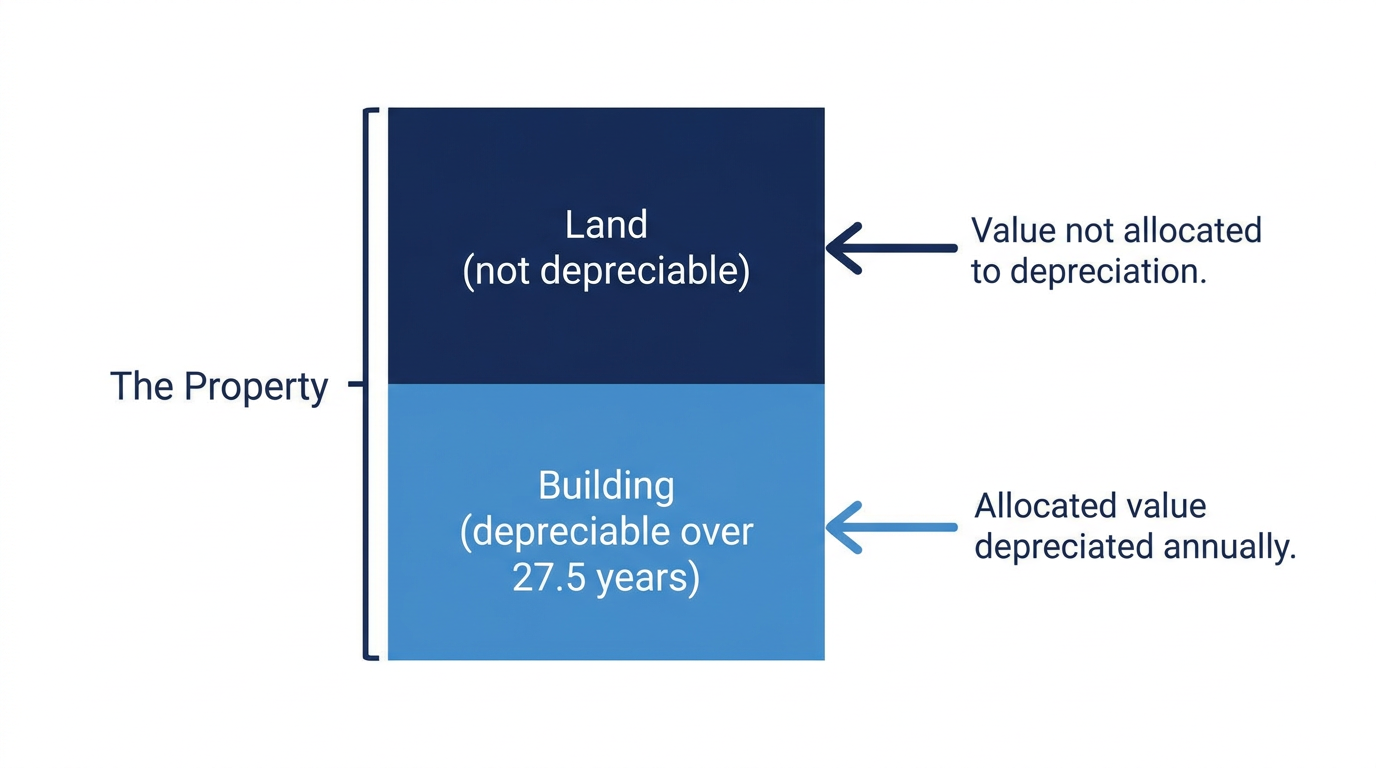
Only the structure depreciates — never the land. This is the foundational rule that produces the most common calculation error in rental property depreciation. Land doesn’t wear out. It doesn’t need to be replaced. It holds its value indefinitely in the IRS’s framework, which means the IRS considers it non-depreciable. Before you can calculate a single dollar of depreciation, you must separate how much of what you paid was for the building and how much was for the ground it sits on. More on exactly how to do that in the next section.
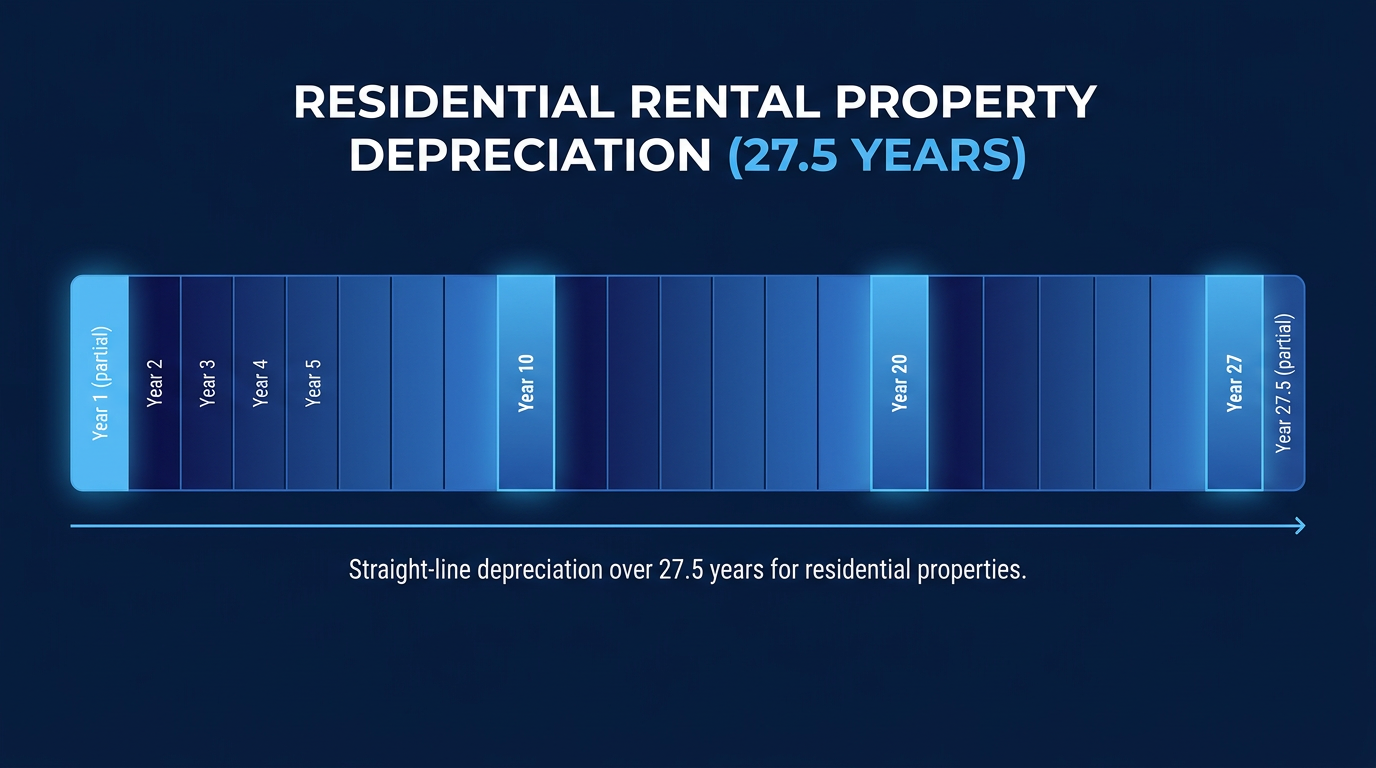
For residential rental property, the IRS assigns depreciation under the Modified Accelerated Cost Recovery System — MACRS — using what’s called the straight-line method over a 27.5-year recovery period. Straight-line means the deduction is equal every year across the recovery period. There’s no front-loading under the base rule, no accelerating, no variability — just a consistent annual deduction calculated as a percentage of your depreciable basis.
This is also, critically, a non-cash deduction. You are not writing a check to anyone. You are not incurring a new expense. You are claiming the paper recovery of a cost you already bore. That distinction matters because it means depreciation directly reduces your taxable rental income without reducing your actual cash flow. A property that generates $24,000 in annual rent with $10,909 in depreciation deductions produces only $13,091 in federally taxable income from that property — even though you received every dollar of the $24,000 in actual cash.
As IRS Publication 527 (2025) — the authoritative IRS source governing residential rental property — makes clear, this framework applies to virtually every residential rental property in the country, as long as the property is placed in service and used in a rental activity.
Depreciation sits at the center of every serious real estate investor’s tax strategy. It offsets rental income. It can create paper losses that offset other income (subject to passive activity rules). And as you’ll see in later sections, it interacts with cost segregation and bonus depreciation in ways that can dramatically compress your tax liability in the early years of ownership. Every tax deduction real estate investors can claim in 2026 tells you what else you should be stacking alongside it — but depreciation is always the foundation.
The next question — once you understand what you’re depreciating and why — is what number you’re actually depreciating. That’s the cost basis calculation, and getting it right is where most investors fall short.
How to Calculate Your Depreciable Cost Basis
The depreciable cost basis is the number the entire depreciation schedule is built on. Get it wrong — too high, too low, or with the wrong components — and every year’s deduction that follows will be incorrect. It compounds. By year five, a miscalculated basis can mean thousands of dollars in errors that need to be unwound.
Here is the IRS-approved formula for how to calculate depreciation on rental property, starting at the foundation:
Depreciable Basis = (Purchase Price + Acquisition Closing Costs + Capital Improvements) − Land Value
Let’s break each component down precisely.
Purchase Price is straightforward: it’s the contract price you paid to acquire the property. Not the appraised value. Not the assessed value. The actual price paid at closing.
Acquisition Closing Costs — and this is where investors frequently leave basis on the table — include title insurance premiums, legal fees, recording fees, survey costs, and transfer taxes. These costs are capitalizable, meaning they add to your depreciable basis rather than being deducted as ordinary expenses in the year you paid them. Mortgage origination points, however, are not added to the depreciable basis — they’re treated separately under interest expense rules.
Capital Improvements add to your basis and start their own separate depreciation schedule. A new roof installed three years after purchase doesn’t retroactively increase your original depreciation — it begins its own 27.5-year (or shorter, if cost-segregated) depreciation schedule from the date it’s placed in service. A kitchen gut renovation, a new HVAC system, an addition — these are all capital improvements, not repairs. The distinction matters enormously. For a deep look at where that line falls, Repairs vs. Capital Improvements: The IRS Distinction That Can Cost You Thousands is required reading for any landlord.
Land Value must be subtracted. The IRS requires it, but does not specify a single approved method for determining how much of your purchase price is attributable to land. The most common approaches are: (1) using the county tax assessor’s land-to-improvement ratio as a starting proxy, and (2) commissioning an independent appraisal. The assessor’s ratio is widely accepted as a reasonable method and is the most practical option for most investors at acquisition. The ratio is typically published in your property tax records as separate “land” and “improvement” assessed values.
Here’s a worked example that ties the formula together:
- Purchase Price: $320,000
- Acquisition Closing Costs: $8,000 (title insurance, legal, recording fees)
- Capital Improvements at Purchase: $0
- Subtotal before land exclusion: $328,000
- Assessor’s Land-to-Total Ratio: 20% (land = $65,600)
- Depreciable Basis: $328,000 − $65,600 = $262,400
That $262,400 is the number that drives every subsequent depreciation calculation for this property. IRS Publication 551 — Basis of Assets governs the full set of rules for basis determination and is the authoritative reference any CPA will cite when reviewing your depreciation schedule.
One more nuance worth flagging: your basis is not static. Every time you add a capital improvement — a new roof, new flooring, an added bedroom — that improvement adds to your basis and launches its own depreciation life. Tracking this in real time, per property, is the difference between a clean tax return and an audit-ready headache.
With a correctly calculated depreciable basis in hand, you’re ready to run the actual straight-line depreciation math.
Straight-Line Depreciation and the 27.5-Year Rule, Calculated
This is the section that directly answers the question most investors type into search engines: how to calculate depreciation on rental property. The math itself is simple. The nuances around timing are where most people go wrong.
Residential rental property depreciates over 27.5 years using the straight-line method under MACRS. This means the annual depreciation deduction is equal every year across the full recovery period. There is no front-loading, no accelerated schedule under the base rule — just consistent, predictable annual deductions.
The annual depreciation rate under straight-line is 1 ÷ 27.5 = 3.636% of your depreciable basis.
Annual Depreciation = Depreciable Basis ÷ 27.5
Continuing from the worked example in the previous section:
- Depreciable Basis: $262,400
- Annual Depreciation: $262,400 ÷ 27.5 = $9,542 per year
Every year for 27.5 years, that investor claims $9,542 as a non-cash deduction against rental income. Over the full recovery period, that’s $262,400 in total deductions — the full depreciable basis, fully recovered.
The IRS Mid-Month Convention is the nuance that catches investors off guard in Year 1. In the year a property is placed in service — and in the final year of the recovery period — you don’t get a full year’s deduction. Instead, the IRS uses a mid-month convention: the property is treated as placed in service at the midpoint of the month in which it actually entered service.
If a property is placed in service in March, it’s treated as placed in service on March 15. That means you get credit for March 15 through December 31 — approximately 9.5 months out of 12. The Year 1 deduction would be: $9,542 × (9.5 ÷ 12) = $7,553.
The “placed in service” date is also frequently miscalculated. This is not the closing date. It’s not the date the first tenant moves in. It is the date the property is ready and available for rent — even if it’s sitting vacant. A property that closed in January, was cleaned and listed in February, but didn’t find a tenant until April is placed in service in February, not April. This distinction affects the mid-month convention calculation and, in edge cases near year-end, whether you get any deduction at all in Year 1.
Depreciation under straight-line continues until one of two things happens: you reach the end of the 27.5-year recovery period and have fully recovered your depreciable basis, or you sell or otherwise dispose of the property — at which point depreciation stops and recapture becomes the relevant concept (covered in full later in this guide).
As IRS Publication 946 — How to Depreciate Property details, the MACRS tables and mid-month convention tables spell out the exact first-year percentage for each month of service — a resource worth bookmarking if you’re calculating this manually.
To put portfolio math in perspective: five properties, each with a depreciable basis averaging $250,000, generate $45,455 in straight-line depreciation deductions annually. That’s before cost segregation and bonus depreciation. It’s a meaningful offset against rental income — and it compounds as the portfolio grows.
Understanding how this interacts with real after-tax returns is critical. Cap rate vs. cash-on-cash return is a concept that looks very different once you factor depreciation into the after-tax cash flow picture — a dimension most return-on-investment calculations conveniently ignore.
Straight-line depreciation is the baseline. But investors who stop here are leaving the most significant deductions on the table. With cost segregation and 100% bonus depreciation under the OBBBA, you can compress years — sometimes decades — of deductions into a single tax year.
Bonus Depreciation Under the OBBBA: What Changed and Why It Matters in 2026
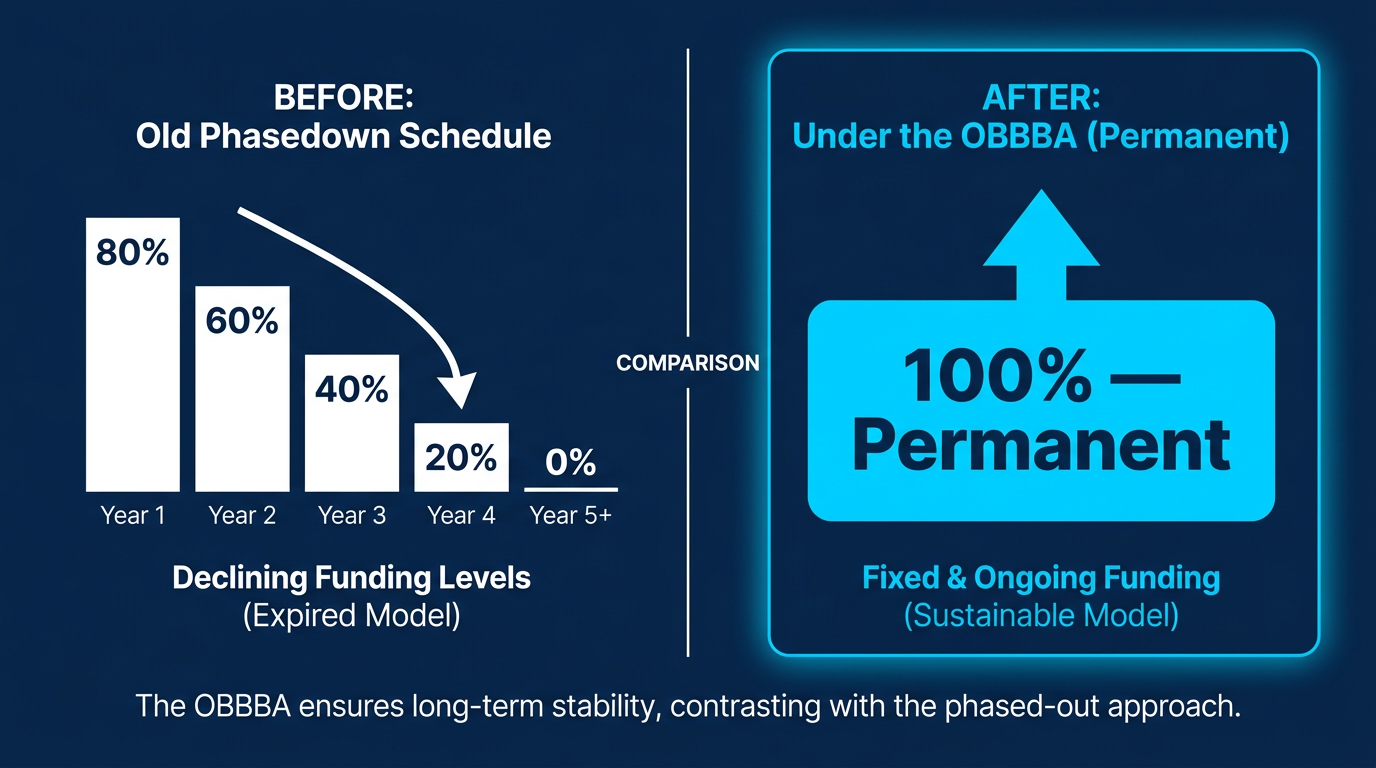
Before mid-2025, bonus depreciation was on a legislated glide path toward zero. Under the Tax Cuts and Jobs Act of 2017, bonus depreciation had been set at 100% through 2022, then stepped down annually: 80% in 2023, 60% in 2024, 40% in 2025, and scheduled to reach zero by 2027. For investors who understood what was at stake, the phasedown represented a ticking clock on one of the most powerful tax acceleration tools in real estate.
Then on July 4, 2025, the One Big Beautiful Bill Act (OBBBA) was signed into law — and it permanently changed the picture.
The OBBBA provisions include the permanent reinstatement of 100% bonus depreciation for qualifying property acquired and placed in service after January 19, 2025. As confirmed by the Tax Foundation’s detailed OBBBA FAQ, this is not a temporary extension — it’s a permanent feature of the tax code. There is no longer a phasedown schedule. There is no sunset. 100% bonus depreciation is now the permanent baseline for eligible property.
What qualifies for bonus depreciation? This is the critical distinction that every investor needs to understand clearly: the 27.5-year building structure itself does not qualify for bonus depreciation. Bonus depreciation applies to tangible personal property and land improvements with a class life of 20 years or less — specifically, 5-year property (appliances, carpeting, fixtures, certain equipment) and 15-year property (land improvements like parking lots, landscaping, fencing, sidewalks). These components must be identified and reclassified out of the 27.5-year building structure through a process called cost segregation — covered in depth in the next section.
Here’s what that looks like in concrete dollar terms. A cost segregation study on a $500,000 rental property identifies:
- $120,000 in 5-year personal property (appliances, flooring, light fixtures, cabinetry)
- $60,000 in 15-year land improvements (parking area, landscaping, fencing)
- $320,000 remaining as 27.5-year building structure
Under 100% bonus depreciation, that $180,000 in reclassified components can be fully deducted in Year 1 — not spread over 5 or 15 years, but entirely in the tax year the property is placed in service. The remaining $320,000 depreciates on the standard 27.5-year schedule. Without cost segregation, all $500,000 would sit on the 27.5-year schedule, producing roughly $18,182 per year.
The difference between $180,000 in Year-1 deductions and $18,182 is not a rounding error. It’s a tax liability that, depending on the investor’s bracket, could represent $45,000–$72,000 in federal taxes deferred to future years.
Investors also have the option to elect out. If your tax situation means a massive Year-1 deduction creates losses you can’t efficiently use (due to passive activity limitations, income thresholds, or other factors), you can elect not to claim 100% bonus depreciation and instead depreciate those components on their regular schedules. This is a strategic planning decision — not a mandate.
For investors reading this who purchased properties in recent years and never ran a cost segregation study: lookback catch-up is available. By filing a Change of Accounting Method (Form 3115), you can claim all missed accelerated depreciation — going back to the original placed-in-service date — in a single current-year tax return. No amended returns required. The result can be a substantial one-time deduction that resets your tax position significantly.
For a complete breakdown of what the OBBBA changed for real estate investors specifically, including the Section 179 interaction, How the Big Beautiful Bill Changes Bonus Depreciation and Section 179 for Real Estate Investors is the dedicated deep-dive.
The OBBBA made bonus depreciation permanent. But to actually access it on a rental property, you need the mechanism that unlocks it: a cost segregation study.
Cost Segregation: How to Pull Years of Deductions Into Year One
Cost segregation is the IRS-approved engineering analysis that sits between bonus depreciation and the actual deduction on your tax return. Without it, every dollar you paid for your rental property — building, fixtures, flooring, parking lot, landscaping — sits on the 27.5-year depreciation schedule by default. Cost segregation breaks the property into its individual components, assigns each one to the correct depreciation class life, and surfaces the accelerated deductions that the standard schedule never would.
The formal classification structure works like this:
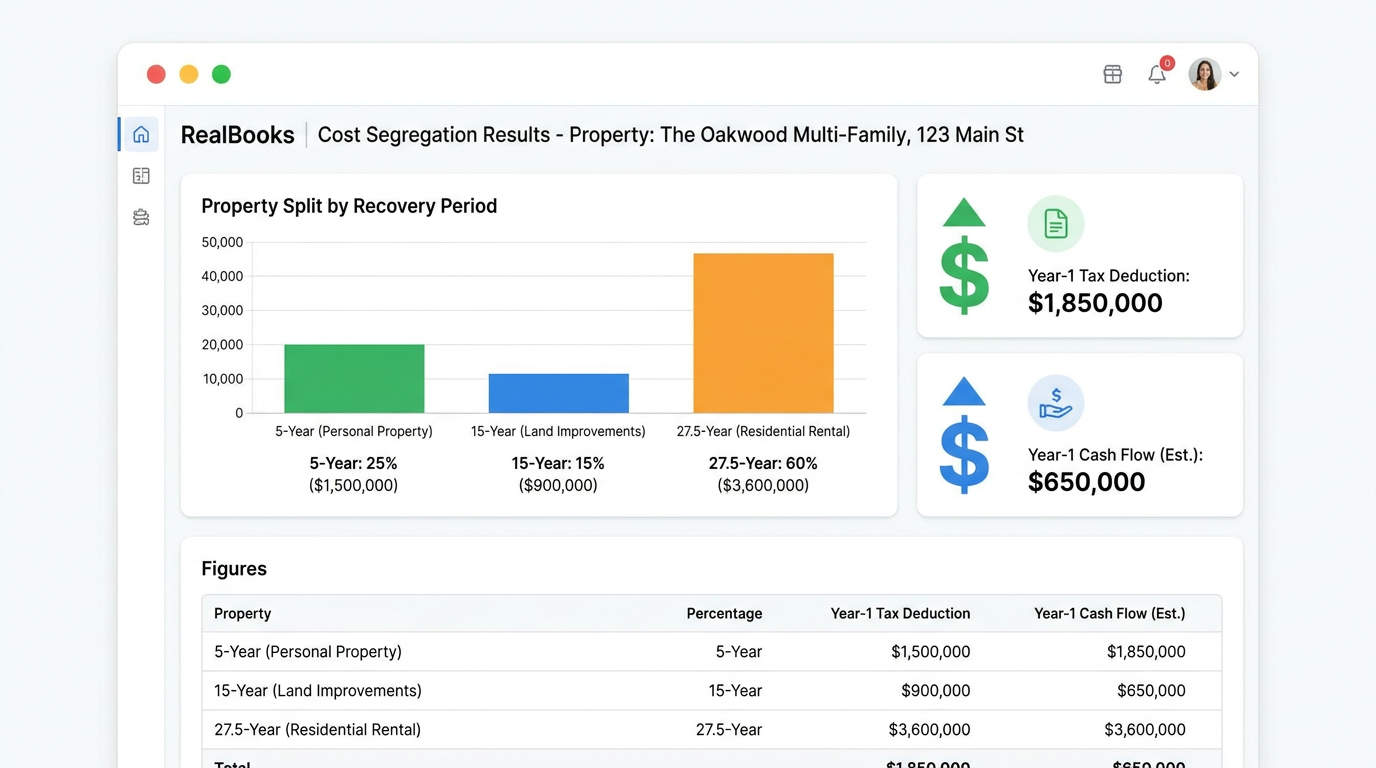
- 5-year property: tangible personal property not permanently affixed to the structure — appliances, carpeting, window coverings, certain cabinetry, decorative lighting, and similar items. Under 100% bonus depreciation, these are fully deductible in Year 1.
- 15-year property: land improvements that are not structural — paved parking areas, landscaping, irrigation systems, site drainage, exterior signage, sidewalks, and fencing. Also fully deductible in Year 1 under current law.
- 27.5-year property: the building structure itself — foundation, framing, roof, exterior walls, load-bearing elements, and permanently integrated systems like plumbing and electrical. This portion stays on the straight-line schedule.
Historically, a formal cost segregation study required an engineer’s site visit, detailed blueprints review, and component-level valuation — a process that typically cost between $5,000 and $15,000 and was economically justified only for properties above a certain value threshold. That barrier kept the strategy out of reach for smaller portfolio investors.
The economics of cost segregation are clear across property value ranges. For a $350,000 rental property where a study identifies $85,000 in 5-year and 15-year components:
- With cost segregation + 100% bonus depreciation: $85,000 deducted in Year 1
- Without cost segregation: $85,000 depreciated over 27.5 years = $3,091 per year
That’s the difference between a $85,000 deduction and a $3,091 deduction — in the same tax year, on the same property, for the same investment. An investor in the 32% federal tax bracket would see a difference of $26,432 in Year-1 federal taxes.
Across a portfolio, the math compounds quickly. Typical cost segregation studies reclassify 15–30% of a residential rental property’s value into shorter depreciation schedules. On a $400,000 property, that’s $60,000–$120,000 in components eligible for accelerated treatment. On five properties, the opportunity can easily exceed $500,000 in compressed deductions — the kind of tax optimization that used to require a dedicated engineering firm and a significant engagement budget.
This is where RealBooks fundamentally changes the access equation. RealBooks’ AI-powered cost segregation feature performs the component-level classification — across 5-year, 15-year, and 27.5-year schedules — and produces a CPA-ready report in PDF or Excel format. The analysis that traditionally required a months-long engineering study and a four-figure invoice now happens inside your portfolio dashboard. For investors who have never run cost segregation, the RealBooks Cost Segregation product page shows exactly what the output looks like and what’s covered.
The three AI agents inside RealBooks each play a specific role in making this work accurately. Penny — the bookkeeper — keeps costs correctly assigned to the right property and the right asset category in real time. Dollar Bill — the builder — tracks every renovation expense, classifies it correctly as a capital improvement or repair, and ensures improvement costs flow into the depreciation schedule as they should. Uncle Sam — the tax optimizer — calculates depreciation across all properties, identifies components eligible for bonus depreciation, flags cost segregation opportunities, and surfaces deductions before your CPA opens the file.
For investors who renovated a property recently, cost segregation applies there too. Renovation costs that represent capital improvements create their own depreciable basis and their own cost segregation opportunity. How renovation costs affect your cost basis and depreciation walks through how to handle improvement costs correctly so nothing gets left behind.
The Cost Segregation 101: What It Is, Who Qualifies, and How Much It’s Actually Worth guide provides the dedicated deep-dive for investors who want to understand the strategy in full before running their own study.
Cost segregation maximizes deductions while you own the property. But depreciation doesn’t simply disappear when you sell — the IRS has a specific mechanism to recapture it. Every investor who plans to sell eventually needs to understand what that means, and why it’s almost never a reason to avoid claiming depreciation in the first place.
Depreciation Recapture: What Happens When You Sell a Rental Property
Depreciation recapture is the most misunderstood — and most feared — aspect of rental property depreciation. Investors sometimes avoid claiming depreciation specifically because they’ve heard that recapture creates a tax bill at sale. This fear, while understandable, is almost always financially counterproductive. Understanding exactly how recapture works reveals why.
When you sell a rental property, the IRS recaptures the depreciation you claimed over your holding period by treating a portion of your gain as ordinary-ish income rather than capital gain. For residential rental property — classified as Section 1250 property — the applicable mechanism is Unrecaptured Section 1250 Gain. This is the portion of your total gain equal to the cumulative straight-line depreciation you claimed on the building. It is taxed at a maximum federal rate of 25% — not your ordinary income rate, but above the standard long-term capital gains rates of 0%, 15%, or 20%.
Here’s how the gain breaks down at sale for a concrete example:
- Original Purchase Price: $320,000
- Closing Costs Added to Basis: $8,000
- Cumulative Depreciation Claimed over 8 Years: $80,000 (approx. $9,542/year × 8 years, adjusted for first-year partial)
- Adjusted Basis at Sale: $320,000 + $8,000 − $80,000 = $248,000
- Sale Price: $425,000
- Total Gain: $425,000 − $248,000 = $177,000
Of that $177,000 total gain:
- Up to $80,000 is classified as Unrecaptured Section 1250 Gain — taxed at a max of 25%
- The remaining $97,000 is taxed as long-term capital gain (0%, 15%, or 20% depending on income)
The recapture tax on $80,000 at 25% = $20,000. Had the investor not claimed depreciation, the adjusted basis would remain $328,000, and the total gain would be only $97,000 — but they would have paid income tax on $80,000 more in rental income across those 8 years. The time value of that tax deferral, plus the compounding value of the capital that wasn’t paid in taxes each year, almost always exceeds the recapture cost. Running the math on your specific situation is a CPA conversation — but the directional answer is almost always the same: claim the depreciation.
There is one more critical fact that makes the “avoid depreciation to avoid recapture” strategy self-defeating: the IRS calculates recapture tax on depreciation “allowed or allowable” — meaning depreciation you were entitled to claim, whether or not you actually claimed it. If you owned a property for 10 years and never depreciated it, you still owe recapture tax on all 10 years of depreciation you could have claimed when you sell. You paid income tax on more rental income every year, and you still pay the recapture tax. It’s the worst of both outcomes.
The 1031 exchange is the primary tool investors use to defer both depreciation recapture and capital gains tax at sale. By exchanging into a like-kind property under Section 1031, you carry your tax liability forward into the replacement property — indefinitely, as long as you keep exchanging. 1031 Exchange Rules Explained: The Real Estate Investor’s Complete Guide covers the mechanics, timelines, and requirements in full.
One practical implication of accelerated depreciation through cost segregation: investors who claim large Year-1 bonus depreciation deductions on 5-year and 15-year components will face higher recapture exposure at sale — because those components are taxed at ordinary income rates under the Section 1245 recapture rules (for personal property), which can be higher than the 25% Unrecaptured 1250 rate. This doesn’t change the math in favor of not claiming — because the time value of capital is almost always decisive — but it does make careful record-keeping and proactive exit planning even more important for investors using aggressive cost segregation.
As IRS Publication 544 — Sales and Other Dispositions of Assets details, the specific recapture calculations depend on the character of each component and the holding period involved. This is a conversation to have with your CPA well before any sale — not at closing.
Understanding recapture frames why accurate, complete, year-by-year depreciation records aren’t just helpful — they’re essential. Which brings us to the final, most practically urgent section of this guide: the mistakes that cost investors real money, and the system that prevents them.
The Most Common Rental Property Depreciation Mistakes — And How RealBooks Fixes Them
Most depreciation errors don’t happen because investors are careless. They happen because the complexity compounds across time, across properties, across improvements — and a spreadsheet or a once-a-year tax appointment isn’t built to track it all. Here are the six mistakes that cost rental property investors the most money, and how RealBooks addresses each one systematically.

1. Depreciating the full purchase price — land included.
The IRS is explicit: land is not depreciable. Investors who run depreciation calculations on their full purchase price without excluding land value are overstating their basis and creating audit exposure. This is Mistake One because it’s the most structurally embedded error — if you set up the original basis incorrectly, everything downstream is wrong. RealBooks separates land value from building value at the asset level during property setup, so the basis calculation starts from the right number.
2. Using the closing date as the placed-in-service date.
These dates are often identical, but not always — and when they differ, it matters. A property that closes in November but isn’t ready to rent until January has a placed-in-service date of January, not November. Using the closing date in November would give you two months of a deduction you didn’t earn, and misalign your depreciation schedule from the start. The mid-month convention means even a few weeks can change your Year-1 deduction materially. Penny tracks placed-in-service dates per property, separate from acquisition dates.
3. Never running a cost segregation study.
Straight-line depreciation on the 27.5-year schedule is the default, not the optimal. Investors who never run cost segregation are leaving $20,000 to $100,000 or more in accelerated deductions untouched — per property. Across a portfolio, this is the single largest source of missed tax savings for real estate investors. Uncle Sam flags properties where cost segregation hasn’t been performed and runs the reclassification analysis inside the platform, without a separate engagement.
4. Treating capital improvements as repairs.
A $30,000 roof replacement is a capital improvement. A $400 gutter cleaning is a repair. The distinction seems clear in extremes, but it blurs consistently in practice — especially for renovations that include both capital and repair-level work. Treating a capital improvement as an immediately deductible repair costs you years of depreciation deductions on that asset. Dollar Bill classifies every project and expense line item correctly in real time, so improvements flow into the depreciation schedule and repairs flow through to the expense ledger.
5. Not claiming depreciation — then paying recapture at sale anyway.
As covered in the previous section, the IRS’s “allowed or allowable” rule means that if you skip depreciation deductions during ownership, you still owe recapture tax when you sell. The investor who never claims depreciation pays taxes on every dollar of rental income throughout ownership and still faces the recapture liability at sale. This is the most financially damaging mistake on this list. There is no scenario where voluntarily forgoing your depreciation deduction and then paying recapture anyway is the right outcome.
6. Losing track of depreciation history across a growing portfolio.
At two properties, a well-maintained spreadsheet might be sufficient. At five or ten, it isn’t — especially when you’re tracking original basis, improvement additions, cost segregation reclassifications, bonus depreciation elections, partial-year conventions, and recapture exposure for each property across multiple years. Errors multiply, records get lost, and CPAs spend billable hours reconstructing data at tax time. RealBooks maintains a complete, CPA-ready depreciation schedule for every asset, across every property, updated continuously — so your tax preparer is reviewing, not rebuilding.
The integrated effect of Penny, Dollar Bill, and Uncle Sam working in concert is that your depreciation is calculated correctly from Day 1, your improvements are captured in real time, your cost segregation is run on every property, and your tax records are clean and exportable at any point in the year. Still using spreadsheets to manage your rental properties? There’s a specific cost to that — and it grows every year. For investors managing assets across multiple entities, managing finances across multiple LLCs is another dimension where a system purpose-built for real estate investors changes the outcome.
You can start a free trial at app.realbooks.io and see what your depreciation schedule actually looks like — across every property, every asset class, every year.
The Investor Who Gets Depreciation Right
Rental property depreciation isn’t complicated once you know the formula. The hard part is executing it correctly, completely, and consistently — across every property you own, every year you own it, through every improvement you make and every tax law that changes.
The 27.5-year straight-line schedule is your baseline. Your correctly calculated depreciable basis — purchase price plus capitalizable closing costs plus improvements, minus land — is the number it runs on. Cost segregation is how you move from the baseline to the maximum, reclassifying 5-year and 15-year components that, under the OBBBA’s permanent 100% bonus depreciation, can be fully deducted in Year 1. Recapture is not a reason to avoid any of this — it’s a reason to track your depreciation carefully and plan your exits with intention, ideally through a 1031 exchange.
The investors who are winning on taxes in 2026 aren’t doing anything exotic. They have their cost basis right. They run cost segregation on every acquisition and renovation. They claim every deduction they’re legally owed. And they have a system that makes all of it repeatable — not a once-a-year scramble before the April deadline.
Your numbers should work as hard as your investments do. RealBooks automatically tracks your depreciation schedules, classifies property costs for cost segregation, and keeps your tax records CPA-ready year-round — across every property in your portfolio.
Already inside the platform? Run your first cost segregation analysis at app.realbooks.io and see your Year-1 deduction in minutes.
Ready to maximize your tax savings?
RealBooks automatically tracks expenses, manages assets, and calculates depreciation across your entire portfolio.
Start Free Trial →