Every Tax Deduction Real Estate Investors Can Claim in 2026: The Complete Guide

The average real estate investor overpays on taxes every single year — not because the deductions don’t exist, but because no one tracked them properly. You know the deductions are out there. Mortgage interest. Depreciation. Repairs. Professional fees. You’ve heard the names. But knowing a deduction exists and actually capturing it — documented, categorized, attributed to the right property — are two completely different things.
If you just made your Q2 estimated tax payment on June 16th, here’s the good news: you still have more than half of 2026 left to make sure the rest of this tax year costs you a lot less. And if there’s ever been a year to pay close attention to your rental property tax deductions, it’s this one.
2026 is the most powerful tax year for real estate investors in at least a decade. The One Big Beautiful Bill Act (OBBBA), signed into law on July 4, 2025, permanently restored 100% bonus depreciation — a change that fundamentally reshapes the math on every property acquisition and renovation you do this year. On top of that, the SALT cap increased to $40,400, and investors who already have their books in order are positioned to capture every dollar of it.
This guide covers every major deduction category available to rental property investors in 2026 — from the foundational three (mortgage interest, property taxes, insurance) through depreciation strategy, operational deductions, professional expenses, and the advanced passive activity loss frameworks that separate investors who are optimizing from those who are simply filing. These are landlord tax deductions that exist year-round, not just at tax time.
The RealBooks philosophy is simple: tax preparation is an all-year practice, not a year-end scramble. The investors who benefit most from 2026’s exceptional tax environment are the ones whose books are current, categorized, and property-specific — every single month. Let’s make sure you’re one of them.
Here’s what’s coming: we’ll start with why 2026 is uniquely powerful, then walk through every deduction category systematically, and close with a clear picture of what capturing every deduction actually looks like in practice.
Why 2026 Is the Most Powerful Tax Year for Real Estate Investors in a Decade
Most years, tax planning for real estate investors is about discipline — tracking the same deductions, staying organized, avoiding mistakes. 2026 is different. This year, the legislative environment has shifted dramatically in investors’ favor, and those who understand the change will capture deductions that simply weren’t available in prior years.
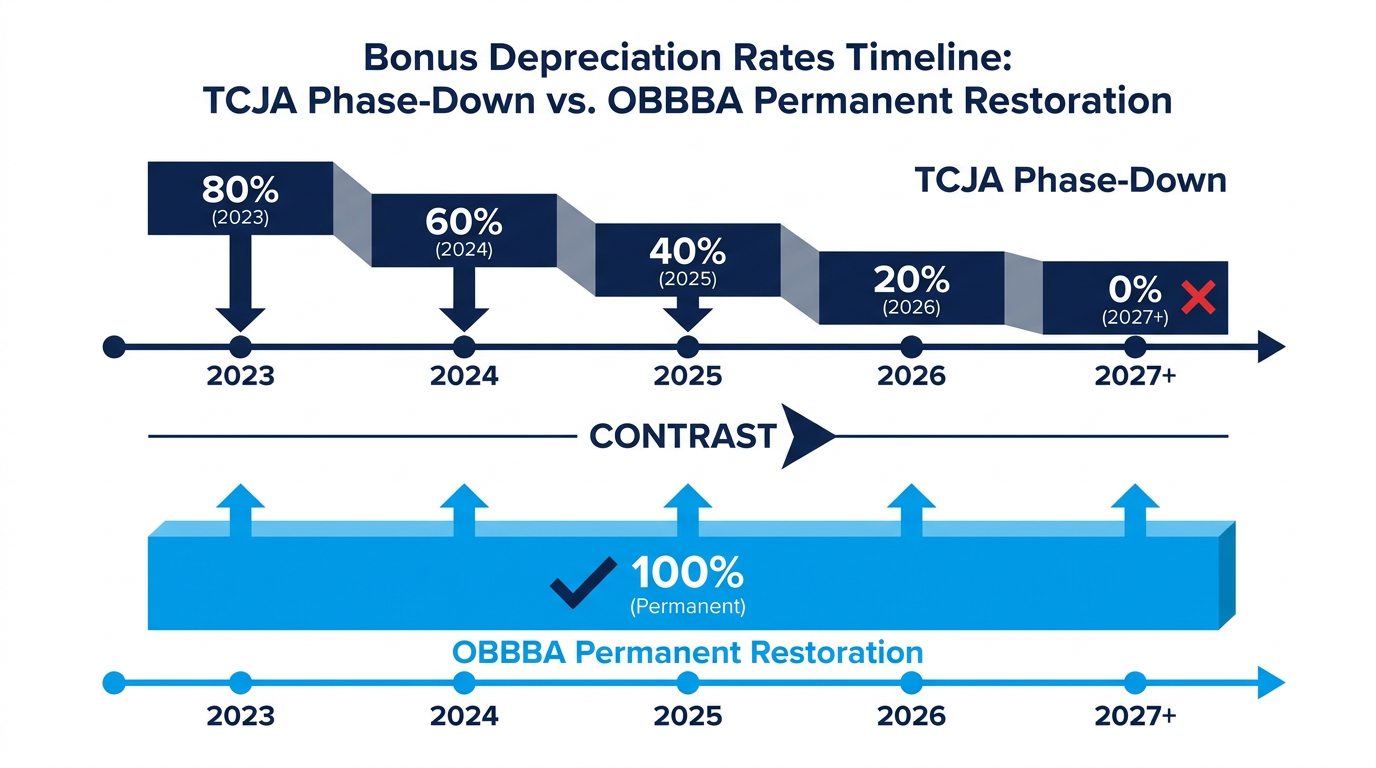
The centerpiece is the One Big Beautiful Bill Act. Signed on July 4, 2025, the OBBBA permanently restored 100% bonus depreciation for qualified property placed in service after January 19, 2025. To understand why this matters, you need to know what was happening before it passed. Under the Tax Cuts and Jobs Act (TCJA), bonus depreciation was on a scheduled phase-down: 80% in 2023, 60% in 2024, 40% in 2025, 20% in 2026, and 0% by 2027. Without OBBBA, real estate investors would have been looking at a near-total elimination of bonus depreciation within two years.
The OBBBA didn’t just pause that phase-down. It eliminated it permanently.
According to the Tax Foundation, the OBBBA makes 100% bonus depreciation permanent for most property acquired after January 19, 2025 — which means every qualified short-life asset you place in service in 2026 can be fully expensed in Year 1, not spread across a 5-, 7-, or 15-year recovery period. For investors doing renovations, acquisitions, or improvements this year, this changes the entire calculus of their Year 1 tax position.
For a more detailed breakdown of how the OBBBA changes bonus depreciation specifically, the RealBooks companion post on how the Big Beautiful Bill changes bonus depreciation and Section 179 is the most complete investor-focused resource available.
Beyond bonus depreciation, the OBBBA also increased the personal SALT (State and Local Tax) deduction cap from $10,000 to $40,400. This is especially relevant for investors in high-tax states like California, New York, and New Jersey who own multiple properties and pay significant state income taxes. While rental property taxes themselves have always been deductible outside the personal SALT cap (more on that in Section 2), this increase in the personal cap provides meaningful additional relief for investors who also itemize on their personal returns.
What this means in practice:
- Qualified property placed in service in 2026 is eligible for 100% first-year bonus depreciation
- Cost segregation studies done in 2026 unlock maximum acceleration on short-life components
- Investors who act proactively — not reactively — will capture the most value from this environment
- The SALT cap increase provides additional benefit for multi-property investors in high-tax states
The real estate investor’s tax calendar doesn’t run January to December and then compress into April. It runs in quarters. Q1 estimated payment (January 15), Q2 (June 16), Q3 (September 15), Q4 (January 15 of the following year) — each one is a checkpoint. Each is an opportunity to confirm that your deductions are being captured in real time, not reconstructed from memory later. If you’re unsure whether your books are where they should be at the halfway mark, the RealBooks mid-year financial checkup guide is a practical place to start.
The investors who benefit most from 2026’s exceptional tax environment aren’t the most sophisticated. They’re simply the most organized. Their books are current. Their expenses are categorized. Their depreciation schedules are maintained. They don’t need to scramble in April because they’ve never stopped paying attention.
With that context in place, let’s walk through every deduction they’re capturing — starting with the three that form the foundation of every rental property return.
Mortgage Interest, Property Taxes, and Insurance: The Foundation
Every rental property investor claims these three deductions. They’re not exotic. They’re not controversial. But they are frequently under-documented, misapplied across multi-property portfolios, or quietly losing value because the tracking systems aren’t built for real estate. Getting these three right — on every property, every month — is the baseline.
Mortgage Interest
Mortgage interest is fully deductible on loans used to acquire, build, or substantially improve a rental property, reported on Schedule E. This includes primary mortgages, second mortgages, HELOCs (when the proceeds are used for the rental property), and refinance loans. The key qualifier is use of funds — if a HELOC is taken out on a rental property but the proceeds go toward personal expenses, that portion is not deductible.
What doesn’t qualify: the personal portion of a mixed-use loan, and prepaid interest beyond the current tax year (with limited exceptions).
Documentation matters here more than most investors realize. Your lender should issue a Form 1098 showing the mortgage interest paid during the year. If your lender doesn’t issue a 1098 — which is common with private lenders and seller-financed arrangements — you’re responsible for maintaining your own loan statements and payment records. Per IRS Publication 527, this documentation is required regardless of the source of the loan.
For investors with multiple properties, each property’s mortgage interest must be tracked separately and attributed to the correct property on Schedule E. A single combined total across all properties isn’t sufficient — and it creates errors that compound over time as the portfolio grows.
Property Taxes
Real property taxes paid on rental properties are fully deductible — and importantly, they are not subject to the personal SALT $10,000 cap (or the new $40,400 cap under OBBBA). The SALT limitations apply to personal deductions on Schedule A. Rental property taxes are deducted on Schedule E as a business expense, making them fully deductible regardless of how many properties you own or which state they’re in.
What doesn’t qualify: special assessments levied for local improvements — sidewalks, sewer lines, curbs — are not deductible as property taxes. These are typically added to the property’s cost basis instead. Transfer taxes paid at acquisition similarly don’t qualify as a current-year deduction.
Documentation: county tax bills, assessor statements, and escrow accounting statements from your lender are the primary records. If your taxes are escrowed, confirm the amount actually paid (not just collected) during the tax year.
Insurance
Landlord insurance, hazard insurance, flood insurance, liability insurance, and umbrella policies (pro-rated for rental use) are all fully deductible. If you carry a policy that covers both your personal residence and one or more rental properties, you can deduct the rental-use portion.
A common point of confusion: title insurance. It’s typically added to the property’s cost basis at acquisition rather than deducted as a current-year expense. Life insurance premiums are never deductible as a rental expense.
For short-term rentals, the rules shift slightly. If a property is rented fewer than 15 days per year, no deductions apply at all. Above that 15-day threshold, expenses — including insurance — must be allocated between rental days and personal-use days. The IRS guidelines on rental real estate income and deductions provide the framework for that allocation.
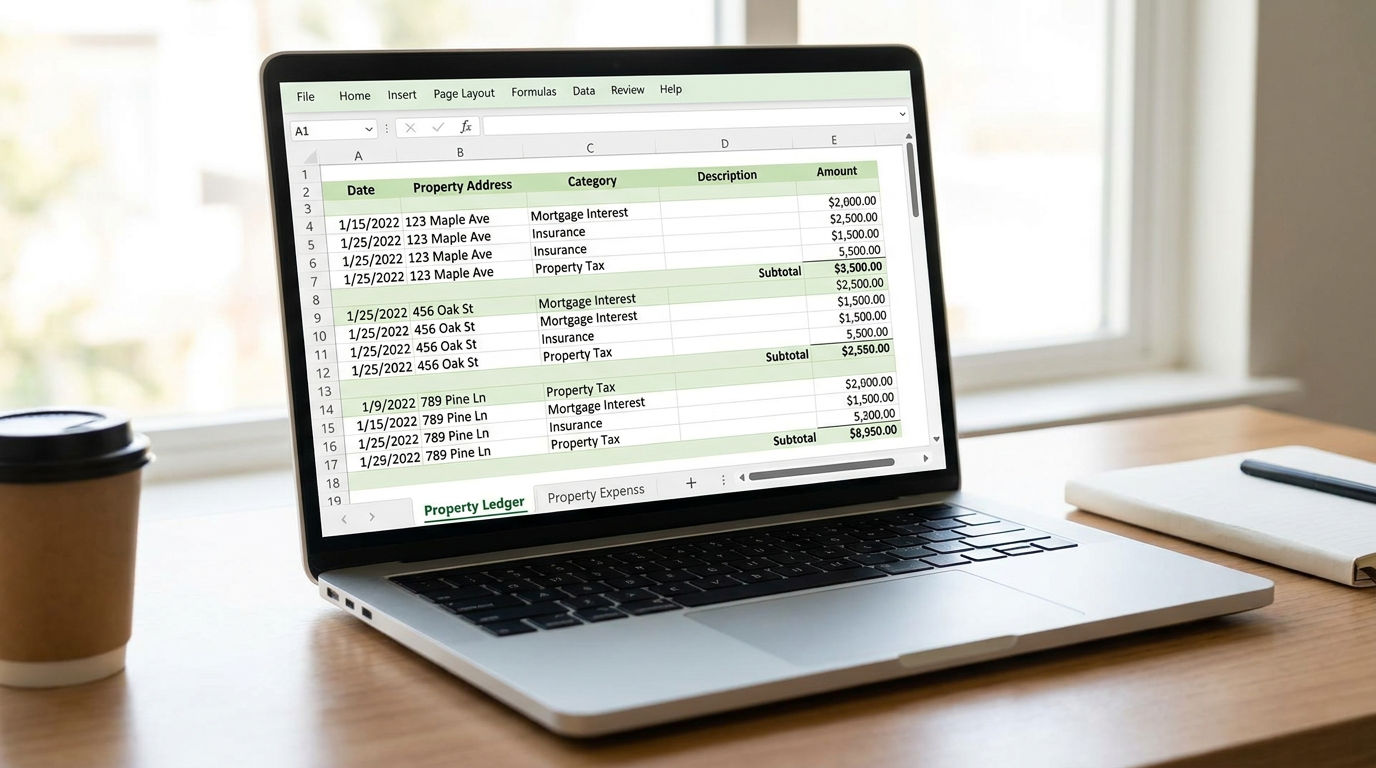
The multi-property tracking challenge: When you own one property, keeping these three deductions organized is manageable. When you own five, eight, or fifteen properties — each with its own lender, tax authority, and insurance provider — the per-property tracking requirement becomes the constraint. Penny, RealBooks’ AI bookkeeper, automatically categorizes mortgage payments, tax payments, and insurance premiums to the correct property the moment they hit the connected account. These deductions are captured the day they occur, not reconstructed in April from a stack of statements.
The foundational three are the floor of every investor’s return. But the most powerful tax strategy in real estate isn’t any single operating expense — it’s depreciation. And in 2026, depreciation has never been more valuable.
Rental Property Depreciation: The Most Powerful Strategy in Your Portfolio
Depreciation is the deduction that makes real estate uniquely powerful as an investment vehicle. It’s a paper loss — a reduction in taxable income that doesn’t require you to spend a dollar. While your property potentially appreciates in market value, the IRS allows you to deduct its “wear and tear” every single year. Understanding how depreciation works at each layer — standard, cost segregation, and bonus — is the single highest-leverage piece of tax knowledge a real estate investor can have in 2026.
Standard 27.5-Year Straight-Line Depreciation
Residential rental property is depreciated over 27.5 years using the straight-line method under MACRS (Modified Accelerated Cost Recovery System). The building is depreciable. The land is not — land doesn’t wear out.
The starting point is your depreciable basis: purchase price minus the value of land, plus closing costs attributable to the property (legal fees, title insurance allocated to the purchase, recording fees). For example, a $300,000 property with $50,000 land value yields a $250,000 depreciable basis. Divide by 27.5 years and you get approximately $9,090 in annual depreciation — a deduction you claim every year, whether the property is generating income or not, whether it’s going up in value or not.
The documentation anchor here is your HUD-1 or Closing Disclosure from acquisition, a property appraisal to support the land value allocation, and Form 4562 (Depreciation and Amortization) filed with your return each year.
Cost Segregation: Accelerating the Timeline
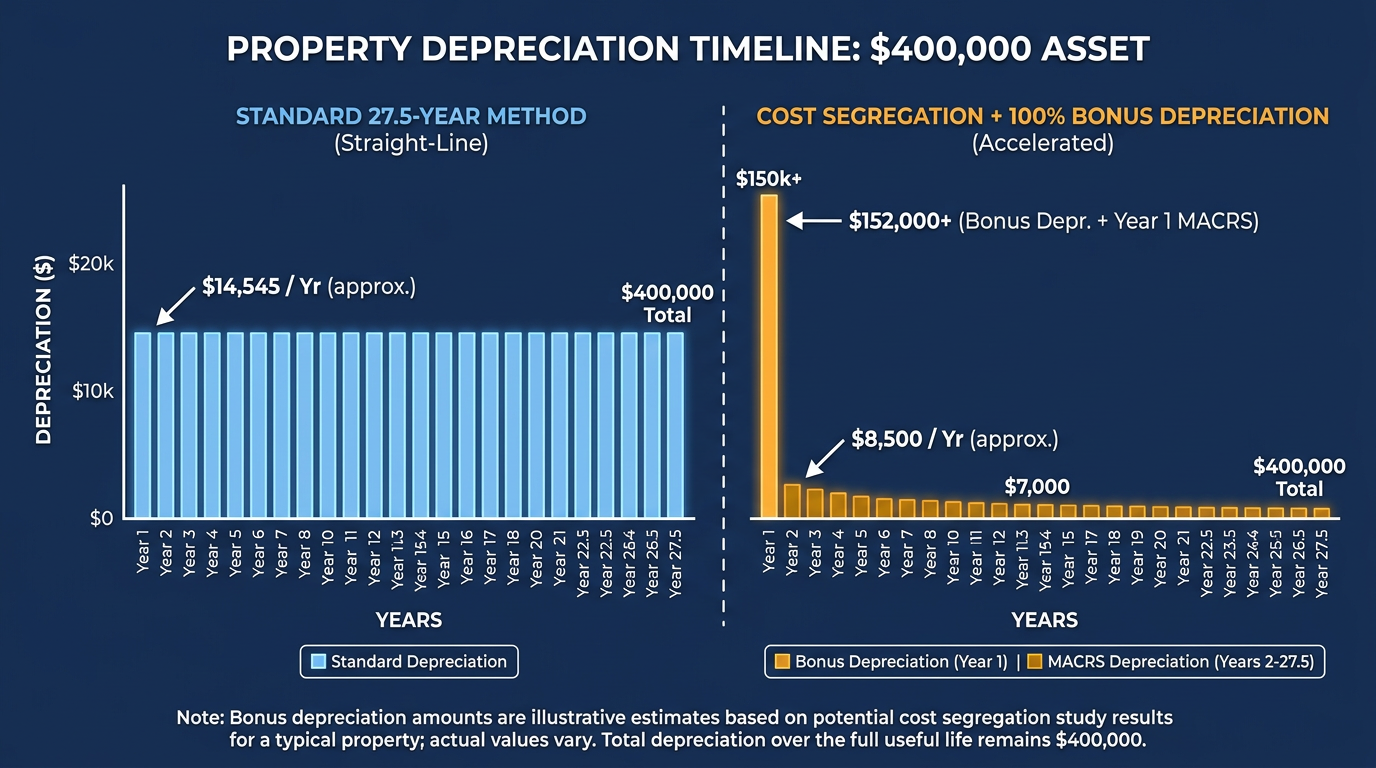
Standard depreciation spreads the deduction over 27.5 years. A cost segregation study reclassifies components of the property into shorter recovery periods — 5, 7, or 15 years — dramatically front-loading those deductions.
Here’s how it works: personal property components like appliances, carpeting, and cabinetry recover over 5–7 years. Land improvements like parking lots, landscaping, and outdoor lighting recover over 15 years. These components are embedded in the purchase price of every property — they just haven’t been separated from the 27.5-year structure. A cost segregation study, performed by a qualified engineer, does that separation.
The practical result: an investor who would have claimed $9,090 per year on a $300,000 property might instead claim $40,000–$60,000 in Year 1 by separating and accelerating the shorter-life components. The total deductions over time don’t change — but the timing shifts dramatically in your favor.
Cost segregation is typically worthwhile on properties valued at $500,000 or above, where the study fee is easily offset by the first-year tax savings. The ROI on a well-executed cost seg study often exceeds 5:1. And the lookback rule means investors don’t have to have done this at acquisition: a cost segregation study can be applied to a property you’ve owned for years, catching up on all missed accelerated depreciation in a single year through a Form 3115 filing.
For a complete investor-focused breakdown of how cost segregation works and who qualifies, see the RealBooks cost segregation guide.
100% Bonus Depreciation in 2026: The Game-Changer
This is where the OBBBA changes everything. Under the restored 100% bonus depreciation provision, the 5-, 7-, and 15-year property components identified in a cost segregation study can be fully expensed in Year 1 — not spread across their recovery period. According to RSM US, the OBBBA makes this permanent for most property acquired after January 19, 2025.
The combination is powerful: cost segregation identifies the short-life components. Bonus depreciation eliminates their remaining tax burden immediately.
“In 2026, a $500,000 rental property with a cost segregation study could generate $80,000–$120,000 in Year 1 depreciation deductions through 100% bonus depreciation on short-life components. Consult your CPA to model the specific numbers for your property.”
Qualified Improvement Property (QIP) — interior, non-structural improvements to nonresidential property — retains a 15-year MACRS recovery period and is fully eligible for 100% bonus depreciation. If you’re improving a commercial property in your portfolio, this is a significant first-year deduction opportunity.
What does not qualify for bonus depreciation: the building structure itself (still 27.5 years) and land.
Depreciation Recapture: The Important Caveat
When a property is eventually sold, the IRS recaptures the depreciation taken at a 25% rate (Section 1250 unrecaptured gains) — not the same as ordinary income, but not capital gains either. This is a known and manageable cost. The strategic response is to defer the liability while using the current-year tax savings to compound portfolio growth. A 1031 exchange can defer recapture indefinitely for investors who continue reinvesting. Uncle Sam, RealBooks’ tax AI agent, tracks depreciable assets, monitors depreciation schedules, and surfaces cost segregation opportunities by property — so no component is ever misclassified and every asset sits in the correct recovery period automatically.
Depreciation is the big lever. But the operational deductions investors claim every month add up to thousands more — and they’re only fully captured when tracked property-by-property, in real time.
Operational Deductions Every Landlord Should Be Claiming Monthly
If depreciation is the annual anchor of a rental property tax return, the operational deductions are the steady current running beneath it. These are the day-to-day, property-by-property expenses that accumulate across a portfolio into a meaningful number — and they represent some of the most frequently under-tracked landlord tax deductions in practice.
Repairs and Maintenance vs. Capital Improvements
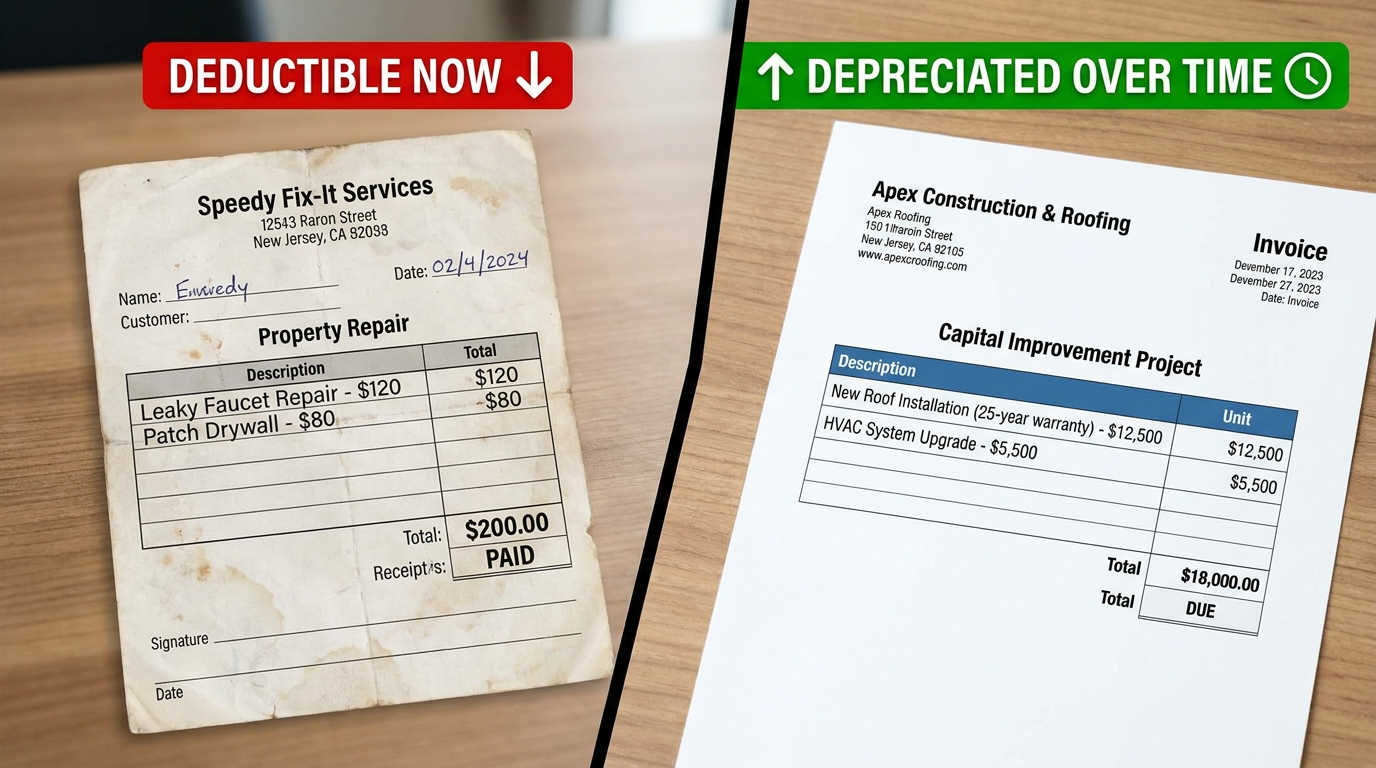
This is the most consequential distinction in rental property tax accounting, and it trips up even experienced investors. Repairs are fully deductible in the year incurred. Capital improvements must be capitalized and depreciated over their useful life. Getting this wrong — in either direction — creates either a missed deduction or an IRS compliance problem.
The IRS applies three tests to distinguish the two:
- Betterment: Does the work materially add to the property’s value or make it significantly better than before?
- Restoration: Does the work restore the property to working condition after substantial deterioration?
- Adaptation: Does the work adapt the property to a new or different use?
If the answer to any of those questions is yes, it’s likely a capital improvement. If none apply — if it’s simply maintaining the property’s current condition — it’s a repair.
Qualifying repairs (deductible now): fixing a leaky pipe, patching drywall, repainting walls between tenants, replacing a broken window, cleaning or servicing HVAC filters.
Capital improvements (depreciated over time): adding a new room, replacing an entire roof, installing a new HVAC system, adding a deck.
The de minimis safe harbor adds a useful layer for smaller items: investors with an applicable financial statement can elect to expense items under $5,000 per item or invoice; without an AFS, the threshold is $2,500. For small appliances, fixtures, and components under these thresholds, you can deduct them immediately rather than depreciating them.
The RealBooks guide on repairs vs. capital improvements covers this distinction in full detail, with specific examples across the most common renovation scenarios.
Property Management Fees and Software
Property management company fees — typically 8–12% of gross rent — are fully deductible, as are leasing fees, tenant placement fees, and renewal fees charged by the manager. Beyond the management company, software subscriptions used for property management and virtual assistant costs for administrative tasks related to your rental activity are also deductible.
Utilities
When the landlord pays utilities rather than passing them to the tenant, they’re deductible: water, gas, electricity, trash collection, and internet (when provided as part of the lease). For short-term rentals, utilities must be allocated between rental days and personal-use days — only the rental-use portion qualifies.
HOA Fees and Special Assessments
Monthly HOA dues paid on rental properties are fully deductible. Special assessments are trickier: a special assessment for routine maintenance (painting the exterior of a condo building, repairing a parking structure) is generally deductible. A special assessment for a new community amenity — a pool, a fitness center, a new clubhouse — is more likely a capital improvement and must be depreciated.
Advertising and Vacancy Costs
Every dollar spent attracting tenants is deductible: listing fees on platforms like Zillow, Apartments.com, or Airbnb, professional photography for listings, signage, and digital advertising spend. Importantly, a property being vacant between tenants does not disqualify these deductions — as long as it’s held out for rent and available. For short-term rental hosts, Airbnb’s host service fees are deductible as a commission or advertising expense.
The IRS rental real estate recordkeeping guidelines specify that documentation for all operational expenses must be maintained — invoices, receipts, contractor agreements — and organized per property, not in a single pile. Dollar Bill, RealBooks’ project management AI agent, tracks repair jobs and improvement projects in real time, flagging potential repair vs. capital improvement classifications before they become tax problems. Penny routes every operational expense to the correct property as transactions clear the connected account.
Beyond day-to-day operations, investors also rack up significant professional and administrative expenses that are fully deductible — from CPA fees and legal costs to home office space and every mile they drive to a property.
Professional, Vehicle, and Home Office Deductions Investors Often Miss
These deductions are frequently overlooked, not because investors don’t know they exist, but because they’re not tracking them in the context of their investment activity. A conversation with a real estate attorney about a lease dispute, a tank of gas on the way to inspect a property, the corner of the spare bedroom used exclusively to manage the portfolio — each represents a real deduction that most investors quietly forfeit every year.
Legal and Accounting Fees
The fees you pay a CPA to prepare Schedule E and your investment-related returns are fully deductible. So are attorney fees for lease drafting, evictions, and landlord-tenant disputes, bookkeeping services, and tax planning consultations directly related to your rental activity.
Here’s a useful meta-point: if you use RealBooks to manage your portfolio’s books, that subscription is deductible as a professional service or software expense. The cost of the tool that captures your deductions is itself a deduction.
The important exception: legal fees incurred to acquire a property — title searches, closing attorneys, deed preparation — are not deductible in the year paid. They’re added to the property’s cost basis and recovered through depreciation.
Professional Services and Consulting
Real estate coach fees are deductible when they’re directly related to your active investment activity — not aspirational education, but specific guidance tied to your current portfolio operations. Property appraisal fees for operational decisions (refinancing, insurance, dispute resolution) are deductible. Cost segregation study fees are deductible. Financial planning fees directly tied to rental portfolio management qualify as well.
Keep invoices, engagement letters, and payment records for all professional services. The IRS looks for a clear business connection.
Vehicle and Travel Expenses
Every trip to inspect, manage, repair, collect rent from, or otherwise conduct business at a rental property is deductible. This includes driving across town to meet a contractor, flying to inspect an out-of-state property, and attending real estate conferences directly tied to your active investment activity.
The 2026 IRS standard mileage rate is 72.5 cents per mile — up 2.5 cents from 2025, per the IRS. Two methods are available:
- Standard mileage rate: Multiply qualifying business miles by 72.5 cents. Simple, and usually sufficient for investors who don’t drive an exceptionally high-cost vehicle.
- Actual expense method: Track and deduct the actual costs of gas, insurance, maintenance, and vehicle depreciation, pro-rated for business use. More complex, but potentially more valuable for expensive vehicles driven primarily for business.
For flights, hotels, and other travel expenses related to out-of-state property activity, the full cost is deductible when the trip is primarily for business. Documentation is non-negotiable: the IRS scrutinizes travel deductions carefully. Maintain a mileage log for every property-related drive — date, destination, purpose, and miles — and keep receipts for all other travel expenses.
“Keeping a mileage log takes 30 seconds per trip. Over a year of managing even two properties, it can add up to hundreds of dollars in deductions you’d otherwise forfeit. The barrier isn’t effort — it’s habit.”
What doesn’t qualify: commuting from home to a permanent outside office, or personal travel where a property visit is incidental rather than the primary purpose.

The Home Office Deduction
For investors who manage their rental portfolio from home — without a separate commercial office — a dedicated home workspace may qualify for the home office deduction. The requirement is strict: the space must be used exclusively and regularly for business. A desk in a shared guest room doesn’t qualify. A dedicated room or clearly defined workspace used only for portfolio management does.
Two calculation methods are available:
- Simplified method: $5 per square foot of the dedicated workspace, up to 300 square feet ($1,500 maximum annually).
- Regular method: Calculate the actual percentage of your home used for business and apply that percentage to actual home expenses — mortgage interest, utilities, insurance, repairs.
The regular method requires more record-keeping but can produce a significantly larger deduction, particularly for investors with higher housing costs. For investors managing multiple LLCs with distinct legal and accounting fee structures, the RealBooks guide on managing finances across multiple LLCs covers how to properly attribute these professional expenses across entities.
Uncle Sam, RealBooks’ tax AI, tracks mileage-eligible trips and flags professional service expenses as they’re coded — keeping them organized by category so nothing gets missed when it matters most.
The deductions covered so far all apply within a single tax year. But some of the most powerful strategies in real estate extend across years — through passive activity losses, the real estate professional status, and carry-forward loss strategies that can dramatically reduce a high-income investor’s tax bill over time.
Passive Losses, Real Estate Professional Status, and the Carry-Forward Advantage
This is where tax strategy separates from tax compliance. Investors who understand the passive activity loss framework — and know how to position themselves within it — are the ones who can genuinely approach the “how to pay no taxes on rental income” outcome that drives so many investors to real estate in the first place. These are sophisticated strategies, and they require coordination with a CPA for your specific situation. But knowing they exist is the starting point.
The Passive Activity Loss Rules — Section 469
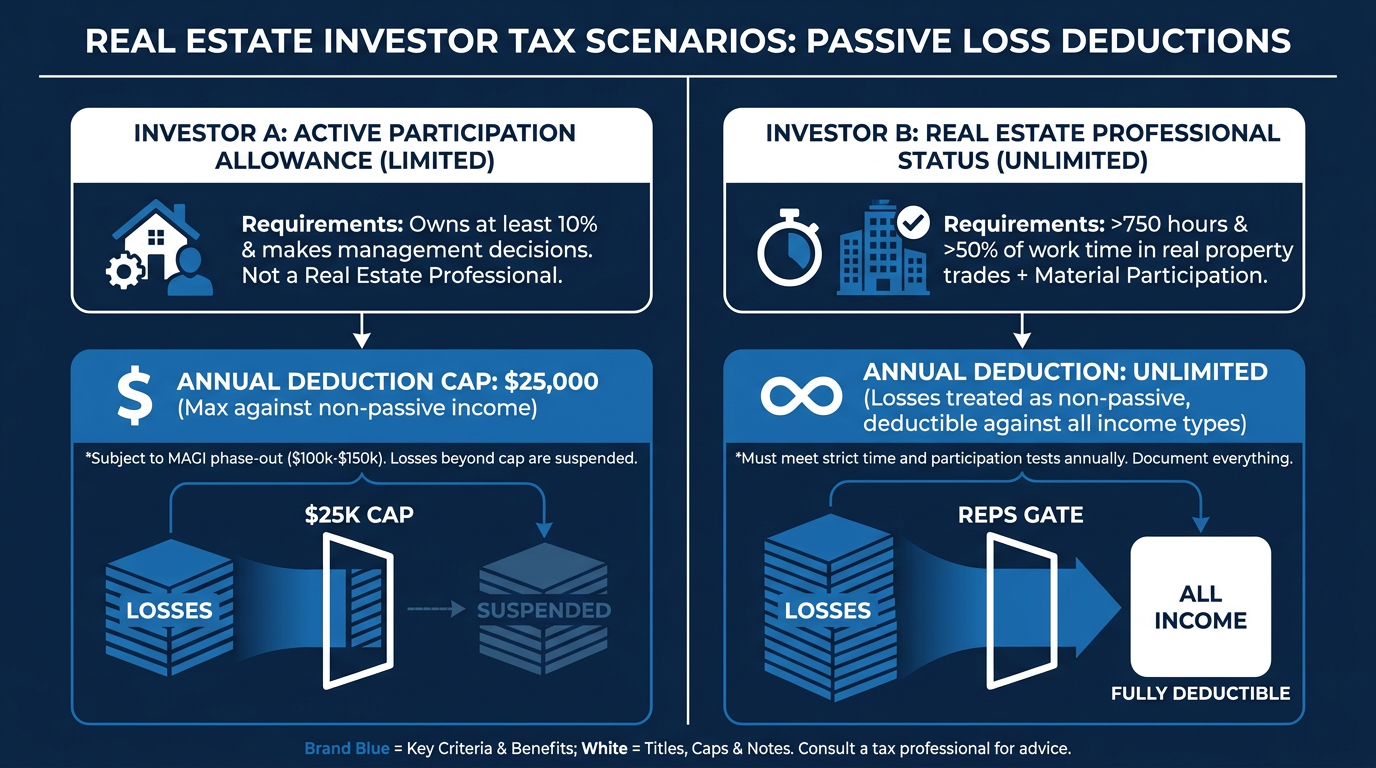
Under IRS Section 469, rental activity is generally classified as passive — which means losses generated by rental properties can only offset other passive income. They cannot, by default, offset W-2 wages, self-employment income, or active business income.
This is the core tension for high-income investors. You may have a property generating significant paper losses (largely from depreciation), and those losses may be sitting on the sideline, unable to reduce your ordinary income tax bill. Section 469 creates two important exceptions to this rule.
Exception 1: The $25,000 Active Participation Allowance
Investors who actively participate in their rental activity — meaning they make management decisions, approve tenants, and authorize repairs, even if a property manager handles day-to-day tasks — can deduct up to $25,000 in rental losses against ordinary income, as long as their adjusted gross income (AGI) is under $100,000. The allowance phases out ratably between $100,000 and $150,000 AGI, disappearing entirely above $150,000.
For investors in that AGI range, this allowance can be meaningful — particularly early in a portfolio when properties are generating small losses and the investor’s income hasn’t yet crossed the phase-out threshold.
Exception 2: Real Estate Professional Status (REPS)
If the investor — or their spouse, filing jointly — spends more than 750 hours per year in real estate activities, and real estate represents more than 50% of their total working hours, their rental losses are reclassified as active. No AGI limit. No $25,000 cap. Rental losses can offset all income, without restriction.
REPS is a legitimate and powerful strategy for investors who are transitioning to full-time real estate, or for couples where one spouse manages the portfolio while the other earns W-2 income. The IRS scrutinizes REPS claims heavily — detailed time logs (date, activity, description, hours) are essential documentation. The investment in record-keeping is the price of admission.
The Short-Term Rental Tax Advantage
There’s a third pathway that’s driving significant investor interest: the short-term rental classification. If the average guest rental period at a property is 7 days or fewer, the activity is classified as a non-passive short-term rental business — not subject to the passive activity rules under Section 469.
This is why short-term rental tax deductions are such a heavily searched topic. The tax treatment is fundamentally different and potentially far more favorable. STR losses — including the depreciation acceleration from a cost seg study — can offset W-2 and other active income without requiring REPS status.
There’s a catch: material participation requirements apply. The investor must meet one of the IRS’s seven material participation tests, the most common of which is spending more than 100 hours in the activity and more hours than any other person.
The Carry-Forward Loss Strategy
Even investors who don’t qualify for the $25,000 allowance or REPS aren’t losing those deductions — they’re deferring them. Passive losses that can’t be deducted in the current year are suspended and carried forward to future tax years. When a property is eventually sold, all suspended passive losses for that property are released at once and can offset the gain from the sale.
This makes depreciation extraordinarily powerful for long-term holders. Every year, the depreciation deduction reduces taxable income within the PAL limits. Any excess builds a deferred tax asset. At disposition, that accumulated carry-forward fires — often turning what would have been a significant capital gain into a much smaller (or even neutral) taxable event. A 1031 exchange defers both the gain and the recapture, allowing that carry-forward to continue compounding.
Per IRS Topic 414 and IRS Publication 527, the passive activity rules apply broadly across the rental portfolio, which is why tracking passive vs. active income classification — and suspended loss balances — on a per-property basis is so important.
Uncle Sam monitors passive versus active income classification across the entire RealBooks portfolio, tracks suspended loss balances property by property, and alerts investors when they’re approaching or crossing PAL thresholds — so the carry-forward is never lost when a property is sold.
Knowing every deduction is step one. Capturing every deduction — property by property, category by category, all year long — is where most investors fall short. Here’s how to fix that.
Capturing Every Deduction, All Year: The RealBooks Approach
The problem isn’t awareness. Most experienced real estate investors have a general sense of which deductions are available. The problem is capture. And the gap between knowing a deduction exists and actually claiming it — documented, categorized, attributed to the right property — is where tens of thousands of dollars disappear every year.
Why Investors Miss Deductions in Practice
Generic accounting tools — QuickBooks, spreadsheets, even dedicated property management software — aren’t designed around the tax and financial structure of real estate investing. Expenses get categorized incorrectly. Transactions get mixed across properties. Renovation costs blur into operating expenses. And when April arrives, the process becomes a six-week scramble to reconstruct twelve months of activity from bank statements, email inboxes, and contractor text threads.
The investors who leave the most money on the table aren’t the ones who don’t know the deductions exist. They’re the ones who can’t prove them. Documentation is the difference between a deduction claimed and a deduction lost.
The Four Investment Phases and How RealBooks Tracks Each
Real estate investment moves through four distinct phases — each with its own expense types, tax treatment, and documentation requirements. The 3-phase financial framework for fix-and-flip investors maps this logic, and it applies equally to long-term rental portfolios.
- Acquisition Phase: Closing costs, inspection fees, loan origination fees, and legal fees all require proper routing — some to the property’s depreciable basis, some as current-year deductions. RealBooks’ expense management through Penny captures these at the transaction level and routes them correctly, automatically.
- Renovation Phase: This is where the repair vs. capital improvement distinction becomes most dangerous. Dollar Bill, RealBooks’ project management AI, tracks every renovation expense in real time — budget vs. actual, phase by phase, contractor by contractor — and flags potential classification issues before they land in the wrong tax bucket. RealBooks project management is the renovation-phase operating system.
- Operations Phase: Penny categorizes every recurring expense — mortgage payments, insurance premiums, property taxes, management fees, utilities, HOA dues — to the correct property, in the correct category, every month. There is no “miscellaneous” bucket. Nothing falls through.
- Disposition Phase: Uncle Sam maintains the complete depreciation schedule, adjusted basis, and suspended passive loss balance for every property — so when a sale happens, the full tax picture is already assembled. The RealBooks asset management platform maintains these schedules continuously, and the year-end tax reporting package is ready in hours, not weeks.
What Tax-Ready Year-Round Actually Looks Like
For investors who are still managing their portfolio on spreadsheets or in a generic accounting tool, the contrast with a purpose-built system is significant. The case for replacing spreadsheets in rental property management covers this in detail, but the practical difference comes down to this:
- Real-time P&L by property: so estimated tax payments are based on actual numbers, not guesses
- Scheduled depreciation tracked automatically: no manual asset schedules, no missed entries
- Every expense attributed to the right property: no year-end re-categorization exercise
- Complete documentation trail: receipts, invoices, and payment records attached to every transaction
The year-end tax package — the document your CPA needs to prepare your return — is the natural byproduct of a system running correctly all year. When the books are right every month, April isn’t a scramble. It’s just a date.

RealBooks is built specifically for real estate investors — not adapted from generic small-business accounting software. Three AI agents working in concert: Penny tracks every dollar, Dollar Bill manages every project, Uncle Sam protects every deduction. One platform. One source of truth. The numbers work as hard as the investments do.

The Deductions Are There. The Question Is Whether You’re Capturing Them.
2026 is an exceptional year to be a real estate investor from a tax perspective. The OBBBA’s permanent restoration of 100% bonus depreciation is the most significant legislative shift in real estate taxation in years. Cost segregation has never been more powerful. The foundational deductions — mortgage interest, property taxes, insurance, depreciation, operational expenses, professional fees — are all available, all year, on every property.
What separates the investors who benefit from this environment from those who simply file a return is the system underneath it. The per-property tracking. The repair vs. improvement distinction applied in real time. The depreciation schedule that never falls behind. The mileage log kept with discipline. The passive loss balance monitored continuously.
Every investor’s situation is unique — the strategies in this guide should be applied in consultation with a qualified CPA or tax professional who understands your specific portfolio, income level, and entity structure. RealBooks is the bookkeeping and financial tracking system that makes those conversations more productive — and those deductions more defensible.
Tax preparation isn’t a year-end scramble. It’s an all-year practice. The second half of 2026 starts now.
Ready to Stop Leaving Money on the Table?
RealBooks automatically tracks expenses, manages assets, and maximizes deductions across your entire portfolio — so tax season is never a scramble again.
Start your free trial at app.realbooks.io →
Want to see how RealBooks handles depreciation tracking, per-property expense categorization, and year-end tax reporting? See how it works →
Ready to maximize your tax savings?
RealBooks automatically tracks expenses, manages assets, and calculates depreciation across your entire portfolio.
Start Free Trial →