Repairs vs. Capital Improvements: The IRS Distinction That Can Cost You Thousands

A real estate investor spends $18,000 replacing every window in a rental property. They call it a repair and deduct it immediately. Two years later, the IRS calls it a capital improvement — and the investor owes back taxes, interest, and penalties on every dollar of that overstated deduction. This exact scenario plays out thousands of times a year, quietly draining real estate portfolios while investors assume they’ve done everything right.
Here’s the uncomfortable truth: most real estate investors are making repair vs. capital improvement classification decisions without a real system. They’re relying on gut instinct, a vague memory of something their CPA mentioned once, or the assumption that if it felt like a repair, it probably was one. The IRS doesn’t see it that way.
The distinction between a repair and a capital improvement is one of the most financially consequential decisions a real estate investor makes — and it’s one the IRS scrutinizes closely. Get it wrong in one direction and you’re overstating deductions, inviting an audit, and facing penalties plus interest. Get it wrong in the other direction and you’re silently forfeiting deductions you were legally entitled to take, spreading them across 27.5 years instead of claiming them now.
This post covers everything you need to know to get this right:
- The IRS definitions of repairs and capital improvements, and why they carry such dramatically different tax consequences
- The BAR Test — the three-part IRS framework that determines how every property expense is classified
- Real-world renovation scenarios with clear verdict labels, from painting walls to gut renovating a kitchen
- The three IRS safe harbors that can legally protect certain deductions without requiring a full BAR analysis
- What misclassification actually costs — in penalties, interest, and missed deductions
- How RealBooks and AI agent Penny automate correct classification at the exact moment an expense hits your account
By the end, you’ll have the framework to make smarter classification decisions — and the knowledge that you don’t have to make them alone.
Why This Distinction Matters More Than Most Investors Realize
Most investors understand taxes at a high level: income in, deductions out, net taxable income somewhere in the middle. What fewer investors fully appreciate is that when you get to take a deduction matters just as much as whether you get to take it at all. And for real estate expenses, the classification of a single invoice can determine whether that deduction lands this year or gets stretched across nearly three decades.
The entire repairs vs. capital improvements framework hinges on two sections of the Internal Revenue Code. Section 162 covers ordinary and necessary business expenses — costs that are directly deductible in the year they’re incurred. If an expense qualifies as a repair under Section 162, you write it off immediately, reducing your taxable income in the current tax year with full effect. Section 263(a), on the other hand, governs capitalization — the process of treating an expenditure as a long-term asset rather than an immediate expense. Capital improvements must be added to the property’s basis and depreciated over time: 27.5 years for residential rental property, and 39 years for commercial real estate.
That difference in timeline is not a technicality. It’s the difference between a $15,000 deduction working for you this year versus giving you approximately $545 per year over the next 27.5 years. At a 30% effective tax rate, an immediate deduction saves you $4,500 in taxes right now. The same expense capitalized returns only about $163 in annual tax savings — a fraction of the immediate benefit, and one you’ll still be collecting well into your retirement.
Now flip it: what happens when you take that immediate deduction and the IRS determines it should have been capitalized? You lose the full deduction, you’re required to set up a depreciation schedule retroactively, and you owe the difference in taxes. Plus interest — often compounding for one to three years before the IRS catches it. Plus an accuracy-related penalty of up to 20% of the tax underpayment. A $15,000 misclassified improvement doesn’t just cost you the deduction. It costs you the deduction plus a penalty plus years of compounding interest. The math turns punishing very quickly.
Misclassification also runs in the other direction, and this version is quieter but equally damaging. When an investor incorrectly capitalizes a repair — one they should have deducted immediately — they’re voluntarily deferring a tax benefit they could have had today. They lock themselves into 27.5 years of drip-fed deductions, losing the time value of money on every dollar. This mistake doesn’t come with an audit notice. It just costs you, silently, year after year.
The reason this area receives particular IRS scrutiny is precisely because of this dual nature. A large spike in “Repairs and Maintenance” on Schedule E is a known audit trigger. A pattern of unusually large repair deductions relative to the property’s assessed value raises flags. And with real estate portfolios generating dozens of repair and renovation invoices per year, the cumulative exposure can be significant — especially for investors managing five, ten, or twenty properties.
“The repair vs. improvement decision isn’t just an accounting choice — it’s a tax strategy decision with a multi-decade horizon. Most investors don’t treat it that way, and that gap is where money is lost.”
The core principle to internalize is simple: a repair maintains. An improvement enhances, extends the useful life, or fundamentally changes the nature of the asset. But as straightforward as that sounds in the abstract, applying it to a real contractor invoice on a real property is where things get genuinely complicated — which is exactly why the IRS developed a structured framework to guide the analysis.
Think of it this way: every renovation invoice you receive is, in essence, a question the IRS is eventually going to ask. The time to answer it correctly is now — not during an audit two years from now. Understanding how the IRS framework actually works is the first step to answering that question right, every single time.
The BAR Test: Three Questions the IRS Will Ask About Every Expense
When the IRS evaluates whether an expenditure is a deductible repair or a capitalizable improvement, it doesn’t rely on guesswork or dollar thresholds alone. It applies a structured three-part test, enshrined in the IRS tangible property regulations — commonly known as the BAR Test. The name is an acronym: Betterment, Adaptation, Restoration. If an expense satisfies any one of these three criteria, it must be capitalized as a capital improvement rather than deducted as a repair.
Understanding BAR isn’t just an academic exercise. It’s the actual analytical tool the IRS uses when it audits your Schedule E — and it’s the framework your CPA should be applying when they review your books. Internalizing it means you can make defensible, informed decisions at the point of the expense, before any mistakes compound.
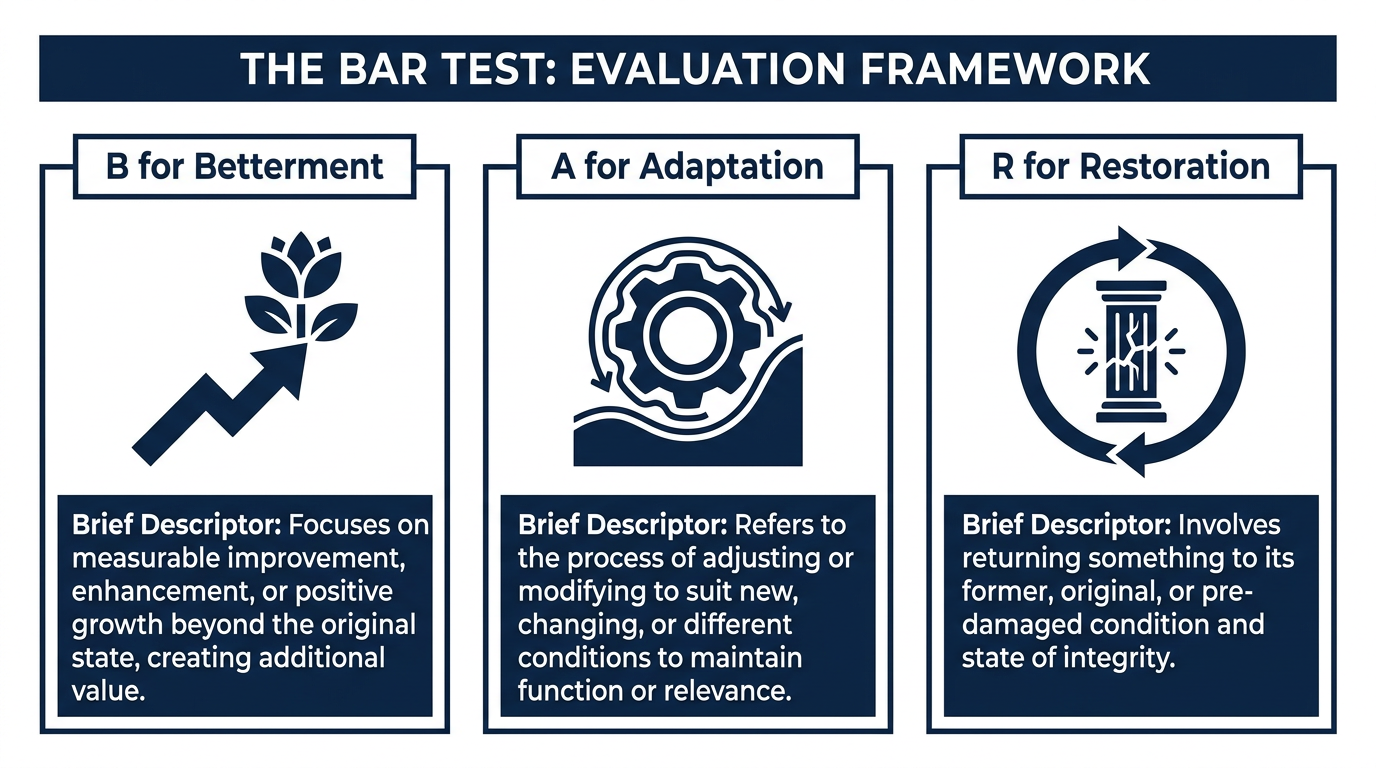
B — Betterment: Does the Work Make It Meaningfully Better?
The betterment prong asks whether the work fixes a pre-existing defect that was known at the time the property was acquired, adds a major new component, or materially increases the property’s capacity, strength, efficiency, or quality. If the answer to any of those questions is yes, the expense must be capitalized.
A straightforward example: upgrading an electrical panel from 100 amps to 200 amps is a betterment. The property can now handle significantly more electrical load than it could before. The work didn’t simply restore what was there — it expanded the capability of the system in a material way. Similarly, adding central air conditioning to a property that previously had none is a betterment. You’re not restoring a prior condition; you’re creating a new one.
By contrast, replacing a faulty circuit breaker to restore the panel to its normal operating condition is a repair. You’re bringing the system back to what it was — not making it more capable.
A — Adaptation: Does the Work Change How the Property Is Used?
The adaptation prong captures expenditures that convert property to a new or different use — specifically, a use that’s inconsistent with how the property was originally placed in service. If the work meaningfully repurposes the asset, it’s an improvement.
Converting a residential garage into a rentable studio apartment is adaptation. The space has been fundamentally repurposed from its original function. Adding a separate entrance to create a second rental unit is adaptation. Reconfiguring an open floor plan into individual offices for a commercial tenant is adaptation. In each case, the property is being modified to serve a purpose it wasn’t originally built to serve.
Compare that to painting those same rooms, replacing damaged flooring, or fixing a broken door lock. Those activities maintain the property’s existing use — they don’t change it.
R — Restoration: Does the Work Rebuild or Replace a Major Component?
The restoration prong is arguably the most commonly triggered — and the most commonly misunderstood. It applies when work replaces a major component or substantial structural part of the property, returns property that has deteriorated to an unusable condition back to operating condition, or rebuilds the property to like-new condition.
Replacing an entire HVAC system is restoration. Replacing an entire roof is restoration. Replacing all the windows in a building — as in the scenario that opened this post — is restoration. In each case, a major component of the property has been replaced wholesale, not simply patched or partially repaired.
An important nuance from the IRS regulations: the BAR test is applied at the level of the unit of property (UOP), not the building as a whole. For a building, the IRS identifies eight key structural systems — plumbing, electrical, HVAC, elevator, escalator, fire protection, gas distribution, and security systems — each evaluated independently. This means that replacing the entire plumbing system is analyzed as a restoration against the plumbing system as the unit of property, not against the building’s total value. This prevents investors from arguing that a full HVAC replacement is “just a small part” of the overall building.
This UOP concept matters enormously in practice. It means that the relevant comparison isn’t always “how much did I spend relative to what the whole building is worth?” It’s “how significant is this expenditure relative to the specific system or component being worked on?” A $30,000 HVAC replacement might represent a small percentage of a $2 million property’s total value — but it replaces 100% of the HVAC system, which makes it a restoration regardless.
Applying the BAR test correctly requires asking the right questions at the right level of analysis. It’s not enough to know the dollar amount — you need to understand what system was affected, what the work actually did to that system, and whether the end result is a maintained property or an improved one. Once you understand the framework, you can see how it applies to the real renovation decisions investors face every day.
Real Renovation Scenarios: Repair or Capital Improvement?
Theory is useful. But where the BAR test really earns its place is in the practical application — standing in front of a contractor’s invoice and making a defensible call on how to code it. The following scenarios mirror the situations real estate investors encounter every day, moving from clear-cut decisions to genuinely gray areas that require careful analysis.
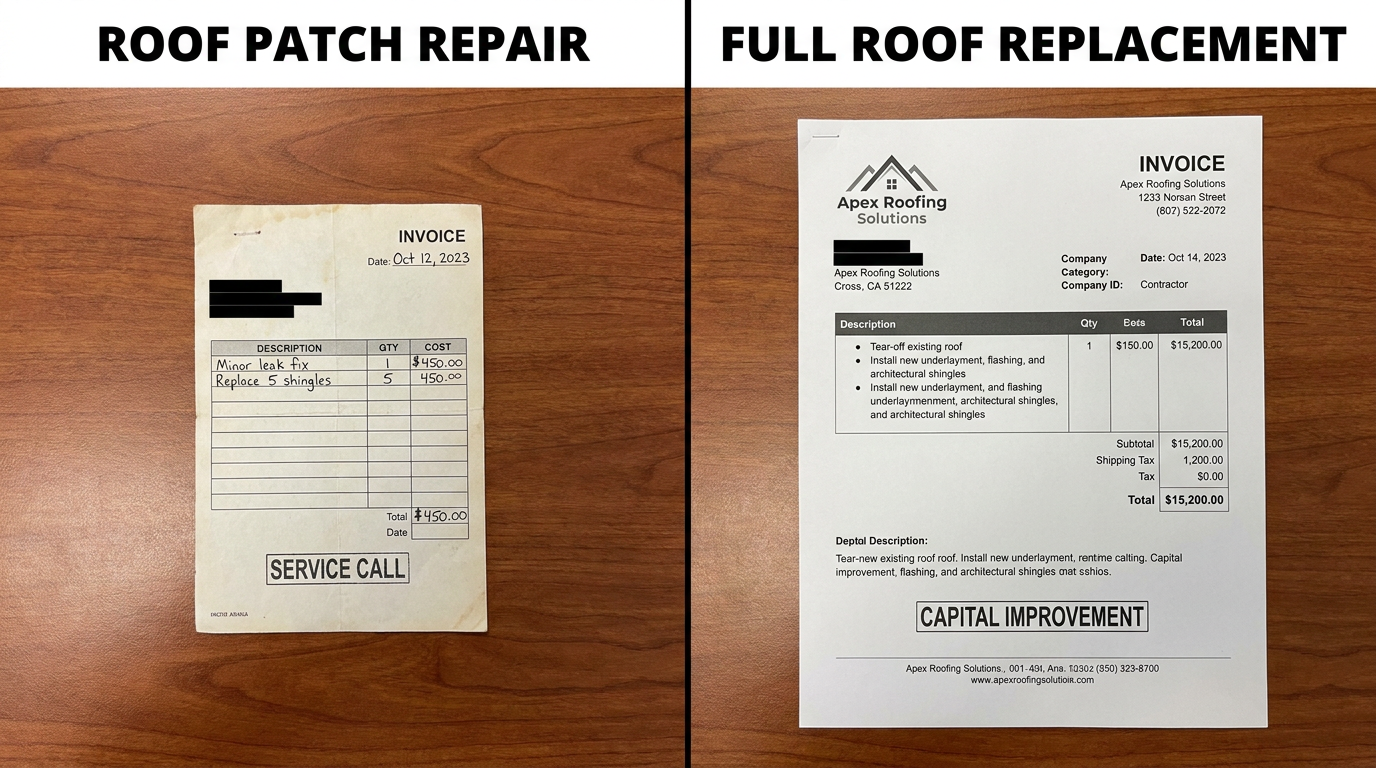
✓ Repair — Painting Interior Walls
Routine interior painting is a repair. It maintains the property’s existing condition, doesn’t extend its useful life beyond its original estimate, and doesn’t increase its capacity or value in a material way. Whether you’re painting between tenants or freshening up a unit after a few years of use, interior painting is deductible in the current year under Section 162. This is one of the cleaner calls in real estate tax classification.
✓ Repair — Replacing a Broken Window Pane
A single broken window pane is a repair. You’re restoring a component to its original function — not replacing the window system across the property, and certainly not upgrading to a materially better product. The work is isolated, restorative, and leaves the property in the same general condition it was in before the damage occurred.
✓ Capital Improvement — Full Window Replacement Across the Entire Property
This is the scenario from the opening of this post — and it’s a capital improvement under the restoration prong of BAR. When you replace all the windows in a building, you’re replacing a major component of the building envelope. Even if the new windows are the same grade as the old ones, the wholesale replacement of a substantial structural component triggers capitalization. This must be added to the property’s basis and depreciated over 27.5 years.
✓ Repair — Patching a Leaking Roof Section
Patching a section of roof that has developed a leak is a repair. You’re addressing a specific, localized failure and returning that portion of the roof to its prior operating condition. The roof as a system remains intact. The patch doesn’t replace a major component — it maintains one.
✓ Capital Improvement — Complete Roof Replacement
Replace the entire roof, and the analysis flips completely. The roof is a major structural component of the building, and replacing it wholesale is a restoration under BAR. It doesn’t matter that the old roof was worn out and the new one is the same grade — replacing a major component is categorically an improvement, not a repair. This gets capitalized and depreciated.
✓ Depends — HVAC Repair vs. HVAC Replacement
Replacing a faulty capacitor, a worn fan belt, or a failing compressor within an existing HVAC unit is generally a repair — you’re maintaining the system, not replacing it. But replacing the entire HVAC system, including the air handler, condenser, and ductwork, is a capital improvement. The HVAC system is one of the IRS’s eight enumerated building systems — replacing it in its entirety triggers restoration regardless of the system’s age or condition.
✓ Repair — Repainting and Refinishing Kitchen Cabinets
Giving existing kitchen cabinets a fresh coat of paint or a new finish is a repair. The cabinets remain functionally the same; you’ve simply maintained their appearance. This is distinguishable from replacing the cabinets themselves, which would be analyzed differently.
✓ Capital Improvement — Full Kitchen Gut Renovation
Tear out the cabinets, replace the countertops, install new appliances, and retile the floor? That’s a capital improvement. A comprehensive kitchen renovation constitutes a material betterment to the property — it materially increases the quality, functionality, and condition of the kitchen as a system. Even if the renovation was “necessary” to attract tenants, the scope and outcome determine the classification, not the motivation.
✓ Gray Zone — Flooring Replacement
Replacing damaged flooring in a single room due to water damage is likely a repair — it restores the property to its prior condition after a casualty event. But replacing all the flooring across an entire rental property with a materially superior product? That could constitute betterment, depending on the quality upgrade involved. This is the kind of expense where documentation of scope, condition before the work, and the reason for the work becomes genuinely critical.
The gray zone is where most classification mistakes happen — not in the clear cases, but in the projects that start as repairs and expand mid-job, or where the line between maintaining and improving is blurry. In those cases, the best protection is thorough documentation: invoices with detailed scopes of work, before-and-after photos, and a clear record of the property’s condition prior to the work. The IRS examines the facts and circumstances of each situation — and your documentation is the evidence that tells that story in your favor.
Real estate investors who track every renovation from quote to final invoice have a significant advantage in these gray-zone situations, because the paper trail exists at the project level — not reconstructed from memory months later at tax time.
IRS Safe Harbors That Can Legally Protect Your Deductions
Here’s something many real estate investors don’t realize: the IRS doesn’t require you to run every single expense through the full BAR analysis. For certain categories of expenditures, the IRS has established safe harbors — legal frameworks that allow you to deduct expenses immediately without going through the entire BAR test. Understanding these safe harbors can be worth thousands of dollars per year, per property.
There are three primary safe harbors that matter for real estate investors. Each has specific eligibility requirements, thresholds, and election mechanics. None of them are automatic — they must be actively applied.
Safe Harbor #1 — The De Minimis Safe Harbor
The de minimis safe harbor allows you to deduct expenditures below a defined threshold per invoice or per item, without capitalizing them regardless of what the BAR test might otherwise conclude. The threshold depends on your financial statement situation:
- $2,500 per invoice or item if you do not have an Applicable Financial Statement (AFS)
- $5,000 per invoice or item if you do have an AFS (typically, audited financial statements prepared by a CPA)
This means that a $2,000 appliance replacement — a new refrigerator, a new dishwasher, a new water heater — can be deducted in full in the current year, without any BAR analysis required, as long as the per-item cost falls below your threshold. The same applies to tools, equipment, and other tangible property items below the limit.
The de minimis safe harbor must be elected annually by attaching a statement to your tax return. It’s not complicated, but it is an active election — your CPA or tax software needs to include it. It also does not apply to inventory or land.
Safe Harbor #2 — The Safe Harbor for Small Taxpayers (SHST)
The Safe Harbor for Small Taxpayers extends additional protection to qualifying landlords who stay within annual spending thresholds. To qualify, two conditions must both be met:
- Your annual gross receipts must be $10 million or less
- The unadjusted basis of the building (generally, what you paid for it before depreciation) must be $1 million or less
If you qualify, you can deduct annual repair, maintenance, and improvement costs up to the lesser of $10,000 or 2% of the building’s unadjusted basis — even if those costs would otherwise require capitalization under BAR. For a property with a $500,000 unadjusted basis, that’s up to $10,000 per year in potentially immediate deductions that bypass the full BAR analysis.
Like the de minimis safe harbor, the SHST must be elected annually by attaching a statement to your tax return. It’s applied on a property-by-property basis, which means you need to track eligibility and make the election for each qualifying property separately. How the Safe Harbor for Small Taxpayers works in practice is something every landlord under the gross receipts threshold should review with their CPA before filing.
Safe Harbor #3 — The Routine Maintenance Safe Harbor
The Routine Maintenance Safe Harbor covers recurring activities performed to keep property in its ordinary, efficient operating condition — activities that the taxpayer expects to perform more than once during the applicable period. For building structures and systems, that period is ten years.
This safe harbor has no dollar limit — which makes it genuinely powerful for ongoing maintenance programs. Annual HVAC servicing, routine roof inspections, recurring plumbing maintenance, regular pest control — all of these can qualify under the routine maintenance safe harbor, provided the activities are genuinely recurring and not one-time betterments.
The key constraint: the routine maintenance safe harbor cannot apply to betterments. If the maintenance activity, by its nature, improves the property beyond its original condition, it doesn’t qualify.
Unlike the other two safe harbors, the routine maintenance safe harbor doesn’t require an annual election statement — but it still requires meeting the specific criteria. You should document that the activity is genuinely routine and recurring, not a one-time major repair.
Want to make sure you’re capturing every safe harbor deduction you qualify for? See how RealBooks handles it automatically →
The strategic value of safe harbors cannot be overstated. They’re not loopholes — they’re legal frameworks the IRS specifically established to reduce the compliance burden on taxpayers. The investors who know about them and apply them correctly every year capture significantly more immediate deductions than those who don’t. And those year-end tax reports are a lot cleaner when the safe harbor elections have been tracked and documented throughout the year, rather than assembled at the last minute.
Safe harbors reduce the risk — but they don’t eliminate it entirely. For expenses that exceed these thresholds or don’t meet the criteria, the classification decision still matters enormously. And when it goes wrong, the consequences are concrete and compounding.
The Real Financial Cost of Getting This Wrong
Let’s make the consequences tangible. Not hypothetical. Not theoretical. Real dollar amounts, real IRS mechanics, and real outcomes that investors across the country have faced — some of them preventable with better systems, all of them traceable back to the same root cause: classification made without a framework.
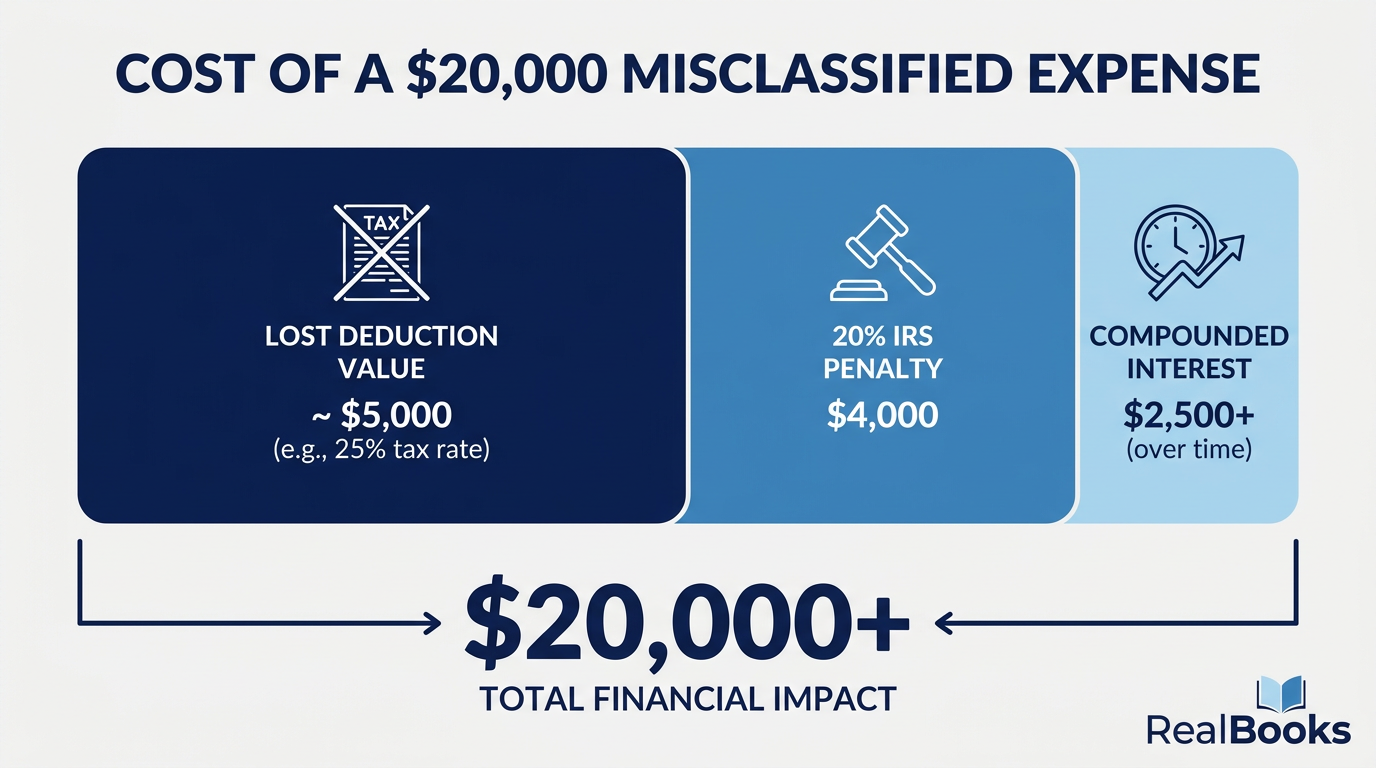
Scenario A — Misclassifying an Improvement as a Repair
An investor replaces the entire HVAC system in a residential rental property for $20,000. They categorize it as “Repairs and Maintenance” on their Schedule E and deduct the full amount in the current tax year. At a 30% effective rate, that generates a $6,000 immediate tax benefit.
Two years later, the IRS audits the return. The agent applies the BAR test: the HVAC system is one of the eight enumerated building systems, and replacing it wholesale is restoration — a capital improvement that must be capitalized and depreciated over 27.5 years. The IRS reclassifies the expense.
Here’s what the investor now faces:
- Loss of the immediate deduction: The $20,000 is removed from current-year expenses and added to the depreciation schedule. The investor’s annual depreciation is approximately $727 per year — not $20,000 all at once.
- Back taxes owed: The $6,000 tax benefit from the overstated deduction is recaptured. The investor owes the IRS the difference in taxes.
- Accuracy-related penalty: The IRS assesses a 20% penalty on the tax underpayment. On $6,000, that’s $1,200 in additional penalties.
- Interest: The IRS charges interest on the unpaid tax from the original due date of the return — often compounding for two to three years before the audit is resolved.
- Total damage: The original deduction benefit, completely clawed back. Plus penalties. Plus years of compounding interest. The investor paid more in penalties and interest than they would have if they’d simply classified the expense correctly from the start.
Scenario B — Misclassifying a Repair as a Capital Improvement
This version of the mistake is quieter, less dramatic, and arguably more common. An investor pays $4,800 to patch and re-coat a flat roof section that was leaking. It’s a repair — localized, restorative, doesn’t replace a major component. But the investor’s bookkeeper isn’t sure, defaults to capitalizing everything that sounds significant, and adds it to the depreciation schedule.
Result: instead of a $4,800 current-year deduction worth approximately $1,440 in immediate tax savings, the investor now receives $174 per year in depreciation — for 27.5 years. The present value of that deferred deduction stream is dramatically lower than the immediate benefit they were legally entitled to take. And if this pattern repeats across five or ten properties, with two or three miscoded expenses per property per year, the cumulative cost becomes quietly devastating.
The Portfolio-Level Problem
Both of these mistakes scale brutally across a real estate portfolio. An investor managing ten properties with five or six renovation projects per year is making fifty to sixty classification decisions annually. Even a 10% misclassification rate — six expenses coded incorrectly — can generate meaningful tax exposure or meaningful missed deductions that accumulate year over year.
The IRS specifically targets Schedule E filers with large, inconsistent repair deductions. A sudden spike in “Repairs and Maintenance” in a single tax year is a documented audit trigger. A pattern of unusually high repairs relative to property value raises flags. And in an audit, the burden of proof is on the investor to demonstrate that the classification was correct — which requires documentation that most investors don’t maintain in real time.
The good news, and the framing that puts this entire discussion in the right light: these mistakes are almost entirely preventable. Depreciation strategies that maximize your tax position exist precisely because the rules, when properly applied, are actually designed to give investors meaningful tax benefits. The problem isn’t the code — it’s the absence of a system to apply it correctly.
“Tax preparation isn’t a year-end scramble — it’s an all-year practice.” — RealBooks
The investors who get this right don’t have better instincts. They have better systems. And those systems exist.
How RealBooks Automates This — Meet Penny, Dollar Bill, and Uncle Sam
Everything you’ve read up to this point has been about understanding the problem. Now let’s talk about solving it — specifically, solving it in a way that doesn’t require you to manually review every invoice against the BAR test, research every safe harbor election at year-end, or hope your CPA catches classification errors before the IRS does.
RealBooks is built for real estate investors, which means it’s built around the specific complexity of real estate bookkeeping — including the repair vs. capital improvement distinction. The platform’s AI agents don’t just record transactions. They understand them, in real time, at the point of entry.
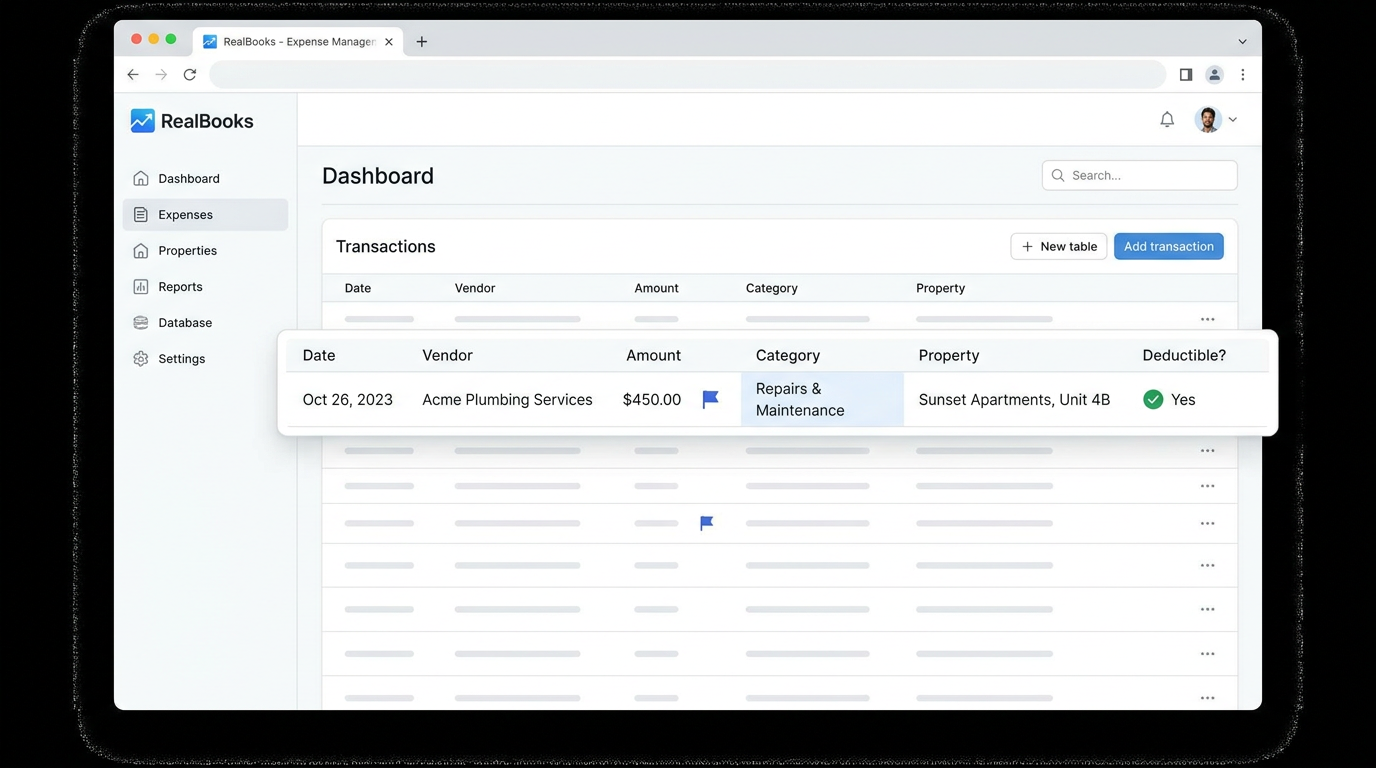
Penny — Your AI Bookkeeper
The moment a transaction hits your connected bank account, Penny is already working. She reads the transaction, identifies the property it belongs to, and categorizes it using IRS-standard expense types: maintenance, repairs, capital improvements, insurance, utilities, management fees, and more. There’s no manual categorization step, no end-of-month reconciliation guesswork, and no spreadsheet to update.
Penny captures receipts via the RealBooks iOS app, Android app, or by forwarding them directly to receipts@realbooks.io — and she automatically matches each receipt to the correct transaction, property, and project. The result is a complete, documented expense record that’s been correctly classified by an AI trained specifically on real estate accounting — not generic business bookkeeping.
For expenses that approach or exceed thresholds that might signal a repair-to-improvement transition, Penny flags them for review. This creates a natural human checkpoint for the genuinely gray-zone situations — exactly where classification mistakes are most likely to occur. You’re not reviewing every transaction manually, but you’re alerted when a transaction deserves a second look.
Dollar Bill — Your AI Project Builder
For renovation projects, Dollar Bill builds out structured project files with room-by-room breakdowns and work categories that mirror how contractors actually scope and invoice jobs: electrical, plumbing, flooring, HVAC, roofing, and more. Every project expense is linked directly to the correct property and the active project — creating a documented trail that makes repair vs. improvement analysis defensible at the invoice level.
He tracks actual spend against estimated budget and flags overruns in real time. This matters more than it might seem at first: a project that starts within the de minimis safe harbor threshold can expand beyond it mid-project. Dollar Bill makes that expansion visible before the invoices pile up in a shoebox and get reconstructed at tax time.
Uncle Sam — Your AI Tax Strategist
Uncle Sam monitors your entire portfolio for every available deduction, year-round. He handles depreciation tracking, flags missed safe harbor elections you may qualify for but haven’t applied, and identifies optimization opportunities across your property schedule. At year-end, he generates a complete, CPA-ready tax report that’s exportable in a single click — clean, organized, and covering every property in your portfolio.
His cost segregation analysis also identifies opportunities to accelerate depreciation on capital improvements that have already been correctly capitalized — squeezing additional tax value from expenses that couldn’t be immediately deducted, by front-loading the depreciation on qualifying components.
The System-Level Advantage
All three AI agents operate on the same Autonomous General Ledger. Whether a transaction comes through the mobile app, an email receipt forward, or a direct bank feed sync, every expense receives the same AI-powered classification, the same property and project tagging, and the same audit-ready documentation. There’s no inconsistency between channels, no data falling through the cracks between platforms, and no version of your books that’s different from the one your CPA sees.
Here’s what that looks like in practice:
Without RealBooks: Contractor invoices accumulate in a folder or a shoebox. Categories are assigned manually at year-end. Classification relies on memory and guesswork. Your CPA does their best with incomplete information. Audit risk is a quiet background concern every April.
With RealBooks: Every invoice is auto-categorized the day it arrives. The correct IRS expense type is applied at the point of entry. Safe harbor eligibility is monitored throughout the year. Your CPA receives a clean, complete report and can focus on strategy — not data recovery.
Start your free trial at RealBooks → No credit card required. See how Penny classifies your first transactions automatically.
Best Practices for Protecting Your Portfolio at Tax Time
RealBooks handles the heavy lifting — but the most tax-protected investors also adopt habits that reinforce their classification accuracy at every stage. These practices aren’t complicated. They’re disciplines that pay dividends every year, whether or not you ever face an audit.

Document at the Time of the Expense — Not Later
The single most important habit in real estate tax classification is real-time documentation. Take photos of the property condition before work begins. Save the contractor’s scope-of-work alongside the invoice. Record the specific issue that prompted the work. These details feel minor in the moment and become critical in an audit. The IRS examines facts and circumstances — and your contemporaneous documentation is the primary evidence that shapes those facts.
Don’t plan to reconstruct this later. By the time tax season arrives, the details of what a specific contractor was fixing in March are already fading. Capture receipts and invoices in real time and attach the context while you have it.
Ask the Right Question for Every Invoice
Before categorizing any renovation expense, ask one question: Did this work restore the property to its original condition — or did it make it better, different, or new? If the work restored, it’s almost certainly a repair. If it enhanced, extended useful life, repurposed, or replaced a major component, it’s almost certainly an improvement. This single question filters the majority of cases without requiring a deep dive into tax code.
Track Expenses by Project, Not Just by Property
A single renovation job frequently includes both deductible repairs and capitalizable improvements. A bathroom renovation might involve both fixing a leaking pipe (repair) and replacing the entire shower enclosure (improvement). If you code the entire job under one category, you’re either overclaiming or underclaiming — and both have consequences. Tracking expenses by project, broken down to the line-item level, gives you a defensible classification structure for every job, regardless of complexity.
Know Your Safe Harbor Thresholds Before the Year Ends
Safe harbor elections are not automatic. If you think you qualify for the de minimis safe harbor or the Safe Harbor for Small Taxpayers, the election must be filed with your tax return. Make sure your CPA knows which elections you intend to make, and make sure your books clearly reflect the per-item costs for expenses you’re treating as de minimis. Reviewing this in November is far better than discovering a missed election in April.
Partner With a CPA Who Specializes in Real Estate
The IRS depreciation guidance is nuanced in ways that general bookkeepers and generic accounting software aren’t built to handle. A CPA who specializes in real estate understands the tangible property regulations, applies them routinely, and knows which safe harbor elections make sense for your specific portfolio. RealBooks is designed to complement your CPA — delivering the clean, correctly categorized data they need to make strategic decisions, rather than spending their time reconstructing your records from scratch.
Don’t Wait Until Tax Season
This may be the most overlooked best practice of all. The best classification decisions happen in real time — at the moment the invoice arrives, when the project is still fresh and the documentation is complete. Waiting until year-end to categorize eight months of contractor invoices means making classification decisions from memory, without the scope-of-work documents, without the before photos, and without the context that makes those decisions defensible.
Quick Reference Checklist for Every Renovation Expense:
- Photograph the property condition before work begins
- Save the contractor’s scope-of-work alongside the invoice
- Ask: Did this restore, or did it improve/change?
- Code expenses to the specific project, not just the property
- Flag any expense near or above safe harbor thresholds for review
- Confirm safe harbor elections with your CPA before filing
The repair vs. capital improvement distinction isn’t going away — but the days of having to navigate it alone, with a spreadsheet and a prayer, don’t have to continue.

The Bottom Line: A Distinction Worth Getting Right
The IRS distinction between repairs and capital improvements is, at its core, a question about time. When do you get to use this deduction — now, or spread across the next 27.5 years? The answer to that question, multiplied across every renovation invoice in your portfolio, multiplied across every year you hold your properties, adds up to a number that matters.
The BAR test gives you the framework. The safe harbors give you legal shelter where it’s available. Proper documentation gives you the evidence to defend any classification under scrutiny. And the right platform gives you all three of these working together, automatically, from the moment an expense enters your world.
Real estate investing is a business — and every business performs better when its financial infrastructure is doing its job. Your books shouldn’t be a year-end reconstruction project. They should be a running, real-time record of exactly where you stand, what you owe, what you’re owed, and what you’ve legitimately earned through every deduction the tax code allows you to take.
Your numbers should work as hard as your investments do.
Stop Guessing. Start Knowing.
RealBooks automatically classifies every repair, improvement, and renovation expense across your entire portfolio — so your books are always accurate, always audit-ready, and always working in your favor.
No credit card required. Free for your first property for 12 months.
Already managing multiple properties? View plans and pricing →
Want to see how it works first? Explore RealBooks features →
Share this with a fellow investor who’s still managing repairs and improvements in a spreadsheet — it might be the most valuable thing you send them all year.
Ready to maximize your tax savings?
RealBooks automatically tracks expenses, manages assets, and calculates depreciation across your entire portfolio.
Start Free Trial →