How to Manage Finances Across Multiple LLCs Without Losing Your Mind

You scaled to five properties. Then seven. Now you’ve got three LLCs, two spreadsheets, a folder called “Taxes 2025 FINAL FINAL,” and a CPA who sighs every time you call. Somewhere along the way, the portfolio grew — but the system didn’t.
If that hits close to home, you’re not alone — and you’re not doing anything wrong. Using multiple LLCs to structure a real estate portfolio is one of the smartest moves a growth-stage investor can make. The problem isn’t the entity structure. The problem is that most investors build their legal architecture before they build their financial system, and then spend the next several years trying to retrofit something that was never designed for the way they invest.
This guide is for portfolio builders and growth-stage investors managing three to twenty or more properties across multiple entities. We’re going to cover everything that matters: why multiple LLCs make sense (and why they get complicated fast), the one operational rule that can’t be bent, the dangerous habit that quietly destroys liability protection, what a real cross-entity reporting setup actually looks like, where the tools most investors are using fall apart, and what a system built for this actually does. No fluff. No lecture. Just the stuff that matters when you’re in the middle of building something real.
Why Smart Investors Use Multiple LLCs — and Why It Gets Complicated Fast
There’s a moment in every real estate investor’s journey when a lawyer, a mentor, or a late-night Reddit thread delivers the advice that changes how they think about their portfolio forever: put your properties in separate LLCs. And it’s good advice. The reasoning is sound, the protection is real, and the investors who ignore it often learn the lesson the hard way.
Liability isolation is the primary driver. The core logic is simple — if a tenant slips and falls at Property B and decides to sue, the damages should be limited to the assets held inside that LLC. Your other properties, held in their own entities, remain protected. Without that wall between entities, a single lawsuit with the wrong outcome could theoretically reach across your entire portfolio. The LLC structure exists to prevent that.
But here’s what the liability conversation rarely covers: the financial management footprint that comes with it.
Three Structures, Three Very Different Realities
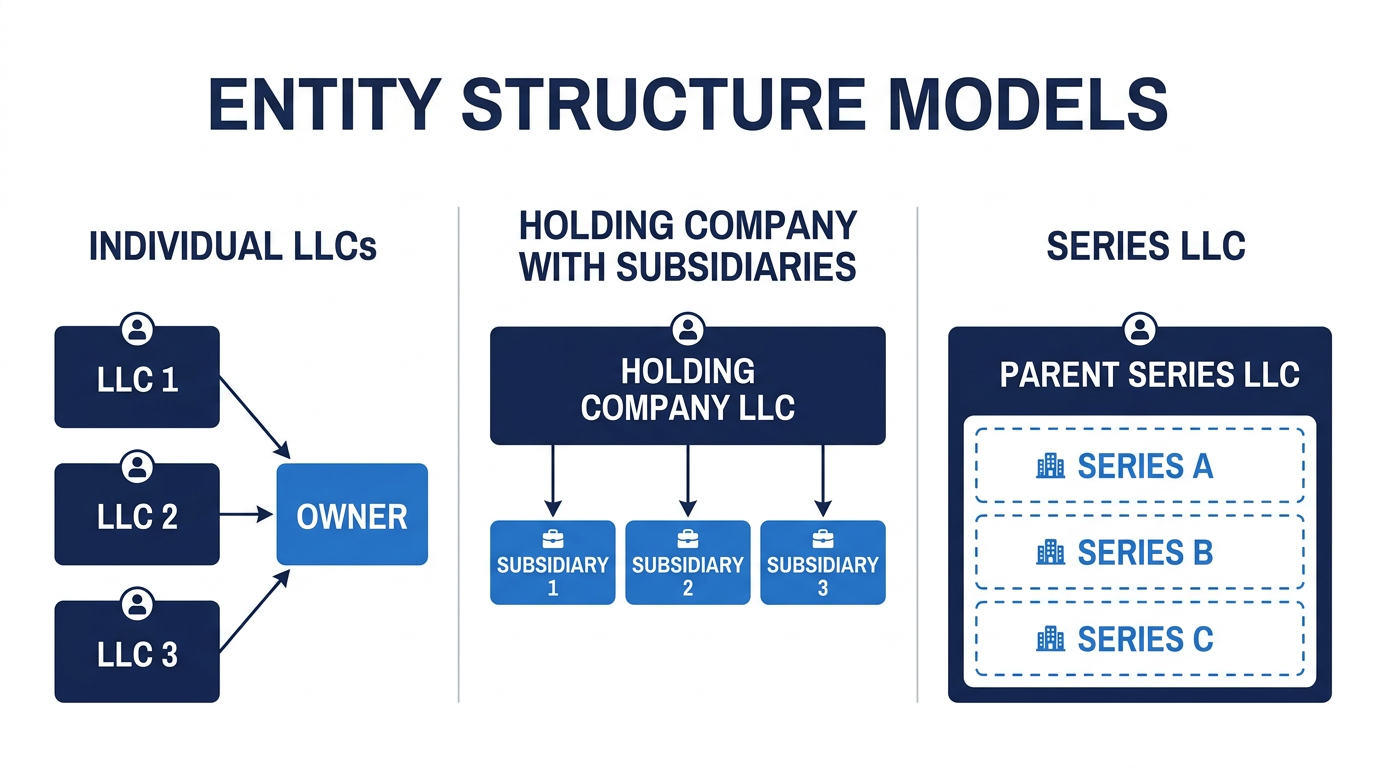
Most portfolio investors end up in one of three entity structures, and each one creates a different set of financial management demands.
Individual LLC per property is the most protective approach. Every property lives in its own entity — completely isolated. If you have eight properties, you have eight LLCs. Maximum liability separation, but also the highest administrative burden. Each entity needs its own bank account, its own books, its own set of financials, and its own tax filings. The separation is the feature — and the challenge.
Holding company with operating LLC subsidiaries offers a different kind of architecture. A parent entity (often a holding company or management company) sits above individual operating LLCs, creating a hierarchy that’s easier to manage from the top while still maintaining separation at the asset level. This structure is popular with investors who want centralized control without sacrificing protection.
The Series LLC is a newer and state-specific option — one parent entity with internal “series” that legally function like separate LLCs. Available in states including Delaware, Texas, and Illinois, the Series LLC can reduce formation costs and administrative overhead. But the legal framework is still evolving, and not every state recognizes them, which matters when you’re acquiring properties across state lines.
According to BiggerPockets’ detailed breakdown of LLC structures for rental investors, the right choice depends on your portfolio size, location, and risk tolerance — and each structure has tradeoffs that extend well beyond the legal and into the operational. A deeper comparison of holding companies versus Series LLCs makes clear that the financial management implications of each structure are just as significant as the legal ones.
The Tax Reality No One Explains Up Front
The IRS treats each LLC as a separate entity for tax purposes, and the filing requirements vary based on how the LLC is classified. According to IRS Publication 3402 on the taxation of limited liability companies, a single-member LLC is typically treated as a disregarded entity and reports income on Schedule E of the owner’s personal return. A multi-member LLC, on the other hand, is treated as a partnership by default — it files its own Form 1065 and issues Schedule K-1s to each member.
What that means in practice: if you have four LLCs, you’re running four parallel sets of books, four separate tax tracks, and four different sets of compliance obligations — simultaneously. Two of those might be single-member LLCs reporting on Schedule E. One might be a multi-member LLC filing a 1065 and issuing K-1s. The fourth might be a holding company with its own structure entirely. Each one is a distinct financial universe, and you’re the one responsible for keeping them all straight.
Most investors choose their entity structure based entirely on legal advice — which is appropriate. What’s less common is thinking through what managing the books across those entities will actually look like on a Tuesday afternoon in February when rent has been deposited in three different accounts and a repair bill just hit the wrong one.
The structure you choose is the starting line, not the finish line. The real work starts when you have to keep those entities financially clean, separate, and visible — every single month, across every property, without letting anything bleed together. Which brings us to the most foundational rule in multi-LLC financial management.
The One-Account-Per-LLC Rule — Non-Negotiable, Not Optional
There are plenty of areas in real estate investing where nuance lives — where context matters, where exceptions exist, where the right answer depends on your situation. Bank account separation is not one of them. This is the one rule in multi-LLC financial management that has no workarounds, no exceptions, and no “just this once.”
Every LLC must have its own dedicated bank account. Full stop.
This isn’t a best practice or a recommendation from overly cautious advisors. It is the operational foundation on which every other piece of multi-entity financial management is built. Without it, nothing else works — not your bookkeeping, not your liability protection, not your tax reporting.
What the Setup Actually Looks Like
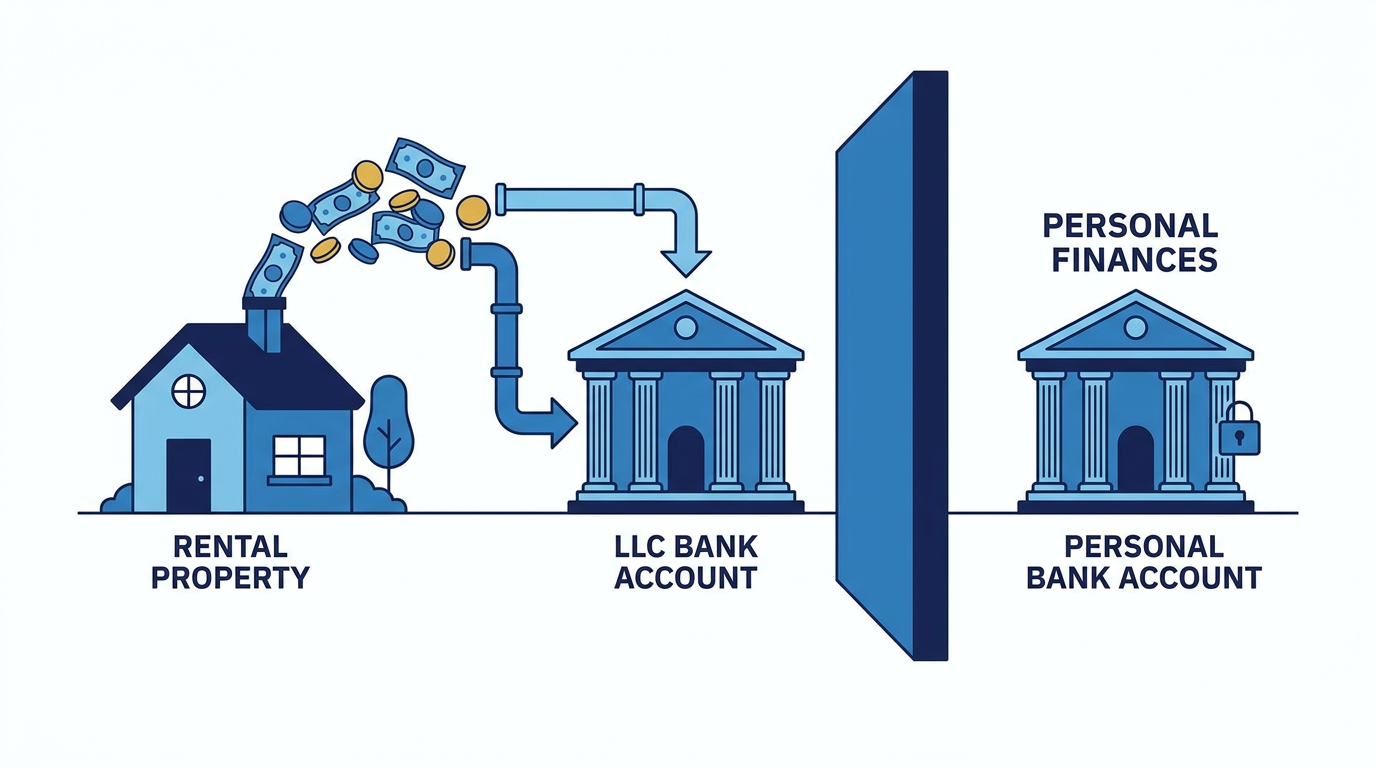
The mechanics are straightforward, even if the discipline required is not. Each LLC needs a dedicated checking account opened in the LLC’s name, using the LLC’s Employer Identification Number — not your personal Social Security number. This distinction matters both legally and practically. The account needs to exist as its own entity in the banking system, not as a personal account with a business nickname.
From that account, the rules are clean:
- All income flows in: Every rent payment, security deposit, and late fee associated with that LLC’s properties goes into that LLC’s account. Not your personal account. Not a “central” account you plan to sort out later. Into the LLC account.
- All expenses flow out: Every repair invoice, insurance premium, property management fee, and maintenance cost gets paid from that LLC’s account. When you need to pay for something related to Property B, it comes from the LLC B account — even if the LLC A account currently has more cash in it.
- Distributions are formal: When you take money out of an LLC for personal use, it’s a formal distribution — documented, intentional, and treated as such. Not a quick transfer to cover a personal expense.
As LegalClarity explains, the moment money flows between personal accounts and an LLC account — or between two LLC accounts without proper documentation — you begin eroding the legal wall between entities. And once that wall starts to crack, the liability protection you worked to build starts to disappear.
More Than a Legal Requirement — The Foundation of Clean Books
The one-account rule isn’t just about legal protection. It’s also the only way to maintain accurate, property-level financial reporting at scale. You cannot produce a meaningful profit-and-loss statement for an individual LLC if its income and expenses are mixed with another entity’s. You cannot accurately calculate the net operating income for a specific property if some of its expenses were paid from a different account. And you cannot give your CPA clean books at tax time if the money has been moving across accounts without documentation.
Here’s the scaling math that most investors underestimate: two LLCs means two accounts to reconcile each month. Five LLCs means five. Ten LLCs means ten. As the portfolio grows, the administrative load of maintaining proper account separation grows with it — and RealBooks’ expense management tools are built specifically to handle that load at scale, automatically assigning every transaction to the right property within the right entity without manual input.
Intercompany transfers deserve a special mention here. There will be times when money needs to move between entities — perhaps LLC A is lending capital to LLC B for a renovation, or a management company charges a fee to operating LLCs it manages. These transfers are legitimate, but they must be documented as formal loans or management fees, with proper paper trails, not treated as routine money movement between accounts you happen to control. The IRS and the courts do not care that it’s all “your” money if the entities are supposed to be legally separate.
Following the one-account rule creates a clean financial foundation — but even investors who understand this rule and follow it faithfully can still fall into the single most dangerous pattern in multi-LLC investing.
The Commingling Trap — How One Shortcut Can Cost You Everything
Picture this: it’s a Saturday morning. You get a call from your property manager — the HVAC unit at one of your units went down. The repair company needs $1,400 and they need it today. You check your phone, glance at the balances across your LLC accounts, and notice that the LLC B account is a little low but the LLC A account has plenty of room. So you use the LLC A debit card — just this once — to pay the repair bill for a property owned by LLC B.
You’ll sort it out in the books later. It’s all your money anyway.
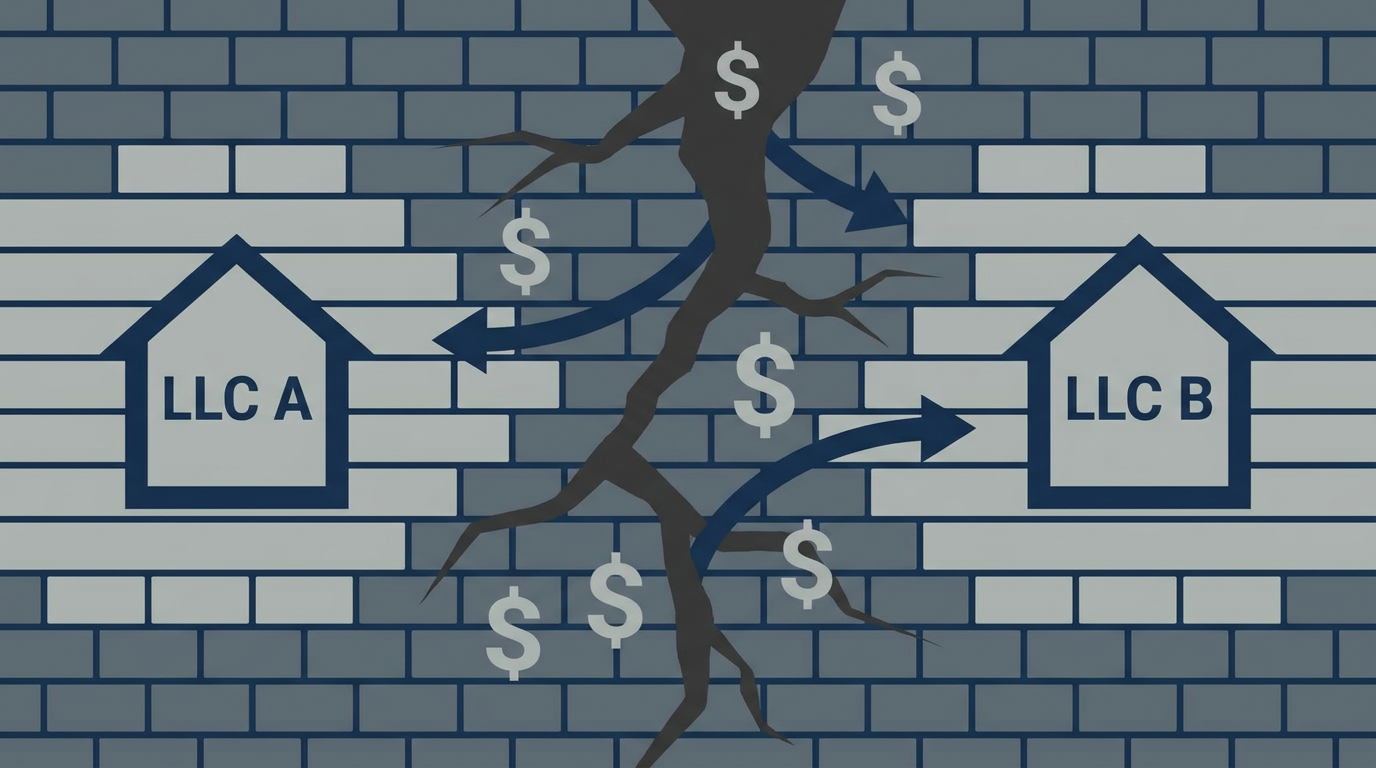
This moment — this one quiet shortcut — is exactly how commingling starts. And it is exactly how liability protection ends.
What Commingling Actually Means
Commingling is the mixing of funds between LLCs, or between LLC and personal accounts, in ways that blur the legal boundaries between entities. It doesn’t require malicious intent or reckless disregard. Most commingling happens in moments exactly like the one described above — rushed, practical, and seemingly harmless.
Common examples that investors don’t realize cross the line:
- Paying a repair bill for Property B from the LLC A account — even temporarily, even with the intention of reimbursing later.
- Depositing rent from an LLC-owned property into a personal checking account because “it’s easier to manage from there.”
- Using one LLC’s cash reserve to fund a down payment on a property owned by a different LLC without a formal loan agreement.
- Paying personal expenses from an LLC account, even occasionally or “by accident.”
- Transferring money between LLC accounts without documentation, just to balance the cash positions.
Each of these actions, however small, weakens the legal boundary between entities. And when those boundaries weaken, so does your protection.
The Legal Consequence: Piercing the Corporate Veil
The term sounds dramatic because the consequence is dramatic. According to Nolo’s widely-cited guide on personal liability and piercing the corporate veil, courts can — and do — disregard the separate status of an LLC entirely when the owner has failed to treat it as a truly separate entity. When that happens, your personal assets become fair game for business liabilities. The wall you built doesn’t just have a hole in it — it ceases to exist.
“The whole point of an LLC is the liability wall. Commingling is like building a wall with holes in it — it looks solid until it matters.”
LegalClarity’s analysis of commingling between companies identifies the same core risk: courts look at whether the LLC was truly operated as a separate entity, and financial records are among the most important evidence in that determination. If your LLC’s bank statements are indistinguishable from your personal account — or from another LLC’s account — you’ve given a plaintiff’s attorney exactly the argument they need.
The Tax and Bookkeeping Fallout
The legal exposure is the most alarming consequence, but it’s not the only one. As LegalClarity outlines in its broader guide on the legal and tax implications of multiple LLCs, commingled records also invite IRS scrutiny. Deductions that can’t be cleanly attributed to a specific entity become harder to defend. Expenses that were paid from the wrong account may be disallowed entirely. And when deductions are disallowed, taxable income rises — meaning you pay more than you owe.
The bookkeeping consequences are equally damaging and often more immediate. Once money has crossed entity boundaries without documentation, tracing it back is expensive and time-consuming. In serious cases, it requires a forensic accountant — someone who charges hundreds of dollars an hour to reconstruct what should never have been scrambled in the first place.
Here’s the scale multiplier: with a single LLC, the opportunities for accidental commingling are limited. With three, five, or eight LLCs, the opportunities multiply — and so does the temptation. More entities means more accounts to juggle, more moments when the convenient shortcut presents itself, and more chances for a rushed decision to quietly undermine years of careful structure. One morning of sloppy banking can compromise protection that took years to build.
The good news is that clean separation is entirely achievable — not with more discipline, but with better systems. Once the financial foundation is solid and the entity walls are intact, the next challenge is one that surprises most investors: how do you actually see what’s happening across all of these entities at once?
Entity-Level vs. Consolidated Reporting — Seeing the Trees and the Forest
Here’s the tension that every multi-LLC investor eventually hits: you need two completely different views of your portfolio, and most financial setups only give you one.
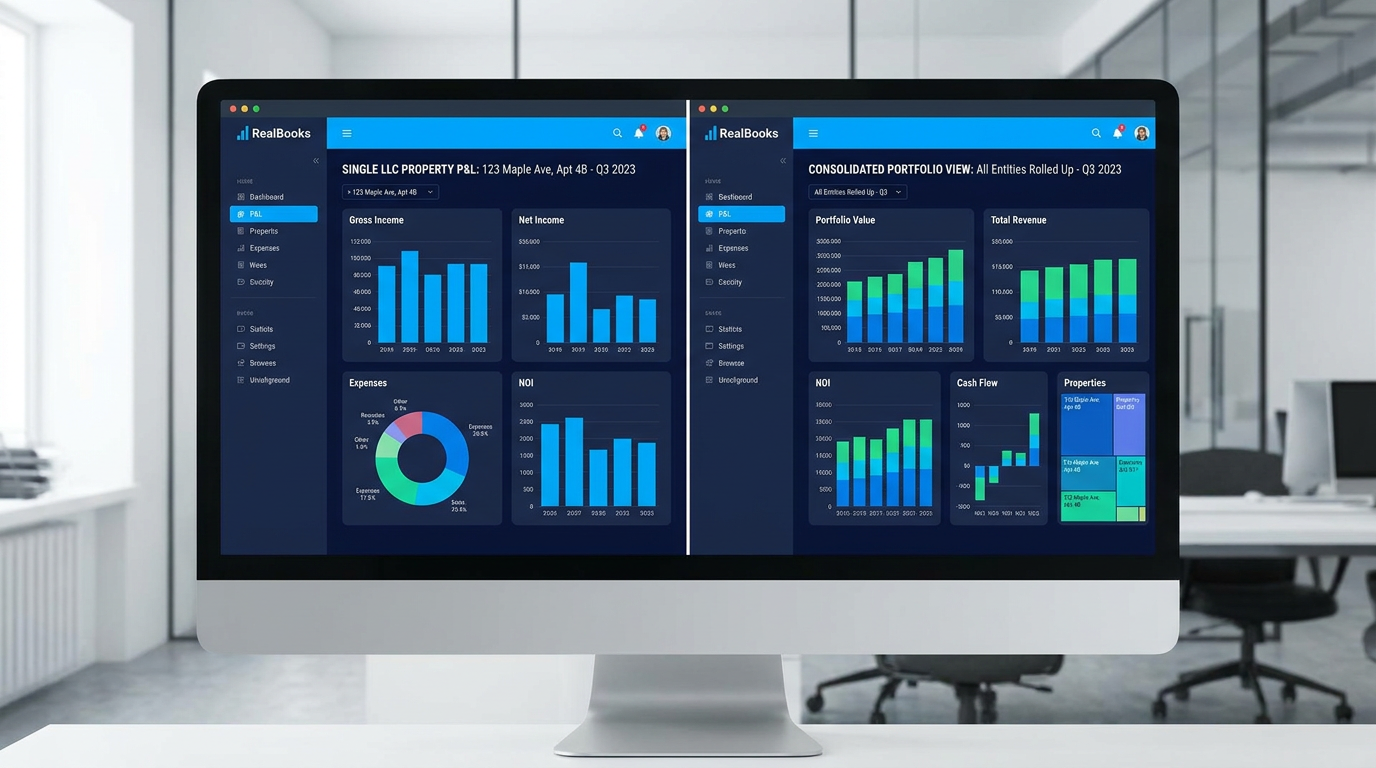
On one side, you need entity-level reporting — clean, separated financials for each LLC. Each entity needs its own profit-and-loss statement, its own expense ledger, its own balance sheet, and its own tax documentation. The IRS requires it. Your attorney expects it. Your CPA needs it to prepare accurate returns.
On the other side, you need consolidated reporting — a portfolio-wide view that rolls all of your entities together into a single picture. As a portfolio investor, you need to see total cash flow, total expense burden, cross-portfolio net operating income, and overall financial position. You need this view to make acquisition decisions, plan distributions, evaluate whether to sell or refinance, and have an honest, productive conversation with your CPA about your tax strategy.
These are two different views of the same money. They require different data structures, different reports, and — in most financial tools — completely different setups. And holding both simultaneously is where most multi-LLC investors struggle.
What Entity-Level Reporting Actually Requires
At the entity level, the IRS requires separate filings for each LLC based on its classification. A single-member LLC files its income and expenses on Schedule E of the owner’s personal return. A multi-member LLC files a partnership return on Form 1065 and issues Schedule K-1s to each member, detailing their share of the income, deductions, and credits. If you have a mix of entity types across your portfolio — which most growing investors do — you’re navigating multiple filing requirements simultaneously.
Entity-level P&L statements aren’t just for taxes. They’re how you evaluate the actual performance of each property and each LLC as a standalone business. Is LLC C generating enough net operating income to justify holding the properties in it? Is a specific property’s expense ratio out of line with the rest of the portfolio? These questions can only be answered with clean, entity-level data.
What Consolidated Reporting Actually Shows
The consolidated view tells a completely different story — and it’s the one you need when you’re thinking about the portfolio as a whole. A proper consolidated report shows:
- Total portfolio income across all entities — the full revenue picture.
- Total expenses by category across all LLCs — seeing where money is actually going at scale.
- Net operating income per property and as a portfolio rollup — your real return on investment.
- Depreciation and tax position across all entities — critical for planning bonus depreciation, cost segregation, and long-term tax strategy.
That last point connects directly to how significant tax decisions ripple across a multi-entity portfolio. If you’re evaluating how recent changes to bonus depreciation and Section 179 affect your holdings — as explored in RealBooks’ breakdown of the Big Beautiful Bill’s impact on real estate investors — you need to see the depreciation position across every entity, not just one at a time.
The Gap Most Investors Don’t See Until It’s Too Late
The challenge is that these two views — entity-level and consolidated — require different data structures that most financial tools aren’t built to handle simultaneously. Generic accounting platforms default to a single “company” per file. To see your entity-level data, you open one company file. To see another entity’s data, you open another. To see the consolidated view? You export both, import them into a spreadsheet, and reconcile manually — every single month, indefinitely.
The practical implication is significant: an investor who doesn’t have a consolidated view is making portfolio-wide decisions based on incomplete information. They’re deciding whether to acquire property number twelve without knowing what the true cash position of properties one through eleven actually is across all entities. That’s not a risk worth taking — especially when the right infrastructure makes both views available simultaneously and in real time.
RealBooks’ tax reporting tools are built around exactly this dual-view architecture, giving investors the entity-level accuracy the IRS requires alongside the portfolio-wide visibility that strategic decisions demand. Understanding what the right system looks like, though, first requires understanding why most of the tools investors reach for aren’t actually up to the job.
Where Generic Tools Break Down — The Cross-Entity Visibility Problem
Most real estate investors don’t start with purpose-built financial software. They start with what they know — a spreadsheet, maybe QuickBooks, perhaps the reporting built into their property management software. And for a while, it works. One property, one LLC, one account. Clean enough.
Then the portfolio grows. And the system that was fine at two properties becomes a genuine liability at eight.
The Spreadsheet Ceiling
Spreadsheets are the default financial tool for early-stage investors, and there’s nothing wrong with that at the beginning. They’re flexible, familiar, and free. But they hit a ceiling fast — and when a growing portfolio pushes past it, the problems compound quickly.
At five or more properties across multiple LLCs, you’re managing five or more tabs at a minimum, with manual data entry at every step. There’s no live connection to your bank accounts, which means every transaction has to be entered by hand — and manual entry means manual errors. There’s no real-time view of anything; the spreadsheet reflects what you entered last week, not what happened this morning. And version control is a myth: which spreadsheet is the authoritative one? The one on your laptop? The one in Google Drive? The one your bookkeeper emailed back with corrections?
The most dangerous spreadsheet problem isn’t the errors you know about. It’s the ones you don’t.
How General Accounting Software Falls Short
General-purpose accounting software — the tools built for small businesses broadly — is a step up from spreadsheets, but it introduces its own set of problems for multi-LLC real estate investors. These tools weren’t built for the way real estate investing works, and the gaps show up quickly.
The most immediate problem: these platforms are designed around a single-company model. To manage multiple LLCs, you need multiple separate company files or accounts — which means logging into a different account for each entity just to see that entity’s numbers. There’s no unified view, no dashboard that rolls up all entities, and no way to compare performance across LLCs without exporting and manually combining data.
Beyond the multi-entity architecture problem, general accounting software has no native understanding of real estate’s specific financial structure:
- No built-in property-level classification — every transaction must be manually tagged or categorized to a specific property and expense type.
- No awareness of Schedule E or Form 1065 — tax-form-aligned reporting doesn’t exist natively; it has to be built through workarounds.
- No understanding of real estate’s distinct investment phases — acquisition, renovation, stabilization, and disposition each require different financial treatment that general tools don’t account for.
- Intercompany transfers require entirely manual workarounds rather than native features.

Signs Your Current System Isn’t Scaling
If any of these sound familiar, your financial system has already hit its ceiling:
- You dread tax season because gathering documents from multiple entities takes days.
- You can tell your CPA what a single property made, but not what your whole portfolio made.
- You’ve paid a repair expense from the wrong LLC account at least once.
- Your “current” books are actually two months behind because reconciliation takes that long.
- You don’t know your true portfolio-wide net operating income without pulling data from multiple places.
- You’ve sent your CPA a folder of bank statements and receipts instead of clean financials.
The BiggerPockets investor community has documented this frustration extensively — investors who built multi-entity structures on the advice of good attorneys, only to find themselves drowning in the operational complexity of managing the books across those entities with tools that weren’t built for the job. Common mistakes in real estate entity setup often circle back to the same root cause: the financial infrastructure wasn’t built to match the legal structure.
The Scale Trap
There’s a predictable pattern that emerges as portfolios grow past the capacity of generic tools. The investor either hires a bookkeeper — adding a cost that grows with every entity — or accepts declining data quality as the manual effort required to maintain the books falls behind the volume of transactions. Neither option solves the underlying problem. A bookkeeper managing spreadsheets across multiple QuickBooks company files is still fighting the same architecture limitations; they’re just absorbing the labor so the investor doesn’t have to.
The real cost isn’t just the time or the bookkeeper’s fee. It’s the decisions made on incomplete data. It’s the deductions missed because the records weren’t clean enough to support them. It’s the CPA hours spent reconstructing what should already have been organized. Tax preparation isn’t a year-end scramble — it’s an all-year practice. And the tools most investors are using make that all-year discipline nearly impossible to maintain.
The RealBooks Autonomous General Ledger was designed specifically to solve the cross-entity visibility problem — not by adding more manual steps, but by eliminating them at the source. What that actually looks like in practice is worth understanding in detail.
What Purpose-Built Multi-Entity Financial Management Actually Looks Like
The difference between a system built for multi-LLC real estate investing and one that’s been adapted for it is the difference between a tool designed for the job and a workaround that approximates it. One runs quietly in the background while you focus on your portfolio. The other requires constant attention just to keep up.
Here’s what purpose-built actually means — and what it changes for investors managing three, ten, or twenty entities.
Multi-Entity Architecture From the Ground Up
A system built for multi-LLC investors treats the multi-entity structure as a fundamental assumption, not an add-on feature. Each LLC gets its own ledger, its own chart of accounts, and its own complete set of financial statements. The separation isn’t simulated — it’s structural. Entity A’s books are genuinely distinct from Entity B’s books, which means the liability wall you built legally is also reflected in your financial data.
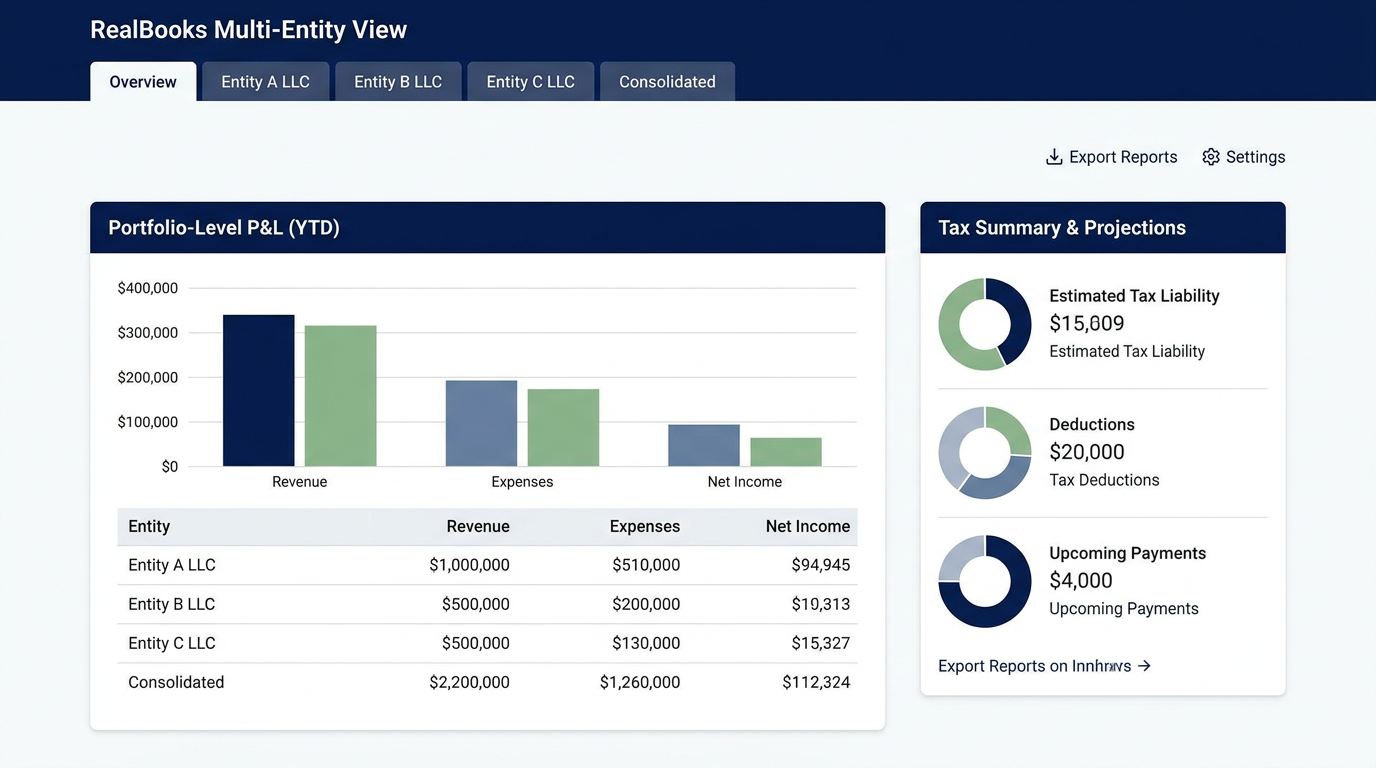
But — and this is the critical difference — all of those separate entity ledgers roll up into a single unified portfolio dashboard. Total portfolio income, total expenses across all entities, net operating income by property and by LLC, and overall tax position — visible in one place, at any moment, without any manual aggregation. You see the trees and the forest, simultaneously and in real time.
Automatic Classification That Eliminates the Manual Burden
In a purpose-built system, every transaction that comes in through a bank feed is automatically classified — not to a generic category, but to the right property within the right LLC. The system understands that a payment from your property management software belongs to a specific unit in a specific property held by a specific entity. It categorizes accordingly, without you touching it.
This is what Penny, RealBooks’ AI bookkeeper agent, does in real time. Every transaction, categorized by property and entity, as it happens. No month-end categorization session. No manual tagging. No spreadsheet imports. The books stay current because the system handles the classification continuously — not because someone sat down to do it.
Tax-Form-Aware Reporting That Speaks the IRS’s Language
A purpose-built system understands the tax filing requirements specific to real estate investors. It knows that single-member LLCs flow through to Schedule E. It knows that multi-member LLCs require Form 1065 and K-1s. It understands how depreciation schedules flow through entity-level reporting and how cost segregation analysis affects the tax position of specific assets.
Uncle Sam, RealBooks’ AI tax strategist, operates year-round — not just at filing time. He identifies deductions, tracks depreciation across properties and entities, and generates tax-ready reports that give your CPA exactly what they need in exactly the format they can use. The result: your CPA spends less time reconstructing your books and more time strategizing on your tax position.
Real-Time Visibility, Not Month-End Scrambles
One of the most significant operational changes a purpose-built system delivers is real-time financial visibility. Not a snapshot from last month’s reconciliation. Not a number that’s approximately right. The actual current state of your portfolio’s finances — cash position, income, expenses, and net operating income — available at any moment.
This changes how you make decisions. Instead of asking “how did we do last quarter?” you can ask “what does our cash position look like right now across all entities?” before committing to a new acquisition. Instead of estimating your tax exposure at year-end, you can see your estimated tax position throughout the year and plan accordingly.
Scaling Without Adding Headcount
Perhaps the most underrated benefit of a purpose-built system is its ability to scale without adding operational cost. A platform with a native multi-entity architecture handles two LLCs and twenty LLCs with equal ease. Adding a new entity is a configuration step, not an operational overhaul. You don’t need to hire a bookkeeper every time you add a property or form a new LLC — the system absorbs the additional volume without requiring additional human input.
RealBooks’ Asset Management tools track every asset across multiple entities, while the Autonomous General Ledger manages the financial engine underneath it all — a self-managing system that ingests transactions, classifies them, reconciles accounts, and keeps every entity’s books current without manual intervention. As the RealBooks platform puts it: from your first flip to your fiftieth door — one platform.
That’s the standard a purpose-built system should meet. Not “works well at two properties.” Works equally well at twenty, without adding complexity, without adding headcount, and without requiring the investor to become a part-time bookkeeper.
Explore how RealBooks handles it all →

The System Your Portfolio Has Been Waiting For
Managing finances across multiple LLCs isn’t hard because real estate investors are doing something wrong. It’s hard because most of the tools available to them were built for a different kind of business — and real estate investing, particularly at the portfolio level, is its own distinct financial universe with its own rules, its own tax forms, and its own operational requirements.
The investors who get this right aren’t the ones working hardest. They’re the ones who built the right system early — or who recognized when their current system had stopped serving them and made the switch before it cost them in missed deductions, commingling mistakes, or decisions made on incomplete data.
A clean multi-entity financial system isn’t just about surviving tax season. It’s about knowing your true cash flow at any moment. It’s about making confident acquisition decisions based on real numbers. It’s about building a portfolio that scales without the administrative weight growing alongside it. It’s about having a conversation with your CPA that feels like strategy — not damage control.
Your portfolio grew. Your financial system should have grown with it.
Your numbers should work as hard as your investments do.
RealBooks is built for exactly this — multiple LLCs, one dashboard, zero manual reconciliation. Trusted by 1,000+ real estate investors nationwide, with $2.4M+ in tax savings identified and 50,000+ transactions processed.
Visit realbooks.io to see how it works →
Already managing multiple entities? See how RealBooks handles multi-entity financial management with the Autonomous General Ledger.
Ready to maximize your tax savings?
RealBooks automatically tracks expenses, manages assets, and calculates depreciation across your entire portfolio.
Start Free Trial →