Your Mid-Year Financial Checkup: 6 Things Every Real Estate Investor Should Review Right Now
June has a way of sneaking up on you. One moment it’s January and you’re setting portfolio goals with fresh conviction. Then suddenly, half the year is gone — and if you haven’t looked closely at your numbers since tax season, you’re flying blind into the back half of 2026. Here’s the reality that most investors don’t confront until it’s too late: the mid-year financial review is one of the highest-leverage habits a real estate investor can build. It’s not a year-end chore. It’s a competitive advantage.
And this June, the stakes are especially concrete. The IRS Q2 2026 estimated tax deadline falls on June 16 — that’s less than two weeks away. If you have rental income, property sales, or passive income that isn’t subject to withholding, there’s a good chance you owe a payment right now. Missing it means penalties that compound every quarter.
But this isn’t just about the deadline. It’s about what June actually represents in the lifecycle of your portfolio. H1 is done. The data exists. You have six full months of income, expenses, project costs, and tax exposure sitting in your books right now — or in a scattered pile of bank statements, spreadsheets, and email attachments, depending on how your systems are set up. Either way, the story is there. The question is whether you can read it.
Managing finances across multiple properties, multiple entities, and multiple active projects is genuinely hard. It wasn’t designed to be easy, and no one gave you a roadmap. Most real estate investors treat financial review as a once-a-year event — a reactive scramble in March that leaves money on the table and creates unnecessary stress. That’s a costly habit. The investors who finish strongest are the ones who know their numbers in June.
This guide is your mid-year financial review for real estate investors — practical, honest, and action-oriented. Here are the 6 things to review right now, and exactly how to do each one.
Run Your H1 Profit & Loss by Property — Not Just in Aggregate
Most investors who do pull a mid-year P&L make the same mistake: they look at their portfolio totals and call it done. Revenue up, expenses manageable, moving on. The problem is that a portfolio-wide view is one of the most misleading numbers in real estate. It hides what’s actually happening inside your portfolio — and what it hides can cost you.
When you pull your profit and loss by property, the picture changes immediately. Suddenly, you can see which properties are genuinely cash flow positive after all expenses, which ones are running heavier than expected on maintenance, and which ones have rent collections that are lagging behind budget. You might find that three properties are performing beautifully while a fourth is quietly dragging your returns down. That’s information you can act on. A blended portfolio average is just noise.
There’s also a structural reason to think property-by-property: the IRS does. Schedule E — the form most investors use to report rental income and expenses — requires you to report each property separately. If your books aren’t organized at the property level, you’re creating reconciliation work for your CPA every year and increasing your audit exposure every time something gets miscategorized.
The most common issues that surface during an H1 property-level P&L review are surprisingly consistent across investors. Miscategorized expenses — repairs filed as capital improvements or vice versa — are nearly universal. Missing income records, especially for short-term rentals or month-to-month tenants who pay informally, show up more often than investors expect. And maintenance costs outpacing projections are a reliable signal that something operational needs attention before it becomes something structural.
The good news is that clean H1 data unlocks everything else on this checklist. When your per-property numbers are accurate, you can make reliable Q2 tax projections, have smarter conversations with lenders about refinancing, and make H2 capital allocation decisions with confidence instead of guesswork.
RealBooks’ Autonomous General Ledger is built precisely for this moment. Every transaction — bank deposit, credit card charge, property management payout, vendor invoice — is automatically classified by property and IRS expense category in real time. Your expense management runs in the background continuously, so your H1 P&L isn’t something you have to reconstruct in June. It’s already built. Penny, RealBooks’ AI bookkeeper, has been doing this work every day since you connected your accounts.
Once you know where each property stands financially, the next question is unavoidable: what do you owe the IRS right now?
Confirm Your Q2 Estimated Tax Payment Before June 16, 2026
This is the most time-sensitive item on the list — and it has a hard deadline that doesn’t move.
The IRS Q2 estimated tax deadline is June 16, 2026. The date shifts from the usual June 15 because that date falls on a Sunday this year. That single-day adjustment doesn’t change the stakes: if you miss it, interest on any underpayment begins accruing immediately, calculated per quarter. The IRS doesn’t care that you planned to pay — it cares whether you did.
For most real estate investors, quarterly estimated taxes are a requirement, not an option. If you expect to owe $1,000 or more at filing — and if you’re earning rental income, that threshold is easy to cross — you’re required to make estimated payments throughout the year. The four 2026 payment deadlines are April 15, June 16, September 15, and January 15, 2027. Missing even one of them creates a gap that the IRS fills with penalty interest.
“The IRS calculates underpayment penalties quarter by quarter — missing June 16 doesn’t just cost you once.”
Calculating your Q2 payment doesn’t have to be overwhelming. Start with your net rental income year-to-date. Add any income from property sales closed in H1. Factor in your depreciation position — accelerated deductions you’ve claimed reduce your taxable income and, therefore, your payment. Understand your passive income and loss position. Then apply the safe harbor rule: pay at least 100% of your prior year’s total tax liability, or 110% if your adjusted gross income exceeded $150,000 last year. If you hit that threshold, you’re protected from underpayment penalties regardless of what your final 2026 tax bill turns out to be.
Form 1040-ES is the IRS worksheet designed to help you calculate exactly what you owe. It walks through the math step by step and includes payment vouchers if you’re still mailing checks — though electronic payment via IRS Direct Pay or EFTPS is faster, more secure, and gives you an immediate confirmation number.
The underpayment penalty isn’t catastrophic on its own, but it’s entirely avoidable — and it compounds. Investors who miss Q2 and then scramble to catch up at Q3 are paying extra for a mistake they could have prevented with a single afternoon of attention. Don’t be that investor.
This is exactly where Uncle Sam — RealBooks’ AI tax strategist — earns his keep. Rather than forcing you to reconstruct your income picture every quarter, Uncle Sam monitors your portfolio’s income and deductions in real time through the tax reporting engine. Your estimated tax liability is visible throughout the year, updated continuously as transactions are classified. No guessing. No scrambling. You log in, see what you owe, and pay it before the deadline.
Estimated taxes are based on your income — but your depreciation position could significantly change what you actually owe. Let’s check that next.
Review Your Depreciation Status Across Every Property You Own
Depreciation is one of the most powerful tools in a real estate investor’s tax arsenal — and one of the most consistently underused. Most investors know it exists. Far fewer have actually optimized it.
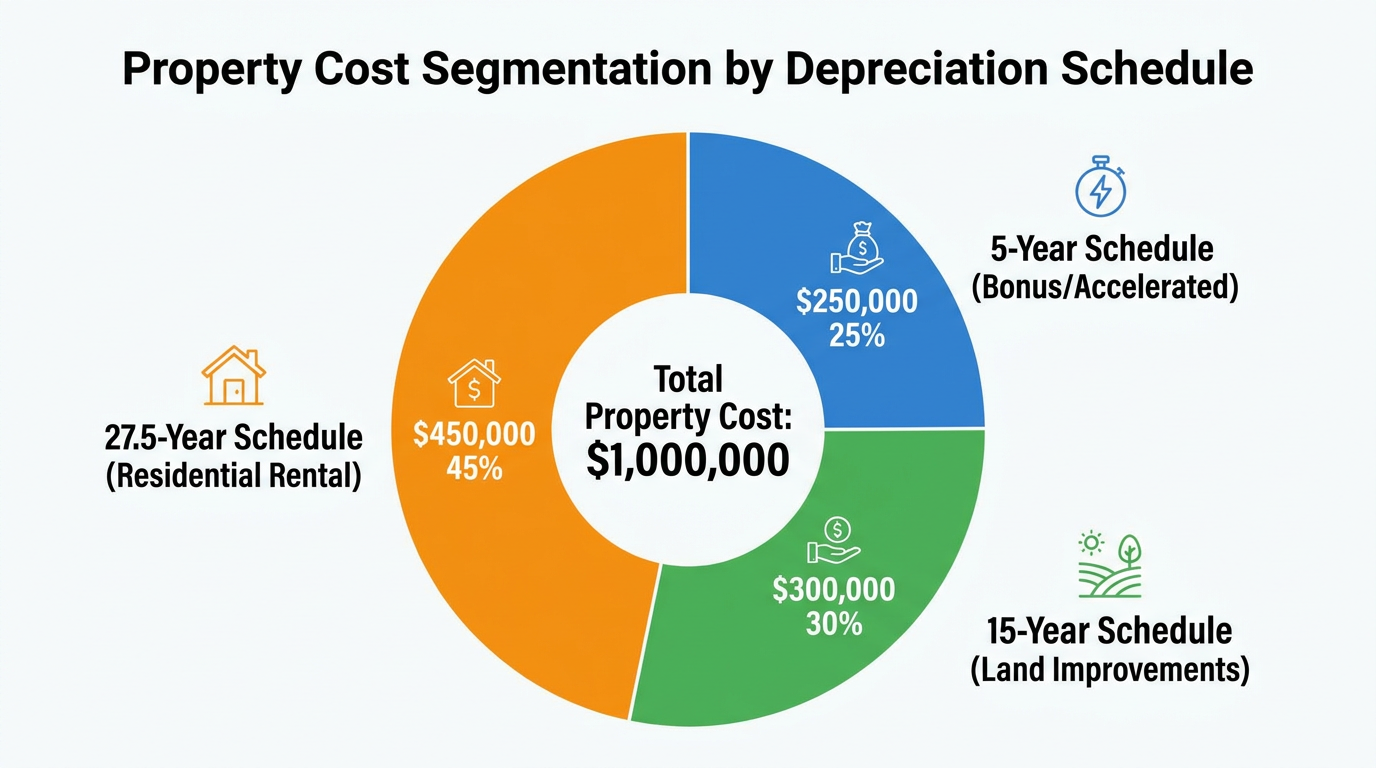
Here’s the foundational reality: residential rental property depreciates over 27.5 years under the Modified Accelerated Cost Recovery System (MACRS), straight-line. That’s the baseline. But the IRS allows certain components of a property to be depreciated on much faster schedules — 5 years, 7 years, 15 years — because those components wear out faster than the building itself. Flooring, fixtures, appliances, parking lot paving, landscaping, certain HVAC components: these are not 27.5-year assets. Treating them as though they are means leaving real deductions unclaimed for decades.
Cost segregation is the process of identifying and reclassifying those short-life components so they can be depreciated faster — and in 2026, this strategy has never been more valuable. The One Big Beautiful Bill Act restored 100% bonus depreciation, which means components identified through cost segregation and classified as 5-year or 15-year property can be fully expensed in Year 1 again. That’s not a timing difference. That’s a potential six-figure deduction in the year you acquire or improve a property, instead of spreading it over multiple decades.
RealBooks automatically classifies your property costs across the correct IRS depreciation schedules.
Historically, cost segregation required an expensive engineering study — typically $5,000 to $15,000 — which made it economical only for large properties or significant portfolios. AI-powered analysis has changed that calculus entirely. RealBooks’ Cost Segregation feature makes accelerated depreciation classification accessible to any investor, regardless of portfolio size, without the engineering firm bill.
Mid-year is the right time to run this analysis — especially for properties acquired in H1 2026. Documentation is fresh. Project records are current. The earlier you run cost segregation on a newly acquired property, the sooner those accelerated deductions start working for you. For investors who already own a portfolio, mid-year is the right moment to audit your existing depreciation schedules: are all acquired properties set up correctly? Have recent improvements been classified accurately as capital improvements — and have those improvements been analyzed for reclassification potential?
Uncle Sam maintains depreciation schedules automatically through the tax reporting engine and flags properties that may benefit from accelerated classification. If you acquired a property this year and haven’t run cost segregation analysis yet, that flag is one of the most valuable notifications you’ll see this month.
For a deeper dive into what the Big Beautiful Bill means for your depreciation strategy, the RealBooks guide on how the Big Beautiful Bill changes bonus depreciation is worth reading in full.
Depreciation applies to assets you already own — but what about the work happening on your properties right now? Capital improvements tracked today become deductions you won’t miss later.
Audit Your Capital Improvement Tracking Before the Costs Disappear
Here’s a scenario that plays out in thousands of investor portfolios every year. A major renovation wraps up in March. Contractor invoices got paid — some from the business account, some from personal, one via Venmo when the plumber was in a hurry. The receipts are in three different email threads. The project came in $8,000 over budget, but no one knows which line items caused the overrun. By the time April rolls around next year, half the documentation is missing and the CPA is making educated guesses about categorization.
That’s not just an organizational failure. It’s a tax problem. And a mid-year audit of your capital improvement tracking is how you stop that scenario before it becomes your reality.
The IRS draws a clear and consequential line between repairs and capital improvements. A repair — fixing a leaky faucet, patching drywall, replacing a broken window — is deductible in the year you incur the cost. A capital improvement — a new roof, a full kitchen remodel, a structural addition — is added to the property’s cost basis and depreciated over time. Miscategorizing one as the other is one of the most common real estate accounting errors, and it creates audit risk in both directions. Improvements filed as repairs inflate your current-year deductions. Repairs filed as improvements defer deductions you could have taken immediately.
Mid-year is the critical moment for reconciliation. Any projects completed in H1 2026 need to be closed out, documented, and categorized now — not in March during tax prep, when memory is fuzzy and invoices are buried. The questions to ask right now: Are all renovation projects in progress properly documented? Are contractor invoices attached to the correct property and project? Are budget-versus-actual figures current? Have you captured every expense, including materials you purchased directly?
The Section 179 deduction — expanded to a $2.5 million limit under the One Big Beautiful Bill — makes it especially worthwhile to identify qualifying improvement costs now. HVAC systems, roofing on commercial properties, and other qualifying improvements may be eligible for immediate expensing rather than multi-year depreciation. But you can only claim what you’ve documented.
Before RealBooks: renovation costs scattered across three different spreadsheets, contractor invoices lost in email, tax categorization done in a panic come April. After RealBooks: every project tracked in real time, every cost classified, every invoice attached.
Dollar Bill — RealBooks’ AI asset and project builder — handles exactly this workflow. He tracks every renovation project room by room through the project management module, attaches contractor invoices as they arrive, monitors budget versus actual spend, and flags overruns in real time. When a project closes, costs are automatically classified as repair or capital improvement and pushed directly to the expense management ledger. Your CPA gets a clean, organized project summary. Your books get accurate entries. And you don’t spend March trying to reconstruct a paper trail that should have never gotten messy in the first place.
For more on how the Big Beautiful Bill affects capital improvement deductions, including the updated Section 179 limits, the RealBooks breakdown of the legislation covers the specifics in depth.
You’ve reviewed your property financials, your tax payments, your depreciation, and your projects. Now it’s time to zoom out — are you holding your properties in the right legal structure?
Revisit Your Entity Structure as Your Portfolio Grows
Entity structure is one of those decisions that investors make once — usually when they buy their first property — and then never revisit again. That’s a mistake that grows more expensive as your portfolio scales.
The structure you set up when you had one duplex and $60,000 in rental income may not be the optimal structure when you’re managing six properties across three LLCs with a business partner and a growing equity position. Tax implications, liability exposure, and scalability all shift as your portfolio evolves. Mid-year is a natural moment to ask whether the framework you’re operating inside still fits the business you’re actually running.
The most common triggers that should prompt an entity structure review:
- Adding a new property — especially if it’s being held in a different name or structure than your existing assets
- Crossing a significant income threshold — higher income changes the math on self-employment taxes and the value of certain elections
- Taking on a partner — partnership agreements and multi-member LLCs have specific operational and tax implications
- Refinancing or restructuring debt — changes to your liability profile can affect how an entity is structured optimally
- Reaching a point where SE tax is a growing burden — this is often when the S-Corp election conversation begins
The key entity options for real estate investors include sole proprietorships (reporting on Schedule E), single-member LLCs (treated as disregarded entities by default), multi-member LLCs (taxed as partnerships), S-Corp elections (for high-income investors seeking to reduce self-employment tax exposure), and land trust structures. Each has different tax treatment, liability characteristics, and administrative overhead. A thorough guide from MGO CPA is a solid starting point if you’re approaching this question for the first time or re-examining your setup.
“Your entity structure should grow with your portfolio. If you set it up when you had one property and haven’t looked at it since, now is the time.”
The Qualified Business Income deduction — the 20% pass-through deduction made permanent under the One Big Beautiful Bill — makes the LLC and S-Corp question even more consequential for 2026. Whether you qualify and how much you can deduct depends in part on how your entity is structured. That’s a conversation worth having with your CPA before the year gets much further along.
One important note: RealBooks is a powerful financial platform, not a licensed accounting firm or legal advisor. Nothing here is legal or tax advice. For entity-specific guidance, work with a qualified CPA or real estate attorney who understands your full situation.
What RealBooks does exceptionally well is support whatever structure you operate within. The asset management platform supports multiple entities natively — each LLC or trust maintains its own clean ledger, while all entities roll up into a unified portfolio dashboard. If you’re running properties across multiple entities and want to understand whether your RealBooks setup matches your legal structure, review your current plan to confirm you have multi-entity support enabled at the right tier.
Entity structure is the framework. Cash flow is the fuel. Let’s make sure your portfolio’s engine is running the way you expect going into H2.
Analyze Your Portfolio Cash Flow With Clear Eyes
Cash flow is the single most quoted metric in real estate investing — and also one of the most frequently misread. Investors who tell you a property “cash flows $800 a month” often mean gross rent minus mortgage payment. They’ve forgotten property taxes, insurance, vacancy allowance, maintenance reserves, property management fees, and capital expenditure provisions. Strip those out and the real number looks very different.
A mid-year cash flow analysis forces the honest accounting. And at the portfolio level, it reveals patterns that individual property reviews don’t surface.
The metrics that matter most at mid-year:
- Net Operating Income (NOI) per property — income minus operating expenses, before debt service. This is your property’s operational health metric.
- Debt Service Coverage Ratio (DSCR) — NOI divided by annual debt payments. Lenders want to see 1.25 or higher; anything below 1.0 means your property isn’t generating enough income to cover its debt.
- Cash-on-Cash Return — annual pre-tax cash flow divided by total cash invested. This tells you what your capital is actually earning.
- Vacancy Rate and Income Impact — even a 5% vacancy rate has a compounding effect on annual returns that most investors underestimate.
- Cap Rate vs. Acquisition Target — is the property performing in line with the cap rate you underwrote at acquisition, or has it drifted?

The answers to these questions directly drive your H2 strategy. If one property’s DSCR is declining, that’s a refinancing conversation — or a pricing conversation with your property manager. If your cash-on-cash return on a buy-and-hold property is underperforming your target, that’s a signal to evaluate whether your capital is deployed optimally or whether it could work harder elsewhere. If you’re sitting on strong cash flow across the portfolio, that’s the green light to evaluate your next acquisition with confidence.
The investors who make the best H2 decisions are the ones who walk into July with actual data, not impressions.
RealBooks’ Asset Management dashboard tracks NOI and cap rate per property in real time, auto-calculated from the income and expense data that Penny captures every day. Your total equity, loan-to-value ratios, and net worth are updated continuously — not estimated once a quarter when you remember to check. The Autonomous General Ledger is the connective tissue that makes this possible: because every income and expense transaction is classified and posted in real time, your portfolio-level financial picture is always current.
This is the full-circle moment of the mid-year checkup. When Penny tracks your expenses, Dollar Bill manages your projects, and Uncle Sam monitors your tax liability — portfolio cash flow visibility becomes automatic. Not a quarterly manual exercise. Not a weekend of spreadsheet work. A living dashboard that reflects the real financial state of your portfolio, every single day.
You’ve just completed six of the most important financial reviews a real estate investor can do. Now let’s talk about what it looks like when you don’t have to do any of this manually.
How RealBooks Makes Your Mid-Year Checkup Automatic
There’s a version of the mid-year financial review that takes a weekend. Bank statements to reconcile, spreadsheets to update, estimates to calculate, invoices to track down, depreciation schedules to check. Coffee going cold on the desk while you try to remember which contractor handled the HVAC job in February.
And then there’s the RealBooks version.
The three AI agents at the core of RealBooks — Penny, Dollar Bill, and Uncle Sam — collectively cover every item on this checklist, working continuously in the background so that when June arrives, the work is already done.
Here’s how the coverage maps across your six checkup items:
Penny handles your H1 P&L by property and your portfolio cash flow. She categorizes every transaction by property and IRS expense type the moment it hits your account, syncing with bank feeds, credit cards, and property management systems without manual imports. Your per-property profit and loss statement is built in real time. Your portfolio cash flow data — the inputs for NOI, DSCR, and cap rate — flows directly from her categorization into the Asset Management dashboard.
Dollar Bill handles your capital improvement tracking. Every renovation project lives on a clean, organized kanban board. Contractor invoices are attached as they arrive. Budget versus actual spend is tracked automatically, with overruns flagged in real time. When a project closes, costs are classified as repair or capital improvement and pushed to the expense ledger — no April scramble, no missing documentation, no CPA guesswork.
Uncle Sam handles your Q2 estimated tax payment, your depreciation status, and your entity structure. He monitors your income and deductions throughout the year and surfaces your estimated tax liability so you’re never surprised by a June 16 deadline. He maintains depreciation schedules for every property in your portfolio and flags opportunities for accelerated classification through cost segregation. For investors operating across multiple entities, he supports separate ledgers for each LLC or trust, with consolidated reporting across the full portfolio.
The Autonomous General Ledger is the infrastructure that connects all three agents. Every transaction classified by Penny, every project cost posted by Dollar Bill, every depreciation entry maintained by Uncle Sam flows through the same self-managing financial engine — continuously reconciled, property-tagged, and IRS-categorized.
The result is a mid-year checkup that used to take a weekend and now takes minutes. Over 1,000 investors are already running their portfolios on RealBooks, with an average of $18,000+ in tax savings identified per investor and just five minutes of average weekly bookkeeping time required. Those aren’t aspirational numbers. They’re what happens when the right infrastructure is in place.
See how RealBooks handles your mid-year checkup automatically — start your free trial today, no credit card required. Or if you’d like to explore the full product suite first, see how it works.
The Investors Who Know Their Numbers in June Win the Year
The six items covered in this guide aren’t a bureaucratic checklist. They’re the difference between reactive investing and intentional portfolio management — between finding out in March that you missed a deduction and knowing in June that you’ve already captured it.
Tax preparation is an all-year practice, not a year-end scramble. The investors who treat it that way — who pull their H1 numbers in June, confirm their estimated payments before the deadline, audit their depreciation and project costs while the records are fresh — those investors finish the year with fewer surprises, more deductions, and better data for their next decision.
The discipline required to do this well is real. But with the right infrastructure, it’s minimal. RealBooks was built to carry the operational weight so that you can focus on what actually requires your judgment — deals, relationships, strategy, and growth.
H2 starts now. Your numbers are ready. Go read them.
Your mid-year checkup is only as good as the data behind it. RealBooks gives you clean, real-time financials across every property — so every item on this list is already handled.
No credit card required. Set up in minutes.
Not sure where to start? See how RealBooks works — or explore pricing to find the right plan for your portfolio.
Ready to maximize your tax savings?
RealBooks automatically tracks expenses, manages assets, and calculates depreciation across your entire portfolio.
Start Free Trial →