Cost Segregation 101: What It Is, Who Qualifies, and How Much It’s Actually Worth

You bought the property. You claimed your depreciation. And you still left tens of thousands of dollars on the table.
It’s one of the most uncomfortable truths in real estate investing: doing everything right — buying smart, managing carefully, filing diligently — still isn’t enough if you’re depreciating your properties the way the IRS defaults to. And for the vast majority of real estate investors, that default approach costs them far more than they realize.
Cost segregation is one of the most powerful, IRS-approved tax strategies available to real estate investors today. It can generate tens of thousands — sometimes hundreds of thousands — of dollars in accelerated tax deductions in a single year. And yet, nine out of ten investors have never used it. Some have never heard of it. Others assumed it wasn’t for them.
Here’s what makes 2026 uniquely critical: the One Big Beautiful Bill Act, signed into law on July 4, 2025, permanently restored 100% bonus depreciation for qualified property. That legislative shift turbocharges cost segregation in a way that hasn’t been possible since 2022. The window isn’t closing — but the sooner you act, the more you keep.
This post covers everything you need to know. What cost segregation is and how it actually works. Who qualifies — including properties you might already own. What the real dollar savings look like at different property values. Why most investors have never used this strategy. And how RealBooks automates the entire process through Uncle Sam, your AI tax strategist — without the $10,000 engineering study.
By the end, you’ll know exactly what you’ve been missing. More importantly, you’ll know what to do next.
What Is Cost Segregation? (And Why Your CPA Never Brought It Up)
Most real estate investors encounter cost segregation the same way: a vague mention at a conference, a footnote in a tax article, or an offhand comment from a more experienced investor who drops it casually, as if everyone already knows. Then, the moment you dig in, you wonder why no one made a bigger deal out of this sooner.
Let’s fix that right now.
Cost segregation is an IRS-approved tax strategy that accelerates the depreciation of a real estate investment by breaking the property down into its individual components — each of which is assigned its own depreciation timeline. Instead of treating your entire property as one monolithic asset that depreciates over 27.5 years (residential) or 39 years (commercial), a cost segregation analysis identifies and separates out the elements that qualify for much faster write-offs: 5 years, 7 years, or 15 years.
The core insight is this: not every part of your building was built to last 39 years. Carpet wears out. Appliances get replaced. Parking lots crack and repave. The landscaping changes. These shorter-lived components shouldn’t be tied to the same depreciation schedule as the foundation and structural walls — and, according to the IRS, they don’t have to be.
This isn’t a gray area or an aggressive tax position. Cost segregation is explicitly sanctioned by the IRS, with its legal foundation formally established by the 1997 Hospital Corporation of America tax court case. Since then, it has been widely used by institutional real estate investors, commercial developers, and REITs. What’s changed in recent years — and dramatically so with RealBooks — is who has access to it.
Without cost segregation, the math is brutal in its simplicity. Take your depreciable basis (typically the purchase price minus land value), divide by 27.5 or 39, and that’s your annual depreciation deduction. A $1,000,000 residential property with a $200,000 land value gives you a depreciable basis of $800,000. Divided by 27.5 years, that’s roughly $29,090 per year. You’ll still be depreciating this property in 2051.
With cost segregation, a significant portion of that $800,000 basis gets reclassified into 5-, 7-, and 15-year property — and deducted far sooner. In Year 1, with 100% bonus depreciation in effect under current law, those reclassified components can be fully expensed immediately. That’s not $29,090 for the year. That could be $200,000 or more, in a single tax year.
Historically, accessing this strategy required hiring a specialty firm to conduct a formal engineering study — a process that cost anywhere from $5,000 to $15,000 and involved months of documentation, site visits, and technical analysis. For a landlord with two or three properties, that price tag killed the ROI before the conversation even started. Most individual investors simply never bothered.
That barrier no longer exists. RealBooks’ AI-powered cost segregation automates this process as part of the platform — no engineering firm required, no five-figure invoice. But we’ll get to that. First, let’s walk through exactly how the reclassification mechanics work.
How Cost Segregation Works: The Component Reclassification Process
Understanding cost segregation at a conceptual level is one thing. Watching it work on an actual property — seeing how components get assigned, reclassified, and deducted — is where the strategy goes from interesting to genuinely compelling.
The process begins with a detailed review of the property: purchase price, closing documents, construction records, renovation invoices, appraisals, and improvement receipts. Every dollar spent on the property gets examined and categorized. From that review, each component is assigned to one of the IRS depreciation classes based on its physical characteristics, function, and expected useful life.
Here’s how those classes break down in practical terms:
5-Year Property (Personal Property): This is the category where investors are often most surprised by what qualifies. Appliances, carpeting, cabinetry, window treatments, certain plumbing fixtures, decorative elements, and specialty flooring can all fall here. The test is straightforward: if it can be removed without damaging the building’s structure, it’s likely personal property. These assets can be fully expensed in Year 1 with 100% bonus depreciation.
7-Year Property: Office furniture, certain specialized equipment, and select fixtures that don’t meet the 5-year personal property definition. Less common in residential rentals, more relevant in mixed-use or commercial settings.
15-Year Property (Land Improvements): This is one of the most impactful categories for real estate investors. Parking lots, driveways, sidewalks, landscaping, fencing, exterior lighting, retaining walls, and swimming pools all qualify as land improvements. They’re separate from the building and depreciate over 15 years — or, with 100% bonus depreciation, can be fully expensed immediately.
27.5-Year / 39-Year Property (Structural Components): The remaining core of the building — foundation, framing, exterior walls, roof structure, HVAC systems that serve the entire structure, central plumbing, and the building’s electrical backbone. These are genuinely long-lived assets, and they stay on the standard depreciation schedule.
According to KMCo’s 2026 cost segregation guide, a well-executed cost segregation study typically reclassifies 20–45% of a property’s depreciable basis from long-life to short-life categories. On a $1,000,000 property with an $800,000 depreciable basis, that’s $160,000 to $360,000 shifted into accelerated depreciation schedules.
“A typical cost segregation study reclassifies 20–45% of a property’s depreciable basis into accelerated depreciation schedules — on a $1M property, that’s up to $360,000 front-loaded into Year 1.”
One critical distinction worth understanding: the total depreciation you take over the life of the property doesn’t change. Cost segregation doesn’t create new deductions out of thin air — it shifts when those deductions occur. You’re borrowing from the future to maximize the present. And given the time value of money, a dollar of tax savings today is worth significantly more than a dollar of tax savings in Year 18.
Renovation costs are also eligible for component analysis. A new roof on a rental property? A kitchen gut renovation? A parking lot repave? Each of these capital improvements can be independently analyzed and reclassified. This means investors who have been making improvements for years — without running cost segregation — may be sitting on unclaimed accelerated deductions they can still recover. The RealBooks cost segregation documentation covers exactly how the platform handles renovation cost classification automatically.
Understanding the reclassification process raises an obvious next question: does your property actually qualify, and does your situation make this strategy worthwhile? The answer, for most investors, is a firm yes — but the specifics matter.
Who Qualifies for Cost Segregation?
One of the most persistent myths about cost segregation is that it’s a strategy reserved for large commercial real estate developers — the kind of investors building Class A office towers or 300-unit apartment complexes. That assumption has kept individual investors out of one of the most valuable tax strategies in real estate for decades. It’s also completely wrong.
Cost segregation is available to any taxpayer who owns real property held for business or investment purposes. That’s a remarkably broad qualification. Here’s what it actually covers:
- Single-family rentals — one of the most common and most underserved use cases
- Small multifamily (2–4 units) — duplexes, triplexes, and fourplexes all qualify
- Large multifamily — apartment buildings of any size
- Short-term rentals — Airbnb and VRBO properties, including those with significant furnishing and improvement costs
- Commercial properties — retail, office, industrial, and mixed-use
- Vacation properties held for rental income
The general rule of thumb among tax specialists is that cost segregation becomes most impactful on properties with a depreciable basis of $300,000 or more. Below that threshold, the math can still work — especially with 100% bonus depreciation — but the returns become more situation-specific. At $300,000 and above, the accelerated deductions are almost always material enough to make the analysis worthwhile.

Timing matters too. The optimal moment to run a cost segregation study is in the year of acquisition or the year of a major renovation. Year 1 is when bonus depreciation delivers maximum impact — the full reclassified amount can be deducted immediately. But waiting doesn’t disqualify you.
Investors who purchased properties in prior years — even years ago — can still benefit through what tax specialists call a “catch-up” or look-back analysis. This provision allows you to claim all missed accelerated depreciation from prior years in a single current-year deduction, without amending previous tax returns. The IRS permits this through a change in accounting method (Form 3115), and it’s one of the most underused tools available to established portfolio investors. One year’s filing can unlock years of accumulated missed deductions.
Do You Qualify? A Mental Checklist:
- You own investment or business real estate.
- Your property has a depreciable basis of $200,000+ (ideally $300,000+).
- You’ve made capital improvements or renovations at any point during ownership.
- You have taxable income — or you have Real Estate Professional Status (REPS) that allows passive losses to offset ordinary income.
- You purchased the property after January 19, 2025 or you’ve owned it for years and have never run a cost segregation analysis.
- Your property is held in an LLC, S-Corp, trust, or personally — all qualify.
The one nuance worth flagging: investors subject to passive activity loss limitations may find their deductions sheltered until they have passive income to absorb them — unless they qualify under REPS. RealBooks’ Tax Reporting tools maintain your depreciation schedules automatically, and Uncle Sam — RealBooks’ AI tax strategist — tracks your deduction eligibility year-round to flag when and how these deductions become usable.
The bottom line: if you own investment real estate and haven’t run a cost segregation analysis, you almost certainly qualify and almost certainly should. And 2026 gives you a reason to act immediately.
Bonus Depreciation in 2026: Why This Year Changes Everything
Tax law changes rarely create genuine excitement among real estate investors. The One Big Beautiful Bill Act is a legitimate exception.
To understand why 2026 is such a pivotal year for cost segregation, you need to understand the legislative arc that led here. The Tax Cuts and Jobs Act of 2017 introduced 100% bonus depreciation — an extraordinary provision that allowed investors to immediately expense the full cost of qualifying short-life assets in the year they were placed in service. Combined with cost segregation, this meant that an investor could reclassify a significant portion of a property’s depreciable basis into 5-, 7-, and 15-year categories and then immediately deduct 100% of those reclassified components in Year 1.
That provision had an expiration date. Beginning in 2023, the bonus depreciation rate began stepping down: 80% in 2023, 60% in 2024, 40% in 2025 (under prior law). By 2027, it was scheduled to disappear entirely. The accelerating power of cost segregation diminished with it.
The One Big Beautiful Bill Act reversed that trajectory — permanently.
Signed into law on July 4, 2025, the OBBBA permanently restores 100% bonus depreciation under Section 168(k) for qualified property acquired after January 19, 2025. This isn’t a two-year extension or a temporary reprieve. It’s permanent law.
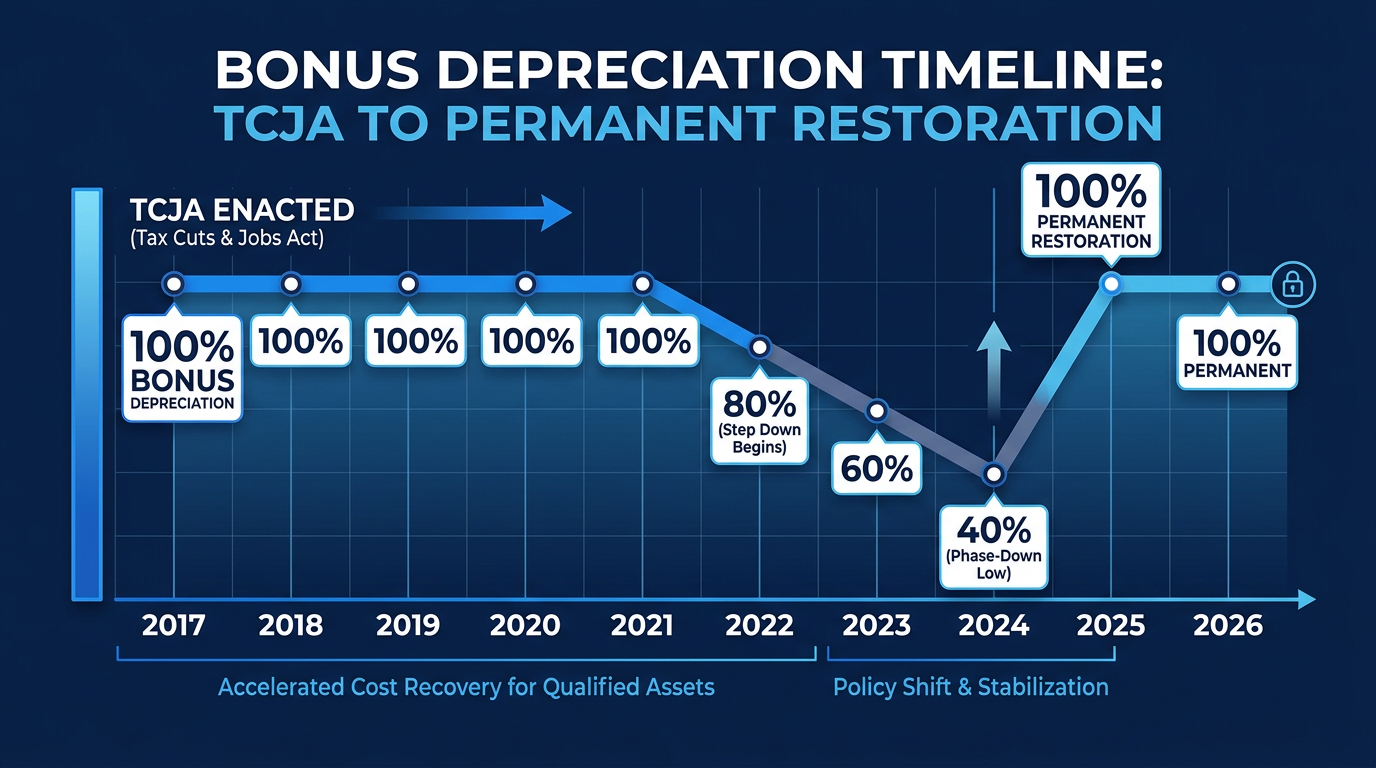
“The One Big Beautiful Bill Act didn’t just restore 100% bonus depreciation — it made it permanent. For real estate investors, that changes the math permanently.”
What does this mean in practical terms for cost segregation? Every component reclassified into a 5-, 7-, or 15-year category via cost segregation is now eligible for 100% immediate expensing in Year 1. You no longer have to wait 5 years for your carpet and appliances to depreciate out, or 15 years for your parking lot. The full value of those reclassified assets hits your return in the year you place them in service.
As Plante Moran’s analysis of the OBBBA explains, this restoration applies retroactively to property acquired after January 19, 2025 — meaning anyone who purchased a qualifying property earlier in 2025 and is filing their 2025 return now can claim the full 100% bonus depreciation on cost-segregated components.
The OBBBA also doubled the Section 179 expensing limit — another provision that layers on top of bonus depreciation for certain improvements, particularly in commercial and mixed-use scenarios. The combined effect of permanent 100% bonus depreciation plus enhanced Section 179 creates the most favorable depreciation environment for real estate investors in nearly a decade.
For investors with existing portfolios, the look-back analysis becomes even more powerful in this environment. Running catch-up cost segregation on properties purchased in 2022 or 2023 — when bonus depreciation was still at 80% or 60% — generates a lump-sum current-year deduction that can dramatically reduce this year’s taxable income.
One important note: consult your tax professional to confirm how these rules apply to your specific situation, particularly around passive loss limitations and your individual tax circumstances.
The legislative opportunity is real, it’s substantial, and it’s permanent. The question is whether you’re positioned to take advantage of it — which brings us to the actual numbers.
The Real Numbers: What Cost Segregation Is Worth at Every Property Value
Abstract tax strategies are easy to dismiss. Concrete dollar figures are not.
Let’s look at what cost segregation actually generates across three common property value scenarios — assuming 100% bonus depreciation under current law, a conservative 20–35% reclassification rate, and a 32–35% effective tax rate. These are illustrative examples based on industry benchmarks. Individual results vary based on property type, location, construction, and personal tax situation.
The Calculation Framework
The math follows a consistent path: Start with the purchase price → subtract land value (typically 15–25% of purchase) → arrive at the depreciable basis → apply cost segregation to reclassify 20–40% of that basis into short-life property → apply 100% bonus depreciation to those reclassified components → calculate the Year 1 deduction and resulting tax savings.
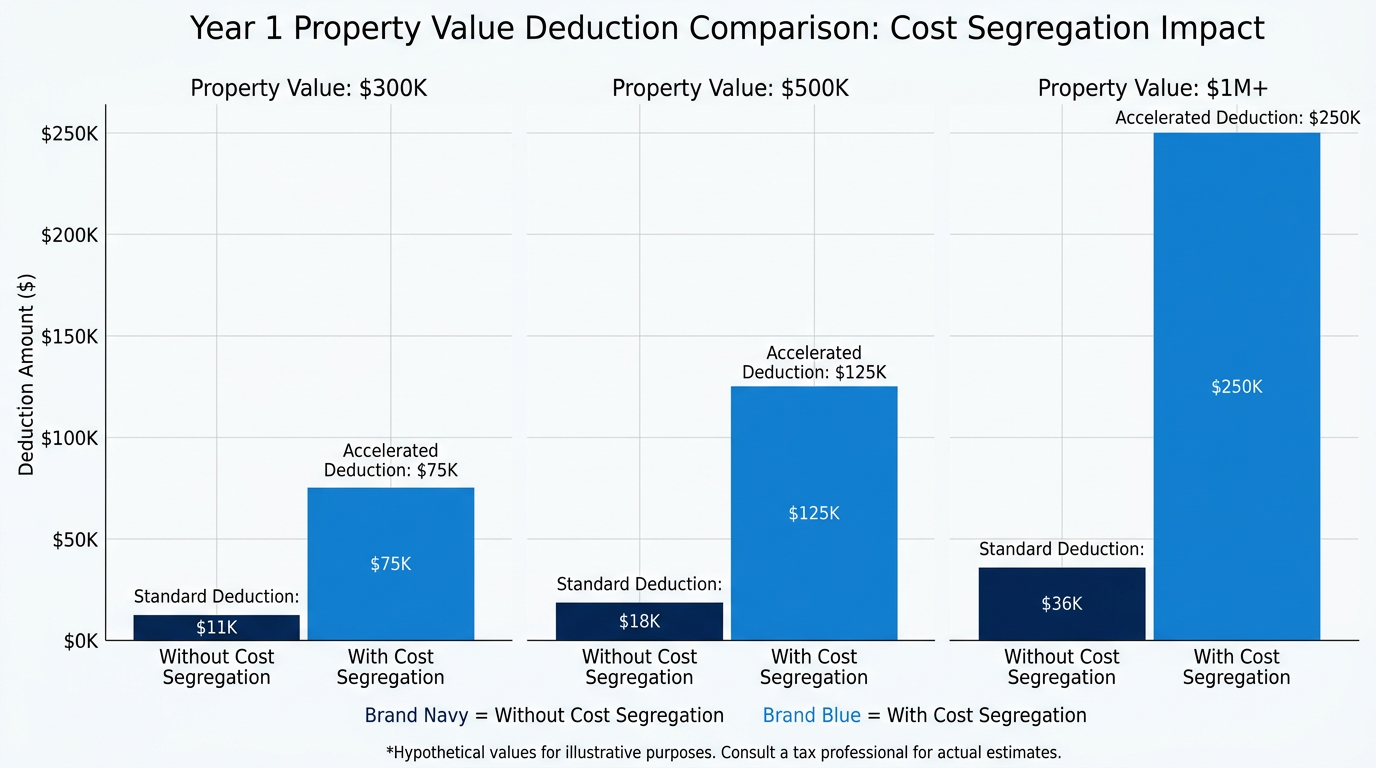
Example 1 — $300,000 Single-Family Rental
- Purchase Price: $300,000
- Land Value (20%): $60,000
- Depreciable Basis: $240,000
- Without cost segregation: ~$8,727/year for 27.5 years
- With cost segregation (25% reclassified = $60,000 in short-life components + 100% bonus depreciation): $60,000 Year 1 deduction from reclassified assets alone
- Estimated additional Year 1 tax savings vs. straight-line: $15,000–$21,000
That’s a $15,000–$21,000 difference — in a single year — on a relatively modest property. For an investor in the 32% bracket, that translates directly into real cash retained rather than sent to the IRS.
Example 2 — $500,000 Small Multifamily
- Purchase Price: $500,000
- Land Value (20%): $100,000
- Depreciable Basis: $400,000
- Without cost segregation: ~$14,545/year
- With cost segregation (30% reclassified = $120,000 in short-life components + 100% bonus): $120,000 Year 1 deduction
- Estimated additional Year 1 tax savings: $35,000–$50,000+
On a duplex or small apartment building, the Year 1 impact becomes difficult to ignore. An investor who buys a $500,000 multifamily without running cost segregation is effectively choosing to defer $35,000–$50,000 in tax savings across the next two decades rather than taking them today.
Example 3 — $1,000,000+ Property
- Purchase Price: $1,000,000
- Land Value (20%): $200,000
- Depreciable Basis: $800,000
- With cost segregation (35% reclassified = $280,000 in short-life components + 100% bonus): $280,000 Year 1 deduction
- Estimated additional Year 1 tax savings: $80,000–$98,000+
At the million-dollar tier — which increasingly represents a mid-range acquisition in many major markets — the numbers become transformational. An $80,000–$98,000 additional Year 1 deduction can entirely reframe the economics of a deal.
The Cost Equation
A traditional cost segregation engineering study costs $5,000–$15,000 in professional fees, before you see a single dollar of benefit. That cost structure has historically made the strategy inaccessible for smaller portfolios — the ROI math works at $1M+ properties, but becomes murky on a $300K rental.
RealBooks’ AI-powered cost segregation is included in the platform subscription — no separate engineering study required, no five-figure invoice. That cost elimination makes cost segregation economically viable for every property in your portfolio, not just your largest acquisition.
One transparency note worth including: depreciation deductions are not eliminated — they’re accelerated. The deductions taken today reduce your basis, which means higher taxable income or depreciation recapture in later years when those short-life assets are fully depreciated. On sale, recapture applies. The long-term tax picture should be reviewed with your CPA, especially for properties you plan to sell in the near term.
Want to see what cost segregation would look like across your specific portfolio? Start your free trial at RealBooks and let Uncle Sam run the numbers for you — across every property, automatically.
Why 90% of Real Estate Investors Never Use This Strategy
If the ROI case for cost segregation is this compelling, why do the vast majority of investors never act on it? It’s one of the most important questions in real estate tax strategy — and the honest answer involves systemic failures, access barriers, and a lot of assumptions that have never been challenged.
None of these reasons are the investor’s fault. But understanding them is the first step to making sure they no longer apply to you.
Reason 1: “My CPA Never Mentioned It”
This is the most common explanation, and it deserves a fair assessment. Most CPAs who serve real estate investors are generalist practitioners. They handle income taxes, deductions, depreciation schedules, and entity structuring across a wide client base. Cost segregation, however, sits at the intersection of engineering analysis and tax law — it’s a specialty practice that many generalist CPAs refer out or simply don’t proactively surface. It’s not that your CPA is incompetent. It’s that cost segregation isn’t part of the standard workflow unless someone explicitly asks for it.
Reason 2: “It Costs Too Much”
For years, the $5,000–$15,000 engineering study fee created a real ROI barrier for smaller portfolios. An investor with two properties earning $120K/year isn’t going to absorb a $10K fee for an analysis — even if the analysis would return three times that in tax savings. The cost structure was designed for institutional deals, and individual investors were left out. That barrier has now been eliminated entirely by AI-powered cost segregation platforms.
Reason 3: “I Thought It Was Only for Big Commercial Deals”
This is a pervasive misconception — and one that has cost individual investors enormously over the years. The strategy works on single-family rentals. It works on small multifamily. It works on Airbnb properties. As established in the qualification section, any investment property with a depreciable basis above $200,000–$300,000 benefits materially from cost segregation, especially with 100% bonus depreciation now permanently in play.
Reason 4: “I Didn’t Know About It”
Cost segregation has historically lived in the world of institutional investors, commercial real estate syndicates, and high-net-worth individuals with specialty tax advisors. It rarely surfaces in the podcasts, forums, BiggerPockets threads, and YouTube channels that serve the individual investor community. Awareness has simply been low — which is precisely why articles like this one matter.
Reason 5: “I Assumed My Accountant Handled It Automatically”
This assumption, while understandable, is almost universally incorrect. Without explicit instruction — or without a platform that surfaces it automatically — most tax preparers apply the default IRS depreciation schedule. They’re not being negligent; they’re following standard process. Cost segregation only happens when it’s specifically requested, analyzed, and applied. Default depreciation doesn’t require any of that.
Reason 6: “The Process Seemed Incredibly Complicated”
Until recently, running a cost segregation study required engaging a specialty firm, gathering years of documentation, scheduling site visits, waiting months for the analysis, and then coordinating the results with your tax preparer. For a self-managing landlord who is already stretched thin, the friction was a legitimate deterrent. The engineering analysis alone was intimidating to most individual investors who didn’t have the time, the contacts, or the technical background to navigate the process.
“Your CPA isn’t dropping the ball — the system just wasn’t built to surface this automatically. Now, with RealBooks, it is.”
The good news is that every single one of these barriers has been dismantled. AI has eliminated the cost. Platform integration has eliminated the complexity. And education — like what you’re reading right now — is eliminating the awareness gap. The system is finally working for the individual investor. All that’s left is to use it.
That brings us to exactly how RealBooks makes this happen — automatically, across every property you own, starting from Day 1.
How RealBooks Automates Cost Segregation — Meet Uncle Sam
At this point in the blog, most cost segregation guides send you to call a specialty firm, get a quote, and navigate a multi-month process. This one does something different. Because RealBooks has fundamentally changed how individual investors access this strategy — making it automatic, portfolio-wide, and included in your subscription.
The engine behind it is Uncle Sam, RealBooks’ AI tax strategist.
Uncle Sam isn’t a chatbot you consult occasionally. He’s an always-on AI agent embedded in RealBooks, dedicated to maximizing your deductions, maintaining your depreciation schedules, and surfacing every missed opportunity — year-round, not just at tax time. He knows current tax law, tracks every component of every property in your portfolio, and flags what needs attention before your CPA ever opens your file.
Here’s exactly what happens when you use RealBooks’ cost segregation:
Automated Component Classification from Day One
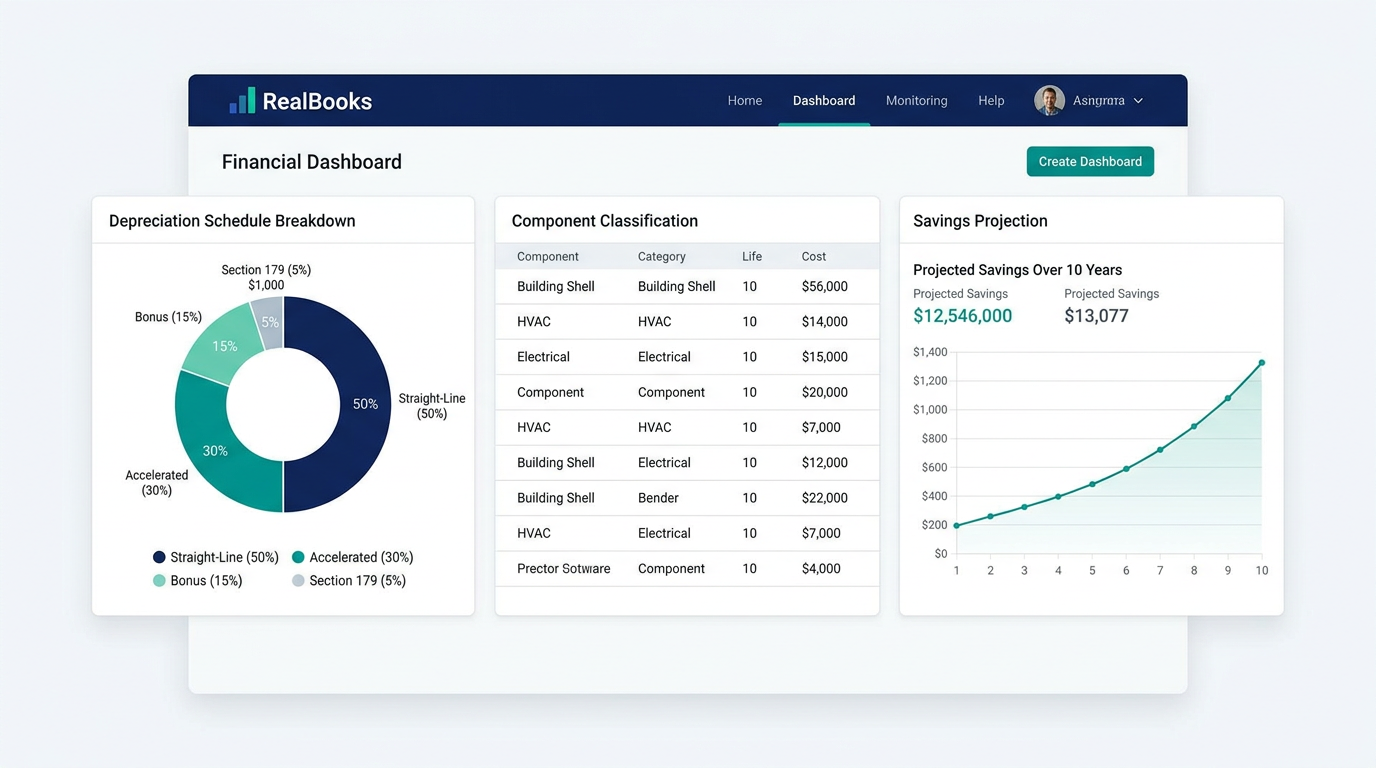
The moment a property is added to RealBooks, Uncle Sam begins allocating costs across the correct IRS depreciation classes — 5-year personal property, 7-year equipment, 15-year land improvements, and 27.5- or 39-year structural components. You don’t configure anything. You don’t submit a request to a specialty firm. You add the property, and the classification begins automatically.
Real-Time Depreciation Schedule Builder
RealBooks generates a complete, property-level depreciation schedule for every component — updated in real time as new improvements, renovations, and capital expenditures are added. No spreadsheet. No manual tracking. No year-end scramble to figure out what you spent on what. The schedule is always current, always accurate, and always organized the way your CPA needs it.
Year 1 Bonus Depreciation Calculation
Uncle Sam calculates your Year 1 bonus depreciation automatically under current tax law — 100% under the OBBBA. Before you file, you can see your projected deduction clearly displayed inside the platform. No guesswork. No back-of-envelope math. The number is right there.
Side-by-Side Savings Comparison
One of the most powerful features in RealBooks’ cost segregation module is the side-by-side comparison: straight-line depreciation versus accelerated depreciation. The investor can see, in plain dollar terms, exactly what they would leave on the table by not running the analysis. This comparison updates dynamically as property data, renovation costs, and tax law change.
Renovation Tracking → Automatic Cost Segregation
Every improvement tracked through RealBooks’ Project Management feature flows directly into the cost segregation analysis. A new roof. A kitchen renovation. A parking lot repave. Each capital expenditure is automatically reclassified into the appropriate depreciation category and added to Uncle Sam’s running analysis. You manage the projects. He manages the tax implications.
Portfolio-Wide Analysis — Not Just One Property
Traditional engineering studies are conducted property by property — each one a separate engagement, a separate fee, a separate process. RealBooks runs cost segregation across your entire portfolio simultaneously. Whether you own two properties or twenty, every asset gets the same rigorous analysis at the same time, updated in real time.
CPA-Ready Export in One Click
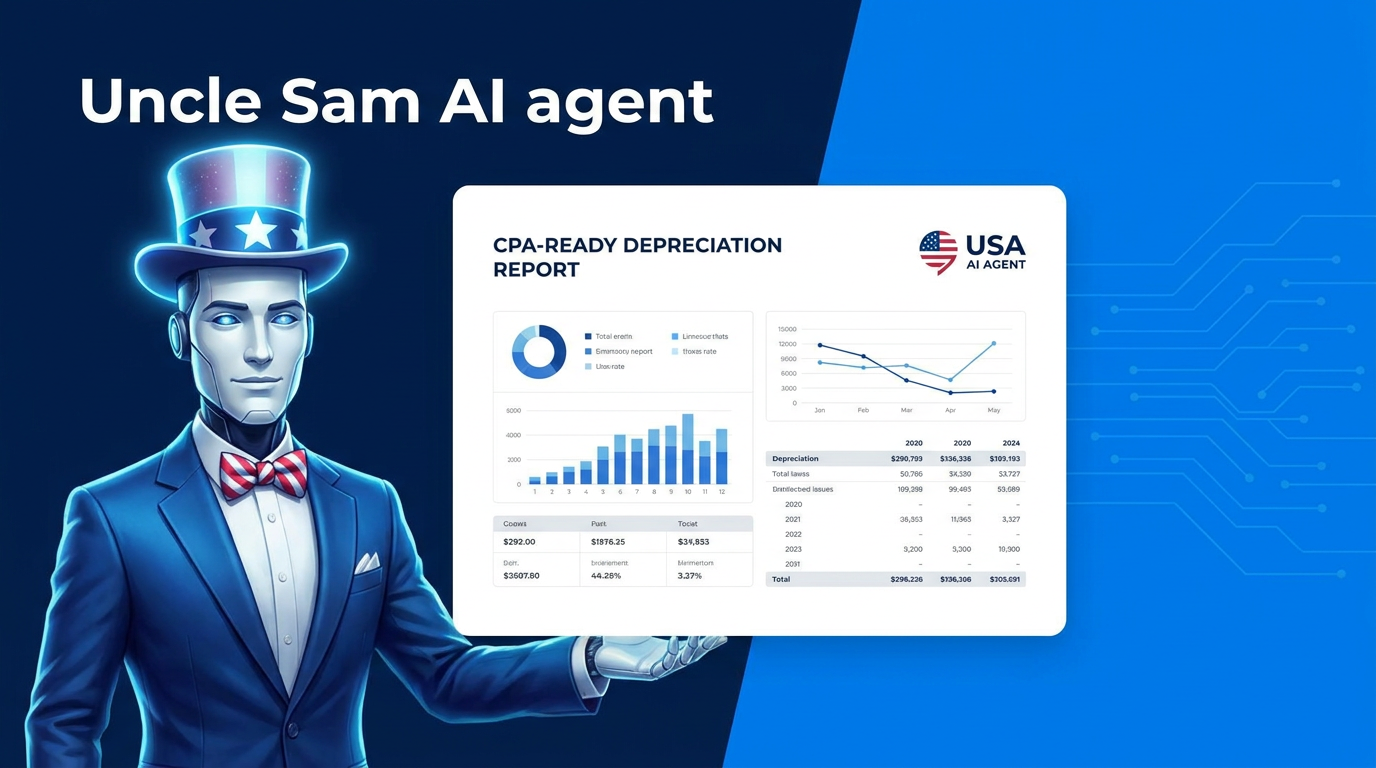
When tax season arrives, Uncle Sam generates a complete, CPA-ready tax reporting package — full depreciation schedules, cost segregation breakdown by component, total accelerated deductions, and a Year 1 bonus depreciation summary. Exportable to PDF or Excel in a single click. Your CPA gets exactly what they need, organized the way they need it, without a back-and-forth that eats hours of billable time.
The Cost Advantage Is the Final Closer
A traditional cost segregation engineering study: $5,000–$15,000 in professional fees. RealBooks’ cost segregation: included in your subscription. At most plan levels, that cost difference alone pays for multiple years of RealBooks. And unlike a one-time engineering study that analyzes a single property at a point in time, RealBooks’ analysis is continuous, portfolio-wide, and updated automatically as your properties evolve.
For technical readers who want the full feature detail, the RealBooks cost segregation documentation covers every aspect of how Uncle Sam handles component classification, bonus depreciation calculation, and schedule generation.
Your numbers should work as hard as your investments do. Uncle Sam makes sure they do.

The Bottom Line: Stop Depreciating the Wrong Way
Most real estate investors are overpaying their taxes — not because they’re doing anything wrong, but because they’re depreciating their properties exactly the way the IRS defaults to, without ever questioning whether a better approach exists. Cost segregation is that better approach. It’s IRS-sanctioned, it’s proven, and it’s been delivering outsized results for institutional investors for nearly three decades.
What’s changed is access. The $10,000 engineering study is no longer the price of admission. AI has made cost segregation analysis automatic, portfolio-wide, and available to every investor — from the landlord with a single-family rental in Phoenix to the operator running fifteen units across three markets.
2026 is genuinely the best year in a decade to act. With 100% bonus depreciation permanently restored under the One Big Beautiful Bill Act, every component you reclassify through cost segregation can be fully expensed in Year 1 — not spread across a decade and a half. That’s a legislative gift that rewards investors who move now.
Cost segregation isn’t a strategy reserved for institutional players anymore. It belongs to any investor with the right system in place. That system exists, and it’s running right now inside RealBooks — for thousands of investors who have already stopped leaving money on the table.
Your portfolio is working hard. Make sure your tax strategy is working just as hard.
Stop leaving money on the table.
RealBooks automatically runs cost segregation analysis across your entire portfolio — without the $10,000 engineering study. Uncle Sam handles the numbers. You keep more of what you earn.
Already have questions about cost segregation and your specific portfolio? Talk to the RealBooks team — we’re here to help.
Ready to maximize your tax savings?
RealBooks automatically tracks expenses, manages assets, and calculates depreciation across your entire portfolio.
Start Free Trial →