1031 Exchange Rules Explained: The Real Estate Investor’s Complete Guide to Tax-Deferred Exchanges in 2026
Imagine selling a rental property for a $200,000 gain — and writing a check to the IRS for $60,000 before you’ve even had a chance to redeploy a single dollar. That’s not a worst-case scenario. For investors who skip the 1031 exchange, it’s Tuesday. Capital gains tax at 15–20%, plus depreciation recapture taxed at up to 25%, can quietly eviscerate decades of equity-building in a single transaction. The painful part? Every dollar of it was deferrable.
The 1031 exchange has been one of the most powerful tax deferral tools in real estate for over a century. Named after Section 1031 of the Internal Revenue Code, it allows investors to defer capital gains taxes by reinvesting the proceeds from a sold investment property into a like-kind replacement property. Done right, you preserve 100% of your equity and put compounding to work on a much larger base. Done wrong — or not done at all — you hand the IRS a significant portion of the wealth you spent years building.
This guide covers everything real estate investors need to know about 1031 exchange rules in 2026: how the IRS framework works, the step-by-step execution process, what qualifies and what doesn’t, how reverse exchanges function, and — critically — the financial tracking infrastructure that determines whether investors actually protect their gains after the exchange closes. Most 1031 exchange guides stop at the legal mechanics. This one goes further, because the bookkeeping and basis-tracking side is where most investors quietly lose money years after the exchange.
There’s also a 2026-specific reason to pay close attention right now. The One Big Beautiful Bill Act (OBBBA), signed into law in 2025, permanently restored 100% bonus depreciation — making the combination of a 1031 exchange with a cost segregation study on the replacement property the most powerful tax deferral strategy available to real estate investors today. This guide covers that combination in full.
Whether you’re executing your first exchange or your fifth, this is the complete playbook.

What Is a 1031 Exchange — and Why Every Real Estate Investor Should Care
Few tools in the entire U.S. tax code are as consistently underused — and underappreciated — as the 1031 exchange. Most real estate investors have heard of it. Far fewer have used it. And a significant number who have used it didn’t fully understand the mechanics beneath the surface. That gap costs real money.
What is a 1031 exchange? At its core, it is a provision under Section 1031 of the Internal Revenue Code that allows an investor to sell an investment property and defer federal capital gains taxes — as long as the proceeds are reinvested into a like-kind replacement property within specific IRS-mandated timeframes. The exchange doesn’t eliminate the tax liability permanently; it defers it. But for many investors, that deferral lasts for decades, through successive exchanges, and ultimately disappears entirely when heirs receive a stepped-up basis at death.
The distinction between deferral and forgiveness is important to understand from the start. When you execute a 1031 exchange, you’re not wiping out the tax — you’re postponing it. The deferred gain follows the replacement property like a shadow. But deferred taxes are, in practical terms, an interest-free loan from the IRS. And when you’re compounding on a larger equity base because you didn’t give 20% back at the point of sale, the long-term difference is staggering.
The equity preservation math is simple — and compelling. Consider an investor who sells a duplex for $400,000 with $150,000 in realized gains. Without a 1031 exchange, they might owe $30,000–$37,500 in capital gains tax (at 20%, plus applicable state taxes), plus additional depreciation recapture tax on whatever accumulated depreciation was claimed during the hold period. It’s not unusual for the total tax bill to approach $50,000–$60,000 on a property of that size. With a 1031 exchange, every dollar of that $400,000 moves forward into the next property, working and compounding from a larger base from day one.
The depreciation recapture angle is one of the most frequently overlooked pieces of this puzzle. When you sell a property that has been depreciated over its hold period, the IRS taxes the recovered depreciation at a rate of up to 25% under Section 1250. This is separate from — and in addition to — capital gains tax. A property held for seven years with annual depreciation of $15,000 accumulates $105,000 in depreciation deductions. When sold, that $105,000 is subject to recapture tax. The 1031 exchange defers all of it — the gain and the recapture — which is why the total tax deferral on a well-appreciated property can be far more than investors initially expect. You can learn more about how depreciation deductions interact with eventual sale taxes in RealBooks’ guide to every tax deduction real estate investors can claim in 2026.
The history of this provision matters, too. Like-kind exchanges have been embedded in the tax code since 1921 — longer than most investors realize. The strategy survived the sweeping Tax Cuts and Jobs Act of 2017, which narrowed its scope significantly by eliminating personal property from eligibility. After 2017, only real property qualifies — no more equipment, vehicles, or artwork exchanges. But real property, in all its forms, remains fully eligible: residential rentals, commercial buildings, raw land, industrial facilities, and more. Congress has consistently preserved this provision because it promotes reinvestment and drives economic activity in real estate markets.
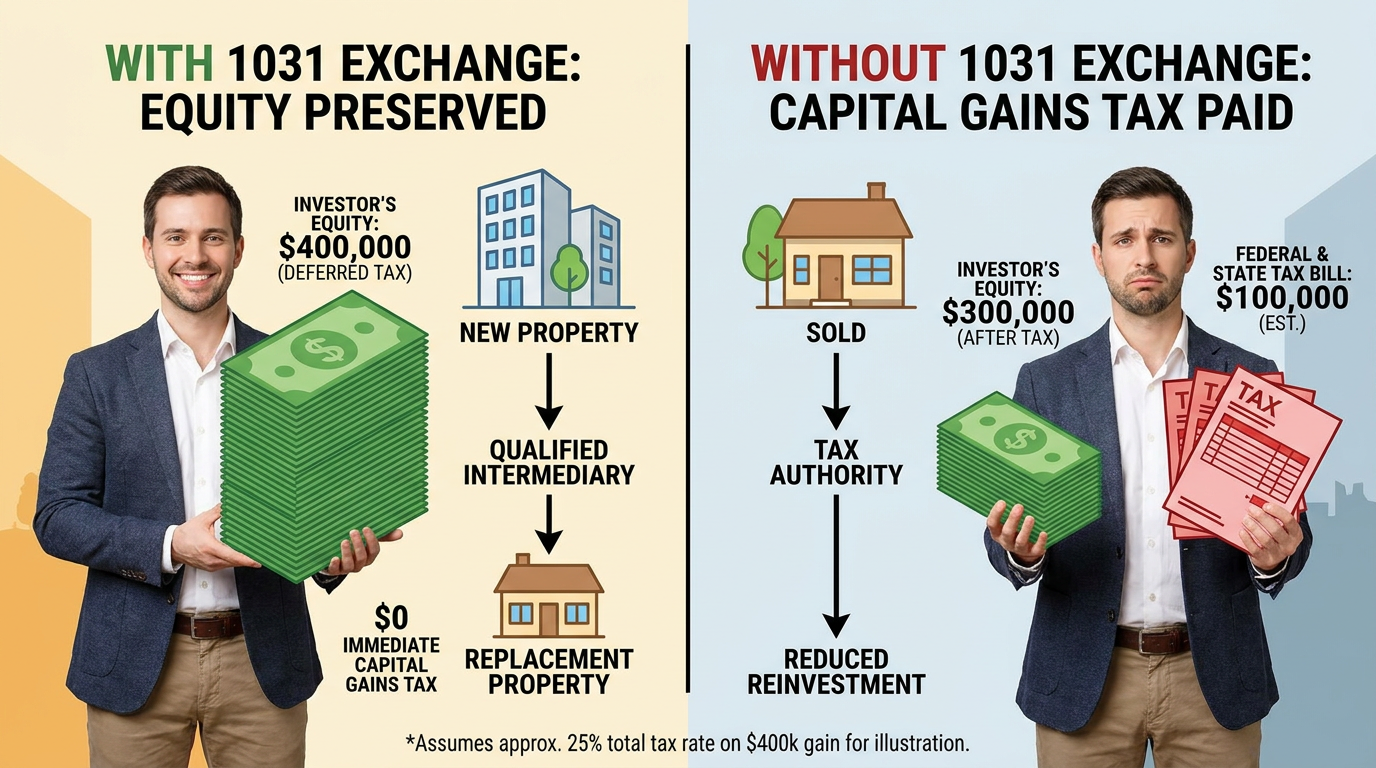
The case for using a 1031 exchange in 1031 exchange real estate investing is not subtle. It is, quite simply, one of the most reliable legal mechanisms available to preserve wealth during a property transition. The question isn’t really whether to use it — it’s how to use it correctly, within the IRS rules that govern every step of the process.
Those rules are where most exchanges succeed or fail. Let’s walk through each one.
The Exact IRS Rules That Govern Every 1031 Exchange
Understanding the IRS framework is where the real work begins. 1031 exchange rules are specific, non-negotiable, and unforgiving of mistakes. There are no extensions for carelessness, no grace periods for busy schedules, and no do-overs once a deadline passes. The good news is that the rules are knowable — and once you understand each one clearly, executing a compliant exchange is entirely within reach.
Here is the complete framework, broken down in plain English.
The 45-Day Identification Rule
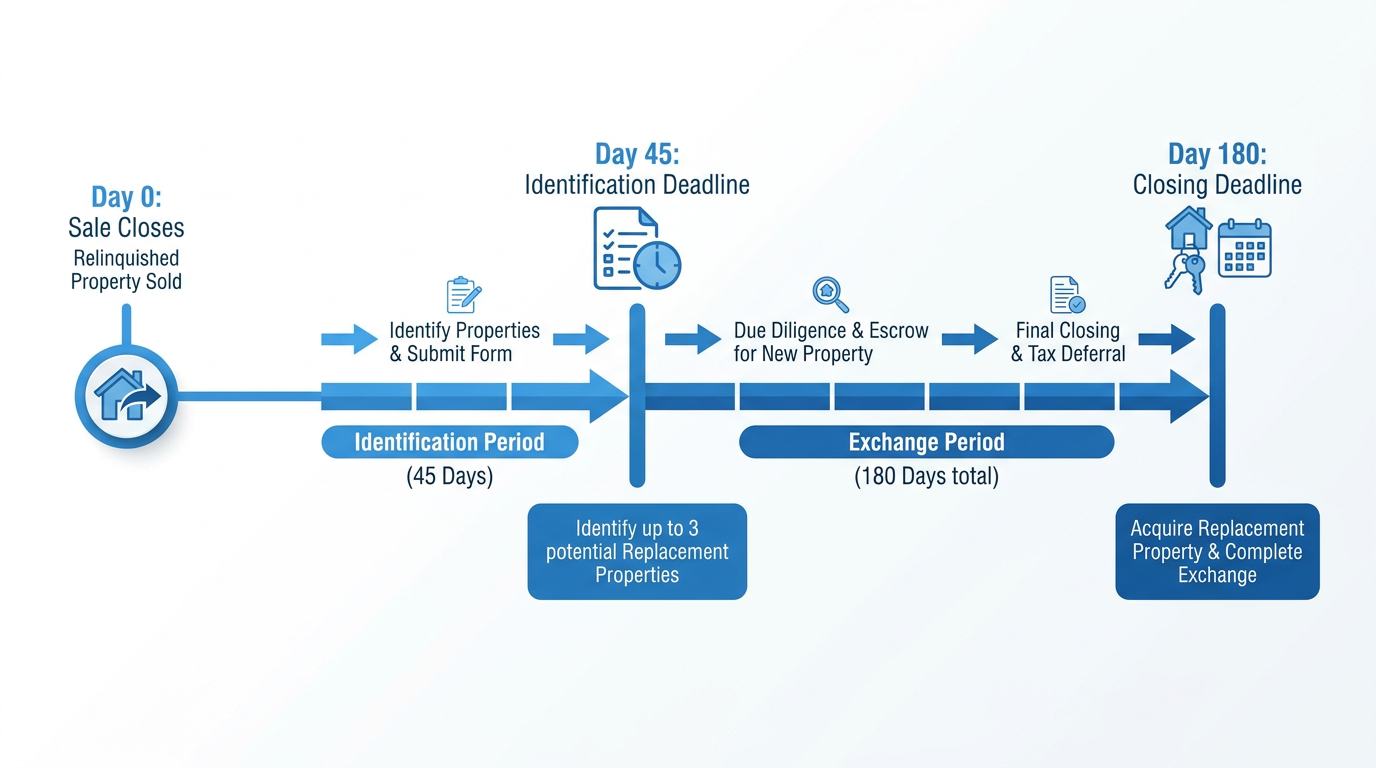
From the moment the relinquished property closes, the investor has exactly 45 calendar days to formally identify potential replacement properties in writing. Not 46. Not “approximately six weeks.” Forty-five calendar days, including weekends and holidays, regardless of what else is happening in your deal pipeline.
This identification must be submitted in writing — typically to the Qualified Intermediary (QI) facilitating the exchange — and must specify each property clearly enough that there is no ambiguity about what is being identified. A general description won’t hold up. An address or legal description will.
The IRS provides three methods for identifying replacement properties, and choosing the right one depends on your market situation:
- The 3-Property Rule — The most commonly used method. You can identify up to three replacement properties of any value, regardless of how their combined value compares to the relinquished property. If you identify three and acquire only one, that’s fully compliant. Most investors use this rule because it provides flexibility without complexity.
- The 200% Rule — You can identify any number of replacement properties, as long as their combined fair market value doesn’t exceed 200% of the relinquished property’s sale price. If you sold a property for $500,000, you can identify multiple properties as long as their combined value doesn’t exceed $1,000,000. This rule makes sense in competitive markets where you want to keep your options wide open.
- The 95% Rule — You can identify any number of properties of any combined value, as long as you actually acquire at least 95% of the total identified value. This is the most permissive rule — and the most demanding to execute. It’s rarely used outside of large, sophisticated exchange transactions.
For most investors in most markets, the 3-Property Rule is the right choice. It’s clean, simple, and provides enough optionality to navigate a competitive acquisition process.
The 180-Day Closing Rule
The investor must close on the replacement property within 180 calendar days of the sale of the relinquished property — or by the due date of that year’s tax return (including extensions), whichever comes first. This distinction matters: if the exchange straddles a tax year (for example, you sell in November and the 180-day window extends into the following April), you may need to file for a tax extension to preserve your full 180-day window. Failing to account for this has cost investors meaningful flexibility.
The 1031 exchange timeline is critical to understand correctly: the 45-day and 180-day periods run concurrently, not sequentially. The 180-day clock starts on the day the relinquished property closes — not after the 45-day identification window expires. This means your identification deadline and your closing deadline are both counting down from the same starting gun.
The IRS Like-Kind Exchange fact sheet confirms these timelines, and they have remained unchanged despite various legislative discussions in recent years, as noted in recent 2026 exchange guidance.
The Like-Kind Requirement
Both the relinquished property and the replacement property must be “like-kind” — but in the world of real estate, this term is interpreted far more broadly than most investors expect. Any U.S. real property held for investment or business use qualifies as like-kind to any other U.S. real property held for investment or business use.
What that means in practice: a single-family rental can be exchanged for an apartment complex. An apartment complex can be exchanged for a commercial office building. A commercial building can be exchanged for raw land. A duplex can become a triple-net leased retail property. The variety of asset types that can move through a 1031 exchange is one of the provision’s most underappreciated strengths.
The post-TCJA (2017) clarification is important: real estate is the only asset class that still qualifies. Personal property — equipment, machinery, collectibles, artwork — no longer qualifies for like-kind exchange treatment. And foreign property cannot be exchanged for U.S. property; the exchange must occur within the same country.
The American Bar Association’s resource on exchanges under Code Section 1031 is one of the most authoritative references available for the like-kind rules and their application to complex situations.
The Equal or Greater Value Rule
To defer 100% of the taxable gain, the replacement property must be of equal or greater value to the relinquished property, and all of the net equity must be reinvested. Any difference — whether in the form of cash received or debt reduction — is called “boot,” and boot is taxable in the year of the exchange.
Boot is not always a dealbreaker. Sometimes an investor accepts a small amount of boot knowingly, having planned for the tax. But boot caught by surprise — from failing to understand the equity math before closing — is a frustrating and avoidable expense. Size the replacement property correctly before committing to it.
Form 8824 is how the exchange is reported to the IRS, filed for the tax year in which the relinquished property was sold. It captures the details of both properties, the deferred gain, and any boot received. Investors should bookmark the IRS Form 8824 page and work closely with a CPA to ensure accurate reporting.
With the rules clearly defined, the next logical question is: how do you actually execute this, step by step?
How to Execute a 1031 Exchange — Step by Step
Knowing the rules is necessary. Executing the exchange correctly is what actually protects your gains. How to do a 1031 exchange is less about legal theory and more about operational discipline — a precise sequence of steps, timed carefully, involving the right professionals at the right moments.
“The moment you receive the proceeds, the exchange is over. The QI is not optional — it’s the mechanism.”
Here is the complete process, from the decision to sell through closing on the replacement property.
Step 1 — Decide Before You Close
The exchange must be structured and set up before the relinquished property closes escrow. This is not a technical nicety — it is a legal requirement. The moment an investor receives or controls the sale proceeds, constructive receipt has occurred, and the exchange is invalidated. There are no exceptions. No retroactive fixes. No “I didn’t know.” This is the single most common mistake investors make, and it is entirely preventable.
Decide to exchange before you list the property. Engage the qualified intermediary before the sale closes. Do not wait.
Step 2 — Hire a Qualified Intermediary
The Qualified Intermediary (QI) is the legally required third party who facilitates the exchange. They hold the sale proceeds (the investor cannot touch them), coordinate with title companies, draft the exchange agreement, and ultimately transfer the funds to purchase the replacement property.
The IRS has specific rules about who can serve as a QI. Your attorney, CPA, real estate broker, or any person who has had a financial relationship with you in the past two years is disqualified. The QI must be an independent third party — and given that they are holding potentially hundreds of thousands of dollars of your money, selecting them carefully matters enormously.
When evaluating a QI, look for: FDIC-insured escrow accounts for exchange funds, errors and omissions insurance, demonstrable exchange experience, transparent fee structures, and clear communication processes. A QI who is difficult to reach or vague about fees is a red flag you cannot afford to ignore.
Step 3 — Close on the Relinquished Property
At closing, the QI receives the proceeds directly from the title company. The investor never takes constructive receipt. This step is clean when it’s set up correctly — the exchange agreement and instructions are already in place, and the QI steps in seamlessly. If the QI isn’t engaged before this moment, there is no exchange.
Step 4 — Identify the Replacement Property (Within 45 Days)
With the proceeds safely held by the QI, the clock starts. The investor has 45 calendar days to submit a written identification of replacement property candidates using one of the three identification methods (3-Property Rule, 200% Rule, or 95% Rule). The identification must be signed and delivered to the QI or another designated party in the exchange. Verbal identifications and unsigned documents don’t count.
Smart investors begin their replacement property search before the relinquished property closes — not after. Pre-identifying candidates allows you to walk into the 45-day window with clarity and options, rather than scrambling to find something under deadline pressure.
Step 5 — Due Diligence and Financing
While the 180-day clock is running, the investor conducts due diligence on the identified replacement property and arranges financing. This step requires coordination — lenders must understand the exchange structure, and the QI must be looped in on the financing arrangements. Many conventional lenders are comfortable with 1031 exchange transactions, but briefing them early avoids delays.
Many investors also structure their exchanges through LLCs, which adds a layer of coordination complexity with the QI and title company. Understanding how to manage finances across multiple LLCs is essential background for investors operating in multiple entities.
Step 6 — Close on the Replacement Property (Within 180 Days)
When due diligence is complete and financing is in place, the QI wires the held exchange funds to complete the purchase. Closing is coordinated between the QI, title company, and lender. Once closed, the exchange is substantively complete.
Step 7 — Report the Exchange
Form 8824 is filed with the IRS for the tax year in which the relinquished property was sold. Work with a CPA to ensure it’s completed accurately — the information on Form 8824 establishes the carried basis of the replacement property, which will matter for every subsequent depreciation claim and eventual sale.
What if you miss a deadline? The exchange fails. The sale proceeds become fully taxable in the year of the sale. Back taxes, plus interest, become due. There is no appeal process for missed deadlines outside of federally declared disasters. This is why the operational discipline of the exchange process is non-negotiable.
Understanding the process also means knowing which properties actually qualify — because not everything does.
What Qualifies for a 1031 Exchange — and What Doesn’t (Including Reverse Exchanges)
A 1031 exchange is broadly available to real estate investors — but “broadly available” doesn’t mean “universally applicable.” The IRS has clear rules about which properties qualify, which don’t, and how the mechanics change when you need to buy before you sell.
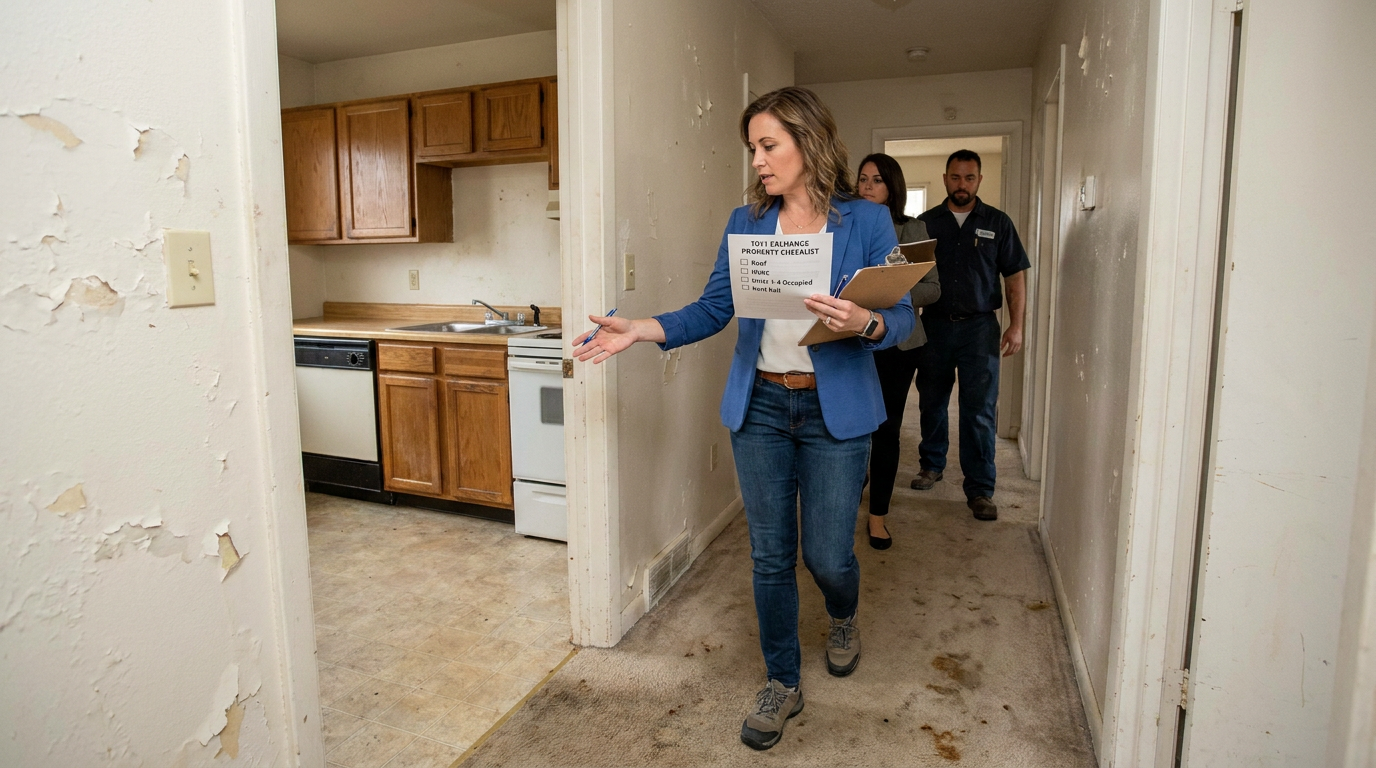
What Qualifies
Any real property held for investment or business use qualifies for exchange treatment. The range of eligible asset types is wide:
- Single-family rentals — the most common relinquished property in individual investor exchanges
- Multi-family properties — duplexes, triplexes, apartment complexes of any size
- Commercial real estate — retail, office, mixed-use, industrial
- Raw land — undeveloped parcels held for investment, even if they produce no income
- Vacation rentals — properties that meet the IRS vacation home safe harbor requirements (held primarily for investment with personal use limited to the lesser of 14 days or 10% of rental days)
- Net-leased properties — triple-net retail, single-tenant commercial
The like-kind interpretation in real estate is intentionally broad. A single-family rental can be exchanged for an apartment complex, which can later be exchanged for a commercial building, which can be exchanged for raw land. The asset type doesn’t need to match — only the investment or business use purpose does.
What Does NOT Qualify
Several categories of property are explicitly excluded from 1031 exchange treatment:
- Primary residences — property must be held for investment or business use, not personal use. Your home does not qualify, though it may qualify for the Section 121 exclusion separately.
- Fix-and-flip inventory (dealer property) — properties purchased with the intent to resell quickly are considered dealer property by the IRS. The investment intent test looks at purpose, not duration. A property you bought to flip and sell quickly does not qualify, even if you happened to hold it longer than planned. Investors who operate both as long-term holders and active flippers need to maintain strict separation between their portfolios. RealBooks’ 3-Phase Financial Framework for Fix-and-Flip Investors covers the right financial system for the dealer side of that portfolio.
- Personal property — post-TCJA (2017), no personal property qualifies. No equipment, vehicles, machinery, or artwork.
- Foreign property exchanged for U.S. property — an exchange must occur within the same country. A Mexican vacation rental cannot be exchanged for a U.S. commercial building.
- Stock, bonds, and financial instruments — real property only.
Documenting investment intent for every property from day one is essential. The IRS examines the facts and circumstances when evaluating whether a property was held for investment — and clean records that demonstrate rental income, depreciation claims, and property management expenses go a long way toward establishing that intent. For help tracking those capital improvements, RealBooks’ guide on repairs vs. capital improvements is a practical companion read.
The Reverse 1031 Exchange
The reverse 1031 exchange is the mirror image of a standard exchange — the investor acquires the replacement property before selling the relinquished property. It exists to solve a specific problem: in competitive real estate markets, the right replacement property can’t always wait for the relinquished property to sell.
Here’s how it works. A third-party Exchange Accommodation Titleholder (EAT), arranged through a QI, takes title to either the replacement property or the relinquished property — holding it under a Qualified Exchange Accommodation Arrangement (QEAA), as authorized by IRS Revenue Procedure 2000-37. The EAT “parks” the property until the other side of the exchange can close. The same 45-day identification and 180-day closing deadlines apply — just flowing in the opposite direction from a standard exchange.
Reverse exchanges are more complex and more expensive than standard exchanges. They require more working capital, since the investor must typically fund the acquisition of the replacement property without yet having the relinquished property proceeds in hand. They also require lenders who understand the EAT structure — not all lenders do. But for investors in tight markets where the right asset is available right now, the reverse exchange is an invaluable tool.
Improvement (build-to-suit) exchanges are worth a brief mention as well — a niche structure that allows an investor to use exchange proceeds for improvements to the replacement property before closing, provided all construction is completed within the 180-day window and the EAT holds title during the construction phase.
With the legal framework fully mapped, there’s one more dimension to this strategy that most guides skip entirely — and it’s the one that determines whether investors truly protect their gains not just at closing, but for years afterward.
The Financial Tracking Side Most 1031 Exchange Guides Miss
Here’s what the legal mechanics guides don’t tell you: a perfectly executed 1031 exchange can still cost you money — significant money — if your financial records aren’t built to handle what comes after.
The exchange closes. You own the replacement property. The deferred gain and accumulated depreciation from the relinquished property have followed you forward — invisibly embedded in the replacement property’s cost basis. And from this moment forward, the financial complexity of your portfolio has increased in ways that your basic spreadsheet or generic accounting software was never built to track.
This is the part most investors miss. And it’s exactly the problem RealBooks was built to solve.
Carried Cost Basis — The Foundation of Everything
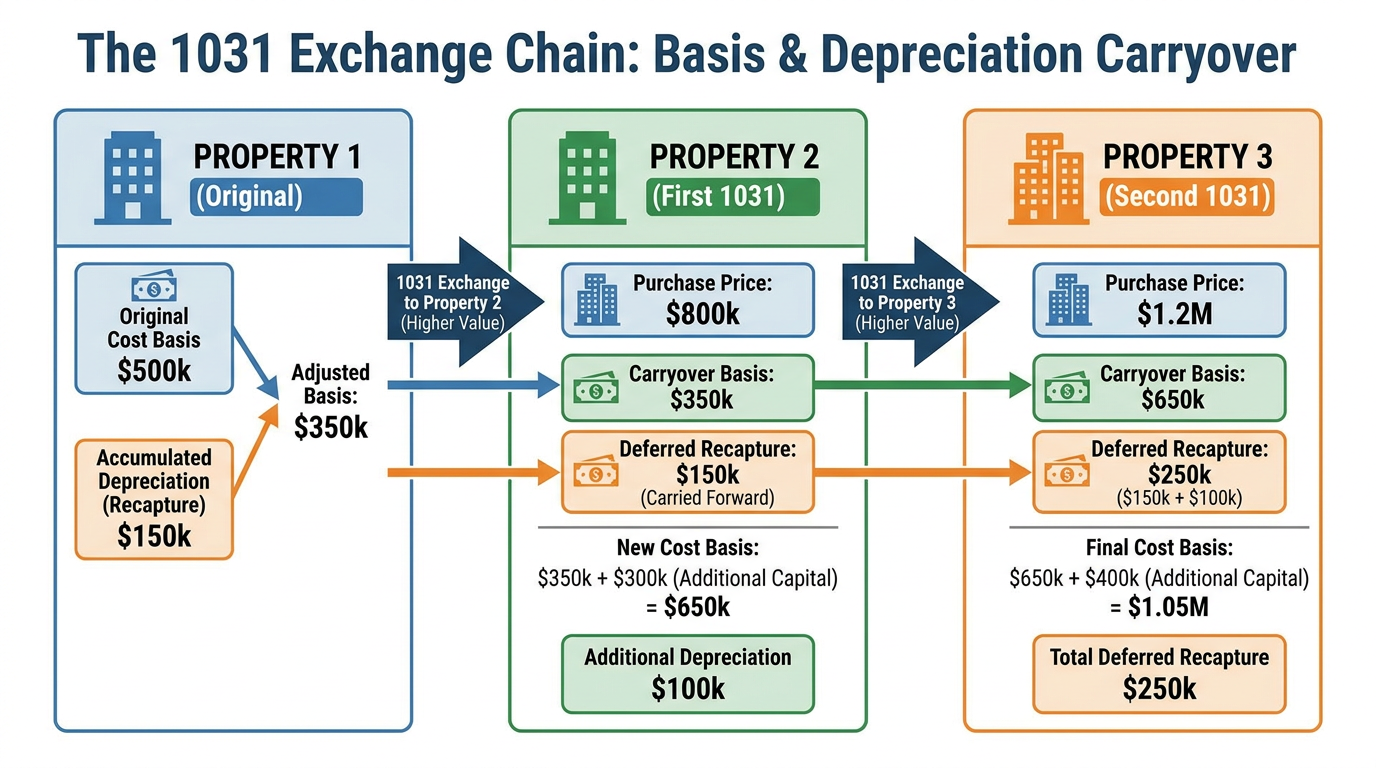
In a 1031 exchange, the cost basis of the relinquished property carries forward to the replacement property. The replacement property does not receive a fresh, stepped-up basis based on its purchase price. It inherits the adjusted basis from the property it replaced — which, after years of depreciation and potential improvements, is often far lower than the original purchase price.
The formula for calculating the replacement property’s starting basis is:
Replacement Property Basis = Adjusted Basis of Relinquished Property + Boot Paid + Gain Recognized − Boot Received − Gain Deferred
In plain English: if you bought a property for $200,000, claimed $50,000 in depreciation, and exchanged into a $500,000 property with no boot in either direction, the replacement property’s starting basis is $150,000 — not $500,000. That matters enormously for future depreciation schedules, and it matters even more if you ever sell the replacement property without another exchange.
Every subsequent exchange in a chain compounds this complexity. Each exchange adds a layer of deferred gain, carried basis, and accumulated depreciation — all of which must be tracked accurately for the investor’s tax position to be correctly understood. You can find a detailed technical breakdown of basis transfer mechanics from FS Capital’s guide to understanding basis in a 1031 exchange.
Depreciation Carries Forward — and So Does the Tax Liability
The accumulated depreciation on the relinquished property doesn’t reset when the exchange closes. It transfers forward to the replacement property, meaning the investor’s depreciation schedule on the new asset begins from the carried basis — not from the purchase price. The replacement property will generate depreciation deductions based on its carried basis, not its full acquisition cost.
This is both manageable and important to understand. When the replacement property is eventually sold without another exchange, all of the deferred depreciation recapture across the entire exchange chain becomes due — taxed at up to 25% under Section 1250. The longer the exchange chain, the larger that deferred liability grows. It’s a powerful compounding deferral strategy — but one that requires meticulous tracking to manage correctly.
The Records You Must Keep — Permanently
The IRS imposes no statute of limitations on the records required to establish basis in a 1031 exchange chain. That means the following documents must be maintained — permanently — for every property in the chain:
- Original purchase price and closing costs for every property exchanged
- All depreciation schedules and Form 4562s for every tax year each property was held
- Exchange agreements and QI documentation from every exchange
- Form 8824 for every exchange, showing the deferred gain and carried basis
- Records of every capital improvement made to each property (which increase basis)
- Closing statements from both the relinquished and replacement property transactions
This is not a “save it in a folder and hope for the best” situation. Missing records from exchange #1 mean missing basis at exchange #3 — and missing basis means overpaying taxes when the chain eventually terminates. The IRS audit window on basis issues can extend back years, making documentation discipline a long-term financial obligation, not just an annual filing task. For investors who renovate their replacement properties, understanding the distinction between deductible repairs and capitalizable improvements is essential — RealBooks’ guide to repairs vs. capital improvements covers this in detail.
How RealBooks Handles This
“Your books before the exchange determine your tax position after it. Clean financials aren’t just good practice — they’re the difference between a clean exchange and a costly reconstruction.”
RealBooks is built for exactly this kind of complexity — the kind that generic accounting software isn’t designed to handle and that spreadsheets eventually fail to sustain.
Dollar Bill, RealBooks’ builder agent, tracks cost basis through exchanges at the property level. When a 1031 exchange closes, Dollar Bill captures the adjusted basis, the carried depreciation schedule, and all improvement records — so the financial continuity of the exchange chain is never broken, even as properties change.
Penny, RealBooks’ bookkeeper agent, tracks every operating expense incurred during the hold period at the transaction level — ensuring that nothing deductible is missed, that repairs and improvements are correctly categorized, and that the books are always current. The expense history that Penny maintains is the foundation of the clean financials that a QI and CPA need when an exchange opportunity arises.
Uncle Sam, RealBooks’ tax strategy agent, flags depreciation recapture implications, identifies cost segregation opportunities on the replacement property, and ensures tax reporting is clean year-round — not just at closing. When an exchange closes and a new property is acquired, Uncle Sam is built to immediately surface the next strategic move.
The RealBooks Asset Management platform maintains an asset-level financial record that follows each property through acquisition, hold, improvement, and eventual exchange — so investors always know exactly where they stand. No reconstructing records under a 45-day deadline. No scrambling to find depreciation schedules from five years ago. The information is already there.
Want to see how RealBooks tracks basis and depreciation through a 1031 exchange? Visit realbooks.io to see how it works.
Clean financial records before the exchange are the prerequisite for everything that comes after — which brings us to the 2026 moment that makes this combination strategy uniquely powerful right now.
2026 Context — Why Pairing a 1031 Exchange With Cost Segregation Is the Smartest Move You Can Make Right Now
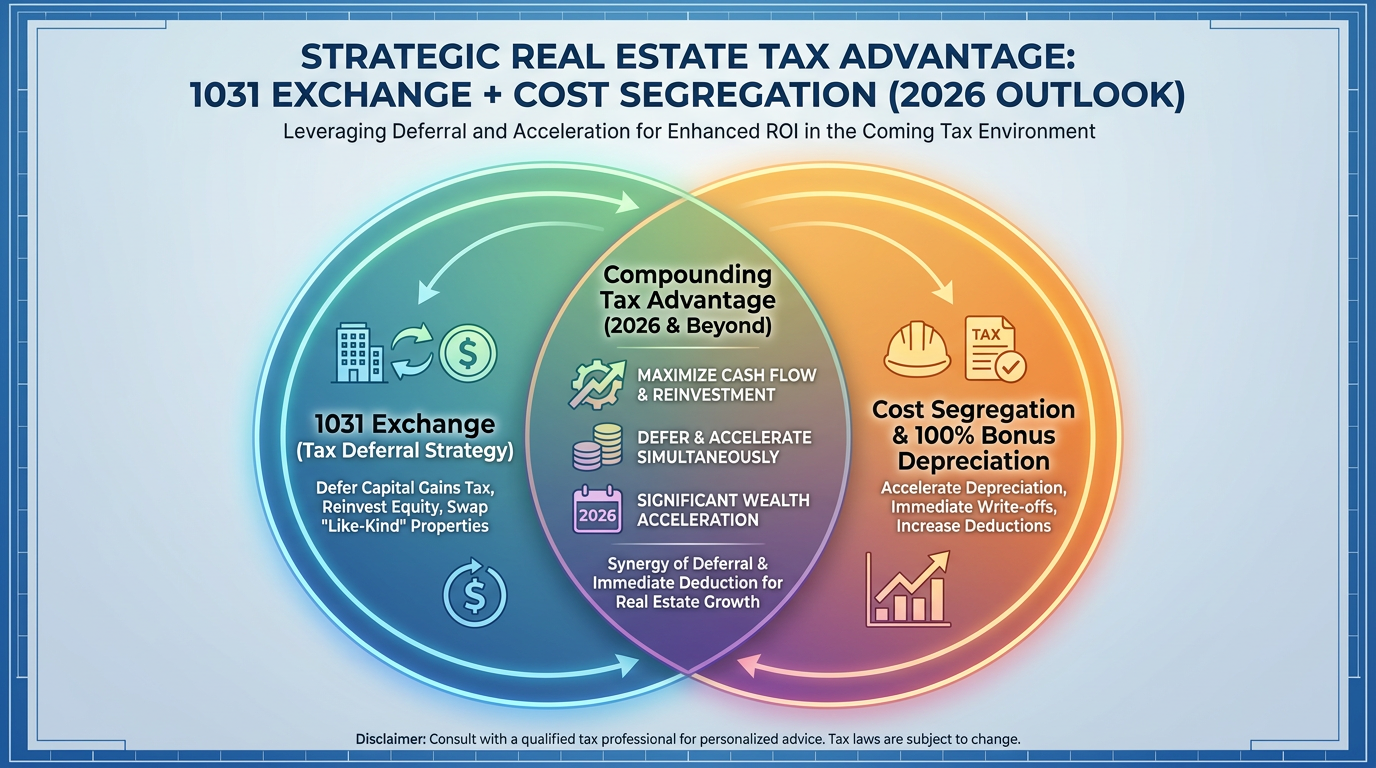
Most investors think of the 1031 exchange as a standalone strategy. In 2026, that’s leaving serious money on the table. The passage of the One Big Beautiful Bill Act has created a tax environment where combining a 1031 exchange with a cost segregation study on the replacement property produces a compounding tax advantage that neither strategy achieves alone.
This is the kind of insight that high-level CPAs share only with their best clients. Here’s the full picture.
The OBBBA Changed the Rules Permanently
The One Big Beautiful Bill Act, signed into law in July 2025, permanently restored 100% bonus depreciation for qualifying property placed in service after January 19, 2025. There is no phase-down schedule, no sunset provision, no scheduled reduction to 80% or 60% in future years. According to RSM US and the Tax Foundation, the OBBBA makes permanent what had been a temporary and declining incentive under prior law.
This matters enormously for 1031 exchange investors. When you acquire a replacement property through a 1031 exchange, a cost segregation study can identify components of that property eligible for accelerated depreciation — personal property components with 5, 7, or 15-year useful lives, rather than the standard 27.5 or 39-year depreciation schedules for the building itself. Under 100% bonus depreciation, those short-life components can be fully deducted in Year 1. You can find the complete breakdown of how the OBBBA changes bonus depreciation rules in RealBooks’ deep-dive on how the Big Beautiful Bill changes bonus depreciation and Section 179. For more on how cost segregation works mechanically, RealBooks’ Cost Segregation 101 guide is the right place to start.
The Power Combination in Practice
The strategy unfolds in three coordinated steps:
- Execute the 1031 exchange — defer all capital gains tax and depreciation recapture from the sale of the relinquished property, preserving 100% of equity for reinvestment.
- Commission a cost segregation study on the replacement property — identify short-life components (typically 20–40% of the building’s value in a well-executed study) eligible for accelerated depreciation treatment.
- Apply 100% bonus depreciation under the OBBBA — depreciate all qualifying short-life components fully in Year 1, generating significant paper losses on the new asset.
The result is a compounding tax advantage that is unavailable with either strategy alone. The investor defers gains on the exit and generates new accelerated losses on the entry.
The Carried Basis Nuance That Makes This Work
Here is the detail that makes this strategy particularly powerful for exchange investors: the cost segregation study on the replacement property works most effectively on the excess basis — the portion of the acquisition that represents new capital invested beyond the carried basis from the exchange.
In a 1031 exchange, the carried basis is often far lower than the replacement property’s purchase price. The difference between the purchase price and the carried basis represents newly invested capital — and that new capital receives a full stepped-up basis, fully eligible for cost segregation treatment and 100% bonus depreciation.
A concrete example: An investor sells a $600,000 rental property and defers $180,000 in gains through a 1031 exchange. They acquire a $900,000 replacement property, contributing $300,000 in new equity beyond what the exchange provided. That $300,000 in new equity receives a full basis allocation — and a cost segregation study on the replacement property can potentially generate $90,000–$120,000 in Year 1 deductions on that portion alone, on top of the deferred gain from the exchange.
For investors who qualify as real estate professionals under IRS rules, this advantage goes further — paper losses from bonus depreciation can be applied against ordinary income, not just passive income, amplifying the after-tax impact significantly. For a comprehensive look at every deduction available in this environment, RealBooks’ guide to every tax deduction real estate investors can claim in 2026 is essential reading. CBIZ’s analysis of cost segregation and bonus depreciation under the OBBBA provides additional technical support for this combination strategy.
Uncle Sam, RealBooks’ tax strategy agent, is built to identify exactly this type of opportunity. When an exchange closes and a new property is acquired, Uncle Sam flags the cost segregation opportunity automatically — connecting the exit event to the next strategic move before the window passes. RealBooks’ cost segregation product capability is the operational home for this analysis.
The combination is powerful. But it only delivers its full value when the exchange itself is executed cleanly — without the mistakes that derail more exchanges than investors realize.
Common Mistakes That Blow Up 1031 Exchanges — and How to Avoid Every One
The exchange doesn’t fail at closing. It fails months earlier — when records weren’t kept, deadlines weren’t tracked, and the wrong property was identified in the wrong way. The most common 1031 exchange mistakes are entirely preventable. Here are the seven that matter most.
Mistake #1 — Taking Constructive Receipt of the Proceeds
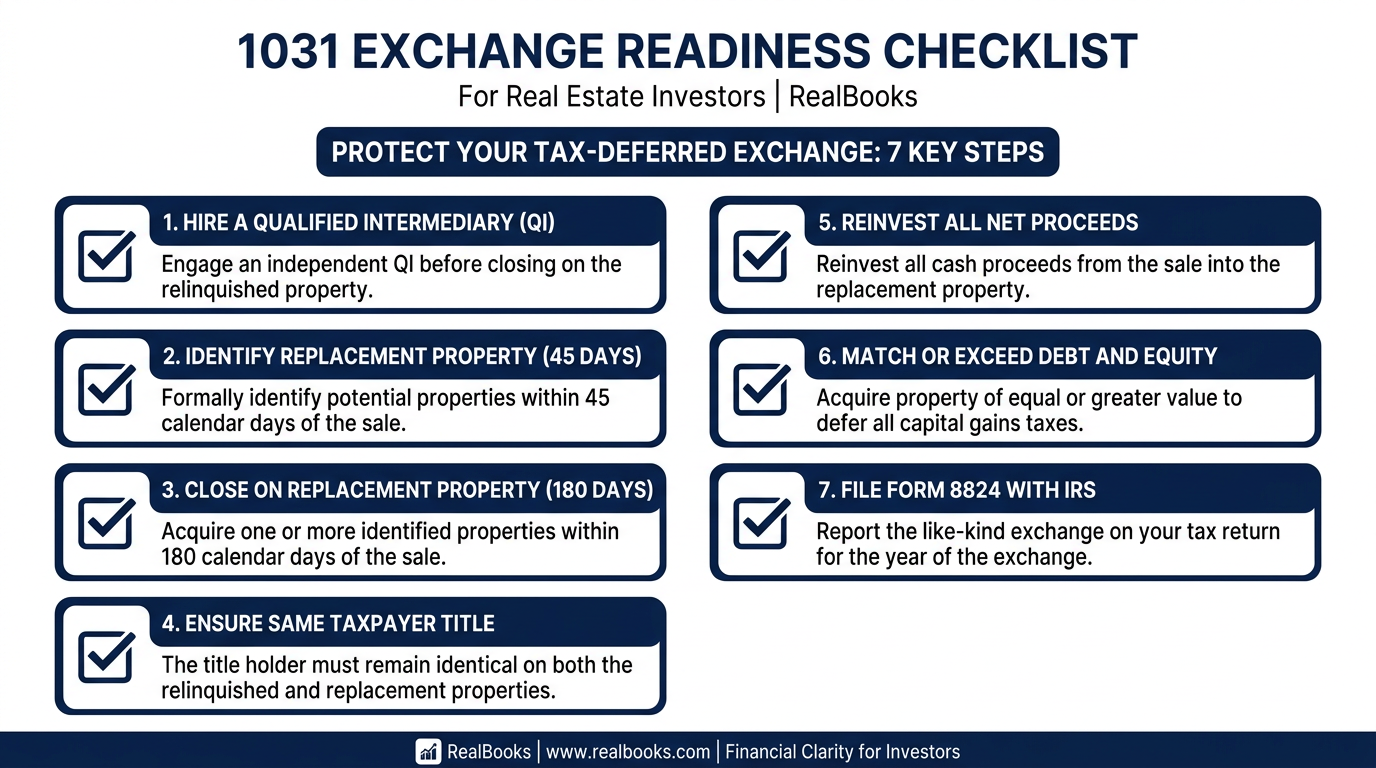
The most common and most irreversible mistake in 1031 exchange investing. The moment the investor receives or controls the sale proceeds — even briefly, even accidentally — the exchange is invalidated. The entire deferred gain becomes taxable immediately. The fix is simple: engage a QI before the relinquished property closes, and let the QI receive the funds directly from the title company. Never route funds through the investor’s own account.
Mistake #2 — Missing the 45-Day Identification Deadline
No extensions. No exceptions. No grace periods. The IRS offers relief only in the case of federally declared disasters — not scheduling conflicts, not slow markets, not difficult negotiations. The solution is to begin your replacement property search before you list the relinquished property. Walk into the 45-day window with candidates already identified, not with a blank list and a ticking clock.
Mistake #3 — Identifying Properties Incorrectly
Identification must be specific — a street address or legal description — and submitted in writing, signed, to the QI or designated party. Vague descriptions (“a duplex in Austin”) don’t hold up. Verbal identifications don’t count. And identifying more properties than your chosen identification method allows invalidates the entire identification. Use the 3-Property Rule unless you have a compelling reason to use the 200% or 95% Rule, and always submit in writing with confirmation of receipt.
Mistake #4 — Receiving Boot Without a Plan
Boot — any cash received or debt reduction that results from the exchange — is taxable in the year of the exchange. Boot isn’t always a mistake; sometimes it’s an intentional trade-off. But boot caught by surprise — because the investor didn’t run the equity math before committing to a replacement property — is an expensive and avoidable outcome. Know your numbers before you close.
Mistake #5 — Exchanging Dealer or Flip Property
Fix-and-flip inventory is explicitly excluded from 1031 exchange treatment. The IRS looks at the investor’s intent at the time of purchase — not just how long the property was held. Investors who operate both as long-term holders and active flippers must maintain strict separation between their portfolios — structurally, financially, and documentably. Clear entity separation and clean books are the best protection. RealBooks’ guide to managing finances across multiple LLCs covers how to do this correctly.
Mistake #6 — Missing or Losing Basis Records From Prior Exchanges
An investor who has completed two or three successive 1031 exchanges and can’t produce the Form 8824 and depreciation schedules from the first exchange has a problem. Missing basis records from earlier exchanges can cause investors to dramatically overstate their taxable gain when the chain finally terminates — because the IRS will assume the lowest defensible basis without documentation. Keep every Form 8824, every QI agreement, every depreciation schedule, every improvement record — permanently. RealBooks Tax Reporting is built to maintain this record continuously, so it’s never reconstructed from memory.
Mistake #7 — Waiting Until Tax Season to Organize the Books
The 45-day and 180-day clocks don’t pause while your CPA catches up on your bookkeeping. When an exchange opportunity arises — often quickly, when a buyer appears or a deal becomes available — clean financials need to be available immediately. Investors whose books are months behind have to reconstruct records under deadline pressure, which is expensive, stressful, and error-prone. Penny’s year-round expense tracking through RealBooks ensures that when an exchange opportunity arises, the financial foundation is already in place — no reconstruction required.
“The exchange doesn’t fail at closing — it fails months earlier, when records weren’t kept, deadlines weren’t tracked, and the wrong property was identified.”

The Complete Picture — and What to Do With It
A 1031 exchange is not a tax trick. It is a proven, IRS-approved strategy with over a century of legal precedent, designed to keep investment capital working rather than surrendering it to taxes at the point of sale. Used consistently, it is one of the most reliable wealth-building mechanisms available to real estate investors — preserving equity, amplifying compounding, and deferring tax liability across an entire investing career.
In 2026, the stakes are higher and the opportunity is greater than it has been in years. The OBBBA’s permanent restoration of 100% bonus depreciation makes the combination of a 1031 exchange with a cost segregation study the most tax-efficient property transition strategy available. Defer the gain on the exit. Generate accelerated losses on the entry. Compound on a larger equity base with a lighter tax burden. That is the playbook.
But the gap most investors leave open isn’t in understanding the rules. It’s in the financial infrastructure required to execute the rules correctly — clean basis records that follow the exchange chain, organized depreciation schedules, year-round expense tracking, and a tax strategy system that flags opportunities before deadlines appear. Without that infrastructure, even a technically correct exchange can leave money on the table through missed deductions, poorly tracked basis, or records that can’t withstand an IRS inquiry.
Dollar Bill, Penny, and Uncle Sam are built for exactly this — the phases, the timing, the tax nuances, and the long game. RealBooks is not generic accounting software retrofitted for real estate. It was built from the ground up for the specific financial complexity that real estate investors navigate: multiple entities, layered depreciation schedules, exchange chains, cost segregation studies, and the year-round bookkeeping discipline that makes all of it possible.
Your numbers should work as hard as your investments do.
Ready to see the system in action? Visit realbooks.io to see how RealBooks tracks cost basis and depreciation through every exchange — from the property you sell to the one you buy.
Know a fellow investor planning their next move? Share this guide with them — it might be the most valuable thing in their inbox this week.
Ready to maximize your tax savings?
RealBooks automatically tracks expenses, manages assets, and calculates depreciation across your entire portfolio.
Start Free Trial →