The Complete BRRRR Method Guide: Buy, Rehab, Rent, Refinance, Repeat — With a Full Financial Tracking Framework for Every Phase

Most real estate strategies ask you to choose between growth and control. Scale too fast and your finances spiral. Move too cautiously and the portfolio never gains momentum. The BRRRR method is one of the few strategies that offers both — a systematic, repeatable engine for building a rental portfolio without continuously injecting new capital — if your numbers are airtight at every step.
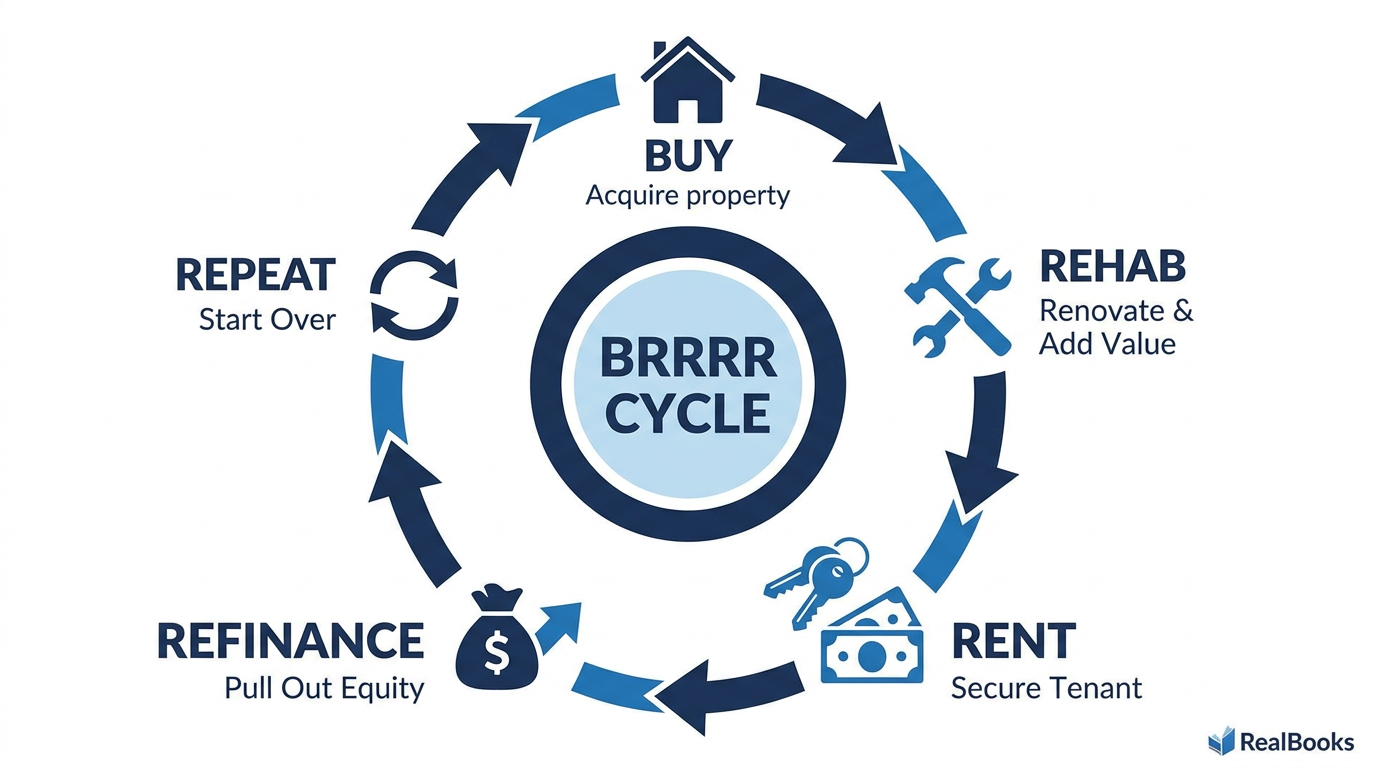
BRRRR stands for Buy, Rehab, Rent, Refinance, Repeat — a capital-recycling strategy that lets investors deploy funds, force appreciation through renovation, stabilize with tenants, and then pull equity out tax-free through a cash-out refinance to fund the next deal. The cycle compounds. The portfolio grows. The initial capital base largely stays intact.
But here’s where most investors quietly lose: it’s not the strategy that fails them. It’s the finances. Misclassified renovation costs. Missed depreciation deductions. Poor appraisal prep. Zero real-time visibility into where the budget stands mid-rehab. These aren’t minor bookkeeping annoyances — they’re deal-killers that erode returns across every phase of the cycle.
This guide walks through every phase of the BRRRR strategy in full detail: what each phase demands financially, what the tax implications are, what you need to track and why, and how to build the kind of system that makes every cycle cleaner than the last. RealBooks was built specifically for this workflow, and you’ll see how it fits naturally at each phase — but the framework itself is what you’re here for. Let’s build it from the ground up.
What Is the BRRRR Method — And Why It Works
For investors hearing about the BRRRR method for the first time, the concept sounds almost too elegant to be real. Acquire a distressed property. Renovate it strategically. Rent it out. Refinance based on the new appraised value. Pull your capital back out. Repeat. The whole machine runs on one core insight: you don’t have to sell a property to access its equity — and when you don’t sell, you don’t trigger a taxable event.
Let’s break down what each letter actually means in practice, because each phase has its own distinct financial logic.
B — Buy: You acquire an undervalued or distressed property, typically at a significant discount to its post-renovation value. The acquisition price, combined with your projected rehab budget, needs to leave room for a healthy spread between your total investment and the property’s after-repair value (ARV). This spread is where your profit and your equity extraction live.
R — Rehab: You renovate the property strategically — not every surface, not every upgrade, but the right improvements that maximize the appraised value relative to the cost. This is called forcing appreciation, and it’s the distinguishing mechanic of the BRRRR strategy. You’re not waiting for the market to carry the value up. You’re creating value deliberately through capital investment.
R — Rent: Once the rehab is complete, you place a tenant and begin generating rental income. This stabilizes the property, satisfies lender requirements for the upcoming refinance, and starts building the operating history that supports a long-term hold.
R — Refinance: With the property renovated, rented, and stabilized, you execute a cash-out refinance. The lender appraises the property at its new, post-renovation value — and issues a conventional mortgage based on that higher number. The difference between what you owe on your short-term acquisition financing and your new loan amount comes to you as cash. Tax-free.
R — Repeat: You take that returned capital and deploy it into the next deal. The cycle starts again.
To make this concrete, consider a simplified example. You purchase a distressed property for $150,000 and spend $35,000 on strategic renovations. The property appraises post-rehab at $240,000. A conventional lender offers a 75% LTV cash-out refinance — that’s a loan of $180,000. You pay off the original financing, and the net cash returned to you is close to your full initial investment. You now hold a cash-flowing rental property with a long-term conventional mortgage in place, and you have capital available to deploy into the next acquisition. That’s the BRRRR cycle at work.
What separates BRRRR from a fix-and-flip is fundamental: you hold the property instead of selling it. That means no capital gains tax on your appreciation event. It means ongoing rental income. It means continued depreciation deductions. And it means the compounding effect of equity growth over time — across multiple properties — rather than a one-time profit event per deal.
As the BRRRR method has grown in popularity across the real estate investing community, it’s attracted serious portfolio builders — investors who aren’t looking for a quick payday, but for a systematic, scalable way to accumulate rental assets. The strategy rewards discipline, planning, and — critically — clean financial tracking at every phase of the cycle.
How do BRRRR investors measure deal performance? The most common metrics are cap rate and cash-on-cash return — both of which require accurate, property-level financial data to calculate correctly. Which is exactly why the financial framework matters as much as the deal itself.
Now that the BRRRR cycle is clear, let’s go phase by phase — starting with the one decision that determines everything else: the buy.
Phase 1 — Buy: Finding, Analyzing, and Financing the Right Deal
The acquisition phase is deceptively simple on the surface. You find a property, negotiate a price, close the deal. But the financial implications of that moment — the cost basis you establish, the financing structure you choose, the costs you track from day one — ripple through every subsequent phase of the BRRRR cycle. Getting the buy right isn’t just about finding a good deal. It’s about setting the foundation for a clean, profitable, tax-optimized hold.
What makes a good BRRRR acquisition? The target is an undervalued or distressed property with strong post-renovation value — a property whose current condition has suppressed its market price below what strategic renovation can achieve. The primary analytical tool most experienced BRRRR investors use is the 70% rule: a rough guideline that says you should target a purchase price no higher than 70% of the ARV, minus your estimated rehab costs. So on a property with a $240,000 ARV and a $35,000 rehab budget, the 70% rule suggests a maximum purchase price around $133,000. This spread protects your ability to refinance out at 75-80% LTV and still recover most of your invested capital.
ARV analysis is both art and science. You need comparable sales data, an understanding of local renovation premiums, and a realistic picture of what the market will actually support. Overpaying for the acquisition — even by $15,000 — can compress your equity at the refinance stage enough to destroy the deal math entirely.

Financing the acquisition introduces another layer of financial complexity. Most BRRRR investors aren’t using conventional mortgages at the buy stage — those products typically aren’t available for heavily distressed properties, and the timelines are too slow for competitive acquisition environments. Common alternatives include:
- Hard money loans — Asset-based, fast-close, short-term. High interest rates (often 9-13%) and origination fees that need to be accounted for in your deal math.
- Private money — Capital from individuals in your network. Terms vary widely and need to be documented clearly.
- HELOCs on existing properties — Leverage equity in your current portfolio to fund the next acquisition.
- Partnership capital — Equity or debt partners who fund the deal in exchange for a return or profit share.
Each financing structure carries different cost profiles. Every dollar of interest, origination fee, and closing cost associated with acquisition financing affects your all-in cost basis — and therefore your equity position at the refinance stage.
Acquisition costs to track from day one include every dollar that goes into getting the property from listed to closed:
- Purchase price
- Closing costs (title insurance, settlement fees, transfer taxes)
- Loan origination fees and points
- Appraisal and inspection fees
- Legal and attorney fees
- Any pre-closing carrying costs
From an IRS standpoint, these costs don’t get expensed immediately — they become part of the property’s cost basis, which is the foundational number that feeds your entire depreciation schedule over the 27.5-year life of the asset. Getting this classification right at closing isn’t optional; it’s the starting gun for every tax benefit that follows.
Most investors don’t open their books until they’re already mid-rehab. That’s too late. Your financial system needs to be live the moment you go under contract — with a dedicated property ledger, a separate account or clean transaction tagging, and every acquisition cost categorized correctly. Mixing acquisition costs across multiple properties, or lumping them into a general account, creates reconciliation problems that compound with every subsequent deal. If you’re managing finances across multiple entities, how to manage finances across multiple LLCs is essential reading before your first closing.
In RealBooks, Dollar Bill — the AI Asset Builder — handles this setup automatically. You give him the property address, purchase price, and property type, and he creates the asset in the platform, establishes the depreciation schedule from the acquisition date, and links every subsequent transaction to that property automatically. Asset Management in RealBooks ensures that from your very first closing cost to your final rehab invoice, every dollar has a home — and that home feeds directly into your tax reporting, your appraisal prep, and your lender documentation when the refi comes.
Once you close, the clock starts ticking on the most financially complex — and most commonly mismanaged — phase of BRRRR: the rehab.
Phase 2 — Rehab: Budgeting, Tracking, and Capturing Every Renovation Dollar
If the acquisition phase sets the table, the rehab phase is where the meal is made — or burned. More BRRRR deals underperform expectations during the rehab phase than any other, and the reasons are almost always financial, not physical. Cost overruns that weren’t caught until they were catastrophic. Renovation expenses miscategorized in a way that cost thousands in missed deductions. Contractor invoices floating in email instead of attached to a job record. A lender asking for project documentation and getting a shrug.
The rehab phase is also where the most tax value in the entire BRRRR cycle is either captured or lost forever. Getting it right requires both budget discipline and financial precision — and those two things don’t happen by accident.
Budgeting the rehab correctly starts with moving away from lump-sum estimates. A single line item that reads “Renovation — $35,000” is not a budget. It’s a guess. Room-by-room, trade-by-trade budgeting gives you the granularity to catch scope creep early, compare contractor bids accurately, and understand exactly where you are relative to plan at any moment. A realistic rehab budget includes:
- Labor costs — broken out by trade (framing, electrical, plumbing, HVAC, finish work)
- Materials — every supply run, every appliance, every fixture
- Permit fees — often overlooked, always required, and traceable to specific improvements
- Contractor fees and overhead — general contractor markup if applicable
- Contingency reserve — typically 10-15% of total budget for unforeseen conditions, especially in older properties
The contingency isn’t pessimism. It’s math. Experienced renovators build it in because they know that walls get opened and surprises appear. The investors who get into trouble are the ones who spent their contingency before the project started.
The single most important financial classification in the entire BRRRR cycle happens during the rehab phase, and most investors either don’t know about it or don’t apply it consistently: the distinction between repairs and capital improvements.
Under IRS rules, a repair — something that restores a property to its original working condition without adding value or extending its useful life — is typically deductible in the year it’s incurred. A capital improvement — something that adds value, extends useful life, or adapts the property to a new use — must be capitalized and depreciated over time. A patched roof is a repair. A new roof is a capital improvement. Replaced broken flooring is a repair. New hardwood floors throughout are a capital improvement. The line isn’t always obvious, and getting it wrong in either direction is expensive.
For a deep dive into this distinction with specific examples, repairs vs. capital improvements is required reading before your first contractor invoice hits the books.
“The biggest tax mistakes I see BRRRR investors make happen during the rehab — either everything gets capitalized when some of it should be expensed, or the opposite. Both cost money.” — A common refrain from real estate-specialized CPAs who review portfolios at year-end.
What to track during the rehab phase, without exception:
- Every contractor invoice — attached to the specific project and property, not filed in a general folder
- Every material receipt — including hardware store runs, appliance deliveries, and supply orders
- Permit fees — with the associated scope of work documented
- Actual spend vs. estimated budget — tracked in real time, not reconciled at month-end
- Change orders and scope additions — these need their own paper trail because they affect both the budget and the classification analysis
- Contractor information — license numbers, insurance certificates, contact details — stored for future reference and lender documentation
There’s another reason real-time tracking matters during the rehab that goes beyond the tax return: your appraisal. When it’s time to refinance, your lender will base the loan on the property’s appraised value — and appraisers and lenders often want documentation of completed improvements. Clean, organized project records with receipts attached to line items support a higher ARV argument and significantly smooth the path to a fast, clean refi.
To understand what renovation investments actually move the needle on appraised value, how much does a renovation cost breaks down regional cost data and ROI by improvement type.
In RealBooks, Project Management is where Dollar Bill builds out the room-by-room rehab project — generating AI-assisted cost estimates using regional data, tracking actual spend against budget as invoices come in, flagging overruns before they become crises, and storing every contractor detail and material choice in an organized, searchable record. Penny, the Autonomous Bookkeeping agent, runs in the background categorizing every transaction — contractor payment, supply run, permit fee — to the correct property and the correct IRS expense type automatically.
The Rehab Tracking Rule is simple: every dollar spent during the rehab phase must have (1) a receipt or invoice, (2) a property tag, and (3) a repair vs. capital improvement classification. Miss any one of these three and you’re leaving money on the table at tax time — or creating a problem your CPA will charge you to fix.
Once your rehab is complete and the property is rent-ready, the strategy shifts from spending to earning — and a new set of financial tracking responsibilities begins.
Phase 3 — Rent: Building Cash Flow and Unlocking Year-Round Tax Optimization
The rental phase is often treated as the “passive” part of BRRRR — you’ve done the hard work of buying and renovating, now you collect rent and wait for the refi window to open. That framing misses something important. The rental phase is where the most powerful, ongoing tax benefits of the BRRRR strategy are generated — and where careless financial management bleeds the most value over time.
The investors who treat the rental phase as a passive waiting period are the ones who scramble in March wondering why their tax bill is higher than expected.
Setting the right rent is the first financial decision of the rental phase, and it’s more analytical than most first-time landlords expect. Rent isn’t just about what comparable units are charging in the market — though that analysis is essential. It’s about what the property needs to generate in order to make the hold worthwhile while you’re preparing for the refinance. The rent should cover:
- PITI — principal, interest, taxes, and insurance on your acquisition financing
- Vacancy reserve — typically 5-8% of gross rent, depending on local market conditions
- Maintenance reserve — a recurring set-aside for ongoing repairs and capital replacement
- Property management fees — if you’re using a manager (typically 8-12% of collected rent)
- Cash flow margin — ideally positive after all of the above, even before considering tax benefits
A property that breaks even or produces modest monthly cash flow before accounting for depreciation and other deductions may generate significant paper losses that shelter income. Understanding that distinction — between cash flow and taxable income — is one of the most important concepts in real estate investing.
Income and expense tracking during the rental phase needs to be granular and consistent:
- Rent receipts logged by property, by month, by tenant
- Security deposits handled as a liability (not income) until forfeited
- Late fees, pet fees, and ancillary income tracked separately
- Every expense — mortgage interest, property taxes, insurance, management fees, maintenance, utilities — categorized correctly and linked to the specific property
This isn’t just organizational tidiness. This is your Schedule E being built in real time. Every correctly categorized expense is a deduction. Every missed receipt is a missed deduction. Over the course of a full rental year, sloppy expense tracking routinely costs investors thousands.
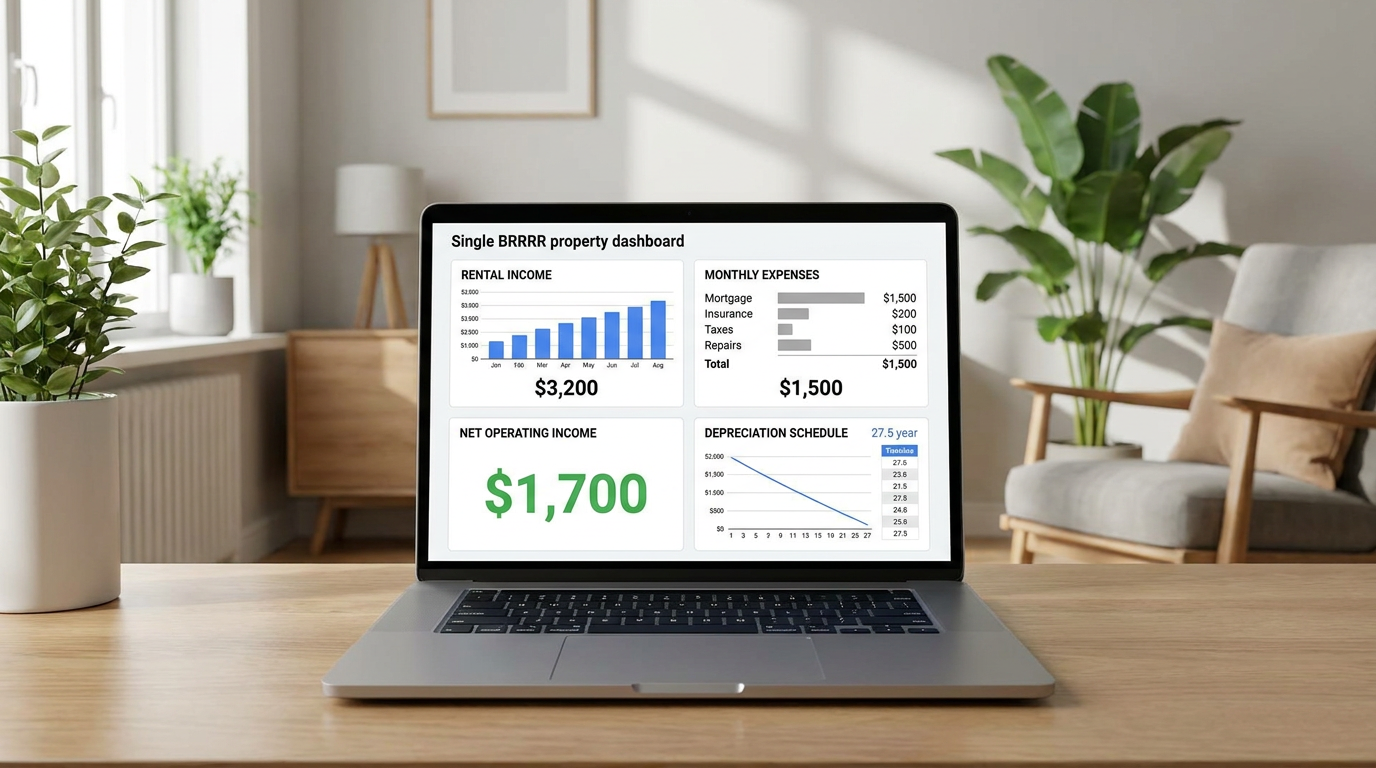
Depreciation is the most powerful passive deduction in real estate investing — and most investors dramatically underutilize it. Here’s how it works: the IRS allows you to deduct the cost of a residential rental property over 27.5 years through straight-line depreciation. The land value is excluded (land doesn’t depreciate), but the building and improvements are deductible.
On a property with a post-rehab value of $240,000 and an allocated land value of $30,000, your depreciable basis is $210,000. Divide that by 27.5 years and you get approximately $7,636 per year in non-cash depreciation deductions. That’s $7,636 in paper losses that reduce your taxable income — without reducing your actual cash flow by a single dollar.
For a BRRRR property generating $18,000 in annual gross rent with $10,000 in cash expenses, your taxable rental income before depreciation is $8,000. After straight-line depreciation, you’re looking at a paper loss of roughly $364 — despite positive cash flow. That’s the power of depreciation as a tax shield.
Cost segregation takes this further. A cost segregation study reclassifies portions of the property’s cost basis into accelerated depreciation schedules — 5, 7, and 15 years instead of 27.5 — dramatically front-loading your deductions into the early years of ownership when they’re worth the most. Under the One Big Beautiful Bill Act (enacted July 4, 2025), 100% bonus depreciation was permanently restored for qualified property placed in service after January 19, 2025 — meaning cost segregation components eligible for 5- or 15-year schedules can potentially be fully deducted in Year 1. For BRRRR investors who’ve recently renovated and stabilized properties, this represents a decade-high opportunity. For a detailed breakdown, cost segregation for real estate investors walks through the mechanics and the math.
For a full picture of every tax deduction real estate investors can claim in 2026 — including mortgage interest, property taxes, insurance, management fees, and professional services — the complete deduction landscape is broader than most investors realize. And understanding bonus depreciation changes under the Big Beautiful Bill is essential reading before your next cost segregation analysis.
In RealBooks, Penny auto-categorizes every rent payment and expense by property, IRS expense type, and accounting period — building your Schedule E data continuously throughout the year. Uncle Sam, the AI tax intelligence agent, monitors your tax position in real time, flags optimization opportunities, runs cost segregation analysis, and tracks whether you qualify for real estate professional status (REPS) — a designation that, if achieved, can unlock the ability to use passive real estate losses to offset ordinary income, turbocharging the tax benefit of depreciation. Cost Segregation in RealBooks is where that analysis lives, purpose-built for the kind of multi-property portfolio that BRRRR investors build.
You’ve bought smart, rehabbed precisely, and stabilized a cash-flowing rental. Now it’s time for the most financially rewarding step in the cycle — the refinance.
Phase 4 — Refinance: Unlocking Equity Tax-Free and Resetting the Cycle
The cash-out refinance is the pivot point of the entire BRRRR strategy. It’s the step that transforms a single well-executed deal into a capital-recycling machine. And it’s the step that most real estate investors outside the BRRRR community don’t fully understand — particularly from a tax perspective.
Here’s the essential mechanic: when your property has been renovated, rented, and stabilized, you refinance your short-term acquisition financing into a conventional long-term mortgage — one based on the property’s new, post-rehab appraised value. If you owe $80,000 on your hard money loan and the lender issues a new mortgage of $180,000 at 75% LTV (based on a $240,000 appraisal), you receive the $100,000 difference in cash. That cash is yours to deploy into the next acquisition.
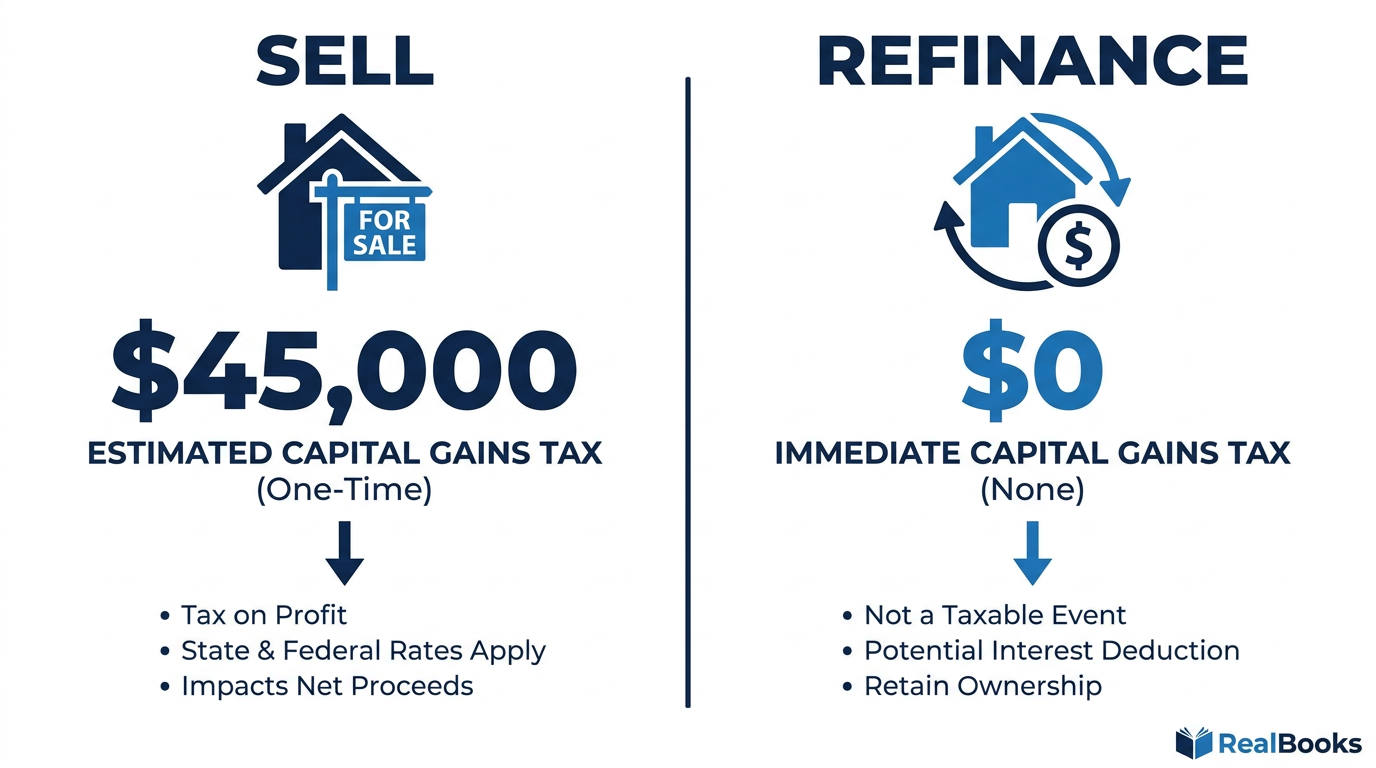
The most important tax principle in the BRRRR strategy: cash-out refinance proceeds are not taxable income. Loan proceeds are debt — they’re not revenue, not profit, not a taxable event. You can pull $100,000 in equity out of a property and owe zero capital gains tax on that extraction. This is for educational purposes only — consult a qualified CPA for guidance specific to your situation.
Contrast this with a fix-and-flip exit. If you sold the same property and triggered a short-term capital gain (property held less than one year), you’d face ordinary income tax rates — up to 37% at the federal level, plus potential state income taxes. On a $100,000 gain, that could mean $37,000+ in taxes. On the same equity extracted through a cash-out refinance? Zero. According to the tax benefits of the BRRRR strategy, this tax differential is one of the primary reasons sophisticated investors choose BRRRR over fix-and-flip as a long-term wealth-building strategy.
What lenders require for a successful cash-out refinance:
- Seasoning period — Most conventional lenders require 6-12 months of ownership before approving a cash-out refinance. Plan your timeline accordingly from the moment you close on the acquisition.
- DSCR — Debt Service Coverage Ratio — The property’s rental income must adequately cover the new mortgage payment. Lenders typically look for a DSCR of 1.20 or higher on investment properties, meaning rent income is at least 120% of the mortgage payment.
- Rental history and lease documentation — A signed lease, rent receipt history, and evidence of tenant stability all support the lender’s confidence in the income stream.
- Clean appraisal — The lender’s appraiser will determine LTV based on a fresh appraisal. Your renovation documentation, comparable sales, and property condition all influence this number.
- Organized financial records — A property-level P&L, income history, and expense documentation. This is where clean books during the acquisition, rehab, and rental phases pay dividends.
That last requirement is where most BRRRR investors feel the squeeze. When a lender asks for a clean property P&L and you’ve been tracking expenses in a spreadsheet — or not at all — the documentation process becomes painful and error-prone. By the time you’re ready to refi in RealBooks, Penny has already built a complete property-level P&L. Uncle Sam has your tax summary ready. Dollar Bill has the complete rehab project record with every invoice and change order documented. Your lender gets organized, professional documentation — not a scramble.
A critical bookkeeping note on the refinance transaction itself: three things need to be recorded correctly in your books — (1) the payoff of the old short-term debt, (2) the setup of the new long-term mortgage, and (3) the cash proceeds received. Getting any one of these wrong creates a balance sheet error that compounds over time and creates problems at your next tax filing. Expense Management in RealBooks and Tax Reporting in RealBooks both play a role here — ensuring the refinance event is captured accurately across your books, your balance sheet, and your tax position.
One more nuance: the refinance does not change your depreciation basis. Your basis was established at acquisition plus capital improvement costs — and that number stays fixed regardless of how much your property is worth or how large your new mortgage is. What does change post-refi is the interest expense. Your new loan’s interest is deductible as a rental operating expense — make sure your bookkeeping reflects the new loan terms from the first payment forward.
With fresh capital in hand, the strategy has one final step — and the most powerful one: doing it all over again, smarter and faster.
Phase 5 — Repeat: Scaling Your BRRRR Portfolio Without Losing Control
The first successful BRRRR cycle feels like a revelation. You deployed capital, forced appreciation, placed a tenant, pulled your money back out, and now you’re looking at a cash-flowing rental with a long-term mortgage and a fresh stack of capital for the next deal. The system works.
Then you do it again. And again. And somewhere around deal three or five — or ten — things get complicated in ways the first deal never prepared you for.
The compounding power of the Repeat phase is real and remarkable. Each completed BRRRR cycle adds a stabilized rental asset to your portfolio, generating ongoing income, building equity, and returning capital for reinvestment — without requiring you to raise new money. An investor who executes even four or five successful BRRRR cycles over five years can build a portfolio that would have required millions in continuous capital injection through a traditional acquisition approach.
But compounding power requires compounding systems. The financial infrastructure that worked fine for one property will buckle under the weight of five. The spreadsheet that tracked one rehab becomes unmanageable across three simultaneous renovation projects. The shoebox of receipts that your accountant sorted through in February becomes a year-long nightmare multiplied by the number of properties you hold.
Where scaling breaks down — and it always does without the right system:
- Expenses get cross-contaminated between properties, creating inaccurate P&Ls for each
- Tax deductions are missed because receipts aren’t attached to the right property at the time they’re incurred
- Renovation budgets across multiple active rehabs can’t be tracked simultaneously in a unified view
- Cash flow reporting is manual, always lagging, and never quite current
- Tax position across a multi-property, multi-entity portfolio becomes opaque until it’s too late to optimize
If you’ve still been using spreadsheets for your rental properties, the Repeat phase is where those tools definitively fail. Not because spreadsheets are bad tools — but because they don’t scale, they don’t integrate, and they require human maintenance that multiplies with every property you add.

The financial requirements of a multi-property BRRRR portfolio are qualitatively different from a single deal:
- Separate, clean ledgers per property — or per LLC if you’re using entity isolation
- Consolidated reporting that rolls individual property performance into a unified portfolio view
- Real-time budget tracking across multiple active rehabs simultaneously, not sequential reconciliation
- Cash flow visibility by property and across the full portfolio at any moment
- Tax position awareness across all properties and entities well before year-end so there’s still time to act
Entity structure at scale adds another layer of complexity. Many serious BRRRR investors hold each property in its own LLC for liability isolation — a sound strategy that nonetheless creates financial management challenges. Multiple LLCs mean multiple bank accounts, multiple P&Ls, multiple tax filings, and multiple ledgers that need to be both independent (for liability purposes) and consolidated (for portfolio visibility). This isn’t a reason to avoid the structure — it’s a reason to build financial infrastructure that handles it cleanly.
Uncle Sam’s role grows alongside the portfolio. As the number of properties increases, so does the tax optimization opportunity — and the tax complexity. Depreciation schedules across ten properties, cost segregation elections timed for maximum impact, REPS qualification tracking, and estimated quarterly tax payments all need to be monitored simultaneously. Uncle Sam does this across the entire portfolio in real time, ensuring investors aren’t blindsided by a tax bill they didn’t see coming and aren’t leaving deductions on the table because they weren’t tracking. A structured mid-year financial checkup becomes essential portfolio hygiene at this stage.
The Autonomous General Ledger is the engine that makes multi-property financial management possible without expanding your team or your workload. Every transaction across every property, every entity, every phase of the BRRRR cycle is continuously classified, tagged, and organized — without manual data entry, without reconciliation marathons, without the cognitive load of maintaining a system that was never designed for this kind of portfolio.
The Repeat phase is ultimately a mindset as much as a mechanism. With each cycle, serious BRRRR investors develop tighter deal analysis, sharper rehab scopes, stronger contractor relationships, and faster stabilization timelines. The strategy improves with repetition — but only when each cycle is documented, measured, and learned from. That requires clean books.
Every phase of BRRRR has its own financial fingerprint — and now it’s time to bring the full framework together in one place.
The Complete BRRRR Financial Tracking Framework — Phase by Phase
Every phase of the BRRRR cycle demands different financial actions, different IRS classifications, and different tools. What follows is the consolidated framework — a phase-by-phase reference you can use on every deal, from your first acquisition to your fiftieth door.
This is the resource that ties everything together. Print it. Bookmark it. Build your financial workflow around it.
Phase 1 — BUY
What to track: Purchase price, closing costs, loan origination fees and points, title insurance, inspection fees, appraisal fees, legal and attorney fees, any pre-closing carrying costs.
IRS classification: All acquisition costs form the property’s cost basis — not immediately deductible operating expenses. This basis feeds the depreciation schedule for the life of the asset. Getting this wrong delays and complicates every tax filing that follows.
In RealBooks: Dollar Bill creates the asset in the platform, establishes the depreciation schedule from the closing date, and links all acquisition transactions to the property ledger automatically. Penny tags every transaction as it clears.
Phase 2 — REHAB
What to track: Contractor invoices by trade and room, material receipts, permit costs, change orders, actual vs. budgeted spend in real time, contractor contact and licensing information.
IRS classification: Each expense must be classified as either a repair (immediate deduction) or a capital improvement (capitalized and depreciated). This classification happens at the invoice level — not at year-end.
In RealBooks: Dollar Bill builds the room-by-room project, tracks budget vs. actual, stores all contractor records, and flags overruns in real time. Penny categorizes every payment to the correct property and IRS expense type automatically.
Phase 3 — RENT
What to track: Rent receipts by property and month, security deposits (tracked as liabilities), late and ancillary fees, mortgage interest, property taxes, insurance premiums, management fees, maintenance and repair expenses, utilities, professional fees.
IRS classification: Operating income and deductible operating expenses feeding Schedule E. Depreciation tracked as a non-cash deduction. Cost segregation opportunities flagged for accelerated schedules where applicable.
In RealBooks: Penny auto-categorizes all income and expenses by property throughout the year. Uncle Sam tracks depreciation, monitors REPS qualification, flags cost segregation opportunities, and builds your tax summary continuously — so April is never a scramble.
Phase 4 — REFINANCE
What to track: Payoff of original short-term debt, setup of new conventional mortgage (loan amount, interest rate, term), cash proceeds received from the refinance, new monthly interest expense going forward.
IRS classification: Loan payoff is a balance sheet event (reduction of liability). New loan setup is a new liability on the balance sheet. Cash proceeds are not income. New mortgage interest is a deductible rental operating expense from the first payment.
In RealBooks: Penny records all three components of the refinance transaction correctly. Uncle Sam generates a property-level P&L ready for lender review before you submit your refi application.
Phase 5 — REPEAT
What to track: Portfolio-wide cash flow by property and in aggregate, individual property P&Ls, consolidated tax position across all entities, active rehab budgets across simultaneous projects, depreciation and cost segregation schedules across the full portfolio.
IRS classification: Multi-entity, multi-property consolidated reporting. Each property’s tax treatment maintained independently; portfolio tax position viewed in aggregate for planning purposes.
In RealBooks: The Autonomous General Ledger handles all classification across every property and entity continuously. Uncle Sam monitors total portfolio tax position, depreciation schedules, and year-end optimization opportunities in real time.
The framework is clear: Penny tracks it. Dollar Bill builds it. Uncle Sam saves it. Together, the three AI agents in RealBooks cover every phase of the BRRRR cycle — without manual bookkeeping, without year-end chaos, and without the financial opacity that costs investors deductions, delays refinances, and limits scale.
Tax preparation isn’t a year-end scramble — it’s an all-year practice. The investors who get the most out of BRRRR aren’t just the ones who find the best deals. They’re the ones whose books are clean on every cycle. To see how RealBooks works across each of these phases, the full platform overview is the best starting point.
For investors who also run fix-and-flip deals alongside their BRRRR portfolio, the 3-phase financial framework every fix-and-flip investor needs applies the same financial discipline to a different exit strategy — and the two frameworks complement each other naturally in a diversified portfolio.

The Bottom Line: BRRRR Works When the Books Behind It Do
The BRRRR method is one of the most sophisticated, tax-efficient, and genuinely scalable wealth-building strategies in real estate — not because the concept is complicated, but because the execution rewards discipline in a way that few other approaches do. You buy smart. You renovate deliberately. You stabilize with tenants. You pull equity out tax-free. You do it again.
The cycle is elegant. But it only runs cleanly when the financial infrastructure behind every phase is accurate, organized, and optimized from the first closing cost to the final refinance transaction. Misclassified renovation expenses, missed depreciation deductions, disorganized rental records, and undocumented rehab projects aren’t just accounting problems — they’re strategic failures that erode the returns the strategy was designed to generate.
Most investors running BRRRR today are doing it with tools that were never built for the complexity of this cycle. Spreadsheets that can’t tag transactions by property in real time. Accounting software designed for retail businesses, not real estate investors running multiple renovation projects across multiple entities. Shoebox receipts that become a CPA’s February problem.
The alternative isn’t more work. It’s better infrastructure.
Your numbers should work as hard as your investments do. Every deal you run is only as strong as the financial data behind it — and every phase of the BRRRR cycle generates financial data that, tracked correctly, saves you money, supports your refinance, and positions you to scale intelligently.
The investors who build lasting BRRRR portfolios — ten properties, twenty doors, multiple entities, simultaneous rehabs — aren’t the ones who found the most deals. They’re the ones who built the system that supports them.
Ready to Track Every Phase of Your BRRRR Strategy?
RealBooks is built for exactly this. From your first BRRRR acquisition to your fiftieth door — one platform tracks every expense, every project, every deduction, and every phase of the cycle automatically.
Visit realbooks.io to see how it works.
Already running BRRRR deals? See how RealBooks handles the financial complexity — explore the full platform or meet your AI team — Penny, Dollar Bill, and Uncle Sam — the financial infrastructure your BRRRR portfolio has been missing.
Ready to maximize your tax savings?
RealBooks automatically tracks expenses, manages assets, and calculates depreciation across your entire portfolio.
Start Free Trial →