The 3-Phase Financial Framework Every Fix-and-Flip Investor Needs

Most investors think about their flip in two moments: the day they buy and the day they sell. The IRS thinks about it in three.
That gap — between how investors track their deals and how the tax code actually works — is where thousands of dollars in profit quietly disappear. Not because the deal went sideways. Because the books did.
Here’s the reality: a fix-and-flip is not a single financial event. It is three distinct phases — Acquisition, Renovation, and Disposition — each with its own rules, its own tax treatment, and its own tracking requirements. Lumping them into one spreadsheet or one generic accounting file doesn’t just create a mess at year-end. It actively costs you money.
This framework applies whether you’re running one flip a year or fifteen. And if you’re a BRRRR investor, it matters even more — because the numbers you get right during acquisition and renovation follow that property into the rental phase and beyond.
By the end of this piece, you’ll understand how the framework works, what belongs in each phase, and how to make sure your system captures all of it automatically — so tax season is a report, not a scramble.
Why Fix-and-Flip Finances Differ From Every Other Strategy
There’s a version of this conversation where we just tell you to “keep better records.” That’s not this conversation.
The reason fix-and-flip accounting trips up even experienced investors isn’t a discipline problem. It’s a structural mismatch between the tools most investors use and the complexity of what they’re actually doing. Understanding why flipping is financially different is the first step to getting it right.
Start with the most fundamental distinction: how the IRS categorizes your income.
If you hold rental properties, you’re generating rental income — reported on Schedule E, offset by depreciation and operating expenses, managed year over year. If you flip a property, you’re generating a sale event. That sale is reported very differently — on Schedule D if you’re classified as an investor, or as ordinary income if the IRS classifies you as a dealer. We’ll get into the dealer vs. investor question in depth when we reach Phase 3. For now, understand that the classification matters enormously, and it’s not something you determine at tax time — it’s shaped by decisions you make before you even buy the property.
The second structural difference is how expenses carry weight depending on when they occur in the deal. An expense incurred at acquisition doesn’t work the same way as an expense incurred during renovation. And neither works the same way as a cost you incur at sale. Each phase has a different relationship with your tax basis, your deductions, and your reportable gain. Generic accounting tools — and spreadsheets — don’t make these distinctions. They treat every dollar the same.
Buy-and-Hold investors track rental income against operating expenses, build depreciation over time, and report everything on Schedule E. The lifecycle is long, and the accounting reflects that.
Fix-and-Flip investors face a sale event at the end of a compressed timeline. Phase-specific costs carry different tax weight. The investor’s classification as a dealer or investor dramatically changes the tax outcome. And every dollar of basis established in Phase 1 and Phase 2 directly reduces the taxable gain recognized in Phase 3.
As Cherry Bekaert’s real estate tax professionals explain, the distinction between dealer and investor property is one of the most frequently litigated issues in real estate taxation — precisely because the financial stakes are so high. Real estate treated as dealer property is subject to ordinary income tax rates. Real estate treated as investment property qualifies for favorable capital gains rates. That’s not a rounding error. That’s often the difference between a good year and a great one.
This is also why purpose-built software like RealBooks exists. Generic small business accounting tools were never designed to handle phase-level cost tracking, basis accumulation, or the UNICAP capitalization rules that govern renovation interest. They were built for invoicing and payroll. You’re running a real estate investment business. The tools should match.
“The frequency, continuity and substantiality of sales is a key consideration in determining whether a property is classified as dealer or investment property.”
— Cherry Bekaert Advisory LLC
Understanding why flipping is structurally different sets the table for what comes next. Let’s walk through Phase 1 — where every deal begins, and where the financial foundation is either built correctly or cracked from the start.
Phase 1 — Acquisition: Every Dollar Before the Keys Hit Your Hand
The acquisition phase begins the moment you identify a deal and start spending money on it. It ends when you close and take ownership. Everything that happens in between — and the costs associated with it — belongs in one carefully tracked financial bucket. That bucket is your cost basis.
Most investors know what basis means in a general sense. Fewer treat it with the precision it deserves. That’s where errors start.
What Is Cost Basis, and Why Does It Matter?
Your cost basis is the starting number from which your eventual gain — or loss — is calculated at the time of sale. Every dollar that legitimately belongs in your basis is a dollar that reduces your taxable gain when you sell. Miss five thousand dollars in acquisition costs, and you’ve just overpaid on taxes by whatever your marginal rate is, multiplied by five thousand.
IRS Publication 551 is the governing document on basis of assets, and it’s worth understanding at a conceptual level even if you never read it cover to cover. The core principle is simple: the costs you incur to acquire an asset become part of what that asset cost you. That total cost — not just the purchase price — is your basis.
What Counts as an Acquisition Cost?
This is where investors consistently leave money on the table. The purchase price is obvious. But the full list of acquisition costs that legitimately belong in your basis is longer than most people track:
- ✅ Goes into Basis: Purchase price, closing costs, title insurance, transfer taxes, recording fees
- ✅ Goes into Basis: Legal fees related to the purchase, pre-purchase inspection costs, loan origination fees
- ✅ Goes into Basis: Due diligence costs, environmental assessments, survey fees
- ⚠️ May Be Capitalized or Deducted: Pre-construction interest and certain carrying costs (this depends on UNICAP rules — more on this in Phase 2)
- ❌ Does NOT Go into Basis: Operating expenses incurred after acquisition that aren’t related to getting the property ready for renovation
Each of these items needs to be tagged to the property’s cost basis — not to a general “property expenses” line item, not to operating costs, and not lumped together with renovation spending. That last mistake is the most common, and it’s where the one-big-bucket problem begins.
The Basis Tracking Problem
Here’s what happens in practice: an investor closes on a property, drops the closing statement into a shared folder, and moves immediately into renovation mode. By the time tax season arrives, the closing costs are scattered across a bank statement, an attorney invoice, and an email from the title company. The CPA reconstructs what they can. Some costs get missed. The basis is understated. The taxable gain is overstated.
This isn’t hypothetical. It happens on a significant percentage of flips managed without purpose-built tracking. The cost isn’t just in the dollars missed — it’s in the time spent reconstructing records that should have been organized from day one.
RealBooks Asset Management creates a dedicated property record the moment a deal is initiated — capturing the purchase price, all acquisition costs, entity assignment, and financing details, and beginning basis tracking from day one. Nothing gets buried in a folder. Nothing gets reconstructed at year-end.
A Note for BRRRR Investors
If your strategy is Buy, Rehab, Rent, Refinance, Repeat, accurate acquisition tracking is even more critical. Your basis doesn’t disappear at refinance — it carries forward into the rental phase and directly informs your depreciation schedule. It also determines your gain if and when you eventually sell. An inaccurate acquisition record is a problem that compounds over years, not just one tax season.
Getting acquisition right is the foundation. Now comes the phase where most of the financial complexity — and most of the financial opportunity — actually lives.
Phase 2 — Renovation: Where the Tax Complexity and Opportunity Lives
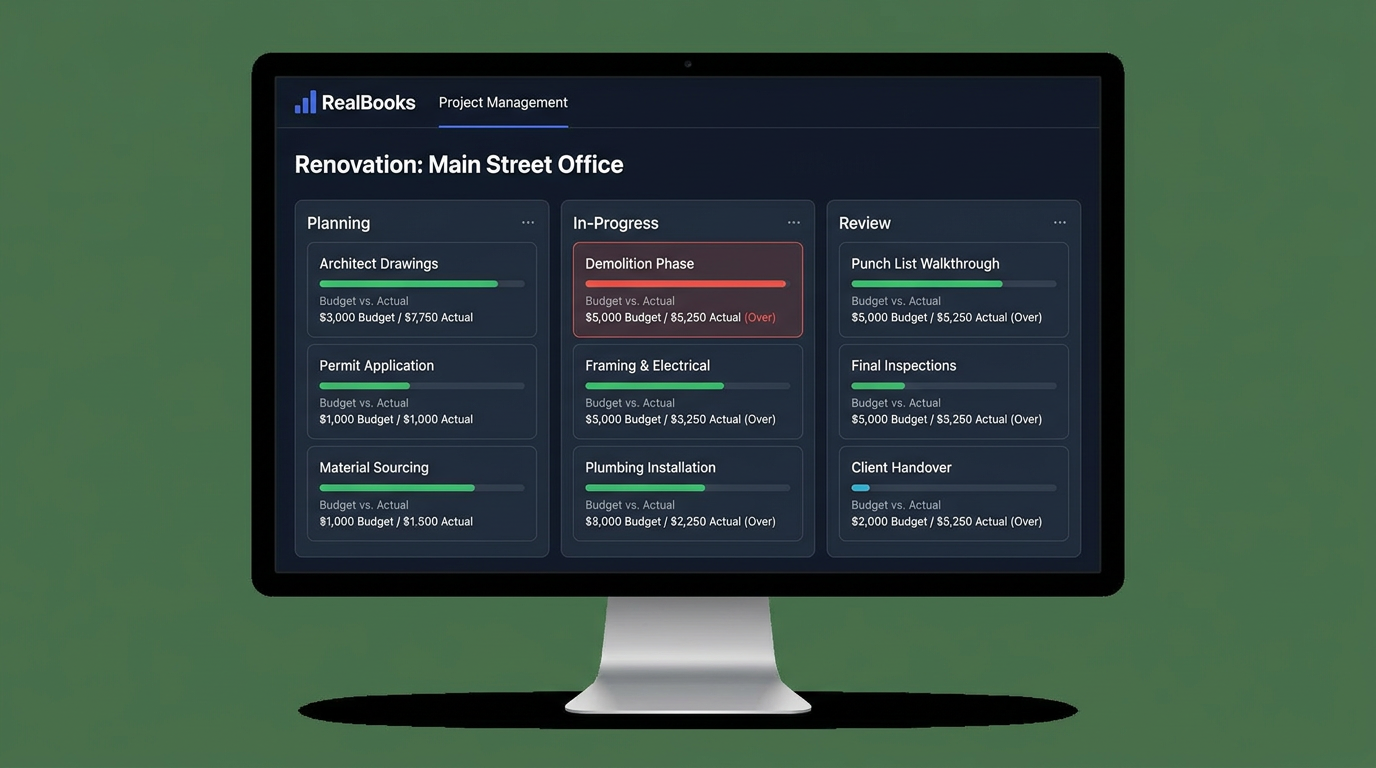
Renovation is where deals are made or broken. Every investor knows this from an operational perspective. What fewer investors fully grasp is that it’s also where the tax outcome is being set — one invoice at a time.
The renovation phase carries more financial nuance than any other stage of a flip. The classification of renovation costs, the treatment of renovation interest, and the distinction between what’s immediately deductible versus what gets added to your basis — these aren’t abstract accounting questions. They have direct, material impact on what you owe at disposition.
Repairs vs. Capital Improvements: The Distinction That Matters Most
Not all renovation spending is treated equally by the IRS, and the line between a repair and a capital improvement has significant tax implications.
A repair is work that keeps the property in its ordinary operating condition. Patching a leaking pipe, replacing a broken HVAC unit with an equivalent model, repainting a room — these are generally immediately deductible in the year incurred. They don’t get added to your basis; they reduce your taxable income directly.
A capital improvement is something that betters the property, restores it to a like-new condition, or adapts it to a new use. Full kitchen gut renovation, adding a bathroom, replacing a roof system, upgrading electrical panels — these get capitalized into your cost basis and are recovered at the time of sale (or, in a rental context, depreciated over time).
The IRS uses what’s commonly known as the BRA Test to evaluate renovation costs. Here’s what it asks:
- Betterment: Does this work fix a defect that existed when you bought it, or make the property materially better? → Capital
- Restoration: Does it bring the property back to its original working condition in a significant way? → May be a repair or capital, depending on extent
- Adaptation: Does it change how the property is used? → Capital
This determination isn’t always clean. A contractor replacing broken flooring throughout an entire property is harder to categorize than a single room patch. That’s exactly why the classification decision shouldn’t be made at tax time — it should be made as each invoice is processed.
UNICAP Rules: What They Are and Why They Apply to Flippers
Here’s where things get genuinely complex, and where most generic accounting tools completely fail real estate investors.
The Uniform Capitalization rules — codified as Section 263A of the Internal Revenue Code — require certain taxpayers to capitalize indirect costs into the basis of property they produce or develop. For a fix-and-flip investor classified as a real estate producer, this means that costs like interest, real estate taxes, insurance, and overhead expenses incurred during the renovation period may need to be capitalized into the property’s cost basis rather than immediately deducted.
In plain English: the interest you’re paying on your hard money loan during the renovation doesn’t automatically become an immediate expense deduction. Under UNICAP, it may need to be added to the property’s basis instead, and recovered at the time of sale.
As The Tax Adviser published by the AICPA explains, real estate producers are typically subject to these capitalization requirements. However, there is a significant exception for small business taxpayers: under Sec. 263A(i), taxpayers with average annual gross receipts below a specific threshold — $29 million for 2023 — are not required to capitalize costs under Sec. 263A. For most individual fix-and-flip investors, this exception may well apply, and it can meaningfully accelerate the deductibility of costs that would otherwise be carried on the balance sheet through the life of the project.
This is not a determination you should make on your own. It’s a conversation to have with your CPA before you start a project. But it’s also something your accounting system needs to be capable of handling — because if every expense lands in the same undifferentiated bucket, making that determination accurately is nearly impossible.
Budget vs. Actual: Protecting Your Margin in Real Time
Renovation overruns are the number one profit killer in fix-and-flip investing. Experienced investors know this. The challenge is that most tracking systems only tell you after the fact how bad the overrun was — usually when you’re reconciling at the end of the project or, worse, at the time of sale.
A purpose-built system tracks budget vs. actual spend in real time, as invoices come in and payments go out. That means you can see — during the renovation, not after it — whether your kitchen budget is at 65% or 105%. That visibility gives you options: you can negotiate, you can adjust scope, you can make informed decisions. You can’t do any of that if you’re working from memory or a spreadsheet updated every few weeks.
Contractor Management and Audit Defense
Every contractor invoice, every W-9, every payment record isn’t just bookkeeping hygiene. It’s documentation that defends your deductions in the event of an audit. Having project-level records — costs attached to specific work, at specific properties, in specific renovation phases — is a fundamentally different level of documentation than a bank statement showing a payment to “ABC Contracting.”
RealBooks Project Management handles every task, invoice, and contractor payment which is attached directly to the renovation project — not buried in an email thread or sitting in a contractor’s invoicing system. Budget vs. actual is visible in real time. Cost classification happens as costs are logged. And when the project closes, all renovation costs are automatically pushed to the expense ledger, properly classified as repairs or capital improvements.
For BRRRR investors, it’s worth noting again: every dollar of renovation cost flows into the property’s basis, which then drives both the refinance valuation and, if the property is retained as a rental, the depreciation schedule. Accuracy here has a long tail.
Renovation sets the stage. Now it’s time to close the deal — and understand what the financial finish line actually looks like.
Phase 3 — Disposition: Closing the Deal and the Books the Right Way
The day you sell feels like the finish line. And it is — operationally. Financially, it’s where every decision you made in Phases 1 and 2 either pays off or costs you.
Disposition is the phase where your taxable gain is calculated, where your tax classification determines your rate, and where the quality of your prior record-keeping determines how confident you can be in the numbers. Get it right, and you know your outcome before you sign the closing documents. Get it wrong, and you’re guessing — or leaving the gap for your CPA to fill in under time pressure.
Calculating Your Gain: The Formula That Rewards Good Records
The formula for calculating your gain on a flip is straightforward in principle:
Taxable Gain = Sale Price − Adjusted Basis
Your adjusted basis is your original cost basis — built during acquisition — plus all capitalized renovation costs from Phase 2. Every title fee, origination cost, and capital improvement you correctly tracked and captured reduces your taxable gain dollar for dollar.
Disposition costs also reduce your net proceeds and your taxable gain. Real estate commissions, closing costs, staging fees, and other sale-related expenses should be tracked and deducted — not estimated after the fact.
This is the moment where every dollar missed in Phases 1 and 2 becomes a tax overpayment. And it’s why the framework isn’t just about organization — it’s about protecting your after-tax profit.
The Dealer vs. Investor Question: The $50,000 Difference
Here’s the question that drives your entire tax outcome at disposition: is the IRS going to treat you as an investor or a dealer?
According to Cherry Bekaert’s real estate tax team, this distinction is one of the most frequently litigated issues in real estate taxation — and for good reason. The financial stakes are enormous.
As an investor: Your gain is taxed at capital gains rates — 0%, 15%, or 20% depending on your taxable income. If you held the property for more than 12 months, long-term capital gains rates apply. On a $100,000 profit, you might owe $15,000–$20,000 in federal tax.
As a dealer: Your gain is taxed as ordinary income — rates ranging from 10% to 37% based on your bracket — plus self-employment tax of 15.3%. On that same $100,000 profit, your tax bill could exceed $45,000. You also lose access to 1031 exchange treatment.
The IRS makes this determination by looking at a specific set of factors: the frequency and regularity with which you buy and sell properties, the extent of improvements you make, whether flipping is your primary business activity, how long you held each property, and what your stated intent was at purchase. None of these factors is individually determinative — they’re evaluated in combination.
If you flip properties regularly and it’s your primary income source, the IRS is likely to view you as a dealer. If you flip occasionally alongside other investment activities, investor status may be defensible. The right answer depends on your specific facts and circumstances — and it’s a conversation to have with your CPA before you start a project, not after you’ve already sold.
Why 1031 Exchanges Typically Don’t Work for Flippers
A common question among investors transitioning from buy-and-hold to fix-and-flip is whether a 1031 exchange can defer taxes at the time of sale. The short answer, for most flippers: no.
The IRS restricts 1031 like-kind exchange treatment to property held for investment or productive use in a trade or business — not property held primarily for resale. As the IRS explains in its guidance on like-kind exchanges, dealer property — inventory — does not qualify. If the property is classified as dealer inventory, the 1031 door is closed.
Reporting: Schedule D vs. Schedule C
Investors report their flip gain on Schedule D. Dealers report on Schedule C — or a business return, depending on entity structure. Getting this wrong isn’t a minor administrative error; it’s a material misstatement on your tax return that creates audit exposure.
If your books are phase-separated and your records are clean, generating the disposition summary is a straightforward exercise. RealBooks Tax Reporting produces tax-ready reports with phase-level detail — your adjusted basis automatically calculated from Phases 1 and 2, your gain clearly stated, and the summary exportable to your CPA in a single click.
Understanding the three phases is step one. The bigger question for most investors is: why do so many of them still manage this with tools that were never built for it?
The “One Big Bucket” Trap: Why Generic Tools Fail Fix-and-Flip Investors
You’re not doing it wrong. The tools you’re using were never built for what you’re doing.
That’s the honest framing. The spreadsheet approach and the generic small business accounting software approach both fail fix-and-flip investors for the same fundamental reason: they don’t understand phases. They treat every dollar of expense the same, regardless of when it was incurred, what it was for, or how it should be classified. The investor ends up making those determinations manually — usually under deadline pressure, with incomplete records, and after the fact.
The Spreadsheet Problem
Most investors start with a spreadsheet. It makes sense — you know Excel, you can build tabs, you can track columns. For the first deal or two, it might feel manageable.
Then you run three deals simultaneously. Then a contractor dispute on Deal 2 eats your attention for a month. Then tax season arrives and you’re printing bank statements and trying to remember whether that $14,000 payment to a contractor in October was Phase 2 renovation on the Maple Street property or Phase 1 closing costs on the Oak Avenue property.
There’s no phase separation in a spreadsheet. No budget vs. actual tracking. No automatic classification. No audit trail that ties a specific invoice to a specific project at a specific address. Just rows and columns that require a human being to maintain them with perfect discipline across every deal, every month, every year.
The Generic Software Problem
Tools built for small businesses — and even some general real estate platforms — treat real estate like any other industry. They’re designed for a plumber tracking invoices or a retail store managing inventory. They don’t have a concept of “cost basis” that distinguishes between acquisition costs and renovation costs. They don’t understand UNICAP. They can’t classify a renovation expense as a repair vs. a capital improvement and route it to the right ledger automatically.
The result is that the investor does all of this manually — or skips it entirely, leaving the classification decisions to the CPA at year-end. That’s the scramble. That’s the $800-an-hour CPA trying to reconstruct six months of renovation activity from a box of receipts.
The Real Cost of Getting It Wrong
Misclassifying a capital improvement as a repair — or vice versa — isn’t just a bookkeeping error. It’s a tax error with downstream consequences. Understating your cost basis overstates your taxable gain. Lumping renovation interest into operating expenses rather than capitalizing it (when UNICAP requires capitalization) creates a reporting discrepancy. Missing acquisition costs from your basis means you’re paying taxes on money that should have been shielded.
None of this is the result of being a bad investor. It’s the result of using a system that wasn’t designed for the complexity of what you’re doing.
What Purpose-Built Tracking Changes
When every expense is tagged to its phase at the moment it’s recorded — acquisition, renovation, or disposition — the entire picture changes. Budget vs. actual is visible throughout the renovation, not reconstructed at the end. Cost classification happens in real time, not at tax season. The year-end report is a printout, not an excavation.
RealBooks was built specifically for this. Not adapted from a general accounting platform. Not a workaround built on top of a small business tool. Purpose-built for real estate investors who run the full spectrum of deal complexity, from single-family flips to multi-property BRRRR portfolios. And it starts with Expense Management that captures and categorizes every transaction automatically — by property, by phase, by type.
This is exactly the problem RealBooks was built to solve — and it starts the moment you acquire a new deal.
How RealBooks and Dollar Bill Manage Project Phases Automatically
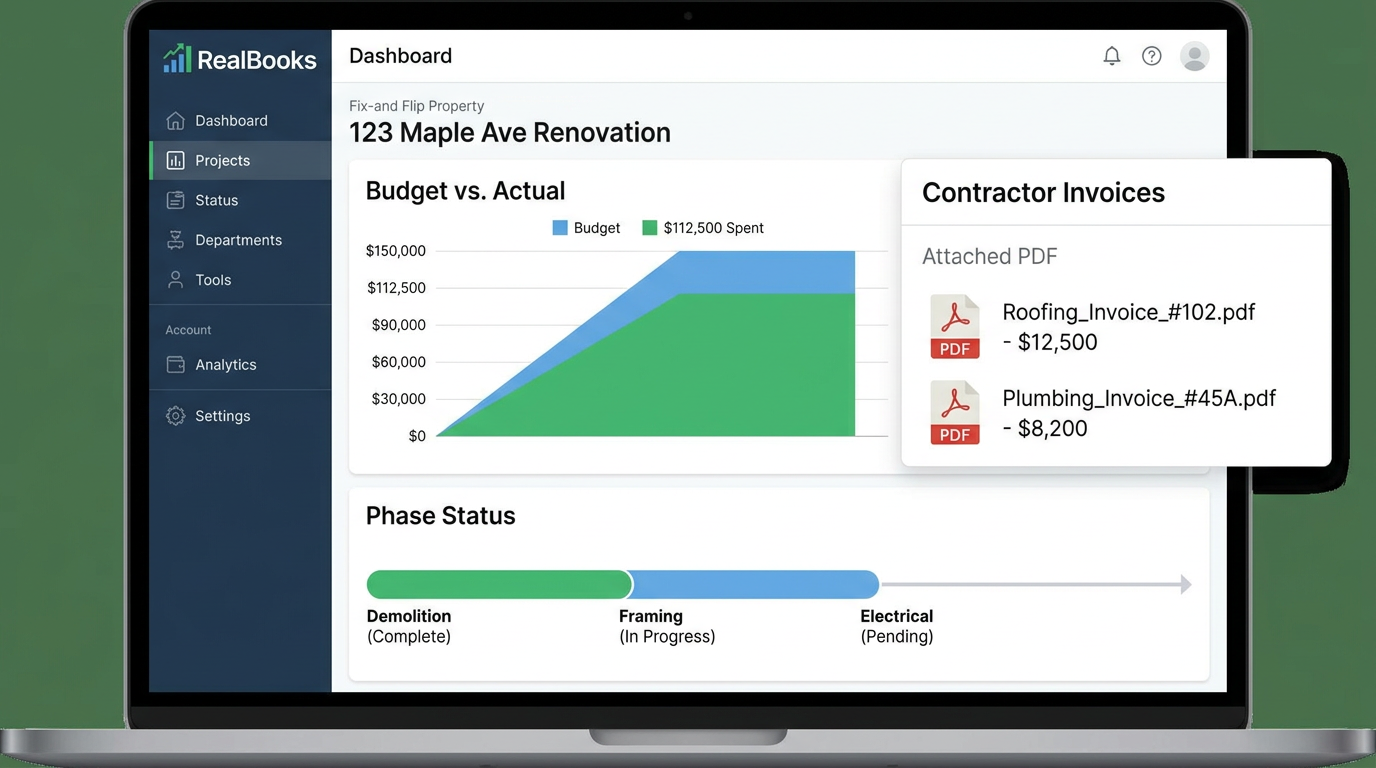
Let’s make this concrete. Here’s what the 3-phase framework looks like when it’s running automatically — powered by RealBooks and its AI agents: Dollar Bill, Penny, and Uncle Sam.
These aren’t generic software features. They’re purpose-built AI agents, each focused on a specific job in your financial workflow.
Dollar Bill — Your AI Project Builder
Dollar Bill is the AI agent that sets up every new deal. Tell him about an acquisition in plain English — the address, the purchase price, your renovation plan — and he creates the property record in RealBooks, establishes the cost basis, sets up a room-by-room renovation project, and generates AI-powered rehab estimates based on the scope you describe.
From the moment Dollar Bill sets up the deal, the phase structure is in place. Acquisition costs are tagged to the cost basis — not operating expenses. Renovation costs are routed to the project ledger. The two never get mixed. And because the structure exists from day one, every subsequent transaction that hits the system has a home.
Phase 1 in RealBooks — Acquisition
RealBooks Asset Management creates the property record the moment the deal is initiated. The purchase price, all closing costs, entity assignment, and financing details are captured and tagged appropriately. Basis tracking begins immediately. Nothing waits until after the renovation to be categorized — the acquisition record is complete and accurate from the day you close.
Phase 2 in RealBooks — Renovation
RealBooks Project Management powers the renovation phase through a visual kanban board that moves tasks through Planning → In Progress → Review → Complete. Budget vs. actual spend is updated in real time as invoices and receipts are processed. Every contractor invoice is attached directly to the relevant project task — not buried in an email inbox or sitting in a PDF folder.
When invoices come in through the expense management pipeline — via bank feed, receipt photo, or forwarded email — Penny, the AI categorization agent, routes each transaction to the right property, the right project, and the right phase. Repairs go to the appropriate ledger. Capital improvements get flagged for basis capitalization. The classification happens automatically, not as a year-end decision.
When a renovation project closes, all associated costs are pushed to the expense ledger automatically — correctly classified and correctly attributed to either the property’s basis or the deduction ledger.
For deeper technical detail on how the project management system works, the RealBooks Project Management documentation walks through the full workflow.
Phase 3 in RealBooks — Disposition
When the property sells, Uncle Sam — the tax reporting AI agent — generates a comprehensive, tax-ready report that includes your adjusted basis (automatically calculated from all Phase 1 and Phase 2 capitalized costs), your realized gain, and a full phase-level summary of income and expenses.
Your CPA receives a clean, exportable report — not a shoebox. The adjusted basis is calculated with full cost history included. Schedule D support is built in. The report reflects everything the 3-phase framework is designed to produce: accurate numbers, clean classification, and zero reconstruction required.
The Results for Real Investors
The investors using this system aren’t doing more work. They’re doing less — because the system does the classification, the categorization, and the reporting automatically. The result is an average of just 5 minutes of bookkeeping per week, and the kind of tax-ready records that protect deductions and reduce audit exposure.
📊 Ready to see the 3-phase framework in action?
RealBooks sets up your next flip automatically — from acquisition to sale. Start your free trial at app.realbooks.io — no credit card required.
Understanding the framework is valuable. Having it run automatically is transformative. Here’s how to put it into practice — starting today, with your next deal.
Putting the Framework Into Practice Starting With Your Next Deal
The 3-phase financial framework isn’t complicated. What makes it hard to implement is inertia — the pull of existing habits, existing spreadsheets, and existing tools that feel “good enough” until tax season proves they aren’t.
Here’s how to apply the framework starting right now, regardless of where you are in your current deal pipeline.
Step 1: Separate Your Phases Before You Close
The moment you sign a purchase agreement, create a dedicated tracking structure for that deal. This isn’t just an accounting best practice — it’s a tax defense strategy. Acquisition costs need their own record from day one. If you wait until after the renovation to sort out what belonged in basis vs. what was a renovation expense, you’ll be guessing. And guessing costs money.
If you’re using RealBooks, Dollar Bill sets this up for you the moment you input the deal. If you’re not yet on a purpose-built system, at minimum create a separate folder, spreadsheet tab, or ledger line for acquisition costs — and keep it separate from everything else.
Step 2: Know Your Classification Risk Before You Start
If you flip properties regularly — more than one or two per year — talk to your CPA about dealer vs. investor status before you start your next project. Not after you’ve sold. Before.
Your entity structure matters here. Operating through an S-Corp versus an LLC versus as an individual can significantly affect your tax outcome. So can the timing of deals, the extent of improvements, and your overall pattern of activity. These are decisions that can be planned proactively. They can’t be undone retroactively.
For investors who want to dig deeper into related tax strategy topics — including how recent legislative changes affect depreciation planning — the RealBooks blog post on how the Big Beautiful Bill changes bonus depreciation is a useful companion read.
Step 3: Track Renovation Costs in Real Time
Every invoice. Every receipt. Every contractor payment. These should be logged during the renovation — not reconstructed at year-end. The gap between real-time tracking and retrospective reconstruction isn’t just operational — it’s financial. Costs that can’t be documented are costs that can’t be defended.
This doesn’t require hours of administrative work per week. With bank feeds connected and a system that auto-categorizes incoming transactions, real-time tracking becomes a background process, not a burden.
Step 4: Classify Costs Correctly as You Go
The repair vs. capital improvement decision shouldn’t wait until your CPA asks about it in March. Build the habit of categorizing expenses by type as they’re processed. If you’re unsure whether a cost qualifies as a repair or a capital improvement, note it, flag it, and resolve it quickly — not six months later when the context has faded.
A system that handles automatic classification based on project context and invoice type makes this nearly effortless. That’s exactly what RealBooks Project Management is designed to do.
Step 5: Run a Disposition Report Before You Close
Know your projected taxable gain before the sale closes. Know your adjusted basis. Know your approximate tax liability. This isn’t just financial hygiene — it’s a negotiating tool. Knowing your after-tax outcome allows you to make better decisions about price, timing, and deal structure.
If you discover late in the process that your gain is higher than expected because renovation costs were misclassified, you have very few options. If you know early, you have choices.
With RealBooks Tax Reporting, this projection is available on demand — not just at year-end. Uncle Sam generates it automatically based on the real-time state of your books.
One System That Handles All of It
The investors who execute this framework consistently — phase separation from acquisition, real-time renovation tracking, accurate cost classification, pre-disposition reporting — don’t necessarily work harder than those who don’t. They use systems built for the complexity of what they do.
You can start building better habits right now, with your current tools. But if you want the framework to run automatically — so the focus stays on finding the next deal, not managing the last one — see how RealBooks works and explore getting started.
The Framework Is Your Profit Protection Plan
The 3-phase financial framework — Acquisition, Renovation, Disposition — isn’t an accounting exercise. It’s how smart investors protect their profit at every stage of a deal.
Every dollar that’s misclassified, missed, or misattributed is a dollar that either overstates your tax liability or underpays it — creating audit exposure. Neither outcome is good. Neither is acceptable when the fix is a system built to prevent it.
Tax preparation isn’t a year-end scramble — it’s an all-year practice. The investors who get this right aren’t doing extra work. They’re doing it once, correctly, in real time, with every cost properly attributed to the phase where it belongs.
The ones who don’t get it right aren’t careless. They’re using tools that weren’t designed for what they’re doing. A spreadsheet is a powerful tool — for many things. Phase-separated, basis-accumulating, UNICAP-aware real estate financial management is not one of them.
When your numbers work as hard as your investments do, the result isn’t just cleaner books. It’s more confident decisions, more defensible deductions, and more of your profit staying where it belongs — in your pocket.
“Your numbers should work as hard as your investments do.”
Start Running Your Flips With the Framework Built In
RealBooks is the bookkeeping and financial management platform built for real estate investors. It brings expenses, projects, and reporting into one place — so you can stop managing spreadsheets and start managing your portfolio.
Start Free Trial — No Credit Card Required →
See How It Works at realbooks.io →
Already tracking your flip in a spreadsheet? See how RealBooks handles project phase tracking — from first invoice to final report.
Ready to maximize your tax savings?
RealBooks automatically tracks expenses, manages assets, and calculates depreciation across your entire portfolio.
Start Free Trial →