How to Become a Landlord: The Complete Beginner's Guide to Buying, Managing, and Profiting From Your First Rental Property in 2026

Here’s something that rarely gets said out loud: the average landlord with two to five properties still tracks their income and expenses in a spreadsheet — or worse, a folder of crumpled receipts in a kitchen drawer. That’s not a criticism. It’s a reality check. And it’s a good place to start any honest guide on how to become a landlord, because it tells you something true about the gap between what people imagine landlording looks like and what it actually involves.
The idea sounds simple enough. Buy a property. Find a tenant. Collect rent every month. Let the asset appreciate. Build wealth while you sleep. And in broad strokes, that’s real. Rental property is one of the most time-tested vehicles for building long-term financial security — not because it’s easy, but because it rewards people who get the fundamentals right from the very beginning.
The reality, though, has more moving parts. There’s the acquisition process, the financing, the tenant screening, the lease agreements, the maintenance calls, the tax filings, the depreciation schedules, and the monthly reconciliations. None of it is impossibly complicated. But none of it runs on autopilot either — at least not without the right systems in place.
This guide covers all of it. From how to analyze your first deal and navigate financing options, to how to set up your landlord finances before the first rent check arrives, to how to handle tenants, taxes, and the financial habits that keep a rental portfolio profitable year after year. Whether you’re considering your first purchase or just trying to understand what you’re getting into, by the end of this you’ll know exactly what it takes — and what to set up from day one.
What Being a Landlord Actually Looks Like in 2026
Before you analyze a single deal or talk to a single lender, it’s worth getting clear on what you’re actually signing up for. Misaligned expectations are the root cause of most early landlord frustration — and the good news is, the reality is manageable once you see it clearly.
A landlord is a property owner who leases their property to tenants in exchange for rent. Simple enough. But attached to that definition is a set of legal obligations, financial responsibilities, and ongoing operational duties that don’t disappear once the lease is signed. You are, in a real sense, running a small business — even if you only own one property.
The passive income myth deserves a straight answer. Rental income can absolutely become relatively hands-off over time, especially once you have good tenants, systems, and possibly a property manager in place. But calling it “passive” in the early stages is a stretch. You’ll be setting up bank accounts, learning local landlord-tenant laws, responding to maintenance requests, reconciling monthly transactions, and preparing for tax season. None of these tasks are overwhelming individually. Together, in the first year, they take real time and attention.
That said, the operational load drops significantly once you have the right systems in place. This is one of the most important things to understand about building a rental portfolio: the systems you set up on property #1 are what allow you to scale to property #5 without chaos. First-time landlords who skip the setup phase — who start collecting rent without a dedicated bank account, without a bookkeeping structure, without a clear process for tracking expenses — end up paying for it in CPA hours, missed deductions, and stress every April.
The Main Ways Beginners Get Into Landlording
There are a few distinct entry paths worth knowing about, because the right one depends on your financial situation, your risk tolerance, and how involved you want to be.
The most common starting point is a long-term rental — purchasing a single-family home or a small multifamily property (a duplex, triplex, or fourplex) and renting it to one or more tenants on a standard 12-month lease. It’s predictable, relatively simple to manage, and gives you stable monthly cash flow.
House hacking is increasingly popular among first-time buyers — and for good reason. The strategy involves buying a small multifamily property, living in one unit, and renting out the others. The rental income from your tenants offsets your mortgage, dramatically reducing your own housing costs while you build equity. Because you’re occupying the property, you can often access owner-occupant financing with a lower down payment, which makes it one of the most capital-efficient ways to start. If this path interests you, the House Hacking: The Complete 2026 Guide goes deep on the strategy.
Short-term rentals — Airbnb or Vrbo-style — can generate higher gross income in the right markets, but they come with more complexity: higher turnover, more active management, local regulation variability, and platform dependency. They’re not typically the best starting point for a first-time landlord unless you have a specific market advantage or local support system.
What Day-to-Day Landlord Life Actually Looks Like
On a typical month, a landlord with one to three properties is handling: confirming rent receipt and following up on any late payments, responding to a maintenance request or coordinating a repair, reviewing bank statements, logging new expenses to the right property, and doing a light check on the lease status. It’s not a 40-hour-a-week job. But it’s also not zero. Expect to spend two to five hours per property per month on the administrative side — and more during tenant turnovers or major repairs.
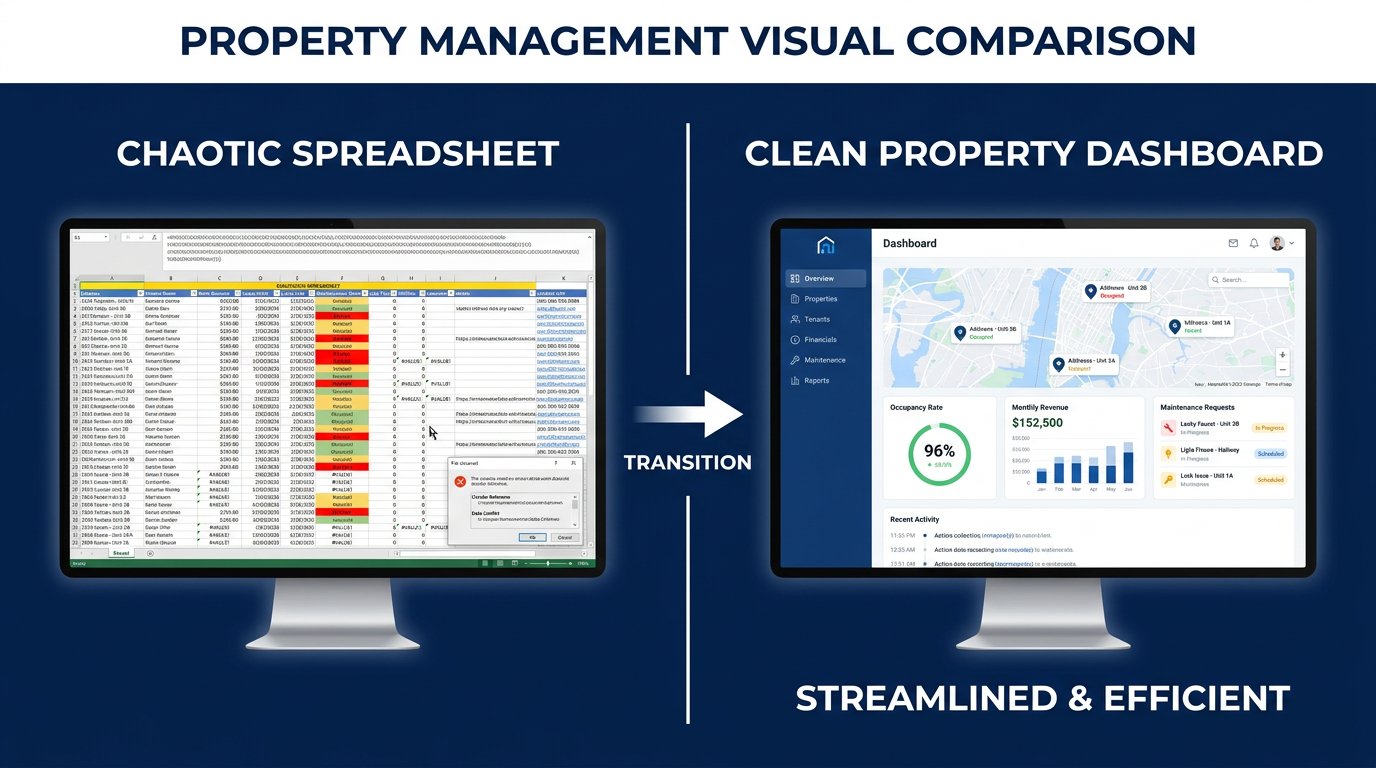
The biggest pain point for most landlords isn’t the maintenance or even the tenants. It’s the financial side — specifically, the fact that most property management tools and general accounting platforms were never built with rental real estate in mind. Data lives in spreadsheets. Expenses get mixed with personal accounts. Tax time becomes a reconstruction exercise. The landlords who avoid this trap are the ones who treat the financial setup as seriously as the property search itself.
With a grounded picture of what landlording actually involves, the natural next question is the one most people start with: how do you actually buy your first rental property — and how do you know if a deal genuinely makes sense before you commit?
How to Buy Your First Rental Property — From Pre-Approval to Closing
Buying a rental property is not the same as buying a primary residence. The financing works differently, the numbers you’re analyzing are different, and the due diligence process has a few extra layers. Here’s how to walk through it step by step — without getting swept up in a deal before you understand what you’re looking at.
Start With Your Numbers Before You Look at Properties
The most common mistake first-time investors make is falling in love with a property before they understand whether the financing actually works for them. Get clarity on three numbers before you ever open Zillow with investment intent.
Credit score: Investment property loans typically require a minimum score of 620 to 680, but you’ll access meaningfully better rates above 740. If your score needs work, that’s worth addressing before you start. A half-point difference in interest rate on a $250,000 loan adds up to tens of thousands of dollars over a 30-year term.
Down payment: For a conventional investment property loan, expect to put down 15 to 25%. FHA loans allow as little as 3.5% down, but only if you’re owner-occupying the property — which is why house hacking is such a powerful entry strategy for buyers with less capital. Per AmeriSave’s 2026 guide to buying your first rental property, down payment requirements are the single most common barrier for first-time investors who haven’t planned ahead.
Debt-to-income ratio: Most lenders want your total monthly debt obligations — including the new mortgage — to stay under 45% of your gross monthly income. Know this number before you get to the underwriting stage.
Choose the Right Financing Path
Once you know your baseline eligibility, you’ll want to match your situation to the right loan type.
- Conventional investment loans are the standard path for most buyers. You’ll put down 15-25%, qualify based on your personal income and credit, and get a 30-year fixed rate.
- FHA loans work if you’re house hacking — owner-occupying one unit of a 2-4 unit property. Low down payment, but mortgage insurance applies.
- DSCR loans (Debt Service Coverage Ratio loans) are increasingly popular with investors who have strong rental income but irregular personal income — self-employed buyers, for example. Qualification is based on the property’s projected rent-to-mortgage ratio rather than your personal income or tax returns.
- Portfolio loans are held by individual lenders rather than sold on the secondary market. Terms vary widely but can be more flexible on credit or property condition requirements.
Analyze the Deal Before You Fall for It
This is where most beginners either skip steps or get overwhelmed. The goal of deal analysis is to screen out bad deals quickly and evaluate promising ones carefully. A few tools help.
The 1% rule is a fast filter: monthly rent should be at least 1% of the purchase price. A $200,000 property should rent for at least $2,000/month. This isn’t a guarantee of cash flow — it’s a screen. Properties that don’t pass the 1% filter in most markets will struggle to cash flow after expenses. Properties that pass still need a full analysis.
Cap rate and gross rent multiplier are the two metrics most investors use to compare properties quickly. For a full breakdown of what each measures and when to use it, the Cap Rate vs. Cash-on-Cash Return guide walks through both in plain terms.
Run a Real Cash Flow Model
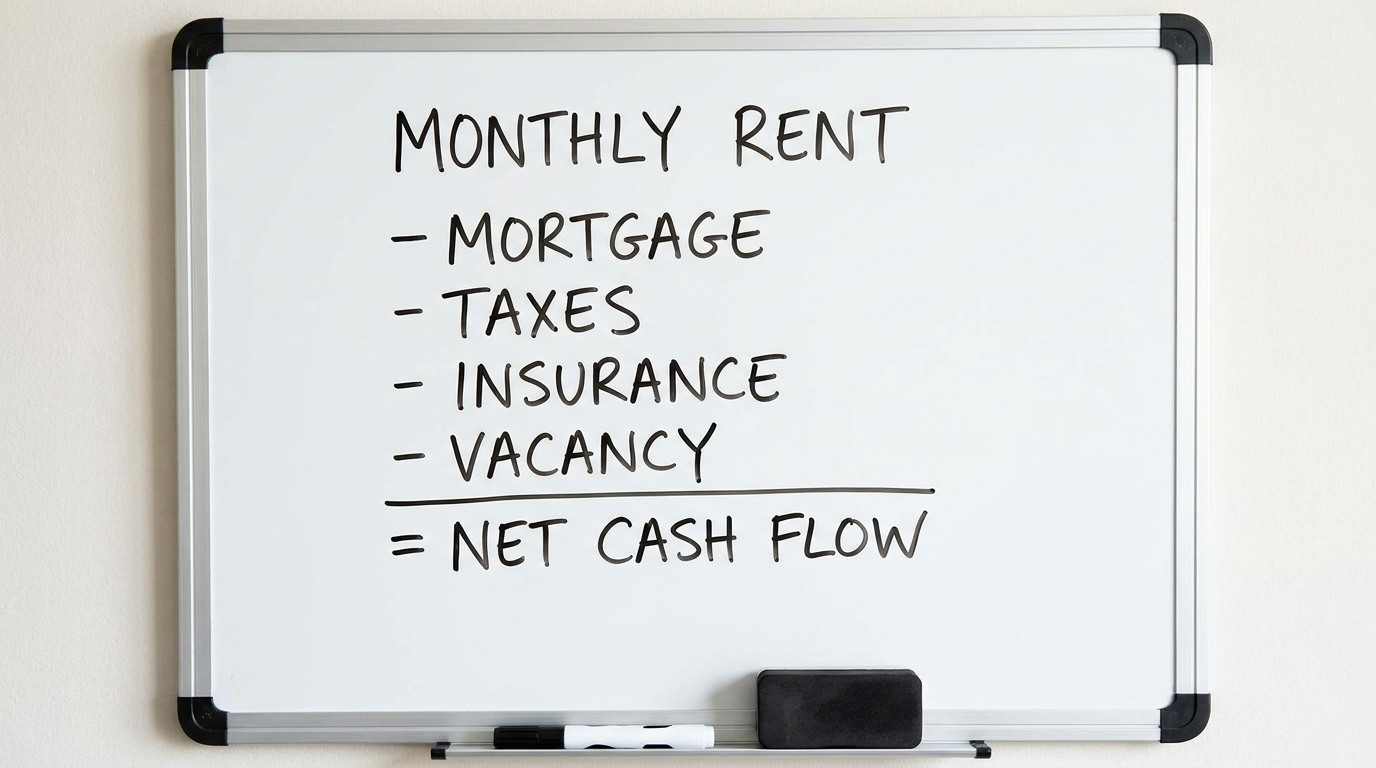
A simple example makes this concrete. Take a property at a $250,000 purchase price with a 20% down payment ($50,000). Your loan is $200,000. At a 7% interest rate on a 30-year fixed mortgage, your principal and interest payment is roughly $1,331/month. Add property taxes ($250/month), insurance ($100/month), and a vacancy allowance of 5% ($100/month on $2,000 rent). That puts your monthly expenses at approximately $1,781 before any maintenance reserve. On $2,000/month rent, you’re looking at roughly $219/month in net cash flow — before maintenance.
Most experienced investors budget 1% of the property’s value annually for maintenance and repairs. On a $250,000 property, that’s $2,500/year, or about $208/month. That brings your net closer to $11/month in the early years — not life-changing, but the equity paydown and appreciation are happening in the background. The numbers look better on properties with higher rent-to-price ratios, which is why market selection matters enormously.
Before you sign anything, budget for the unexpected. Understanding what renovation or repair costs you might be walking into is essential — the How Much Does a Renovation Cost? guide is a useful reference when estimating pre-purchase rehab costs.
Due Diligence, Closing, and What Comes Next
Before you make an offer, get a professional inspection. Not as a formality — as intelligence. A good inspector will flag deferred maintenance, roof age, HVAC condition, plumbing issues, and electrical concerns. Price any significant findings into your offer or your renovation budget.
Research comparable rentals in the area. Zillow, Rentometer, and local property management companies can all help you validate what the market will actually bear in monthly rent. If existing tenants are in place, review the current lease before closing — it transfers with the property.
At closing, take title in whatever ownership structure makes sense (more on LLC considerations in the next section). Set up your property in your financial system from day one. Get landlord insurance in place before the closing date. And prepare for your first tenant — which starts with understanding who to rent to, and how.
Once you’ve closed on a property, the clock starts — and so does your financial responsibility. Setting up the right financial infrastructure from day one is what separates landlords who always know their numbers from those who scramble at year-end.
Setting Up Your Landlord Finances From Day One
Most first-time landlords underestimate how important the financial setup phase is. Not because it’s complicated, but because skipping it creates compounding problems: mixed-up expenses, missed deductions, bookkeeping backlogs that take hours to untangle, and legal vulnerability if you’re holding property in an LLC. Getting this right before the first rent payment arrives is one of the highest-leverage things you can do.
Open Dedicated Bank Accounts — Not Optional
The single most foundational rule of landlord finance: never mix personal and rental money. Open a dedicated checking account for each rental property — or at minimum, one account per LLC if you hold properties in separate entities. Every rent payment goes in. Every expense comes out. Full stop.
Commingling funds isn’t just a bookkeeping inconvenience. If you hold property in an LLC and mix personal and business money, you risk “piercing the corporate veil” — meaning the liability protection the LLC is supposed to provide can be invalidated. Separate accounts are how you demonstrate that the entity is genuinely separate from your personal finances.
Should You Use an LLC?
This question comes up constantly with first-time investors, and the honest answer is: it depends, and you should talk to an attorney before deciding.
LLCs offer liability separation. If a tenant is injured on your property and sues, an LLC can theoretically protect your personal assets from the judgment. That’s real value, especially as your portfolio grows. What LLCs don’t offer for most beginners is a tax advantage. Single-member LLCs are pass-through entities by default — the income still flows directly to your personal return and gets taxed at your ordinary income rate. No special rate, no additional deduction. The tax treatment of a property you own personally and one you hold in a single-member LLC is essentially the same.
For managing the financial complexity that comes with multiple LLCs as your portfolio grows, the How to Manage Finances Across Multiple LLCs guide covers the strategies investors use to keep multiple entities organized and audit-ready.
Build Your Chart of Accounts From the Start
A chart of accounts is the financial skeleton of your landlord business — the categories that every dollar flowing through your properties gets assigned to. Setting it up properly from the beginning means your P&L statement always tells you something useful, your tax return is easy to prepare, and you never have to reconstruct what happened to money six months after the fact.
For a rental property, your core accounts typically look like this:
Income accounts: Rental Income, Late Fees Collected, Security Deposit Applied (only when applied — more on this below)
Expense accounts: Mortgage Interest, Property Taxes, Insurance, Repairs & Maintenance, Capital Improvements, Property Management Fees, Utilities (if landlord-paid), Advertising, Professional Fees (attorney, accountant), Travel
Liability accounts: Security Deposit Held (this is a liability, not income — you owe it back to the tenant unless applied)
Asset and equity accounts: Property Value, Accumulated Depreciation, Owner Equity
One of the most common bookkeeping errors first-time landlords make is recording security deposits as income when received. They’re not. They belong to the tenant until something changes. Booking them as income overstates your taxable rental income and can create reconciliation problems at lease end.
Automate Your Bookkeeping From Day One
Manual bookkeeping — spreadsheets, paper ledgers, even desktop accounting software that requires manual entry — works until it doesn’t. The limitations become visible fast: there’s no real-time view of where you stand, errors compound, and nothing scales. When you add a second property, your spreadsheet becomes a coordination problem. When you add a third, it breaks.
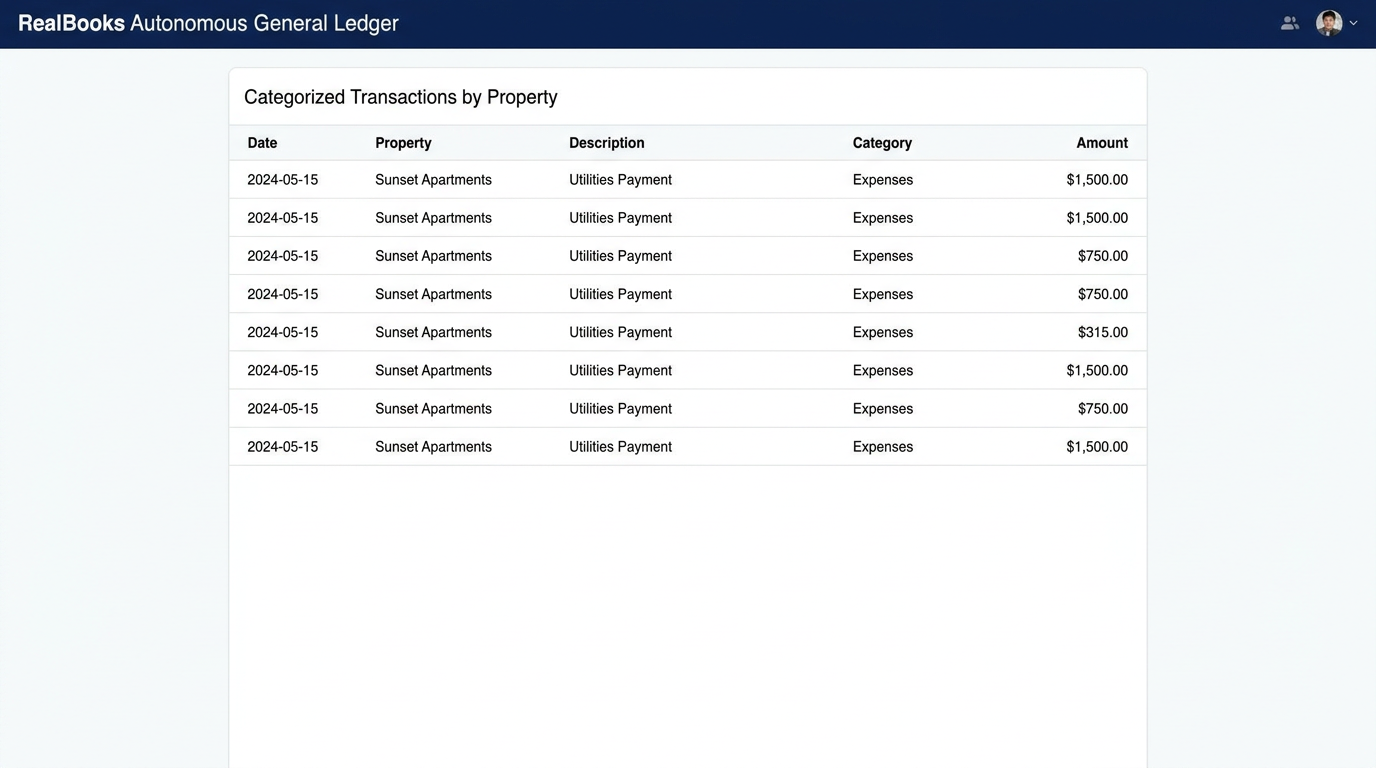
The alternative is connecting your bank feeds to a platform that categorizes every transaction automatically. Penny, RealBooks’ AI bookkeeper, does exactly that — connecting to your bank feeds and assigning every transaction to the correct property and expense category without manual data entry. Mortgage payment hits? Assigned to Mortgage Interest for the right property. HVAC repair invoice? Logged under Repairs & Maintenance, tied to the property address. No month-end reconciliation sprint. No backlog building up in a shoebox.
If you’re currently managing rentals on spreadsheets and wondering if there’s a better way, the Still Using Spreadsheets for Your Rental Properties? breakdown addresses exactly that question.
What Records to Keep — and For How Long
The IRS requires landlords to keep records substantiating all rental income and deductible expenses. That means: bank statements, receipts and invoices for every repair or expense, lease agreements, the depreciation schedule for each property, insurance declarations, and documentation of any capital improvements. The general IRS guidance is to keep rental records for at least three years after the return they relate to is filed — and longer if there’s any chance of audit or carry-forward items.
A well-organized financial setup isn’t just about tax compliance — it’s the foundation that makes every other part of landlording easier. And it’s worth getting right before your first tenant moves in.
Ready to set up your rental finances the right way from day one? Explore how RealBooks works →
With your finances structured and your property ready to rent, the next decision is one of the most consequential a landlord makes: who you rent to, and how you manage the relationship from there.
Finding, Screening, and Managing Tenants the Right Way
Tenant quality is one of the most important variables in whether a rental property is profitable or painful. A reliable tenant who pays on time, takes care of the property, and communicates like an adult makes landlording genuinely manageable. The wrong tenant — late payments, property damage, legal disputes, costly turnover — can erase a year of cash flow in a single lease cycle. Getting the selection process right is worth real time and attention.
Pricing Your Rental to Hit the Market
Before you list the property, spend time researching comparable rentals in the area. Zillow, Rentometer, Apartments.com, and local property management company websites are all useful data sources. Look at properties with similar bedroom count, square footage, condition, and location. Price too high and you extend vacancy; even one month of empty property at $2,000/month costs you $2,000 — often more than a small pricing adjustment would have cost annually. Price too low and you leave real money on the table over the life of the lease.
Aim for market rate. Not aspirational rate. Not bottom-of-the-market rate. The rent that a qualified tenant will actually sign for in your area, in your condition tier, within a reasonable marketing window.
Marketing That Attracts the Right Applicants
List on Zillow, Trulia, Facebook Marketplace, and Apartments.com. These platforms reach the majority of active rental seekers in most U.S. markets. Syndication means a listing on one often populates others automatically.
The single highest-impact variable in how quickly your property rents is photography. Clean, well-lit, professionally composed photos of a show-ready unit will reduce your vacancy period meaningfully. This is not the place to cut corners. A $150 photography session pays for itself in days if it reduces vacancy by even a week.
Write a listing description that’s accurate, readable, and complete. Include the rent, lease term, pet policy, parking situation, and any restrictions or requirements. Surprises discovered mid-showing are a waste of everyone’s time.
Screening Tenants — Consistently and Legally
Once applications start coming in, your job is to evaluate each applicant against a consistent, written set of criteria — and to apply those criteria uniformly to every applicant. This isn’t just good practice; it’s how you stay compliant with Fair Housing laws, which prohibit discrimination on the basis of race, color, national origin, religion, sex, familial status, or disability. Some states and municipalities add protected classes beyond the federal list.
A typical screening checklist includes:
Credit score — most landlords require a minimum of 620, though some set the bar higher in competitive markets. Pull credit through a screening service, not a personal favor.
Income verification — the standard is gross monthly income of at least three times the monthly rent. Request recent pay stubs, bank statements, or tax returns for self-employed applicants.
Rental history — contact previous landlords directly. Ask about payment history, property condition at move-out, and whether they’d rent to this person again.
Background check — a criminal background check is standard, though some states limit how far back you can look or what you can consider. Know your local rules.
Document your screening criteria in writing before you begin accepting applications. If an applicant is declined, the written criteria is your record of why the decision was consistent with your policy.
The Lease Agreement — Don’t Use a Generic Template
Your lease is a legal document. It governs your relationship with your tenant for the duration of the tenancy, and in many cases, beyond it. Use a state-specific lease — either one prepared by a local real estate attorney or one from a reputable property management software platform that’s updated to reflect current state law.
At minimum, your lease should address: rent amount and due date, grace period and late fees, security deposit amount and return conditions, lease term (start and end date), maintenance responsibilities (who handles what), pet policy, subleasing restrictions, and conditions for entry.
What’s enforceable varies significantly by state. A late fee that’s legal in Texas may be unenforceable in California. A self-help eviction clause that a landlord in one state thought was binding is almost universally illegal. State-specific matters.
Security Deposits, Rent Collection, and the Ongoing Relationship
Security deposits are a liability on your books from the moment you collect them — not income. Most states cap them at one to two months’ rent and have specific rules about how they’re held and returned. Track them separately in a dedicated account and a dedicated line in your bookkeeping system.
Set up automated rent collection from day one. ACH bank transfers through a property management portal or rent collection platform eliminate the paper check problem entirely. Rent should flow directly into your dedicated property checking account. When a payment comes in on time, it gets recorded automatically. When it doesn’t, you get a notification. No chasing, no guesswork.
For the ongoing landlord-tenant relationship, the habits that matter most are: a clear maintenance request process (written requests, documented responses), routine property inspections in compliance with your state’s required notice period, and proactive lease renewal conversations at least 60-90 days before expiration.

One distinction that matters more at tax time than most beginners realize: the difference between a repair and a capital improvement determines whether you deduct an expense in the year it’s paid or depreciate it over years. Repairs vs. Capital Improvements covers the IRS rules in detail and is worth reading before you make any significant spending decisions on the property. Understanding how IRS Publication 527 classifies what counts as taxable rental income — including advance rent, lease cancellation payments, and services in lieu of rent — is equally important.
Managing tenants and maintaining the property is the operational side of landlording — but what most beginners underestimate is the tax side, which starts the moment you close on the property.
Landlord Taxes Explained — Schedule E, Deductions, and Depreciation
Taxes are where most first-time landlords either leave money on the table or get themselves into trouble. The good news is that the U.S. tax code is genuinely favorable to rental property owners — there are substantial deductions available, including one that requires no out-of-pocket spending whatsoever. The bad news is that these advantages only show up if you’ve been tracking your finances correctly all year. Here’s what you need to know.
How Rental Income Is Taxed
Rental income is reported on Schedule E (Supplemental Income and Loss), which attaches to your Form 1040. It is classified as passive income by default — which means it is not subject to self-employment tax (15.3%), unlike income from a business you actively operate on Schedule C. For most landlords with long-term rentals, this is a meaningful tax advantage.
On Schedule E, you list each rental property separately with its address, report the total rents received for the year, then deduct eligible expenses line by line. The net income — or net loss — flows to your Form 1040 and is taxed at your ordinary income rate. If you own multiple properties, each gets its own column, and all net figures combine.
Short-term rentals — those rented for fewer than 15 days on average per year — can sometimes cross into business activity and get reported on Schedule C instead, where self-employment tax applies. The rules have nuance; if you’re running an Airbnb and providing hotel-like services, it’s worth discussing the classification with a CPA.
The Major Deductions Landlords Can Claim
The IRS allows landlords to deduct ordinary and necessary expenses of managing and maintaining a rental property. According to IRS guidance on rental income, deductions, and recordkeeping, the primary deductible expenses include:
Mortgage interest — the interest portion of your monthly payment (not principal) is deductible in full for most investment properties.
Property taxes — annual real estate taxes are deductible as a rental expense (note: the $10,000 SALT cap applies to your primary residence, not to rental properties, which are deducted on Schedule E).
Insurance premiums — landlord insurance, flood insurance if applicable, and any umbrella policies attributable to the rental property.
Repairs and maintenance — any ordinary repair that keeps the property in working condition. Fixing a leaky faucet, patching drywall, repainting a room. Deducted in full in the year paid.
Property management fees — if you hire a property manager, their fee (typically 8-12% of monthly rent) is fully deductible.
Utilities — if you pay any utilities on behalf of tenants, those costs are deductible.
Professional fees — attorney fees for lease drafting, CPA fees for tax preparation, and similar professional services attributable to the rental.
Travel — costs of traveling to inspect, maintain, or manage the property. Mileage, airfare, and lodging if you manage a remote property.
Advertising — the cost of listing the property, professional photography, and any paid marketing.
For a comprehensive look at every category available in 2026, the Every Tax Deduction Real Estate Investors Can Claim in 2026 guide goes through each line item with examples.
Depreciation — The Biggest Deduction Most Beginners Underuse
This is the deduction that genuinely changes the math of rental property ownership — and it costs you nothing out of pocket.
Residential rental properties are depreciated over 27.5 years using straight-line depreciation. That means the IRS allows you to deduct 1/27.5th of the depreciable value of the property each year, even while the property itself may be appreciating in market value. The land portion of the purchase is not depreciable — only the structure.
On a $300,000 property where $50,000 is allocated to land, the depreciable basis is $250,000. Divide by 27.5 and you get approximately $9,090 per year in depreciation deductions. This is a non-cash deduction — you don’t spend $9,090. You simply reduce your taxable rental income by that amount each year, even if the property is cash-flow positive.
For higher-value properties or investors looking to front-load depreciation benefits, cost segregation is worth knowing about. It’s a strategy that accelerates depreciation on certain components of a property — appliances, fixtures, paving — to shorter schedules (5, 7, or 15 years) rather than 27.5 years. The Rental Property Depreciation Guide 2026 explains the full calculation, and Cost Segregation 101 covers when and how to use that strategy.
Repairs vs. Capital Improvements — Get This Right
A repair keeps a property in its existing condition. A capital improvement extends the property’s life or adds to its value. The IRS treats them very differently.
Repairs are deducted in full in the year they occur. Capital improvements — a new roof, an HVAC system replacement, an added bathroom, a kitchen renovation — must be depreciated over time. Getting this wrong in either direction costs money. Calling a capital improvement a repair and deducting it in full triggers an audit risk. Treating a repair as a capital improvement and depreciating it means you’re waiting years to recover a deduction you could have taken immediately.
Passive Activity Loss Rules and Estimated Tax Payments
If your rental expenses exceed your rental income in a given year — not unusual in the early years, especially with a large depreciation deduction — you have a passive loss. Most landlords whose adjusted gross income (AGI) is under $100,000 can deduct up to $25,000 of those passive losses against ordinary income. That deduction phases out between $100,000 and $150,000 in AGI. Above $150,000, passive losses carry forward and offset future rental income or gains when you sell.
One more thing most first-time landlords don’t anticipate: rental income has no withholding. Nothing is taken out at source the way an employer withholds from a paycheck. If you expect to owe more than $1,000 in federal tax, the IRS expects quarterly estimated tax payments, due in April, June, September, and January.
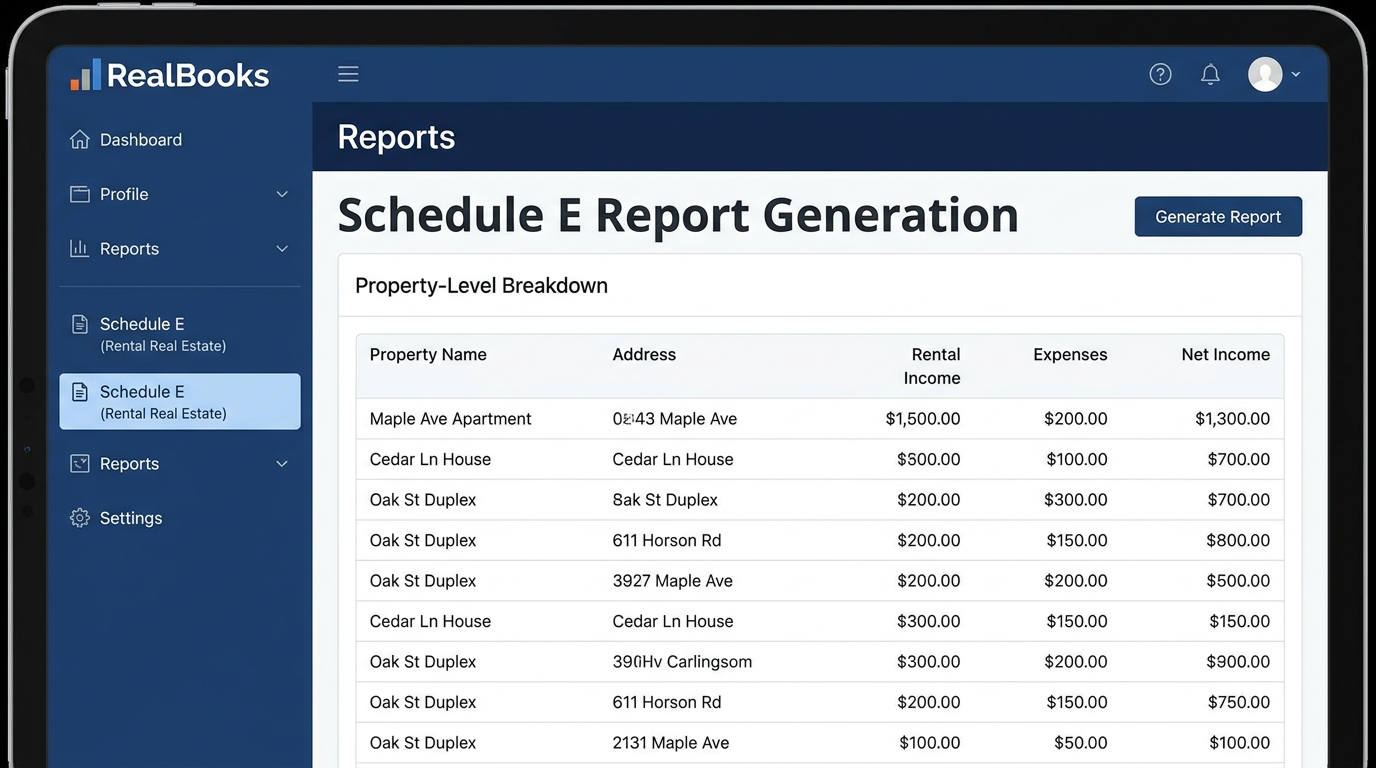
This is where staying organized all year — not just in April — pays off most. Uncle Sam, RealBooks’ AI tax strategist, scans every transaction in real time against IRS-recognized deduction categories so you’re not reconstructing a year of receipts during tax season. He handles depreciation tracking, flags potential deductions you might miss, and generates a tax-ready Schedule E report your CPA can act on immediately. RealBooks Tax Reporting is built to keep you tax-ready 365 days a year, not just on April 14th. As always — RealBooks is a financial management tool, not a licensed accounting firm. For personalized tax advice, work with a qualified CPA.
Understanding your taxes is essential — but staying tax-ready isn’t a once-a-year effort. The landlords who come out ahead financially are the ones who review their numbers monthly, not just in April.
The Financial Habits That Keep Landlords Profitable Year-Round
The investors who consistently know their numbers — who can tell you at any given moment whether each property is making money, what their year-to-date deductions look like, and whether they’re on track to hit their return targets — didn’t get there by accident. They built a financial rhythm. Not a complicated one. But a consistent one.
This is the practice that separates landlords who feel in control from the ones who feel reactive. And it’s achievable for anyone, including someone managing their first property.
Monthly Financial Habits
Every month, there are a handful of financial tasks that should happen as a matter of course — not in a frantic catch-up session, but as routine.
Confirm rent receipt. Verify that all rent payments have cleared your dedicated property account. Record any late fees. Follow up promptly on anything outstanding — a tenant who is two days late and hears nothing from you quickly learns that the policy is flexible.
Reconcile your accounts. Match every bank transaction against your ledger. If you’re using an automated system like Penny, this happens continuously in the background. If you’re doing it manually, make it a monthly standing appointment.
Review your property-level profit and loss. Is this property actually making money after all expenses this month? If not, why not — and is this a temporary deviation or a structural issue? Real-time visibility on this question is one of the most valuable things a landlord can have.
Categorize new expenses as they happen. Waiting until year-end to assign three hundred transactions to the correct property and expense category is a miserable exercise and an error-prone one. Capture expenses when they’re fresh.
Quarterly Financial Habits
Every quarter, zoom out. Reviewing cash flow by property on a three-month basis gives you a smoother signal than monthly numbers, which can be distorted by irregular expenses like annual insurance payments or one-time repairs.
Check your year-to-date expenses against your budget. Are you tracking as expected? Is any category running materially over? A maintenance category that’s trending high in Q1 can be an early warning sign of a larger problem — a roof that needs replacement, a plumbing system approaching failure — that’s cheaper to address proactively than reactively.
If you’re required to make quarterly estimated tax payments, this is the schedule: April 15 (for Q1), June 15 (for Q2), September 15 (for Q3), and January 15 (for Q4). Mark these in your calendar as non-negotiable. Underpayment penalties are small but avoidable.
The Mid-Year Financial Checkup for Real Estate Investors is worth bookmarking — it walks through exactly what to review in June and July to make sure you’re on track before the back half of the year.
Annual Financial Habits
At year-end, the scope widens.
Full tax preparation means pulling together Schedule E inputs for every property: total rents received, each deductible expense category totaled, depreciation amounts, and any carry-forward losses from prior years. If you’ve been capturing this throughout the year, it’s a straightforward handoff to your CPA. If you haven’t — it’s a reconstruction project.
Review your depreciation schedule. Confirm that any capital improvements made during the year have been added to the asset base and will be depreciated going forward. Confirm that any assets fully depreciated have been noted.
Renew your insurance and compare rates. Review leases expiring in the next 90 days and decide on renewal terms and any rent adjustments based on current market conditions.
The Six Financial Reports Every Landlord Should Track
These aren’t optional extras. They’re what your CPA needs for tax prep, what a lender wants to see when you apply for your next acquisition loan, and what you need to make smart decisions about whether to hold, refinance, or sell a property.
- Property-Level Profit & Loss Statement — is each property profitable, and by how much?
- Cash Flow Statement — where is money actually coming from and going?
- Rent Roll — all properties, all tenants, rent amounts, and lease expiration dates at a glance.
- Accounts Receivable — outstanding and unpaid rent, by property and tenant.
- Depreciation Schedule — your non-cash deduction tracker, updated annually.
- Tax-Ready Summary — Schedule E inputs organized by property, ready for your CPA to act on.
The Real Estate Bookkeeping Guide 2026 goes deep on how to structure each of these reports and what a complete bookkeeping system looks like for a rental portfolio at any stage.
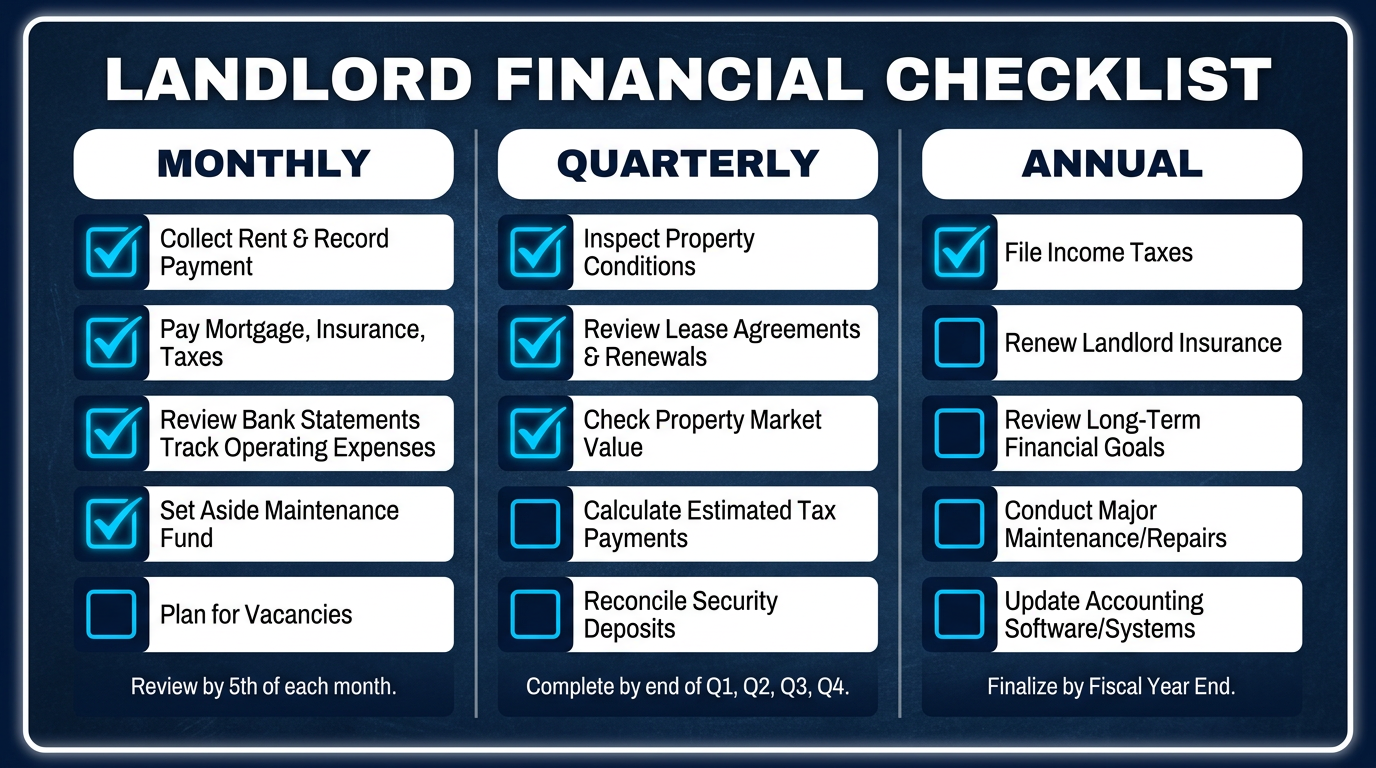
The landlords who run their portfolios this way — with monthly touchpoints, quarterly reviews, and clean year-end data — consistently outperform the ones who run on gut feel. The discipline isn’t complicated. The tools to support it are better than ever. And the payoff compounds year after year.
Building these habits from scratch takes consistency — but the right tools make most of them automatic, which is exactly what RealBooks is built to do.
How RealBooks Handles the Financial Side So You Don’t Have To
Starting your first rental property means you’re managing a property acquisition, setting up financial systems, tracking expenses from day one, preparing for your first tax filing as a landlord, and possibly navigating a renovation or initial rehab — all at the same time. That’s a real operational load, especially when you’re learning as you go.
RealBooks was built by real estate investors who got tired of managing rental finances in tools that were never designed for rental real estate — QuickBooks retrofitted with workarounds, spreadsheets that broke every time a column was added, and tax prep that was a multi-week reconstruction project every April. The platform is built from the ground up for rental property investors. Not adapted. Built.
Here’s how the three core AI agents work in practice.
Dollar Bill — Your Property Setup Agent
When you close on a new property, the first thing you need to do is get it into your financial system. Dollar Bill handles that in plain English. Tell him about the acquisition — the address, purchase price, financing terms, unit count, and any renovation work planned — and he creates the property in RealBooks, builds a project structure for any rehab work, and generates AI-based estimates for renovation scope. Every property, every project, organized from the start. No manual entry, no template-building, no figuring out what goes where. RealBooks Asset Management handles the full property lifecycle from acquisition forward.
Penny — Your Automated Bookkeeper
Penny connects to your bank feeds and classifies every transaction automatically by property and expense category. A mortgage payment comes through — Penny assigns it to Mortgage Interest for the correct property. A repair invoice hits the account — it goes to Repairs & Maintenance, tagged to the address it belongs to. Security deposit received — correctly booked as a liability, not income. Every transaction, every month, audit-ready in real time.
No spreadsheets. No manual reconciliation. No end-of-year scramble to figure out which expense belonged to which property. Penny maintains a continuous, accurate ledger for every property in your portfolio — and she scales as you add more. Explore how Penny works →
Uncle Sam — Your Year-Round Tax Strategist
Uncle Sam scans every transaction against IRS-recognized deduction categories for residential rental real estate in real time. He identifies deductible expenses, tracks depreciation schedules, and flags anything that might be misclassified. He handles standard straight-line depreciation over 27.5 years and, for eligible properties, coordinates cost segregation analysis to accelerate deductions through RealBooks Cost Segregation.
At any point during the year — not just in April — Uncle Sam can generate a tax-ready Schedule E report, organized by property, that your CPA can work from directly. RealBooks has helped investors across the platform identify over $2.4 million in tax savings. That’s not a function of doing anything complicated — it’s a function of capturing every deduction, every month, all year long. See RealBooks Tax Reporting →
The Autonomous General Ledger
Behind all three agents is the RealBooks Autonomous General Ledger — the financial engine that keeps everything running. Real-time bank feed sync, automatic transaction classification, property-level P&L statements, rent roll, accounts receivable, and one-click tax form generation. It’s the financial command center that replaces the spreadsheet stack, the receipt folder, and the month-end scramble. Explore the Autonomous General Ledger →

A final note worth being clear about: RealBooks is a financial management platform, not a licensed accounting firm. For personalized tax strategy, legal entity structuring, or advice specific to your situation, work with a qualified CPA and real estate attorney. What RealBooks gives you is the clean, accurate, real-time data they need to do that work efficiently — and the year-round visibility you need to make confident decisions about your portfolio.

What It Actually Takes — And Why You’re More Ready Than You Think
This is a lot of ground covered. Buying, financing, analyzing deals, setting up financial accounts, screening tenants, structuring leases, navigating taxes, building year-round financial habits, and choosing tools that do the heavy lifting automatically. Laid out all at once, it looks like a tall order.
And it is a real set of responsibilities. Becoming a landlord isn’t complicated, but it requires getting the fundamentals right — especially in the first year, when the habits and systems you establish will either serve you or haunt you for years.
The investors who struggle aren’t usually the ones who made a bad first deal. They’re the ones who ran their finances on gut feel, mixed personal and rental money, lost track of expenses across properties, and discovered in March that their “records” were a folder of screenshots and a half-filled spreadsheet. They paid for that in missed deductions, stressed tax seasons, and decisions made without accurate data.
The investors who come out ahead are the ones who treated their first property like what it actually is: a business. They opened the dedicated accounts. They set up the bookkeeping before the first rent payment. They tracked expenses as they happened. They built a financial rhythm and stuck to it. And they used tools that made most of it automatic.
Tax preparation isn’t a year-end scramble — it’s an all-year practice. Your numbers should work as hard as your investments do.
RealBooks is the bookkeeping and financial management platform built for real estate investors. It brings your expenses, projects, properties, and tax reporting into one place — so you can stop managing spreadsheets and start managing your portfolio.
Visit realbooks.io to see how it works →
See how RealBooks handles the financial side of your first rental — or share this guide with someone who’s thinking about buying their first investment property.
Ready to maximize your tax savings?
RealBooks automatically tracks expenses, manages assets, and calculates depreciation across your entire portfolio.
Start Free Trial →