House Hacking: The Complete 2026 Guide — How It Works, How to Run the Numbers, and How to Manage the Finances

Most homeowners write a mortgage check every single month and get nothing back. The payment leaves, equity creeps forward at a glacial pace, and the house costs them money — every year, without fail. House hackers play a different game entirely. Their tenants help pay the mortgage. The property generates income. The tax code works in their favor. And in many cases, they live for free.
That’s not a pitch. That’s arithmetic.
This guide covers house hacking from first principles to advanced financial strategy. You’ll find the four main approaches and how to choose between them, a complete deal analysis framework with real numbers, the tax deduction rules most guides get completely wrong, depreciation mechanics including cost segregation and 100% bonus depreciation under the One Big Beautiful Bill Act, and — critically — the bookkeeping challenge that trips up nearly every house hacker who doesn’t have a system built for it. If you’re a first-time buyer trying to make ownership affordable in a high-rate environment, or an experienced investor looking to add a cash-flowing asset at owner-occupant financing terms, this is the guide you need.
House Hacking in 2026: What It Is and Why the Timing Is Right
House hacking has a simple core: buy a property, live in one part of it, and rent out the rest. That’s it. The elegance is in what that simple arrangement unlocks financially — and why the current market environment makes it one of the most compelling wealth-building strategies available to individual investors right now.
Let’s start with the definition and build from there. A house hacker is an owner-occupant who uses their property to generate rental income. You might buy a duplex and rent the other unit. You might buy a single-family home with a detached garage apartment and lease it out. You might rent individual rooms to housemates, or list part of your property on Airbnb when you’re traveling. The form changes, but the financial logic stays constant: your tenants subsidize your housing cost, and in the best-case scenario, they eliminate it entirely.
The wealth-building mechanism runs deeper than just a reduced mortgage payment. When you purchase as an owner-occupant, you access financing terms that pure investors can’t get. FHA loans allow you to buy a property of up to four units with as little as 3.5% down, provided you live in one of the units. Conventional owner-occupant financing typically runs at better rates than investor financing, often by 50 to 100 basis points or more. So you’re entering a cash-flowing asset with less capital at risk and better financing terms than an investor buying the same property without the intention to occupy it.
Stack the advantages: low down payment entry, owner-occupant interest rates, rental income offsetting your mortgage, equity building through your tenants’ payments, and tax deductions on the rental portion of the property. The compounding effect on your return on invested capital is significant. A $20,000 down payment that gets you into a duplex generating $1,500 per month in rental income is doing a lot of work for a relatively small initial outlay.
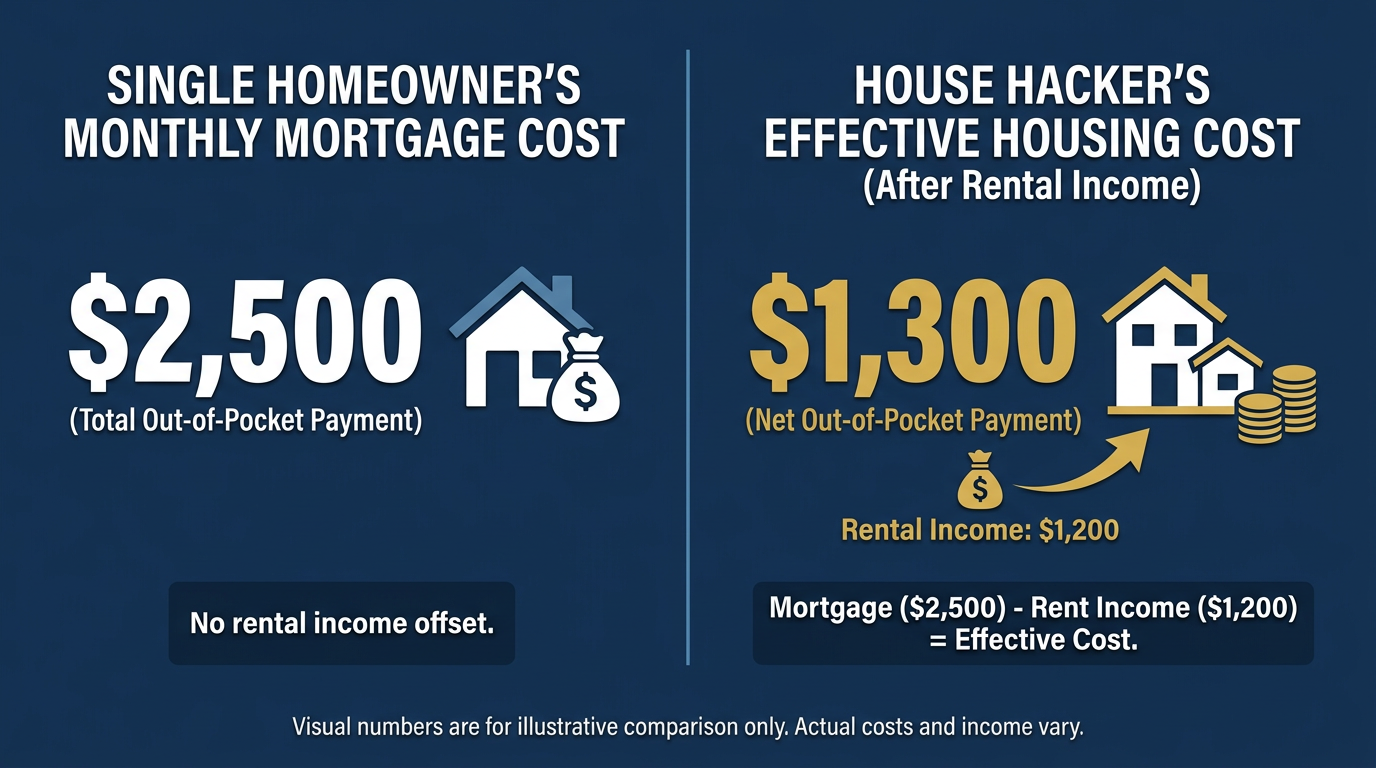
Now layer in the 2026 environment. Thirty-year fixed mortgage rates are sitting around 6.36% as of July 2026, with the range over the past year running from roughly 5.2% to just over 7%. That’s not a rate environment that makes pure homeownership cheap. On a $450,000 home at 6.36%, your principal and interest payment alone is roughly $2,800 per month before taxes, insurance, and any HOA. For a single-income buyer, that’s a crushing monthly obligation. For a house hacker with a tenant paying $1,800 of that, it’s a $1,000-a-month housing cost — below market rent for a comparable unit in most cities.
Home prices have remained elevated in most metro markets. Affordability pressure is real. But that same pressure that makes pure homeownership painful is also what makes house hacking tenants reliable — rental demand stays high when buying is expensive, and vacancy risk is lower when renters have fewer alternatives.
House hacking is also a natural bridge strategy for experienced investors who want to compare it against BRRRR or other acquisition approaches. BRRRR requires investor financing from the start and typically a larger cash reserve for the rehab phase. House hacking gets you into a cash-flowing asset at owner-occupant terms with a fraction of the capital. For investors expanding a portfolio, house hacking a new primary residence every one to two years is a recognized strategy for building a multi-property portfolio with minimal down payment exposure at each step.
The foundation is clear. Now the question is: which version of house hacking fits your situation?
The 4 House Hacking Strategies: Finding Your Right Fit
Choosing a house hacking strategy isn’t about picking the most popular option. It’s about aligning the strategy’s income potential, management demands, and financial complexity with your specific market, risk tolerance, and lifestyle. There are four main approaches, and each has meaningful trade-offs worth understanding before you make an offer.
The Classic Duplex, Triplex, or Fourplex
This is the house hacking model most investors picture first, and for good reason — it offers the cleanest structure, the most reliable income, and the most straightforward path to dramatically reducing your housing cost.
The logic is simple: you purchase a small multifamily property, occupy one unit, and rent the remaining units to tenants. On a duplex, one unit generates rental income. On a triplex, two units do. On a fourplex — the four-unit property that experienced house hackers often call the gold standard — three units generate income while you occupy the fourth.
The FHA financing advantage is most powerful here. FHA loans allow owner-occupants to purchase properties of two to four units with as little as 3.5% down, subject to loan limits that vary by market. There is an important nuance for three- and four-unit properties: the FHA self-sufficiency test requires that the projected rental income from all units (including the owner-occupied unit at market rent) be sufficient to cover the full PITIA payment — principal, interest, taxes, insurance, and any association dues. This test essentially ensures the property can stand on its own financially, which is actually a useful filter for the investor as much as for the lender.
A well-chosen fourplex in a solid rental market can often generate enough income from three units to cover the entire mortgage, leaving the house hacker living rent-free while building equity across all four units simultaneously. That’s not a theoretical outcome — it’s the actual result that aggressive house hackers are engineering in markets across the country.
Single-Family Home with an ADU
Accessory Dwelling Units — garage apartments, basement suites, detached backyard cottages, converted in-law quarters — have become one of the fastest-growing housing types in the United States. Many cities that previously restricted ADU construction have loosened zoning in response to housing shortages, and the result is a growing inventory of properties where a single-family home and a rental unit exist on the same lot.
For house hackers, an ADU setup offers a cleaner landlord-tenant dynamic than a duplex. The main house and the rental unit are physically separated, which means more privacy for both you and your tenant, fewer shared walls, and a living situation that feels less like a traditional landlord arrangement. ADU rents have appreciated sharply in most major markets as demand for smaller, affordable units has grown. A well-maintained ADU in a high-demand city can generate substantial monthly income relative to the additional cost of acquiring a property with one.
The trade-off is lower gross income potential compared to a triplex or fourplex. You’re running one rental unit instead of two or three. But for first-time house hackers who want rental income without the full operational weight of managing multiple tenants, an ADU property is often the right entry point.
Room Rental in a Single-Family Home
Renting individual rooms to housemates rather than entire units to tenants is the highest gross-income-per-dollar-of-mortgage strategy in many markets. In a five-bedroom home, renting four rooms at $800 per month each generates $3,200 in income against the same mortgage that a solo occupant would pay alone. In high-cost cities and college markets, room rents run considerably higher.
The income potential is real, but so is the management intensity. You’re sharing your living space with multiple tenants. Lease structures, house rules, common area maintenance, and tenant turnover are all more complex than in a traditional rental unit arrangement. The strategy works best in markets with strong demand from young professionals, graduate students, or traveling workers — demographics that are comfortable with a shared living arrangement and reliable on rent.
If you have the temperament for it and the right market, room rental can produce the largest immediate reduction in housing cost of any house hacking approach. If you value privacy and quiet and prefer a low-management landlord role, it’s probably not your model.
Short-Term Rental Hybrid
The fourth approach involves short-term rentals — listing your property or a portion of it on Airbnb or VRBO during periods when you’re not there, or dedicating specific rooms or units to STR while occupying the rest year-round. Nightly rates can be substantially higher than long-term rents in the right markets, making the income potential attractive.
The complexity, however, is proportionally higher. STR income is more variable than long-term rental income. Local regulations governing short-term rentals vary enormously and have tightened in many cities. Management demands — guest communication, cleaning, turnover, maintenance — are more intensive. And importantly, the tax treatment differs from standard long-term rental income — a distinction covered in detail in Section 4 of this guide.
The STR hybrid works best for investors in high-demand tourist or business travel markets, who are comfortable with the variable income and operational overhead, and who have systems in place to manage the guest experience efficiently.
“The best house hacking strategy is the one you’ll actually execute well. A fourplex that overwhelms you is worse than a duplex you manage confidently.”
Once you’ve identified the right strategy for your situation, the next critical step is running the numbers to make sure the specific deal you’re considering actually works.

How to Analyze a House Hack Deal: The Numbers That Actually Matter
Strategy selection is conceptual. Deal analysis is where house hacking gets real — and where most beginners either skip the math entirely or use the wrong metrics. Here is the framework you need to evaluate whether a specific property makes financial sense before you make an offer.
The Mortgage Offset Calculation
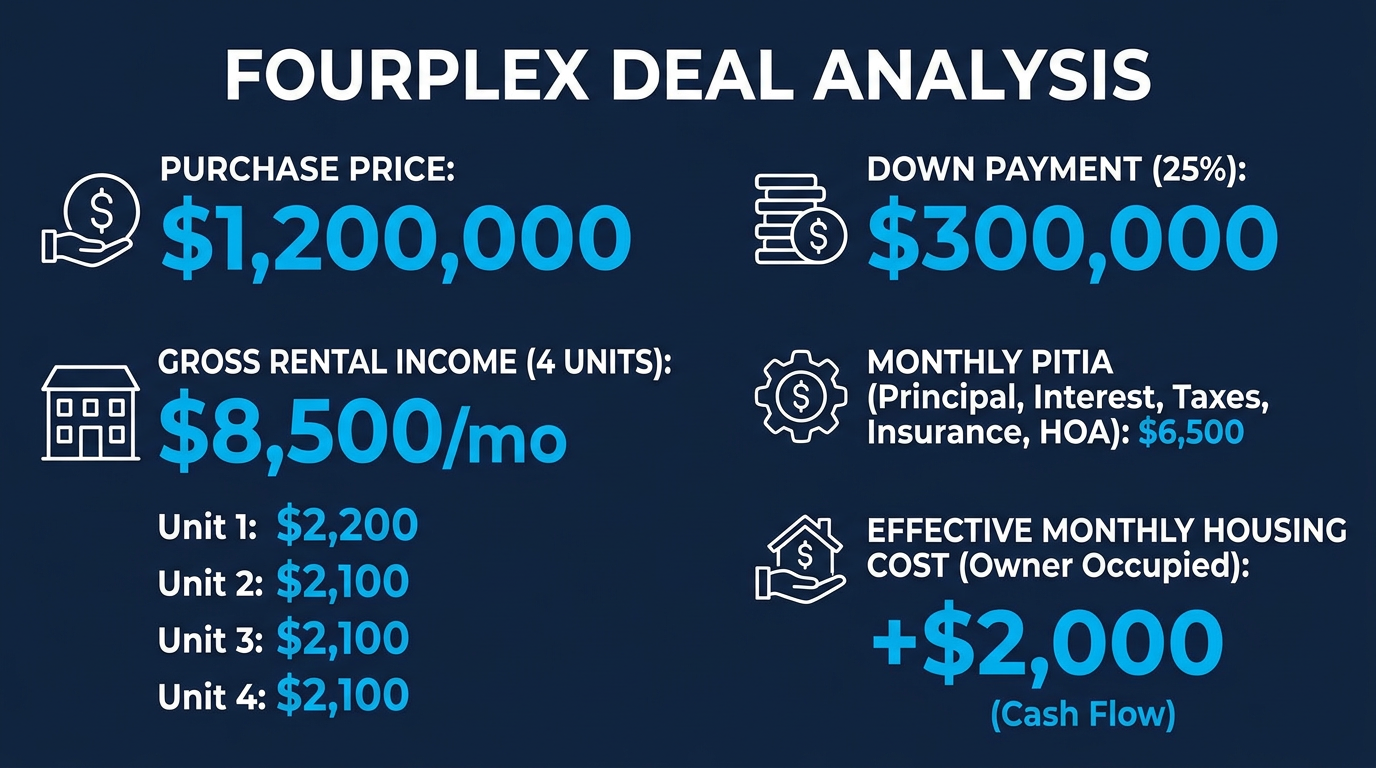
The mortgage offset is the house hacking-specific metric that no general real estate investing course will teach you, because it doesn’t apply to pure rental properties. The calculation is simple: take your total monthly rental income and subtract your full PITIA payment — principal, interest, taxes, insurance, and any HOA dues. The result is your effective monthly housing cost.
If that number is zero, your tenants are paying your entire mortgage. If it’s negative, they’re paying your mortgage and generating additional cash flow. If it’s positive, you’re still paying something toward housing — but almost certainly less than you would in a comparable rental in the same market.
Example: A $450,000 duplex financed with a conventional 10% down payment at 6.36% produces a principal and interest payment of roughly $2,530 per month. Add $500 in property taxes, $180 in insurance, and you’re at approximately $3,210 in PITIA. If the rental unit leases at $1,800 per month, your effective monthly housing cost is $1,410. Market rent for a comparable standalone unit in the same neighborhood is $1,600. You’re already $190 per month ahead of renting — and building equity.
Upgrade that scenario to a fourplex under FHA financing at 3.5% down, three rental units at $1,400 each: $4,200 in monthly income against a PITIA of perhaps $3,500. You’re cash flowing $700 per month while living in the property. That’s the power of scaling to additional units.
Net Operating Income
Net Operating Income (NOI) evaluates the property’s income-generating capability independent of your financing structure. Calculate it as gross rental income minus all operating expenses — vacancy allowance (typically 5-10% of gross rents), repairs and maintenance, insurance, property taxes, and property management fees if applicable. Exclude your mortgage payment from this calculation entirely.
NOI tells you what the property earns as a business, regardless of how you financed it. It’s the foundation for comparing properties across different financing structures and for understanding what happens if you eventually move out and convert the whole property to a pure rental.
Cash-on-Cash Return
Cash-on-cash return divides your annual pre-tax cash flow by the total cash you invested — down payment plus closing costs. For a house hack, the numerator gets more interesting: include not just your actual cash flow but also your housing cost savings. If market rent for your unit is $1,600 and your effective housing cost after rental income is $400, you’re effectively earning $1,200 per month in housing benefit. That benefit should be included in your CoC calculation because it represents real economic value — money you’re not spending.
On a $450,000 duplex with 10% down, your cash invested is approximately $45,000 in down payment plus $10,000 in closing costs, or $55,000 total. If your effective monthly housing cost is $1,000 and market rent is $1,600, your monthly economic benefit is $600, or $7,200 annually. Your cash-on-cash return is approximately 13.1% — a strong number before factoring in equity growth and tax advantages.
For a deeper comparison of cash-on-cash return versus cap rate methodology, the RealBooks blog covers both metrics in full.
Break-Even Occupancy Analysis
Break-even analysis asks: at what occupancy level do your rental revenues cover all operating expenses plus your mortgage? For a fourplex with three rental units at $1,400 each, total potential income is $4,200. If your PITIA plus operating expenses total $3,600, you break even at approximately 86% occupancy — meaning you can afford to have one unit vacant for most of a month and still cover your costs. That margin of safety matters enormously when evaluating risk.
Financing Options in 2026
Three primary financing paths apply to house hackers:
FHA — 3.5% down on 2-4 unit properties with a 580+ credit score. Subject to FHA loan limits by county and the self-sufficiency test for 3-4 unit properties. Requires mortgage insurance premium (MIP), which adds to your monthly payment.
Conventional — typically 5-20% down depending on unit count and lender requirements. No MIP with 20% down. Better rate environment than FHA for borrowers with strong credit profiles.
DSCR loans — Debt Service Coverage Ratio loans qualify on the property’s rental income rather than your personal income. Useful for investors who have complex income structures or who want to keep their personal debt-to-income ratio clean for other financing. Typically requires 20-25% down and carries a higher rate than owner-occupant financing.
The financing choice materially affects your mortgage offset calculation and cash-on-cash return. Run the numbers under each scenario before deciding.
Once the deal pencils out financially, the next layer of analysis is the tax side — which is fundamentally different in a house hack than in either standard homeownership or a pure rental property.
Tax Deductions for House Hackers: What’s Deductible, What’s Not
This is the section most house hacking guides get wrong, gloss over, or skip entirely. The tax treatment of a house-hacked property is not the same as a pure rental — and misunderstanding the rules leads to either missed deductions or overclaiming that creates audit exposure. Here is how it actually works.
The Fundamental Rule: Allocation
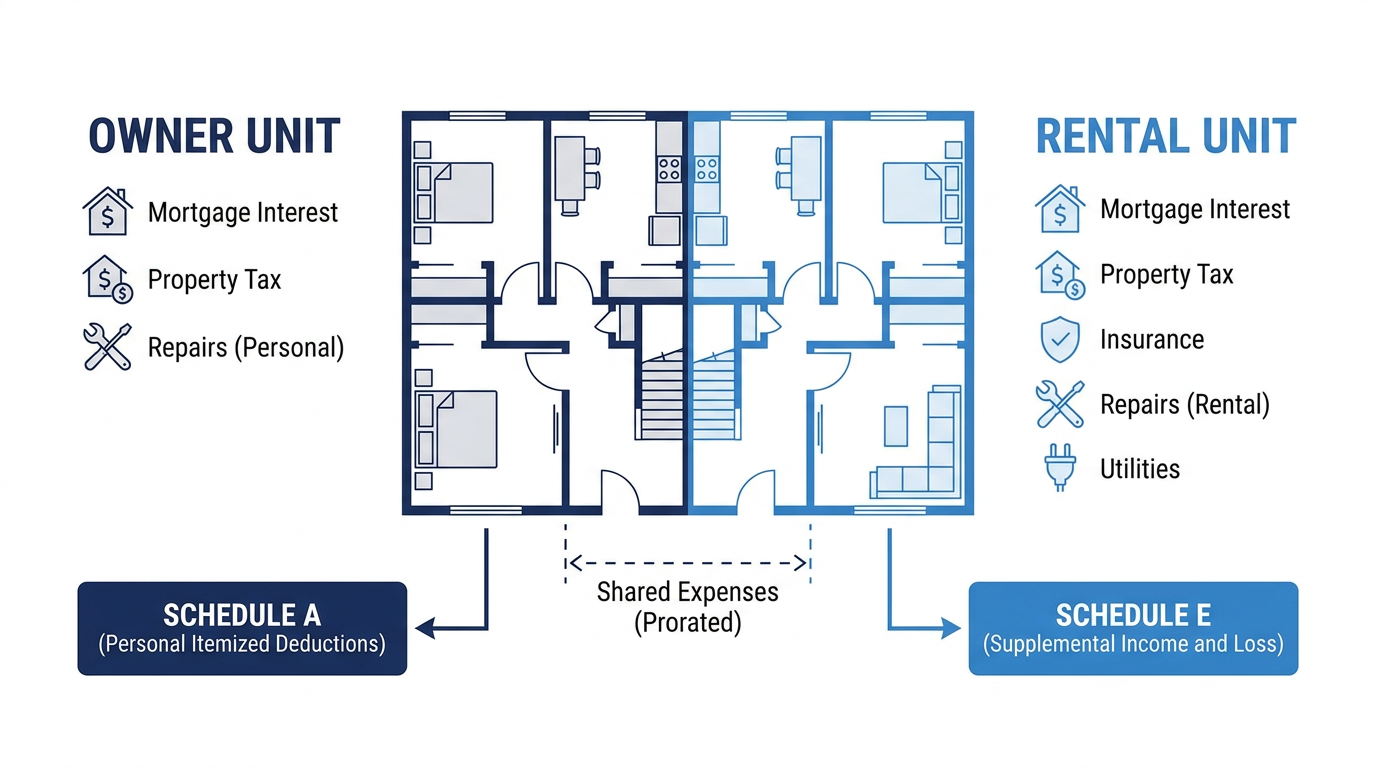
In a house hack, every expense related to the property must be allocated between personal use (your portion) and rental use (your tenants’ portion). Only the rental portion is deductible as a rental expense. The personal portion follows standard homeowner rules — potentially deductible on Schedule A if you itemize, but not on Schedule E as a rental expense.
This is a meaningful distinction. The IRS addresses expense allocation for mixed personal and rental use in Topic 509, and the methodology you use determines which percentage of every shared expense you can deduct as a rental cost.
Two Allocation Methods
Square footage method: Divide the rental square footage by the total square footage of the property. Example: your unit covers 1,200 square feet of a 2,400 square foot duplex. The rental unit is 50% of the total, so 50% of all shared expenses — the roof, the HVAC system, the landscaping, the shared water bill — are deductible as rental expenses.
Unit count method: For multi-unit properties, divide the number of rental units by the total number of units. A fourplex with one owner-occupied unit and three rental units: 3 ÷ 4 = 75% of shared expenses are deductible on the rental side. This method generally applies to true multi-unit properties where units are roughly comparable in size.
Choose your method based on which produces the most accurate reflection of the rental use of the property — and apply it consistently.
What’s Deductible on the Rental Portion
The full picture of real estate investor tax deductions covers the broader landscape, but for house hackers specifically, here is what flows to Schedule E as deductible rental expenses:
- Mortgage interest — the rental allocation percentage only. The personal portion goes to Schedule A.
- Property taxes — rental allocation only. Importantly, the $10,000 SALT cap that limits Schedule A deductions does not apply to the rental portion of property taxes on Schedule E. That portion is a business expense and is fully deductible up to the actual amount.
- Insurance premiums — your landlord or property insurance, at the rental allocation percentage.
- Repairs and maintenance on the rental unit — 100% deductible if the work exclusively benefits the rental unit. A broken faucet in the tenant’s bathroom, interior paint in the rental, a replaced appliance in the tenant’s kitchen — fully deductible.
- Shared repairs — roof replacement, HVAC service, foundation work — rental allocation percentage only.
- Utilities paid by you as the landlord — rental allocation percentage of any shared utility accounts.
- Property management fees — any portion attributable to the rental.
- Depreciation on the rental portion — covered in detail in the next section, and often the largest single deduction.
Direct vs. Indirect Expenses
The IRS distinguishes between direct expenses (costs that exclusively benefit the rental unit) and indirect expenses (costs that benefit the entire property). Direct expenses are 100% deductible on the rental side — no allocation needed. Painting the tenant’s bedroom is a direct expense. Replacing the shared roof is an indirect expense, subject to your allocation ratio.
Understanding this distinction matters especially when you’re doing renovation work. Knowing exactly which improvements qualify as repairs and which are capital improvements determines whether you deduct them immediately or depreciate them over time.
What Happens When You Sell: Section 121 and Depreciation Recapture
The Section 121 capital gains exclusion — $250,000 for single filers, $500,000 for married couples — only applies to the owner-occupied portion of a house-hacked property. The rental portion is subject to capital gains tax on appreciation plus 25% depreciation recapture tax on all depreciation you claimed during ownership.
This is not a reason to avoid depreciation. The time value of taking a deduction today versus paying a tax bill years from now almost always favors taking the deduction. But it is a reason to track your depreciation carefully and plan your eventual exit with a tax advisor. As Cummings Law’s CPA-authored breakdown of house hacking tax considerations notes, proper allocation from the start is critical to a clean accounting of your position when you sell.
Deductions are one tax advantage of house hacking. But depreciation — when structured correctly — is often the larger one, and it works differently on a house hack than on a standard rental property.
Depreciation on a House Hack: Calculating It, Claiming It, and Accelerating It
Depreciation is a non-cash deduction — it reduces your taxable income without requiring you to spend any additional money. For real estate investors, it’s one of the most powerful tools in the tax code. For house hackers, it works under the same principles as a pure rental property, with one critical constraint: you can only depreciate the rental portion.
Calculating Your Depreciable Basis
The calculation runs in four steps:
- Start with the purchase price. In our example, $400,000 for a duplex.
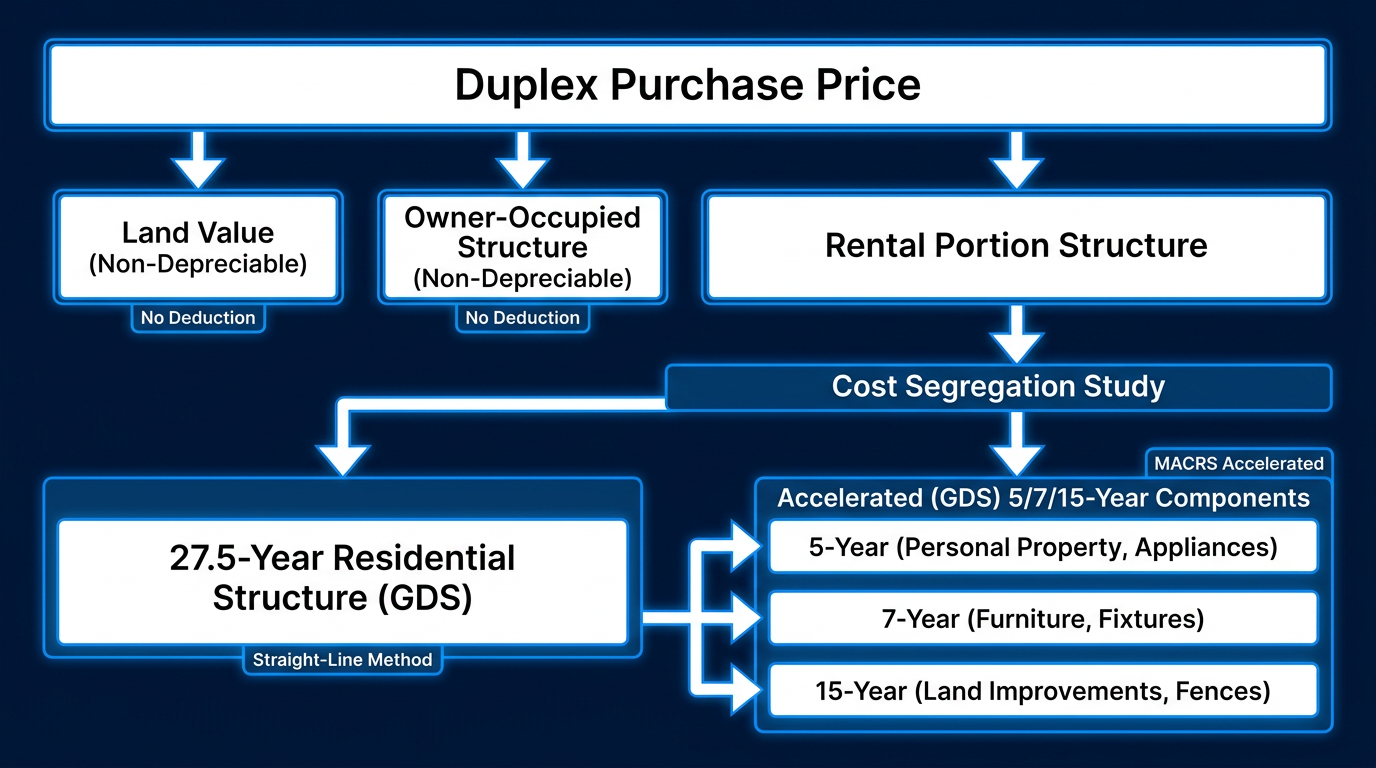
- Subtract the land value. Land is never depreciable. Use the property tax assessment’s land-to-improvement ratio as a reasonable proxy, or obtain an appraisal. Assume $60,000 in land value here.
- Apply the rental allocation percentage. Structure value is $340,000. At 50% rental allocation (square footage method on an equal-unit duplex), the depreciable basis is $170,000.
- Divide by 27.5 years. The IRS requires straight-line depreciation over 27.5 years for residential rental property. Annual depreciation: $170,000 ÷ 27.5 = $6,182 per year.
That $6,182 is a deduction you claim every year on Schedule E without writing a single additional check. At a 24% marginal tax rate, it saves you approximately $1,484 annually in taxes. Over a decade of ownership, that’s nearly $15,000 in tax savings from depreciation alone — on a property where your tenants are also helping pay the mortgage.
The Placed-in-Service Date
Depreciation begins on the placed-in-service date — the day the rental unit is ready and available for occupancy. Not the day you close on the property. Not the day your tenant signs a lease or moves in. The day the unit is rent-ready. If you close in August but spend three months renovating the rental unit, your depreciation clock starts in November, not August. This distinction affects your first-year depreciation calculation and matters at audit.
Cost Segregation: Accelerating Depreciation Beyond 27.5 Years
Standard depreciation assigns the entire depreciable structure to a 27.5-year schedule. But a property is not a monolith. It contains components — flooring, fixtures, appliances, cabinetry, certain electrical systems, site improvements like paving and landscaping — that have shorter useful lives under IRS guidelines. A cost segregation study identifies and reclassifies these components from 27.5-year property to 5-year, 7-year, or 15-year property.
The mechanics for a house hack: only the components associated with the rental portion of the property are eligible for reclassification. A cost segregation analysis on a 50/50 duplex looks at the tenant’s unit and identifies qualifying components there. The owner-occupied unit’s components are not eligible — you can’t depreciate the portion you live in.
For a deeper dive into the methodology, the RealBooks cost segregation guide walks through the full study process and when it makes financial sense to pursue one.
100% Bonus Depreciation Under the OBBBA: The 2025-2026 Game Changer
Here is where house hacking depreciation gets significantly more interesting for investors in 2025 and beyond. The One Big Beautiful Bill Act, signed on July 4, 2025, permanently restored 100% bonus depreciation for qualifying personal property acquired and placed in service after January 19, 2025. IRS Notice 2026-11, issued January 14, 2026, confirmed the rules and provided interim guidance on application.
What does this mean in practice? Short-life personal property — 5-year, 7-year, and 15-year components identified through cost segregation — can be fully deducted in Year 1 rather than depreciated over their recovery periods. For the full legislative context and implications, the OBBBA analysis on the RealBooks blog covers it in detail.
Applied to our duplex example: a cost segregation study identifies $40,000 in 5-year property within the rental unit — flooring, appliances, fixtures, certain electrical. Under 100% bonus depreciation, that’s a $40,000 deduction in Year 1. At a 32% marginal tax rate, that’s $12,800 in immediate tax savings, in addition to the $6,182 in regular annual depreciation.
As Wipfli’s analysis of the 2026 bonus depreciation rules notes, taxpayers should ensure their property meets all eligibility criteria and should document the placed-in-service date carefully. The component election under Notice 2026-11 also allows individual renovation components placed in service after January 19, 2025 to qualify even if the broader project began earlier — a useful provision for house hackers who are renovating the rental unit before or after closing.
One important note: the full rental property depreciation guide on RealBooks covers the 2026 methodology in full, including the interaction between standard depreciation, bonus depreciation, and passive activity loss limitations.
Depreciation Recapture: Plan for It, Don’t Fear It
All depreciation claimed on the rental portion is subject to 25% recapture tax when you sell. This is sometimes used as an argument against taking depreciation — which is financially backwards. A dollar of tax savings today, reinvested or deployed elsewhere in your portfolio, is worth more than a dollar of tax liability payable years in the future. Take the depreciation. Track it carefully. Plan the exit with a tax advisor.
The tax advantages of house hacking — deductions, depreciation, bonus depreciation — are real and substantial. But they only materialize if you’re tracking your finances correctly from day one. And that’s where most house hackers run into a problem that almost no tool has ever actually been designed to solve.
The House Hacker’s Bookkeeping Problem: Why Generic Software Leaves Money on the Table
Here is what house hack bookkeeping actually requires: every shared expense — the mortgage interest, the property insurance premium, the water bill, the landscaping invoice, the HVAC service call — must be split by your defined allocation ratio before it can be categorized correctly. On a 50/50 duplex, every shared bill generates two line items: 50% to the rental ledger as a deductible Schedule E expense, and 50% to your personal ledger as a non-deductible personal cost (or Schedule A eligible if you itemize). Do that correctly, consistently, for every transaction, for the entire year. That is what clean house hack bookkeeping looks like.
In practice, most house hackers don’t do it that way. They use a spreadsheet or a general-purpose accounting tool like QuickBooks, allocate expenses manually and inconsistently, miss the split on transactions that arrive in unexpected formats, and then face a scramble at year end trying to reconstruct which percentage of each shared expense was rental versus personal. The result is either an overstatement of deductions — which is an audit risk — or an understatement, which means money left on the table.

The Volume Problem
A house-hacked property generates 30 to 60 or more transactions per month across mortgage payments, utility bills, insurance, repairs, HOA dues, and incidental expenses. Each of those transactions may require allocation. At scale, the math compounds quickly. Miss the allocation on five transactions a month, and over a year you’ve miscategorized 60 line items — which means 60 potential errors on your Schedule E.
What Generic Accounting Software Gets Wrong
QuickBooks, FreshBooks, and general-purpose platforms have no concept of property-level allocation ratios. They don’t know that you own a house-hacked duplex and that 50% of your insurance premium belongs on Schedule E and 50% doesn’t. That logic has to be applied manually by the investor, every time, for every applicable transaction. There is no split logic built in. There is no understanding of which side of a transaction belongs on Schedule A versus Schedule E. The platform treats your house hack the same way it treats a restaurant or a consulting firm — as a simple business with income and expenses.
The investor fills in the gap manually. Most don’t — not with the consistency that clean books require. As the RealBooks bookkeeping guide for real estate investors notes, the distinction between property-specific bookkeeping and generic accounting is fundamental — and spreadsheets are no better than generic software on this front.
The Renovation Complication
When you’re actively renovating a house-hacked property — which many buyers are — the tracking challenge escalates. Some work benefits only the rental unit: fully deductible or capitalizable to the rental side. Some work benefits only your personal unit: no rental deduction at all. Some work is shared — the roof, the foundation, the main electrical panel — and must be split by your allocation ratio.
Without a project tracking system that understands the distinction between rental-only, personal-only, and shared renovation work, improvement costs get lumped into a single figure and you’re guessing at year end. You either over-deduct and invite scrutiny, or under-deduct and leave real money behind. The case for replacing spreadsheets with purpose-built tools is strongest in exactly this scenario — where the tracking complexity exceeds what manual systems can handle reliably.
What Correct House Hack Bookkeeping Actually Looks Like
Every transaction tagged at the point of entry as personal, rental-only, or shared. Shared expenses automatically split by your defined allocation ratio — no manual calculation required. Renovation projects tracked by unit and location, so rental-side work flows to the rental ledger and personal-side work stays out of your deductions. A depreciation schedule maintained for the rental portion only, updated as improvements are made. Year-round books that are always audit-ready, not reconstructed under deadline pressure in April.
That is not what spreadsheets produce. And it is not what QuickBooks was built to do. It is, however, exactly what RealBooks was built for.
How RealBooks Solves the Financial Complexity of House Hacking
RealBooks is an AI-powered financial platform built exclusively for real estate investors. It is not a general-purpose accounting tool with real estate features bolted on. It is a platform designed around the specific financial mechanics of property ownership — including the allocation, depreciation, and bookkeeping challenges that are unique to house hacking. Three AI agents power the platform, each handling a distinct layer of the financial complexity.
Penny: Your AI Bookkeeper
Penny connects to your bank feeds and imports transactions in real time. Every expense, every payment, every income deposit is categorized automatically and assigned to the correct property and ledger account. For a house-hacked property, Penny understands the allocation split you’ve defined. A water bill arrives: Penny splits it automatically — 50% to the rental ledger as a deductible expense, 50% to your personal ledger. No manual calculation. No risk of forgetting to allocate. No year-end reconstruction.
When a transaction needs review, Penny flags it with a suggested category for a one-click confirmation. For the vast majority of recurring transactions, no intervention is needed at all. Your books are current, clean, and audit-ready at all times — not just during tax season.
Dollar Bill: Your AI Project Builder
When you’re renovating a house-hacked property, Dollar Bill tracks every cost by room and by unit. Flooring work in the tenant’s bedroom: rental side, 100% deductible or capitalizable depending on classification. Kitchen renovation in your personal unit: personal ledger, no rental deduction. New roof: shared expense, split automatically by your defined ratio and queued for the appropriate depreciation treatment.
Every improvement is captured for your depreciation schedule as it’s completed — not reconstructed from memory nine months later. For house hackers doing renovation work on the rental unit, Dollar Bill is the difference between a clean depreciation record and a best-guess estimate that doesn’t hold up to scrutiny.
Uncle Sam: Your AI Tax Strategist
Uncle Sam handles the tax strategy layer. He runs depreciation on the rental portion only, using your defined allocation ratio and the placed-in-service date you’ve recorded. He identifies 5-year, 7-year, and 15-year property components for cost segregation analysis — the same reclassification that normally requires a costly engineering study, built into the platform automatically.
Under the OBBBA and IRS Notice 2026-11, Uncle Sam applies 100% bonus depreciation to eligible short-life components identified in the cost segregation analysis, maximizing your Year 1 deduction within the bounds of what the law allows. At year end, he generates a clean Schedule E summary — every deduction documented, every split accounted for, every number traceable — that your CPA can act on immediately rather than spend hours reconstructing.
The Autonomous General Ledger: The Financial Brain
Connecting all three agents is RealBooks’ Autonomous General Ledger — a self-managing financial engine that maintains a continuous, accurate record of every transaction across your property. Every dollar is classified. Every expense is tied to the right property, the right side of the allocation split, and the right expense category. Property-level profit and loss statements are available any time you want them — not just at year end, not just when you’re preparing for a refinance or a sale.
Here is what that looks like in practice: a $2,200 HOA bill arrives in your feed. Penny splits it 50/50 and posts $1,100 to the rental ledger as a deductible expense, noting the other $1,100 as personal. A roofing invoice comes in at $8,500. Dollar Bill categorizes it as a capital improvement, applies the 50% rental allocation, and queues the rental portion for Uncle Sam’s depreciation schedule. Uncle Sam runs cost segregation analysis on the roofing materials and determines what qualifies for accelerated depreciation under current rules. At year end, your Schedule E is already built. Your CPA reviews, not rebuilds.
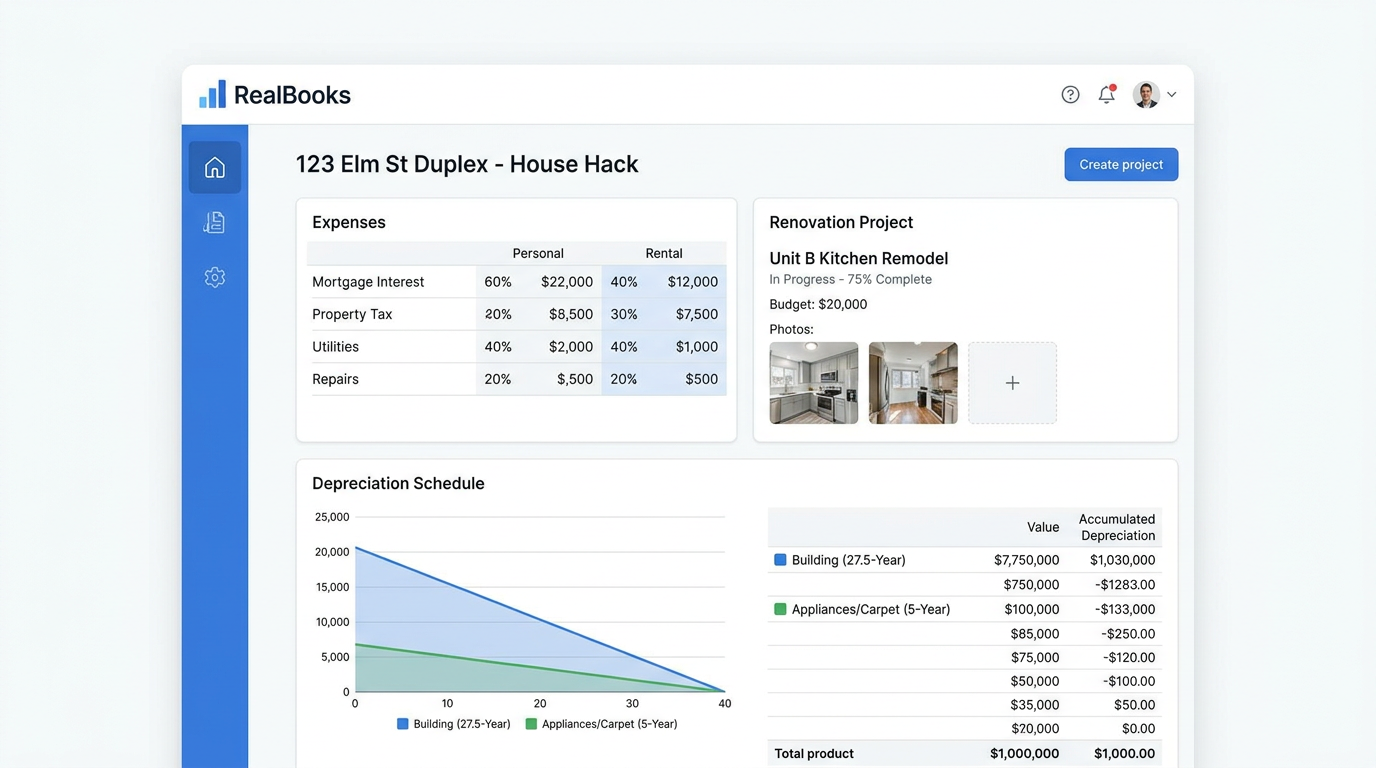
QuickBooks doesn’t know what a Schedule E is. It doesn’t understand allocation ratios, cost segregation, placed-in-service dates, or the difference between a repair and a capital improvement. RealBooks was built by investors who got tired of using tools that weren’t designed for what they actually needed — and then built what they wished had existed.
Your House Hack Needs Finances That Work as Hard as the Property Does
The math on a well-structured house hack is genuinely difficult to match. Low down payment entry through FHA or owner-occupant conventional financing. Rental income that reduces or eliminates your effective housing cost. Tax deductions on every legitimate rental expense. Annual depreciation that generates real paper losses against your rental income. Cost segregation and bonus depreciation that can produce significant Year 1 deductions under the OBBBA. And equity growth across the full property while your tenants fund a meaningful portion of the mortgage.
None of those advantages are automatic. Each one requires something from you: a correct allocation method applied consistently, clean expense tracking throughout the year, a depreciation schedule that reflects only the rental portion, and renovation costs captured at the unit level in real time. Get those systems right, and a house hack can be one of the most financially efficient investments available to an individual in 2026. Get them wrong, and you’ll leave a significant portion of the strategy’s financial benefit on the table — not because the strategy didn’t work, but because the tracking didn’t.
If you’re still building your bookkeeping system from scratch, start with the Real Estate Bookkeeping Guide — it covers the full framework for setting up clean financials across your portfolio, from your first rental to a multi-entity operation.
Your numbers should work as hard as your investment does. Most house hackers settle for something less. You don’t have to.
Your house hack should pay for itself — and then some. RealBooks tracks every expense, splits every shared cost, and builds your depreciation schedule automatically, so you capture every deduction the IRS allows without the manual work.
Visit app.realbooks.io to see how it works.
Ready to maximize your tax savings?
RealBooks automatically tracks expenses, manages assets, and calculates depreciation across your entire portfolio.
Start Free Trial →