LLC for Rental Property: The Complete Guide to Forming, Structuring, and Managing Your Real Estate LLC in 2026

You just closed on your second rental property. Your attorney casually mentions, “You should probably get an LLC.” You nod, open your laptop, and suddenly you’re drowning in 14 browser tabs — each one contradicting the last. Some say form it in Wyoming. Others say California will charge you $800 a year no matter what. One Reddit thread says your lender can call your loan due the moment you transfer the deed. Another says that almost never happens. This is the guide that closes those tabs.
Setting up an LLC for rental property isn’t complicated once someone explains it without the legal hedging or the hype. What it does require is understanding whether it’s right for your situation, which type of LLC fits your portfolio, how to actually form one, how to move existing properties into it, and — the piece most guides skip entirely — how to build the financial infrastructure that makes the legal protection actually hold. This guide covers all of it, in sequence, in plain language.
Let’s start at the beginning.
Do You Actually Need an LLC for Your Rental Property?
Here’s what most attorneys won’t say plainly: it depends. Not because they’re being evasive, but because the honest answer genuinely requires knowing a few things about your situation first. An attorney will almost always recommend an LLC — and they’re not wrong to do so — but understanding why and when it matters most will help you make a smarter, more confident decision rather than just filing paperwork because someone told you to.
The core reason investors form an LLC is liability protection. If a tenant slips on an icy walkway and sues for $800,000, or a contractor dispute turns into litigation that exceeds your insurance limits, an LLC legally separates your personal assets from the judgment. Your personal home, savings accounts, retirement funds, and other investments sit behind a legal wall. Without that wall, they’re all in the pool.
But the wall only holds under certain conditions. Specifically, it holds when you treat the LLC as a genuinely separate legal entity — separate bank account, separate finances, separate bookkeeping, and zero commingling between your personal spending and the LLC’s money. Courts can and do “pierce the corporate veil” when investors blur those lines, which is the legal way of saying: the judge looked behind the LLC and found that you were essentially operating it as your personal piggy bank, so the liability protection disappears. The legal structure alone isn’t enough. The financial discipline has to match it.
So when does forming an LLC for rental property make the most sense? The calculation shifts based on a few key variables:
- Single property, umbrella insurance in place, low liability risk: The urgency is lower. A solid umbrella insurance policy may provide sufficient personal asset protection at a fraction of the administrative overhead of an LLC.
- Multiple properties, growing portfolio, higher liability exposure: A different calculation entirely. The more properties you own, the more tenant relationships you’re managing, the more contractors walking through your units — the more exposure accumulates. An LLC (or a structure of LLCs) starts making obvious sense.
- Pools, older construction, short-term rentals: Higher liability environments by nature. An LLC here isn’t just prudent — it’s arguably essential.
- Financing situation: If you’re planning to use conventional financing (Fannie Mae or Freddie Mac-backed loans), you’ll almost certainly need to buy in your personal name first, then deal with the transfer question later. More on that in Section 6.
State law matters too. LLC protections, formation costs, and the practical enforceability of liability shields vary meaningfully from state to state. According to the IRS, an LLC is a business structure that can be taxed as a sole proprietorship, partnership, or corporation — giving investors flexibility that other entity types don’t. But the legal protections are entirely governed by state law, and what’s rock-solid in Texas may have nuances in California or New York.
For most investors who are actively building a rental portfolio — even if you only have one or two properties today — an LLC for rental property makes sense. The question isn’t really whether, it’s which type and when. And before you can answer that, you need a complete picture of what the LLC actually gets you.
Quick framework: Single property + umbrella insurance + low liability risk = LLC is optional. Multiple properties + growing portfolio + higher liability exposure = LLC is the right move. The question is just which structure fits.
For investors already managing multiple LLCs and looking for guidance on the financial side, RealBooks has a companion deep-dive on managing finances across multiple LLCs worth bookmarking now.
With the “do I need one?” question answered honestly, let’s go deeper into what an LLC actually does for a rental property investor — because the full list of benefits is longer than most people realize.
The Real Advantages of an LLC for Rental Property
Most articles about LLCs for rental property give you a bullet list and call it a day. This section earns more than that. Each benefit below is specific, real-estate-oriented, and relevant to someone who actually owns — or is actively acquiring — rental property. Understanding these fully changes how you think about LLC structure and financial management.
Personal liability protection is the headliner, and it deserves more than a one-line treatment. When a rental property is held in an LLC, the legal separation means that a judgment against the LLC is a judgment against the LLC — not against you personally. Your retirement account, your primary residence, your brokerage account, your car — none of those enter the equation. For investors with meaningful personal net worth to protect, this isn’t abstract. It’s the difference between a lawsuit being a business problem and a lawsuit being a life-altering event.
Pass-through taxation is where the financial benefits begin. An LLC doesn’t pay federal income tax at the entity level. Instead, rental income and losses flow directly through to your personal tax return via Schedule E, as the IRS explains in Tax Topic 414. This is fundamentally different from a C-Corporation, where income is taxed at the corporate level and again when distributed to shareholders. With an LLC, there’s no double taxation. Every dollar of rental income and every deductible expense flows through once, to your return, at your rate.
Tax flexibility goes one step further. A single-member LLC is taxed as a sole proprietorship by default. A multi-member LLC is taxed as a partnership. But either type can elect to be taxed as an S-Corporation if the structure warrants it — a move that can carry self-employment tax advantages for investors who eventually treat their real estate activity as a business. As your portfolio scales, that flexibility becomes genuinely valuable. It’s worth reading the RealBooks guide to real estate investor tax deductions in 2026 for a full breakdown of what flows through under each classification.
Asset separation between properties is the benefit that often gets glossed over. When each property — or group of properties — sits in its own LLC, a lawsuit tied to Property A legally cannot reach the assets in the LLC holding Property B. You’ve created legal firewalls between your investments. Without that separation, a judgment against one property could theoretically reach all of your other properties if they’re held under the same entity or in your personal name.
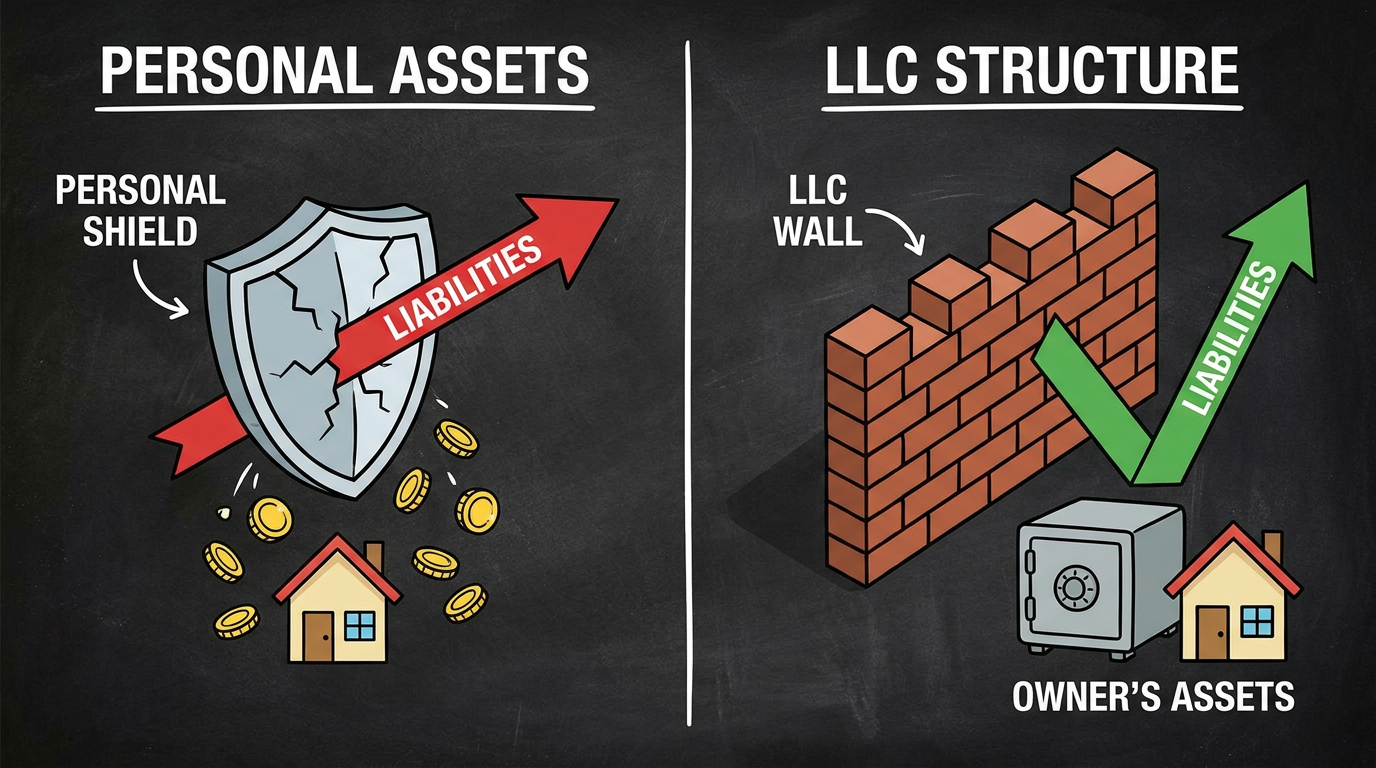
An LLC creates a legal wall between your rental property and your personal finances.
Privacy is a benefit that surprises many first-time LLC users. In many states, public property records list the LLC as the owner of record — not your personal name. That means a title search or a basic public records search doesn’t immediately surface your name as a landlord. For investors who own multiple properties and prefer to keep their real estate holdings out of plain sight, this layer of privacy has real value.
Professional credibility is subtler, but it matters. Vendors, contractors, property managers, and even some commercial lenders respond differently to an LLC than to an individual. It signals that you’re operating a business with some level of structure and intent — not just someone with a side property. That perception affects how quickly contractors call back, how property managers prioritize your account, and how portfolio lenders approach your application.
Estate planning and succession round out the picture. Transferring a membership interest in an LLC to a family member, trust, or business partner is administratively cleaner than a deed transfer for real property. For investors thinking ahead — about what happens to their portfolio when they’re no longer managing it — LLC ownership simplifies the mechanics of succession considerably.
The advantages are real, and for serious investors, they’re compelling. But any credible guide has to give you the other side of the ledger too — because there are genuine costs and complications that most LLC promotion conveniently omits.
The Disadvantages of an LLC for Rental Property — What Most Guides Don’t Tell You
This is the section that separates honest guidance from a marketing piece. The disadvantages of an LLC for rental property are real, they matter, and you should understand them fully before filing anything.
Formation and ongoing costs are the first reality check. Filing fees alone range from $50 in Kentucky to $500 or more in Massachusetts. California imposes an $800 annual minimum franchise tax on every LLC, regardless of income — confirmed annually via the California Franchise Tax Board. If you own three properties in three separate California LLCs, you’re paying $2,400 per year before a single business expense. Add registered agent fees ($50–$300 per LLC per year), annual report filings, and state-specific taxes, and the overhead compounds quickly as your portfolio grows.
Financing difficulty is perhaps the most practical obstacle investors encounter. Most conventional lenders — Fannie Mae and Freddie Mac-backed loans — will not lend to an LLC. They require the loan to be in your personal name. That means investors who rely on conventional financing typically buy properties personally first, then deal with the transfer process afterward (and all the complications that come with it, which Section 6 covers in depth). Portfolio lenders and commercial lenders will lend to LLCs, but their rates are generally higher and their underwriting criteria are different. This is a meaningful structural constraint that shapes how and when you can use an LLC.
Administrative burden scales with your portfolio in ways that are easy to underestimate at the beginning. Each LLC needs its own bank account, its own bookkeeping ledger, its own tax reporting structure. More LLCs means more monthly reconciliations, more annual filings, and more opportunities for something to fall through the cracks. According to the RealBooks Real Estate Bookkeeping Guide, investors who don’t build a systematic financial infrastructure from day one typically find the administrative load overwhelming by the time they reach four or five entities.
The corporate veil problem is the most critical risk to understand. The LLC only protects you if it operates as a genuinely separate entity. That means: rent checks go into the LLC bank account, not your personal account. Repairs are paid from the LLC account. You don’t use LLC funds to pay your personal credit card bill. The moment you commingle funds — even occasionally, even by accident — you create the conditions for a court to pierce the corporate veil and expose your personal assets to judgment. The legal structure is only as strong as the financial discipline behind it.
The LLC protects you. But only if you run it like one.
Multi-state complexity is a real cost for investors who own properties across state lines. Owning a property in Texas and one in Georgia doesn’t just mean two state filings for one LLC — it typically means registering as a foreign LLC in each additional state, which comes with its own fees, its own annual reports, and its own registered agent requirements per state.
The due-on-sale clause is the financing complication that makes many investors hesitate before transferring existing properties into an LLC. It gets its own full section (Section 6), but the short version is: most mortgage contracts include a provision that technically gives the lender the right to call the loan due if the property is transferred to another entity. An LLC transfer can trigger that clause. Proceed carefully.
Self-employment tax considerations are worth flagging with your CPA. Depending on how the LLC is structured and your level of active involvement, rental income may or may not be subject to self-employment taxes. The classification matters more than most investors realize when tax time arrives.
As Wolters Kluwer notes in their analysis of forming an LLC for rental property, the due-on-sale risk and ongoing compliance burden are the two most significant practical obstacles investors face — and both are manageable with the right approach.
Now that you have a balanced picture — real advantages, real disadvantages, no spin — the next question is the practical one: how do you actually form an LLC for rental property, step by step?
How to Form an LLC for Rental Property — Step by Step
The good news is that forming an LLC is not complicated. It’s a series of concrete, sequential steps — most of which can be completed in a few days. Here’s exactly how to do it, from zero to a fully operational LLC.
Step 1 — Choose your state of formation. Form the LLC in the state where the property is located. You’ll see a lot of advice online about Wyoming or Delaware — states with favorable LLC laws and low fees. That advice has merit for certain business structures, but for rental property specifically, it usually doesn’t help. If the property is in Ohio, you still need to register as a foreign LLC in Ohio, which means paying fees in two states and complying with both sets of rules. For most rental property investors, the property’s home state is the right formation state, full stop.
Step 2 — Choose and verify your LLC name. The name must be unique within your state, must include “LLC” or “Limited Liability Company” in the title, and ideally shouldn’t include your personal name (for privacy purposes). Check availability directly through your state’s Secretary of State website — most have a free name search tool. Once you’ve confirmed availability, reserve it if your state offers that option.
Step 3 — Appoint a registered agent. Every LLC is legally required to designate a registered agent — a person or service that receives official legal documents (lawsuits, state notices, tax correspondence) on the LLC’s behalf during business hours. You can serve as your own registered agent if you’re in the state and available during business hours, or use a registered agent service, which typically runs $50–$300 per year. For investors who travel or prefer privacy, a registered agent service is usually the cleaner option.
Step 4 — File the Articles of Organization. This is the formal state filing that officially creates the LLC. It’s submitted to the Secretary of State’s office, either online or by mail. Filing fees range from $50 to $500+ depending on the state. Processing times are typically same-day to a few weeks for online filings. The U.S. Small Business Administration provides clear guidance on business registration if you want a federal-level overview of the process. Once this filing is accepted, your LLC legally exists.
Step 5 — Draft an Operating Agreement. Not every state legally requires an operating agreement, but every serious investor should have one regardless. The operating agreement is the internal governing document of the LLC — it defines ownership percentages, how profits and losses are distributed, what happens if a member wants to exit, and how decisions get made. Without one, your state’s default LLC rules fill in the gaps, and those defaults often don’t reflect what you actually want. If you have a business partner or co-owner in the LLC, this document is essential.
Step 6 — Get your EIN (Employer Identification Number). The EIN is the LLC’s federal tax identification number — its equivalent of a Social Security number. You need it to open a business bank account, file taxes, and hire contractors. Apply directly through the IRS website for free. It takes about 10 minutes and you receive the EIN immediately upon completion of the online application.
Step 7 — Open a dedicated business bank account. This is non-negotiable. Every financial transaction related to the LLC — rent deposits, mortgage payments, repairs, utilities, property management fees — must flow through the LLC’s dedicated bank account, not your personal account. This is the foundational act of treating the LLC as a separate legal entity. Without it, every other step you’ve taken is vulnerable. Most banks will require your Articles of Organization and EIN to open a business account.
Step 8 — Set up your financial infrastructure. Opening the bank account is the first step — not the last. The LLC also needs a bookkeeping system that tracks every transaction by property, by expense category, and by entity. It needs to generate clean financial statements, produce tax-ready reports, and give you a clear view of performance across your portfolio. This is where most investors under-invest, and where the administrative problems that feel “just like part of running rentals” actually compound. The RealBooks guide on managing finances across multiple LLCs walks through exactly how to build that system.
Formation is done. But before — or right after — you complete this process, you’ll need to make a decision that grows more consequential as your portfolio scales: which structure of LLC is right for your situation?
Series LLC vs. Individual LLCs vs. Holding Company — Choosing the Right Structure
Multi-property investors eventually face a structural question that a single-LLC guide can’t answer: as you acquire more properties, how should they be organized? The three primary models each have genuine advantages and genuine limitations — and the right answer depends on your portfolio size, your state, your risk tolerance, and your appetite for administrative complexity.
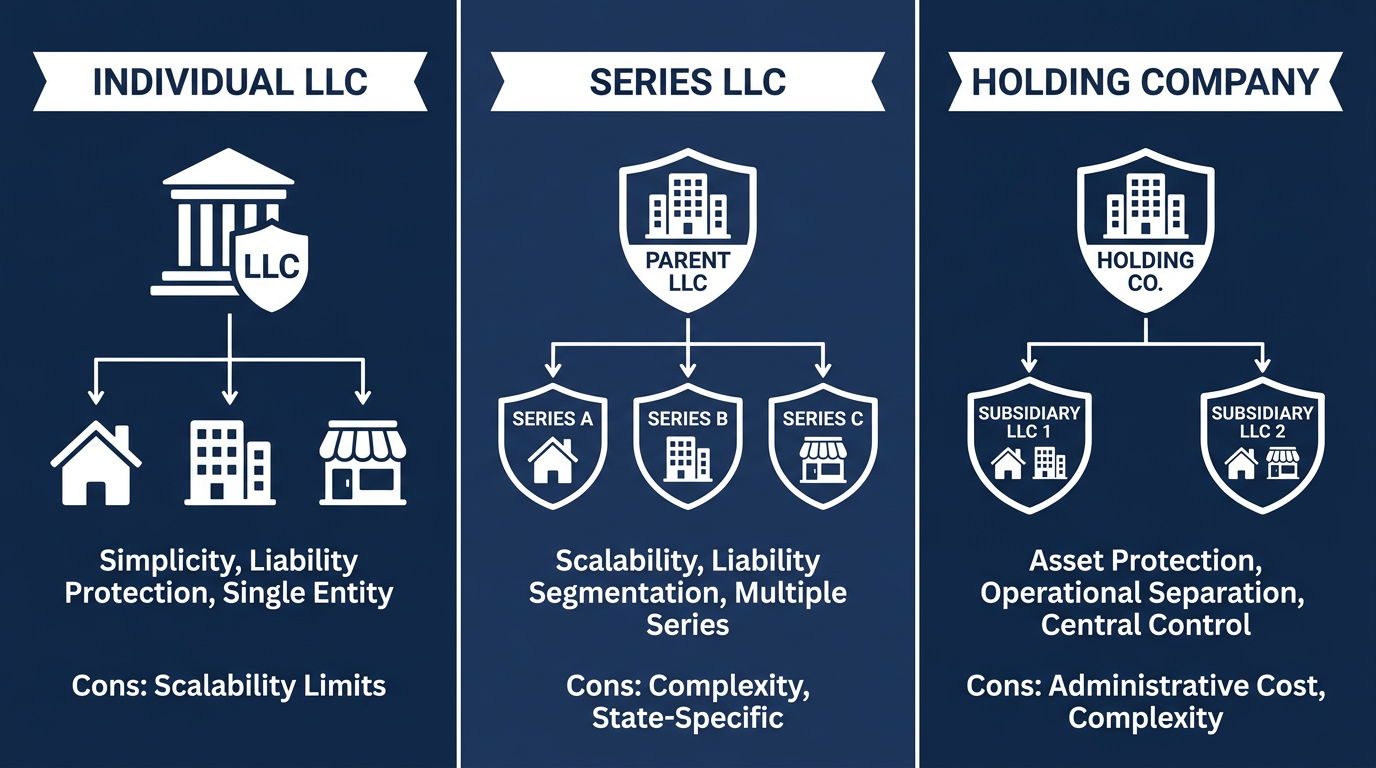
Individual LLC per Property is the most straightforward approach and offers the strongest liability isolation. Each property sits in its own separate LLC. A lawsuit or judgment against Property A has no legal pathway to the assets in Property B’s LLC. The separation is clear, legally well-tested, and easy to explain to attorneys, lenders, and title companies. The trade-off is cost and complexity — each LLC carries its own formation fee, annual report requirement, registered agent fee, bank account, and bookkeeping ledger. For investors with two to four high-value properties, or properties in high-liability environments, this overhead is usually worth it.
Series LLC is a newer structure available in approximately 24 jurisdictions as of 2026, including Texas, Delaware, Nevada, Illinois, and — as of July 1, 2026 — Florida. The core concept is compelling: one parent LLC registration, with individual “series” created underneath it. Each series holds one property and theoretically has its own liability protection, without the cost and administrative overhead of forming a full separate LLC for each asset. Formation cost is lower, management is simpler, and the structure scales more elegantly.
The catch is significant, however. Series LLCs are relatively new, and their liability isolation is legally untested in many jurisdictions. As JMCO’s analysis of Series LLCs in real estate notes, if a series is ever challenged in court in a state that doesn’t have clear case law supporting inter-series isolation, the outcome is genuinely uncertain. Lenders are also often unfamiliar with Series LLCs, which can complicate financing. And if any of your properties are in states that don’t recognize Series LLCs, you’re operating in a grey zone. According to IncOrp’s rental property LLC resource, state-by-state availability and recognition continues to be a meaningful constraint.
Holding Company Structure — sometimes called a parent-child LLC model — adds another layer of protection by placing a parent LLC above individual operating LLCs, each of which holds a property. The parent LLC owns the membership interests of the child LLCs; the child LLCs hold title to the properties. Even if a child LLC is somehow pierced by a court, the parent entity still creates a barrier between the judgment and your personal assets. This is the most robust structure from a liability standpoint and the most common approach for larger portfolios, investors using institutional financing, or those with significant equity across their holdings. The trade-off is proportionally more complexity — more entities, more filings, more accounts, more bookkeeping.
A reasonable framework for deciding:
- 1–2 properties: A single LLC or individual LLCs per property is typically sufficient.
- 3–10 properties in a Series LLC-friendly state: The Series LLC is worth a serious conversation with your attorney — the cost savings are real, but the legal uncertainty needs to be weighed against your specific state’s case law.
- 5+ properties, multiple states, substantial equity: A holding company structure provides the most complete protection and is usually worth the overhead at that scale.
One note that can’t be overstated: these are frameworks, not legal advice. An attorney in your state — one who specializes in real estate or business entity law — should review the final structure before you commit to it. State law variations make this a decision that genuinely cannot be made from a blog post alone.
What every structure has in common, regardless of which you choose, is this: each entity needs its own financial ledger, its own chart of accounts, and its own financial statements — while simultaneously giving you a clear view of performance across your entire portfolio. The financial infrastructure must match the legal structure. The RealBooks guide on managing finances across multiple LLCs is the most practical resource available for building that system.
Once the structure is chosen, investors with existing properties face a specific and often anxiety-inducing challenge: how to move those properties into the LLC without triggering a mortgage call.
Transferring Existing Rental Property Into an LLC — and the Due-on-Sale Clause
This is one of the most searched topics in real estate LLC planning, and one of the most misunderstood. The due-on-sale clause sounds alarming. The reality is more nuanced — but the risk is real, and you should understand it clearly before doing anything with your mortgage.
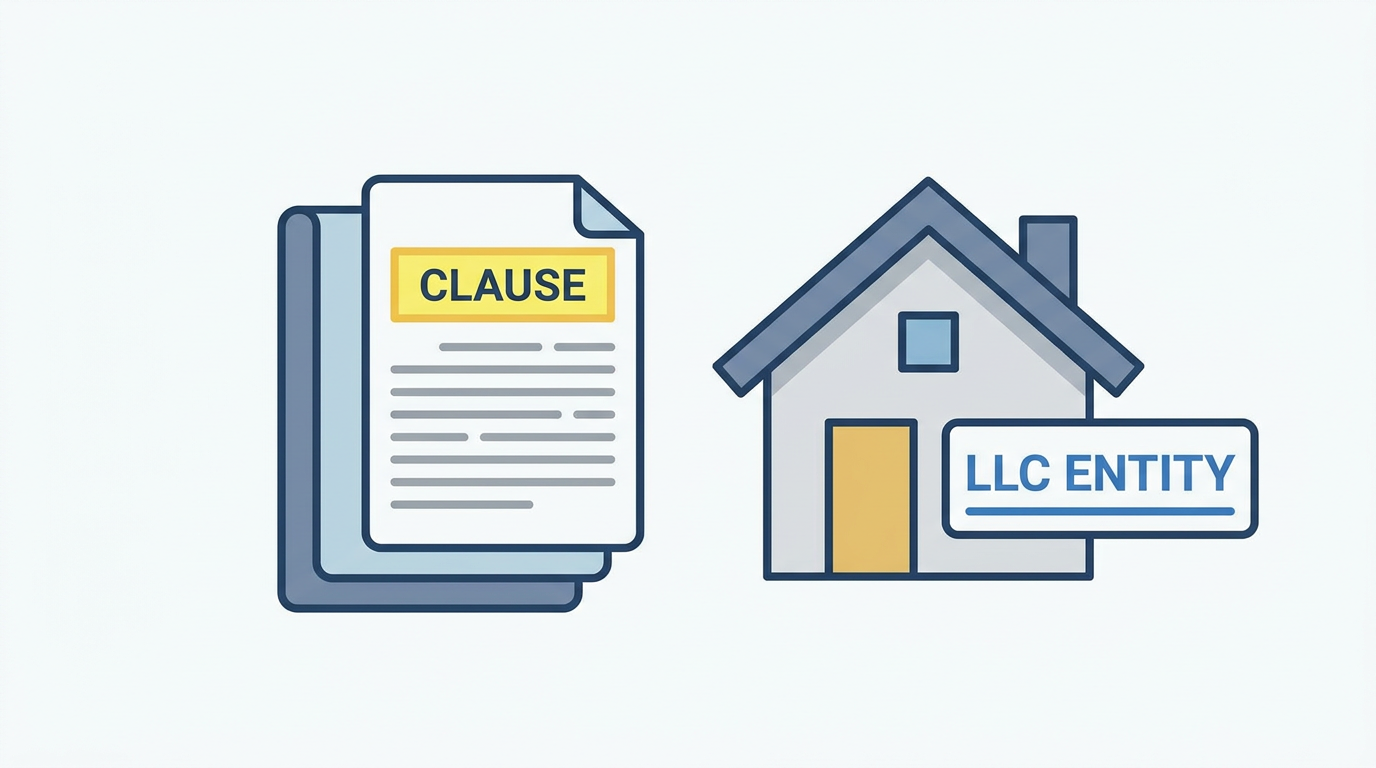
What the due-on-sale clause actually is: A standard provision included in most mortgage contracts that gives the lender the right to demand full repayment of the outstanding loan balance if the property ownership changes hands. Transferring title from your personal name to an LLC is, legally speaking, a change of ownership. That transfer can trigger the clause.
The Garn-St. Germain Act: Federal law — specifically 12 U.S.C. § 1701j-3, passed in 1982 — limits when lenders can enforce due-on-sale clauses. It protects certain transfers, including transfers to a spouse, to a child upon the death of a borrower, and transfers into a living trust for estate planning purposes. It does not protect transfers to an LLC. An LLC transfer is legally fair game for enforcement under this statute.
What actually happens in practice: Most conventional lenders, in practice, do not enforce the due-on-sale clause on LLC transfers — provided the loan payments continue arriving on time. Servicers generally don’t proactively monitor title changes, and calling a performing loan due is not in their financial interest. But “most lenders don’t enforce it” is categorically not the same as “it’s safe to assume they won’t.” If your lender does call the loan — perhaps after a refinancing review, a portfolio audit, or a change in servicing — you’d be required to pay off or refinance the mortgage on short notice. That’s not a hypothetical catastrophe; it’s a meaningful financial risk. Summit Law’s attorney-authored analysis of the transfer process provides a thorough view of how these scenarios play out in practice.
Conventional loan + no lender permission = proceed carefully. Commercial/portfolio loan = LLC ownership from day one is often already supported.
Steps to transfer an existing property into an LLC:
- Talk to your lender first. Some lenders will provide written permission for the LLC transfer, or will process a loan assumption into the LLC’s name. This is always the preferred path. A lender who explicitly approves the transfer eliminates the due-on-sale risk entirely.
- Prepare and record a new deed. A warranty deed or quitclaim deed transfers title from your personal name to the LLC. This is typically handled by a real estate attorney, who will draft the deed and record it with the county recorder’s office. Don’t DIY this step — deed errors are expensive to unwind.
- Update your property insurance. This is a step many investors miss and it’s consequential. Once the LLC holds title, the property insurance policy must list the LLC as the named insured — not you personally. If the policy remains in your personal name and a claim arises in connection with the LLC-owned property, the insurer may have grounds to deny coverage. Call your insurance agent before or immediately after the deed transfer.
- Notify your property manager. If you’re working with a property management company, update them on the change in ownership entity. Lease agreements, maintenance authorizations, and disbursement accounts may need to be updated.
- Update your lease agreements. Existing leases should be amended (or new leases should reflect) the LLC as the landlord of record. This is both legally cleaner and practically important for any future litigation.
- Redirect all financial flows through the LLC. All rent payments should be directed to the LLC’s dedicated bank account. All property expenses — mortgage, insurance, repairs, management fees — should be paid from the same account. This is where the RealBooks guide on repairs vs. capital improvements becomes relevant: improvement costs tracked post-transfer need to be classified correctly under the LLC for proper depreciation treatment.
The tax implication of transfer: For most investors transferring property into a single-member LLC (which is treated as a disregarded entity for federal tax purposes), the transfer has no immediate federal tax consequence — the IRS simply looks through the LLC to the individual owner. Multi-member LLC transfers can be more complex, potentially triggering recognition events. Talk to your CPA before any transfer involving a multi-member entity.
The cleaner alternative for new acquisitions: Portfolio lenders, credit unions, and private lenders who operate outside the Fannie Mae/Freddie Mac conventional system often already accommodate LLC ownership from day one. For investors who are actively growing their portfolios, buying new properties directly in the LLC — with financing structured accordingly — avoids the due-on-sale problem entirely. It’s the more efficient path forward once your portfolio moves beyond the conventional financing stage.
With the LLC formed, the structure chosen, and the property transferred (or acquired directly), one major piece remains — the piece that most guides skip entirely. It’s where the legal structure meets real financial management, and it’s where the actual tax benefits of an LLC for rental property are either captured or lost.
Tax Benefits of an LLC for Rental Property — and the Financial Infrastructure That Makes It All Work
The tax benefits of an LLC for rental property are real and meaningful. But they’re not automatic. They’re captured through the combination of legal structure and the financial systems operating inside it — and for most investors, the financial side is the one that needs the most attention.
Pass-through taxation and Schedule E form the tax foundation. The LLC itself pays no federal income tax. Rental income and losses flow directly to your personal return, reported on Schedule E (or Form 8825 if the LLC is a multi-member partnership filer). Every deductible expense the LLC generates — mortgage interest, property insurance, repairs, property management fees, advertising, utilities — reduces your taxable rental income at the personal level. This is the core tax efficiency of the LLC structure, and it’s confirmed by the IRS in Tax Topic 414. There’s no double taxation, no corporate-level tax, no distribution event. The money flows through, and the deductions flow with it.
Depreciation at the entity level is where it gets more nuanced — and where the financial infrastructure matters enormously. Each property inside the LLC has its own depreciation schedule. Residential rental property depreciates over 27.5 years. Certain improvements depreciate faster. When you hold multiple properties across multiple LLCs, each entity has its own depreciation calculation, its own basis, and its own annual deduction. Filing the wrong depreciation number under the wrong LLC isn’t just a bookkeeping error — it’s an IRS exposure. The RealBooks Rental Property Depreciation Guide covers this in full detail.
Cost segregation inside an LLC is one of the most powerful tax strategies available to rental property investors — and with the passage of the One Big Beautiful Bill Act (OBBBA), it’s become dramatically more valuable. The OBBBA permanently reinstates 100% bonus depreciation for qualified property acquired and placed in service after January 19, 2025, as confirmed by the IRS guidance on first-year depreciation. A cost segregation study reclassifies components of a property — flooring, fixtures, land improvements, specialty systems — from 27.5-year schedules into 5- or 15-year categories. With 100% bonus depreciation restored, those reclassified components can be fully deducted in Year 1. The result is a front-loaded deduction that can dramatically reduce or eliminate taxable income in the year of acquisition. The RealBooks Cost Segregation guide walks through exactly how this works and what investors qualify.
Traditionally, a cost segregation study costs $3,000–$7,000 in engineering fees. The analysis has historically been accessible only to investors with large commercial properties. That’s changed — and it matters more now than ever given the permanent restoration of bonus depreciation.
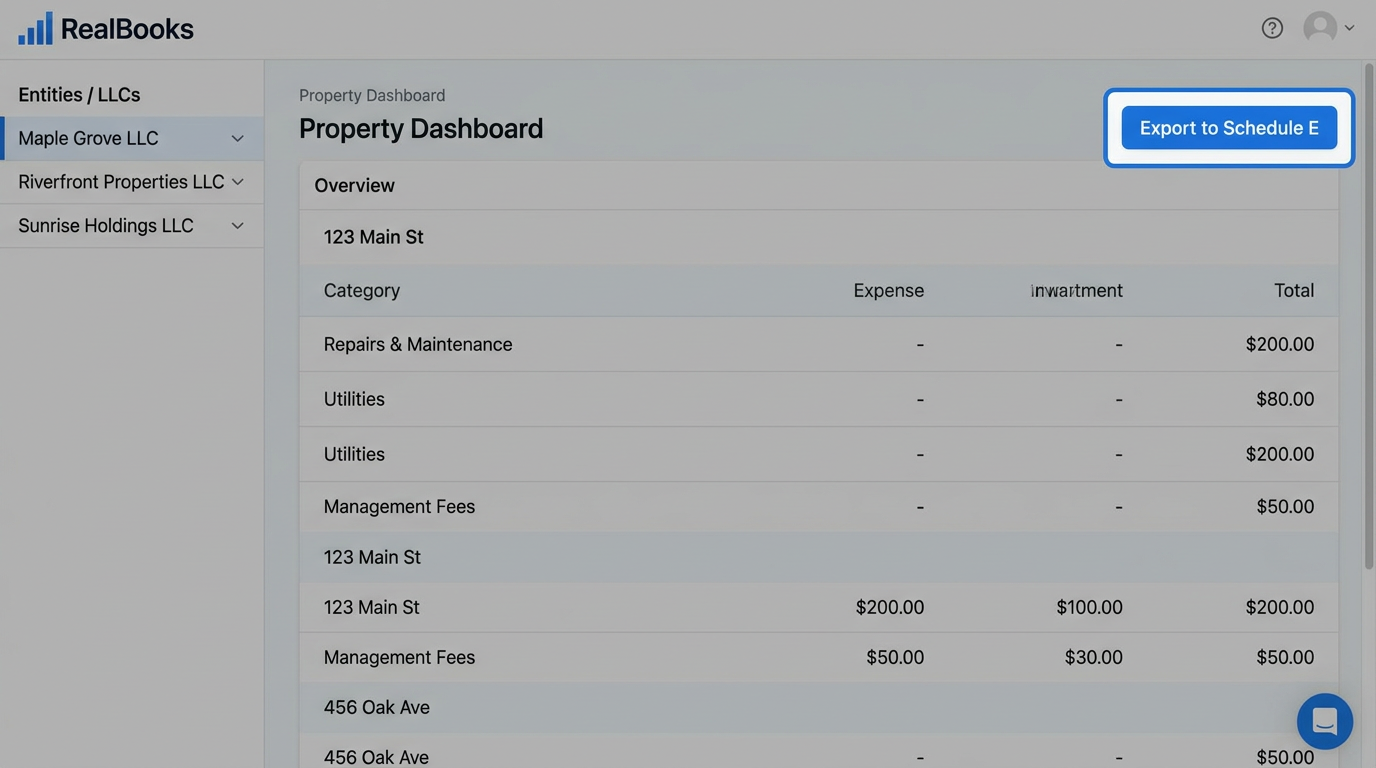
The financial infrastructure problem most investors don’t see coming: Here’s what actually happens. An investor forms the LLC correctly. They open the business bank account. They connect it to a bookkeeping platform — maybe QuickBooks, maybe a spreadsheet. And for the first year, they manage. But by year two, they have two LLCs. By year three, three. Each has its own bank account. Transactions are accumulating in separate ledgers. Expenses are getting assigned to the wrong properties. The cost segregation study from Year 1 is somewhere in a folder but wasn’t captured correctly in the books. And April hits like a freight train — with the CPA asking for organized financials by entity, by property, and by category.
The LLC structure only delivers its full tax value when the bookkeeping matches the legal structure — and that bookkeeping needs to be running correctly all year long, not assembled in a panic in March.
Tax preparation isn’t a year-end scramble — it’s an all-year practice.
This is exactly what RealBooks is built for — and where the AI agents become the financial team running inside your LLC structure.
Penny starts working from the moment your LLC bank account is connected. Every transaction that flows through the account — whether it’s a rent deposit, a contractor payment, a utility bill, or a property management fee — is automatically categorized by property, by expense type, and by entity. No manual data entry. No end-of-month reconciliation sessions. No “was that repair for the duplex on Main Street or the single-family on Oak Avenue?” at 11 PM the night before a meeting with your CPA. Penny handles the expense management with the detail and consistency that maintaining corporate veil integrity requires.
Dollar Bill tracks every improvement, renovation project, and capital expenditure at the property level within each LLC. Every contractor invoice, every materials purchase, every permit cost flows into the right improvement record automatically. This matters because improvements and repairs are treated differently for tax purposes — and because every dollar of improvement cost flows into the depreciation schedule. Nothing falls through the cracks between a contractor invoice and the books.
Uncle Sam handles the entity-level tax strategy. For each LLC that holds rental property, Uncle Sam generates depreciation schedules, tracks cost segregation allocations, and produces tax-ready Schedule E reports — organized by entity, by property, and by year. He identifies missed deductions, flags depreciation opportunities, and ensures your CPA receives clean, complete, organized financials rather than a collection of bank statements and best guesses. Uncle Sam runs the tax reporting and cost segregation analysis year-round — not just when April 15th is looming.
These three agents don’t replace your CPA or your attorney. They’re the financial infrastructure layer that sits inside your LLC structure and makes sure the legal protection and tax benefits you set up are actually being captured — every month, in every entity, for every property.

Bringing It All Together: What Smart LLC Structure Actually Looks Like
By the time you’ve worked through every section of this guide, a clear picture should have emerged — not just of how to form an LLC for rental property, but of what it takes to make the structure actually work.
The legal structure and the financial structure are inseparable. Forming an LLC without building the financial infrastructure to match it leaves most of the value on the table. The liability protection depends on financial separation. The tax benefits depend on accurate, entity-level bookkeeping running throughout the year. The depreciation and cost segregation advantages depend on the right numbers being tracked in the right places, continuously, not assembled at year-end from incomplete records.
The due-on-sale clause and conventional financing complications are manageable. They’re not reasons to avoid an LLC — they’re things to plan around. Buying new acquisitions directly in the LLC with portfolio or commercial financing sidesteps the problem entirely. For existing properties with conventional mortgages, a careful, lender-first approach to the transfer process reduces the risk to a level most investors can accept.
The structure you choose — individual LLCs, Series LLC, or a holding company model — matters, but the right answer depends on your specific portfolio, state, and situation. An attorney in your state is the right person to finalize that decision. What this guide gives you is the framework to walk into that conversation prepared.
And the tax benefits of an LLC for rental property — pass-through treatment, entity-level depreciation, cost segregation, bonus depreciation under the OBBBA — are real and significant. But they’re only fully captured when the bookkeeping is organized correctly throughout the year, in every entity, for every property.
For investors managing multiple LLCs or planning to scale beyond a single entity, the companion guide is the natural next step: How to Manage Finances Across Multiple LLCs walks through exactly how to build the financial system that matches the legal structure you’ve put in place.
Start With the Right Financial Infrastructure
If you’re setting up an LLC for rental property — or already have one — RealBooks gives you the financial infrastructure to make it work from day one.
Penny handles bookkeeping per entity, automatically categorizing every transaction by property and expense type. Dollar Bill tracks every improvement and capital expense per property within the LLC. Uncle Sam manages your depreciation calculations, cost segregation allocations, and tax reporting — so your CPA gets everything they need, organized and ready, without the year-end scramble.
The legal structure creates the protection. The financial infrastructure is what preserves it.
Visit realbooks.io to see how it works.
Or start with the companion guide: How to Manage Finances Across Multiple LLCs →
Ready to maximize your tax savings?
RealBooks automatically tracks expenses, manages assets, and calculates depreciation across your entire portfolio.
Start Free Trial →