How to Use Your Cost Segregation Losses: Passive Activity Loss Rules, the STR Loophole, REPS, the $25K Offset, and Suspended Losses Explained for Real Estate Investors in 2026

Cost segregation is easy to sell. An engineer reclassifies components of your property into shorter depreciation lives, you accelerate tens of thousands of dollars in deductions into Year 1, and suddenly you have a paper loss that looks like it should wipe out a significant chunk of your tax bill. The study gets done. The numbers look great. And then you sit across from your CPA and find out that the IRS won’t let you use those losses the way you thought.
That moment — the gap between generating cost segregation losses and actually deploying them — is what this blog is about. If you want to understand what cost segregation is, how it works, and how engineers calculate component lives, that’s what Cost Segregation 101 is for. This is the companion piece. This is what happens after the study is complete and you’re staring at $80,000 in accelerated depreciation losses wondering where they’re supposed to go.
The answer depends on four paths — and which one is available to you depends entirely on your tax situation. Your income level, the type of property you own, how many hours you spend in real estate, and how you hold your portfolio all determine whether your cost seg losses offset your taxes this year, in a future year, or at the moment you eventually sell. The passive activity loss rules are the governing framework for all of it, and understanding them is the first step.
There are four legitimate ways to use cost seg losses: the $25,000 active participation offset for investors under a certain income threshold, the short-term rental loophole for qualifying STR operators, Real Estate Professional Status for investors whose primary professional life is in real estate, and the suspended loss carry-forward that releases upon disposition. Each path has its own rules, its own limitations, and its own documentation requirements. None of them are complicated once you understand the framework. All of them reward investors who plan ahead.
Why Most Investors Can’t Use Cost Seg Losses Right Away — The Passive Activity Loss Rules
Here is the rule that governs everything else in this blog, and it’s worth stating plainly before building on it: rental real estate is classified as a passive activity by the IRS. That one classification — established under IRC Section 469 — determines the fate of every dollar of cost segregation losses you generate.
Under the passive activity loss rules, losses from passive activities can only offset passive income. Not your W-2 wages. Not business income from a company you actively run. Not dividends or interest. Passive losses against passive income — that’s the wall. And most rental property owners, especially those who work full-time jobs and own investment properties on the side, have no passive income to absorb those losses. The result is that their cost seg deductions generate losses that immediately get suspended, sitting in a holding pattern until something unlocks them.
The passive activity loss rules were written into law as part of the Tax Reform Act of 1986, and the motivation was explicit: Congress wanted to shut down the tax shelter industry that had flourished throughout the 1970s and early 1980s, where wealthy investors used paper losses from passive investments to offset large amounts of ordinary income. The rules succeeded in that goal. The unintended consequence is that working real estate investors — people who are genuinely building portfolios and managing real properties — got caught in the same net. The law wasn’t designed for them. But it applies to them anyway.
Understanding how losses get generated in the first place is important context here. When you run a cost segregation study, an engineer identifies components of your property — flooring, fixtures, landscaping, certain electrical systems — that qualify for 5-year, 7-year, or 15-year depreciation rather than the standard 27.5-year schedule for residential real estate. With 100% bonus depreciation now permanent under the One Big Beautiful Bill Act signed in July 2025, all of those reclassified components can be fully deducted in Year 1 rather than spread over their shorter recovery periods. A $500,000 property with $150,000 in reclassified components might generate a $150,000 deduction in the first year alone. That is genuinely powerful — and it’s also genuinely suspended if none of the four paths apply. For a deeper look at how accelerated depreciation creates these losses, RealBooks’ rental property depreciation guide walks through the mechanics in full.
The tax code distinguishes between two types of participation that matter throughout everything that follows. Active participation is the lower bar — it means you’re making real management decisions about your rental property, even if you’re not hands-on every day. Approving tenants, setting rent, deciding on capital improvements. A property manager doesn’t disqualify you from active participation as long as you remain the decision-maker. Material participation is a substantially higher standard — it means you’re involved in the activity on a regular, continuous, and substantial basis, typically proven through the formal IRS tests outlined in Publication 925. Active participation matters for the $25K offset. Material participation is the standard required by both the STR loophole and REPS. Keeping these two concepts distinct is critical to understanding every section that follows.
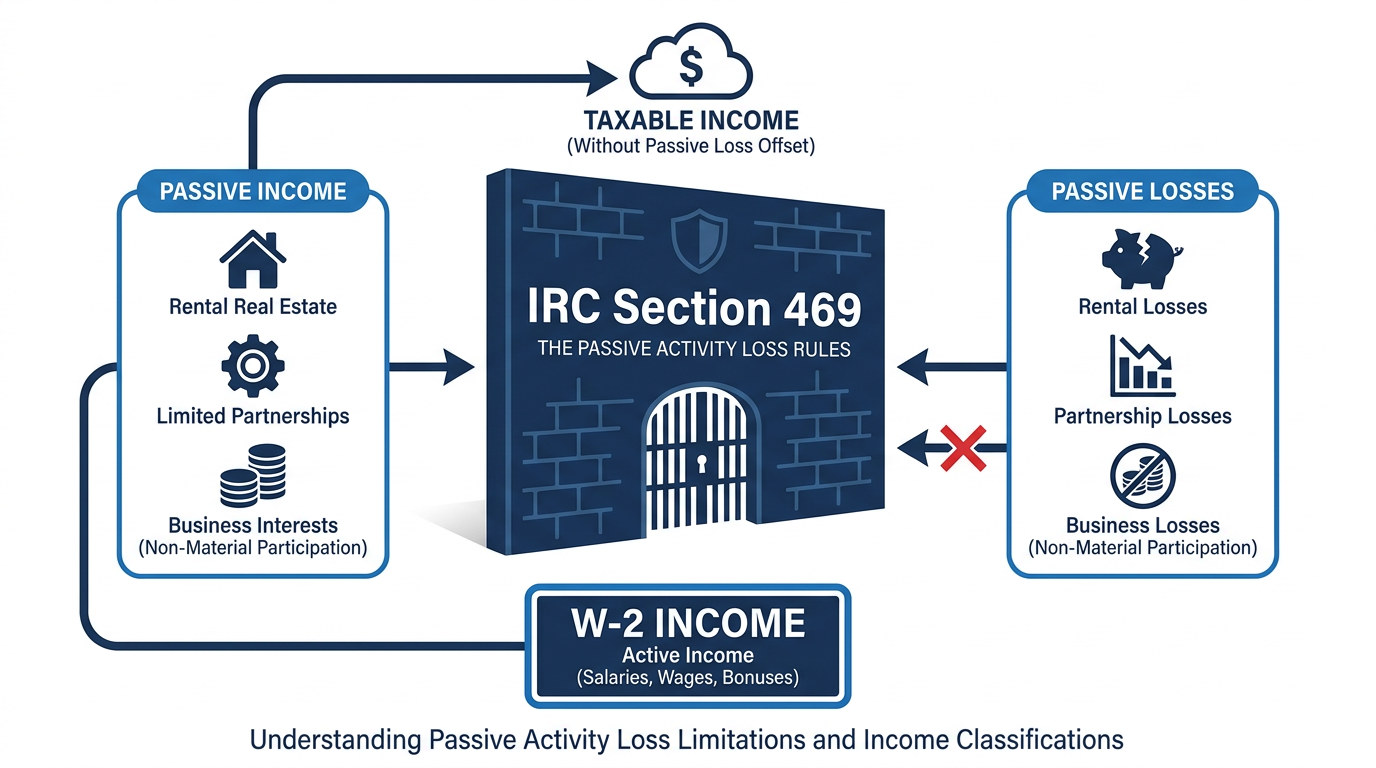
To make this concrete: an investor purchases a $500,000 rental property, commissions a cost segregation study, and generates $80,000 in Year 1 depreciation losses. They earn $180,000 in W-2 wages. They have no other passive income. Under the passive activity loss rules, all $80,000 is suspended — reported on Form 8582, carried forward to future years, and completely unavailable to reduce their current year tax bill. Not lost, not wasted, but locked. The question every investor in this position should be asking is: which of the four paths unlocks those losses, and do I qualify?
Once you understand why the losses get stuck, the next question is: what are the available exits? The most accessible one — and the one that applies to investors earlier in their wealth-building journey — is the $25,000 active participation offset.
Path 1: The $25,000 Rental Loss Offset for Active Participants Under $100K AGI
Congress recognized that the blanket passive classification was particularly punishing for small-scale landlords who are genuinely engaged in managing their properties but don’t meet the full definition of a real estate professional. So it carved out an exception. Under IRC Section 469(i), investors who actively participate in their rental real estate activities can deduct up to $25,000 of passive rental losses against ordinary income each year — regardless of whether they have passive income to absorb it.
The active participation standard, as introduced in the previous section, is intentionally low. You don’t need to be hands-on. You don’t need to be on-call for repairs or personally screening every tenant application. What the IRS requires is that you are making the significant management decisions: setting the rental rate, approving tenants, deciding when to authorize major repairs or capital expenditures, determining lease terms. You can hire a property manager for the day-to-day operational work and still satisfy active participation, as long as you remain the decision-maker in the decisions that matter. The key disqualifier is owning less than a 10% interest in the property — below that threshold, the exception is unavailable.
The income limitation, however, is where most higher-earning investors hit a wall. The $25,000 allowance begins to phase out at a Modified Adjusted Gross Income (MAGI) of $100,000 and disappears entirely at $150,000. The phase-out is linear: for every $2 of MAGI above $100,000, you lose $1 of the allowance. An investor with $125,000 in MAGI gets a $12,500 offset. An investor with $140,000 in MAGI gets $5,000. At $150,000 and above, the allowance is zero — the path closes completely.
This phase-out structure has a practical consequence worth stating directly: this exception was designed for beginning investors. It’s most valuable to someone building their first or second rental property while still employed, whose income hasn’t yet crossed into the range where the allowance disappears. For that investor, the $25K offset can be genuinely transformative. Consider a scenario: an investor with $85,000 in MAGI owns a $350,000 rental and runs a cost segregation study that generates $40,000 in Year 1 losses. Under this exception, they can deduct the full $25,000 against their wages — reducing their taxable income by $25,000 and producing real, tangible tax savings without any special qualification status, hour logging, or property type requirements. The remaining $15,000 in losses doesn’t disappear. It suspends and carries forward to future years, where it can be absorbed by passive income, used under a different path, or released upon disposition.
The calculation interacts with other deductions and tax strategies in ways that compound over time. AGI management — through 401(k) contributions, HSA contributions, and other above-the-line deductions — can keep an investor’s MAGI within the phase-out window even as their gross income grows. Investors who are paying attention to the full range of deductions available to them, including the ones outlined in RealBooks’ complete 2026 deduction guide, often find that they can preserve access to this exception for longer than they expected.
What this exception does not do is scale. As your income grows past $150,000, it’s gone. As your cost seg losses grow to $80,000 or $120,000 on a larger property, the $25,000 cap means most of those losses suspend anyway. This is the path for where you start — and the signal, as you grow, to look at the paths that open at higher income levels.
For investors earning above the AGI threshold, or those with larger portfolios generating losses that far exceed $25,000, the door to the $25K offset is either partially or completely closed. The next path — the short-term rental loophole — doesn’t care what your AGI is.
Path 2: The Short-Term Rental Loophole — How the 7-Day Rule Bypasses Passive Classification
The short-term rental loophole is, in plain terms, a reclassification strategy. It works not by creating an exception to the passive activity loss rules, but by taking the property outside the definition of a “rental activity” entirely — which means the PAL rules that trap long-term rental losses never apply in the first place. For investors who earn too much to use the $25K offset and don’t meet the demanding requirements of REPS, this is often the most accessible high-leverage path available.
The mechanics are grounded in IRS Regulation 1.469-1T(e)(3)(ii), which specifies that an activity is not a “rental activity” when the average period of customer use is seven days or fewer. When a property’s average guest stay falls at or below that threshold, it doesn’t get classified as a rental activity for passive activity loss purposes. Instead, it’s treated as a trade or business — which puts it in an entirely different category under the tax code.
That reclassification is powerful, but it is only half of what you need. The other half is material participation. Simply owning a short-term rental with short average stays doesn’t make the losses non-passive on its own. You must also materially participate in the STR activity during the year. Without material participation, the IRS treats the STR losses as passive losses from a trade or business activity — still trapped, just under a different section of the code.
Material participation for an STR is proven through the same IRS tests described in Publication 925. The two most commonly used are: the 500-hour test (you personally participate in the activity for more than 500 hours during the tax year) and the 100-hour test (you participate for more than 100 hours during the year and at least as much as any other individual involved — including a co-host or property manager). The 100-hour test is the one most STR investors use, because it’s achievable without a full-time commitment to the property. If you’re clocking 150 hours on guest communication, maintenance coordination, pricing updates, and property oversight, and your co-host logs 120 hours, you satisfy the test — your 150 hours exceed both the 100-hour floor and the co-host’s involvement.
Calculating whether your property qualifies on the 7-day average is straightforward: divide total rental days for the year by the number of separate rental periods. A property rented for 220 days across 55 separate bookings has an average stay of exactly 4 days — well within the threshold. A property rented for 200 days across 20 bookings has a 10-day average — it does not qualify. The booking calendar is your evidence, and platforms like Airbnb and VRBO generate downloadable records that make this calculation simple to document.

Here’s what this looks like in practice. An investor earns $400,000 in W-2 income — far above the $25K offset threshold. They own a beach property that they list on Airbnb, with an average booking length of 4.5 days. They run a cost segregation study and generate $65,000 in Year 1 losses under 100% bonus depreciation. During the year, they personally log 160 hours managing the property — handling guest communication, coordinating with a cleaner, updating pricing, and doing two property walkthroughs. Their cleaner isn’t considered in the participation calculation (she’s providing services, not participating in the activity). Their property manager co-host logs 130 hours. The investor’s 160 hours exceed both the 100-hour minimum and the co-host’s 130 — material participation satisfied. The STR qualifies on the 7-day average. All $65,000 is non-passive and offsets their W-2 income directly. No REPS. No income limit.
Two important guardrails belong in every conversation about the STR loophole. First, the vacation home rules under IRC Section 280A can limit your deductions if personal use exceeds 14 days per year or 10% of total rental days, whichever is greater. If you use the property yourself beyond that threshold, expenses must be allocated between personal and rental use — and the rental deductions may be capped at rental income. Plan your personal use carefully. Second, IRS scrutiny of STR deductions has increased materially in recent years. An IRS audit of an STR claiming non-passive losses will look directly at your participation logs. Reconstructed records — created retrospectively at tax time from memory — are a red flag. A contemporaneous log, maintained throughout the year with specific activities, durations, and dates, is the standard that survives examination.
The STR loophole is bounded by two things: property type and participation. If you own long-term rentals, it doesn’t apply regardless of how many hours you work. If you own qualifying STRs but don’t meet material participation, the losses stay passive. Both boxes must be checked. For investors with long-term rental portfolios who want unlimited loss deductions against any type of income, the path that opens that door is Real Estate Professional Status.
Path 3: Real Estate Professional Status — Unlimited Losses, No Income Cap
REPS is the most powerful tax position available to real estate investors. It is also, deliberately, the hardest to qualify for — which is why it produces the most aggressive tax results when properly established and the most damaging audit outcomes when improperly claimed. Understanding exactly what qualifies you, what documentation is required, and what the IRS scrutinizes is not optional. It is the foundation of the strategy.
Real Estate Professional Status is defined under IRC Section 469(c)(7), and qualification requires passing two simultaneous tests in the same tax year:
- The 750-Hour Test: You must perform more than 750 hours of services during the year in real property trades or businesses in which you materially participate.
- The More-Than-Half Test: More than 50% of all personal services you perform during the tax year must be in real property trades or businesses.
Both tests must be satisfied every year. REPS is not a one-time election or a status you maintain by registration. It is an annual qualification — you either meet it or you don’t, and the answer can change year to year as your professional circumstances change.
The more-than-half test is the one that disqualifies most high-earning W-2 employees, and the math is unforgiving. If you work a full-time job that requires 2,000 hours per year, you must log more than 2,000 hours in real estate activities to satisfy the majority-of-time requirement. That’s 40+ hours per week in real estate — on top of, or instead of, your primary employment. For a full-time employee, this is practically impossible. REPS, by design, is intended for people whose primary professional identity is real estate: developers, brokers, property managers, and investors who have stepped away from traditional employment to manage their portfolios full-time.
There is one significant spousal exception worth noting. On a joint return, only one spouse needs to qualify for REPS — and only that spouse’s hours are counted toward the two tests. If one spouse is a full-time real estate investor, developer, or broker while the other works a W-2 job, the real estate spouse’s qualification applies to the joint tax return. All rental losses from properties owned jointly become non-passive and can offset the W-2 income of the other spouse. This is a planning strategy used effectively by dual-income households where one partner transitions full-time into real estate.
Passing both REPS tests is necessary, but it is not sufficient by itself to make your rental losses non-passive. There is a third layer: material participation in each rental property. REPS removes the automatic passive classification for rental activities — but you still need to materially participate in each individual rental to treat its losses as non-passive. For an investor with a single property, this is usually satisfied naturally through hands-on management. For an investor with ten properties, proving material participation individually across each one is burdensome and becomes a documentation challenge.
The solution is the grouping election. Under Treasury Regulation 1.469-9(g), a qualifying real estate professional can elect to treat all rental real estate activities as a single activity for purposes of material participation. Once grouped, the investor’s total hours across all properties are aggregated — making it far easier to satisfy the material participation tests for the portfolio as a whole. The grouping election must be made on a timely filed return and, once made, is binding in subsequent years unless a material change in facts and circumstances justifies revocation.
“The investors who use cost segregation most effectively aren’t the ones who ran the best study — they’re the ones who built the tax position that lets them actually use the losses.” — A tax principle that every serious real estate investor eventually learns the hard way.
Consider the difference in outcomes for two investors who purchase the same property, run the same cost segregation study, and generate the same $80,000 in Year 1 losses. Investor A holds a full-time corporate job that consumes 2,200 hours a year. She manages two rental properties but can’t meet the more-than-half test. Her $80,000 in losses is suspended — carried forward to a future year. Investor B stepped away from his W-2 two years ago to manage a rental portfolio full-time. He logs 1,400 hours in real estate activities, which represents the majority of his professional time. He qualifies for REPS, makes the grouping election, and materially participates in the grouped activity. His $80,000 is fully deductible against any income — business income, investment income, anything. Same study. Same property. Completely different tax outcome.
The audit risk associated with REPS is real and should be stated plainly. The IRS is well aware that REPS is one of the most frequently claimed positions in real estate tax planning, and it examines REPS claims with corresponding attention. The specific failure point in most audits is documentation. Hour logs must be maintained contemporaneously — recorded as you go, not reconstructed from memory at tax time. A calendar entry, a time-tracking app, a detailed journal noting the specific activity, the property it related to, and the time spent — these are the records that survive examination. A spreadsheet assembled in March that claims to reflect 800 hours of activity spread across the prior calendar year will not.
For the complete breakdown of qualifying for REPS, documenting your hours to IRS standards, making the grouping election, and navigating an audit, see RealBooks’ dedicated REPS guide for 2026. It covers the full statutory definition, edge cases, and the documentation systems that hold up under scrutiny.

REPS is powerful precisely because its bar is genuinely high. When the bar is cleared — with real hours, real documentation, and a real estate-primary professional life — it unlocks the most favorable treatment the tax code offers to any investor: unlimited rental losses, deductible against any income type, with no cap. Combined with a cost segregation study running in a year of 100% bonus depreciation, the math is the kind that can bring a six-figure tax liability to near zero.
If you don’t qualify for REPS, don’t operate an STR, and earn too much for the $25K offset, your losses aren’t gone. They’re in reserve — and the mechanics of how they come back are worth understanding in detail.
Path 4: Suspended Passive Losses — Deferred Value That Returns on Exit
For many real estate investors, the correct answer to “which path applies to me?” is none of the three above — not this year. Their income is over $150,000, they don’t have an STR, and real estate isn’t their primary professional activity. That investor’s cost seg losses get suspended, and this section explains exactly what that means, why it isn’t a failure of strategy, and when those losses come back in full.
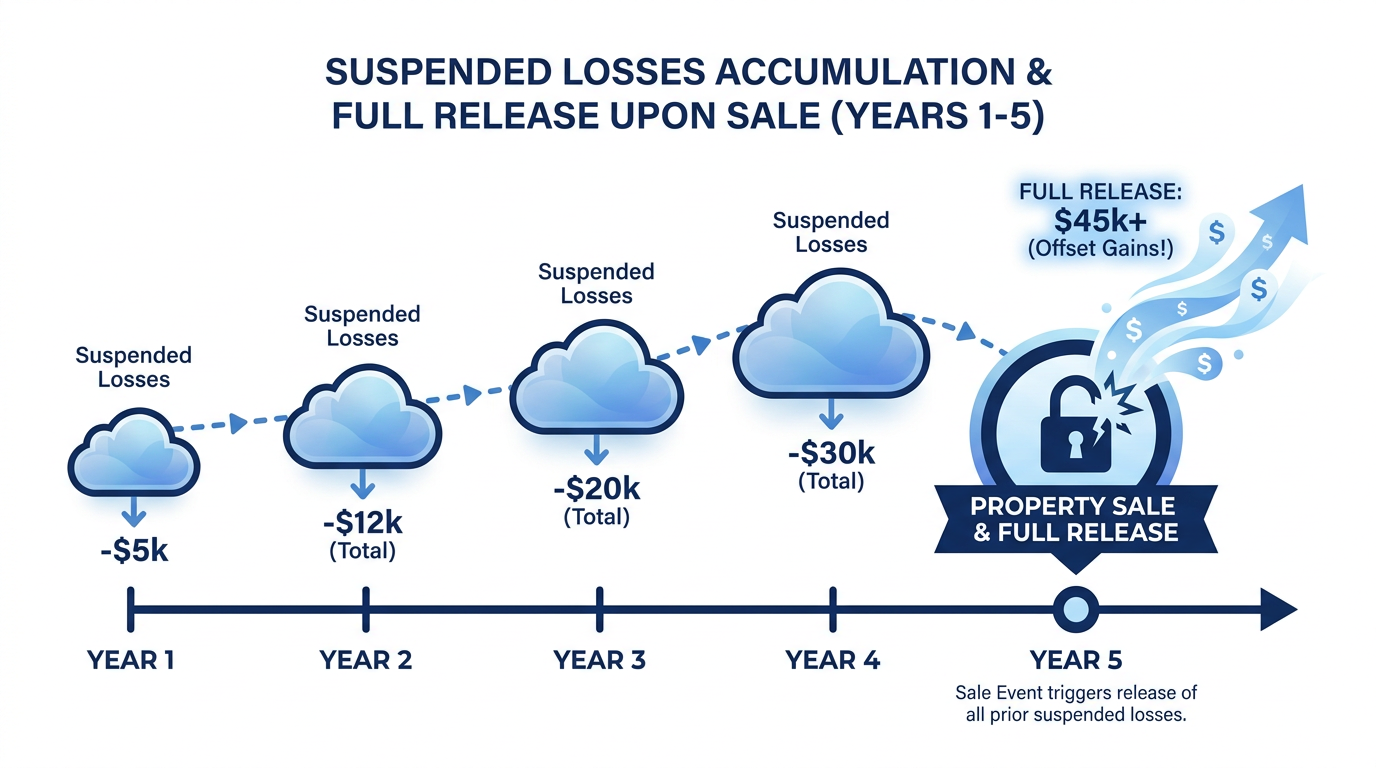
The mechanics of suspended losses start with Form 8582 — the IRS’s Passive Activity Loss Limitations form, which every investor with suspended losses files with their return. Form 8582 tracks, by activity, the cumulative losses that have been generated but not yet absorbed. Year after year, as a property generates losses that exceed passive income and none of the active-use exceptions apply, those losses accumulate on this form. They’re not erased. They’re not forfeited. They’re held, with the IRS fully aware of them, waiting for the right trigger.
There are two triggers that release suspended losses. The first is passive income from any source. If you acquire a second property that generates positive passive income — a performing multifamily, a triple-net lease, a syndication distributing income — suspended losses from Property A can offset that income dollar for dollar. The passive income doesn’t have to come from the same property. Any passive income absorbs suspended losses from any passive activity, as long as both are properly classified. This is one of the reasons that building a diversified rental portfolio over time creates compounding tax efficiency: performing assets generate passive income that mops up the suspended losses from high-depreciation years.
The second trigger — and the most significant — is disposition. When you sell your entire interest in a property in a fully taxable transaction to an unrelated party, all accumulated suspended losses from that property become fully deductible in the year of sale. Not against passive income only. Against any income — ordinary wages, business income, capital gains. The three conditions required for this full release are important:
- Complete disposition of your entire interest in the property — a partial sale doesn’t trigger the full release.
- Fully taxable transaction — the sale must be recognized for tax purposes, not deferred.
- Unrelated party — sales between related parties under IRC Section 267 don’t qualify.
When all three conditions are met, every dollar of suspended passive losses accumulated over the holding period is released in a single year, creating a large offsetting deduction that reduces the taxable gain and potentially other income in that year. This is the long game of passive loss strategy — building up a reserve of suspended losses over years, then capturing them at disposition.
A concrete example clarifies the mechanics. An investor purchases a rental property in 2022 for $800,000. They run a cost segregation study generating $60,000 in Year 1 losses. Their MAGI is $210,000, they have no passive income, no REPS, no STR qualification. All $60,000 suspends. Over the next three years, normal depreciation continues to generate $25,000 in annual losses, all of which also suspend. By the time they sell in 2026, they have accumulated $135,000 in suspended passive losses. At the moment of sale — assuming complete disposition to an unrelated buyer in a fully taxable transaction — all $135,000 is released and deductible against the gain and any remaining income in the year of sale. The investor who knew this was coming planned their year accordingly.
The single most important — and most frequently misunderstood — interaction in this entire discussion is the relationship between suspended losses and a 1031 exchange. The 1031 exchange allows an investor to defer capital gains by rolling proceeds from a sold property into a replacement property. But the mechanism of deferral is tax-critical: a 1031 exchange is explicitly a non-recognition event. Because no gain is recognized in the year of exchange, it does not constitute a fully taxable disposition — and therefore it does not trigger the release of suspended passive losses.
Instead, suspended losses from the relinquished property carry forward to the replacement property. They don’t disappear. But they also don’t get released when the investor might be expecting them. An investor who sells a property with $100,000 in accumulated suspended losses via a 1031 exchange will find those losses attached to their replacement property, waiting for a future qualifying disposition or passive income — not available to offset income in the year of the exchange. This is a planning point with real dollar consequences, and investors who are sitting on significant suspended losses should model both scenarios — taxable sale with immediate loss release vs. 1031 exchange with continued deferral — before choosing their exit strategy. RealBooks’ complete 1031 exchange guide covers the mechanics, timelines, and identification rules in full.
One more interaction at disposition deserves mention: depreciation recapture. When you sell a property, the IRS recaptures all prior depreciation deductions — including the accelerated depreciation from cost segregation — at a 25% rate for unrecaptured Section 1250 gain. The suspended losses released at sale can offset this recapture, but understanding the ordering of gains, recapture, and loss offsets matters for accurate planning. RealBooks’ guide on depreciation allowed or allowable explains what happens at disposition and how recapture interacts with accumulated deductions.
Suspended losses are not a tax strategy failure. They’re deferred tax value — dollars you will use, just not today. The investor who understands this treats their Form 8582 balance as an asset on their tax ledger, not a liability.
All four paths are now on the table. The remaining question is a practical one: how do you identify which path you’re on, and how do you build the systems that make each one work?
Matching Your Situation to the Right Path — And Building the Systems That Execute It
Tax law is only as useful as your ability to apply it to your specific facts. The four paths described in this blog aren’t theoretical options — they’re executable strategies, each with specific qualifying criteria and specific documentation requirements. The practical question every investor should answer before December 31st is: which path applies to me this year, and what do I need to have in place to use it?
The decision logic flows from a few key questions. Start with AGI. If your Modified Adjusted Gross Income is under $100,000 and you actively participate in your rentals, the $25,000 offset is your first line. Use it, suspend the rest, and revisit as income grows. If your MAGI is above $150,000, cross this path off and move to the next question.
Ask next about property type. Do you operate any short-term rentals with an average guest stay of seven days or fewer? If yes, material participation is the question — and it’s achievable with 100+ hours and more than any other participant. If you clear both bars, the STR loophole makes your losses non-passive regardless of your income level. Run a cost segregation study on your STR property and the losses flow directly against your W-2.
If your rentals are long-term and your income is above the $25K threshold, the question becomes professional time allocation. Is real estate your primary professional activity? Do you log more than 750 hours in real property trades or businesses, and does that represent more than half of your total personal services? If both answers are yes — or if your spouse can answer yes — REPS is your path. If not, your losses suspend and the disposition strategy becomes the plan.
These paths are not mutually exclusive across a portfolio. An investor might simultaneously operate an STR property where losses are non-passive via the loophole and hold long-term rentals whose losses are suspended, all in the same tax year. The accounting has to keep those streams cleanly separated — because the IRS treats each activity differently and will expect your records to reflect that separation.
- Identify the activity type for each property (STR vs. long-term rental).
- Determine which exception or path applies to each.
- Log the hours and records required by each path throughout the year.
- Ensure suspended losses are tracked by property and by year on Form 8582.
- Model the disposition decision before executing — especially if a 1031 exchange is on the table.
What makes all of this work — or fail — is the quality of your books. You cannot claim REPS without a contemporaneous hour log. You cannot prove the 7-day STR average without booking records. You cannot release suspended losses at disposition without knowing exactly what’s accumulated by property and by year. Clean, property-level accounting isn’t a year-end scramble — it’s an ongoing system that makes each of these paths defensible.
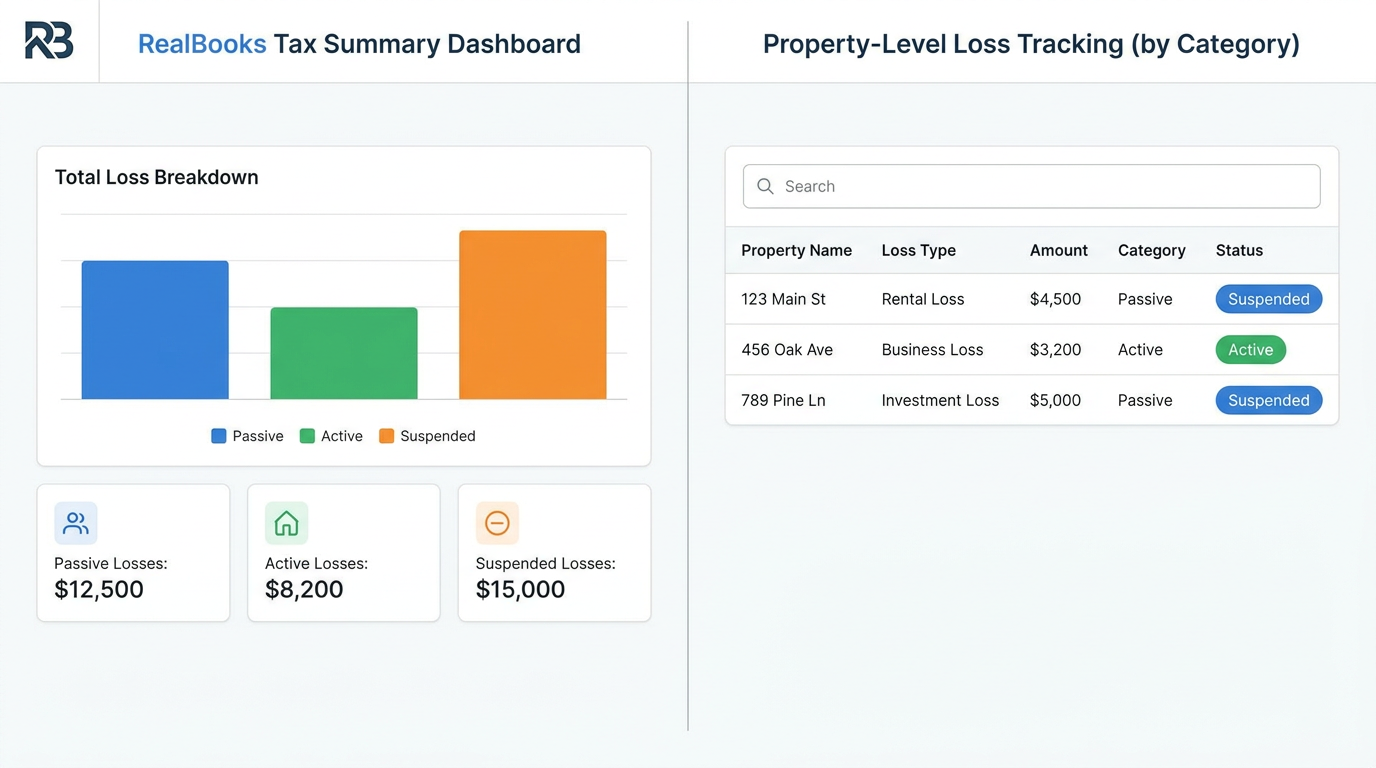
This is where RealBooks operates. Uncle Sam, RealBooks’ tax AI agent, classifies your rental activities by type and maps them to the appropriate passive loss treatment — flagging STR properties, identifying REPS eligibility signals, and tracking which losses are passive, non-passive, or suspended. Penny handles expense tracking and accumulated loss monitoring at the property level, so you always know exactly what’s sitting in reserve before you make a disposition decision. Dollar Bill manages project-level costs, ensuring that capital expenditures are correctly capitalized rather than expensed — which directly determines the depreciable base that a cost segregation study then accelerates.
The investors who get the most out of cost seg losses aren’t the ones who ran the most sophisticated engineering study. They’re the ones who understood their path before the study was commissioned, maintained the records throughout the year, and had books that matched the story their tax return told. With 100% bonus depreciation now permanent under the One Big Beautiful Bill Act and larger front-loaded losses now the norm, getting the path question right is more consequential than it has ever been.
If you haven’t read the foundational piece on what cost segregation is and how the engineering study works, Cost Segregation 101 is the right starting point before this blog. If you’re ready to understand your books and how they support whichever path applies to you, RealBooks’ real estate bookkeeping guide for 2026 covers the operational foundation in detail.

What This Actually Comes Down To
The cost segregation study isn’t the hard part. The engineering is straightforward; the numbers are calculable. What separates investors who use every dollar of depreciation they’re entitled to from investors who leave most of it suspended indefinitely isn’t the quality of the study — it’s the understanding of the rules and the systems to execute them.
Your losses follow rules. The rules are learnable. The four paths covered in this blog — the $25K offset, the STR loophole, REPS, and the suspended loss carry-forward — are not loopholes in the pejorative sense. They are the mechanisms that Congress built into the tax code to provide relief from the passive activity rules in specific, qualifying circumstances. They reward investors who plan ahead, document their activity, and structure their portfolios with their tax position in mind.
And the path you’re on today may not be the path you’re on in three years. As your income grows, your portfolio expands, your time allocation shifts, and your professional focus evolves, the optimal strategy shifts with it. An investor in the $25K offset window today might be an REPS candidate in five years. An STR operator who qualifies for the 7-day loophole now might transition to long-term rentals and need to think carefully about disposition timing. The tax strategy is not a one-time decision — it’s a living calculation that rewards continuous attention, not a once-a-year scramble in April.
Track everything. Classify everything. Know what’s suspended, what’s non-passive, and what’s available at sale — before you need to make the decision.
See How RealBooks Handles This Automatically
Uncle Sam, Penny, and Dollar Bill handle the tracking, classification, and tax reporting that make each of the four paths actually executable — without the spreadsheet chaos and year-end reconstruction that most investors rely on. If you want a system that knows your path, tracks your hours, monitors your suspended losses by property, and keeps your books ready for whatever exit decision you make — visit realbooks.io to see how it works.
For investors specifically looking at cost segregation analysis and passive loss tracking: realbooks.io/products/cost-segregation shows how RealBooks handles it from study integration through annual reporting.
The next step isn’t complicated. It’s just knowing what you have — and having a system that tracks it.
Ready to maximize your tax savings?
RealBooks automatically tracks expenses, manages assets, and calculates depreciation across your entire portfolio.
Start Free Trial →