You Skipped Depreciation. The IRS Still Counted It.

You bought the rental. You collected rent. You paid the mortgage, the insurance, the property taxes, and the occasional plumbing bill that showed up at the worst possible time. And when your CPA asked about depreciation, you told them to skip it. You’d heard it creates a bigger tax bill when you sell. You were being conservative. Smart, even.
Then you sold the property after twelve years. And the IRS sent you a tax bill that included depreciation recapture — on depreciation you never actually claimed.
That’s not a glitch. That’s the rule.
Here’s what most real estate investors don’t know: depreciation isn’t optional in effect, even if you never claimed a dollar of it. The Internal Revenue Code contains a provision — IRC §1016(a)(2) — that reduces your property’s adjusted basis by the depreciation you were allowed to deduct, regardless of whether you actually took the deduction. The IRS calls it “allowed or allowable.” And it means that when you skip depreciation, you pay the recapture tax anyway. You just don’t get the deduction that would have offset it.
The result is the worst of both worlds: you gave up years of legitimate tax deductions during ownership, and you still owe the IRS at sale as if you took every single one.
This is one of the most expensive misunderstandings in real estate investing — and it’s surprisingly common.
In this guide, we’re going to walk through exactly how the “allowed or allowable” rule works, how to calculate your depreciable basis correctly (the number most investors get wrong), what depreciation recapture actually costs at sale, and how to use Form 3115 to recover years of missed deductions without touching a single prior-year return. Along the way, you’ll meet three AI agents from RealBooks — Uncle Sam, Penny, and Dollar Bill — who handle exactly this kind of work for investors who are done leaving money on the table.
Why Depreciation Feels Optional — And Why It Absolutely Isn’t
The logic seems reasonable on the surface. If depreciation creates a taxable event when you sell — what the IRS calls “unrecaptured Section 1250 gain” — then why claim it at all? Skip the deduction now, avoid the recapture later. Simple math. Except it isn’t, because the IRS doesn’t play by that math.
Many real estate investors skip depreciation deliberately. Some are advised to by well-meaning but misinformed sources. Others simply don’t bother setting up a depreciation schedule because they’re managing properties with spreadsheets and receipts in a shoebox. Whatever the reason, the common thread is the assumption that not claiming depreciation means not creating a future tax liability.
That assumption is wrong. Completely, expensively wrong.
IRS Publication 946 — How to Depreciate Property is explicit on this point. Under the “Adjusted Basis” section, it states: “You must reduce the basis of property by the depreciation allowed or allowable, whichever is greater.” And then it goes further: “If you do not claim depreciation you are entitled to deduct, you must still reduce the basis of the property by the full amount of depreciation allowable.”
Read that again. Even if you claimed zero depreciation, the IRS still reduces your basis as though you claimed all of it.
This matters enormously at the moment of sale. Your taxable gain is calculated as the difference between your sale price and your adjusted basis. The lower your adjusted basis, the higher your gain. By skipping depreciation, you silently eroded your adjusted basis — year after year, without receiving any tax benefit — and when you sold, you paid capital gains and recapture tax on a much larger gain than you should have had.
“You pay the recapture tax either way. The only question is whether you got the deduction first.”
This is the core of what Uncle Sam, RealBooks’ AI tax strategist, helps investors understand. Uncle Sam has one rule: he assumes the IRS will count it. The only question is whether you were smart enough to use it.
IRS Publication 527 — Residential Rental Property reinforces this for residential rental investors specifically, walking through how depreciation must be calculated and reported on Schedule E, and what happens to your basis when you sell. The rules are not ambiguous. The IRS isn’t offering a “no depreciation” option — they’re simply penalizing the investors who don’t know that.
Understanding why the rule exists this way is the first step. The next step is understanding how depreciation actually works mechanically, so you can calculate the full cost of what you’ve missed — and start doing it right.
How Real Estate Depreciation Works Under MACRS
If you own a residential rental property placed in service after 1986, the IRS requires you to use the Modified Accelerated Cost Recovery System — MACRS — to depreciate it. This isn’t a choice you make. It’s the mandated method, and it comes with specific rules for recovery periods, conventions, and asset classifications.
For residential rental property, the MACRS recovery period is 27.5 years, using straight-line depreciation. That means every year you own the property, you can deduct 1/27.5 of your depreciable basis — approximately 3.636% — as a depreciation expense against your rental income. For commercial real estate, the recovery period extends to 39 years. IRS Publication 527 covers the residential rental rules in detail, including how to handle conversions from personal use to rental use.
A few mechanics that investors frequently get wrong:
1. You depreciate the building, not the land. Land doesn’t wear out, so the IRS won’t let you depreciate it. Before you calculate your annual depreciation deduction, you must separate the land value from the building value. We’ll cover the exact method in the next section.
2. Depreciation begins when the property is “placed in service.” This doesn’t mean when you bought the property, and it doesn’t mean when a tenant moves in. It means when the property is ready and available for rent — vacant is fine, as long as it’s rentable. The date you placed it in service is the date your depreciation clock starts.
3. The mid-month convention applies. For residential and commercial real property, MACRS uses the mid-month convention. This means the IRS treats all property placed in service during a given month as placed in service at the midpoint of that month. In the first and last year of ownership, your depreciation deduction is prorated accordingly.
4. Personal property within the rental depreciates on shorter schedules. Appliances, carpet, and certain fixtures inside a rental property fall under 5-year MACRS property, not 27.5-year. Claiming these separately — rather than bundling everything into the building’s 27.5-year schedule — is where cost segregation comes in.
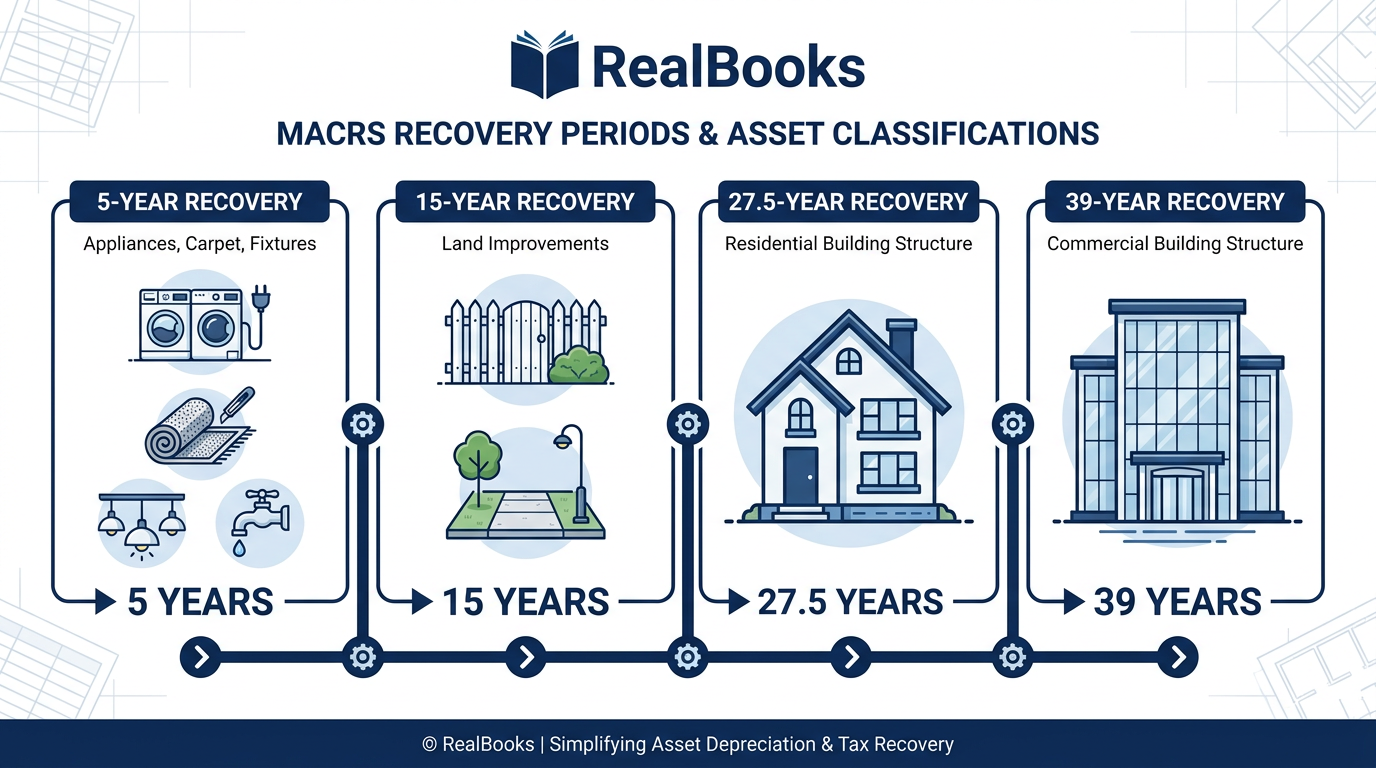
This is exactly where Penny, RealBooks’ AI bookkeeper, earns her keep. Penny tracks every asset on the right schedule so nothing gets miscategorized — appliances don’t get lumped into the 27.5-year schedule, land improvements don’t get buried in the building’s basis, and nothing falls through the cracks at tax time.
Cost segregation is another lever entirely. By reclassifying certain building components — think specialty electrical, plumbing for specific uses, or certain interior finishes — into 5-year or 15-year categories, you can accelerate those deductions dramatically. RealBooks’ Cost Segregation tool automates this analysis using engineering-grade methodology, identifying year-one deductions that most investors don’t even know exist.
But none of this is worth anything if you’re starting from the wrong number. Before depreciation can work for you, you need to know what you’re actually depreciating — and that calculation trips up more investors than almost any other part of real estate accounting.
Calculating Your Depreciable Basis — The Number Most Investors Get Wrong
This is where the math lives. And most investors get it wrong in ways that either leave deductions on the table or create audit exposure they don’t even know about.
Your depreciable basis is not simply what you paid for the property. It’s a specific number derived from your purchase price, adjusted for eligible closing costs, reduced by the land allocation, and — if you converted a personal home to rental — potentially subject to a fair market value comparison. Let’s walk through it step by step.
Step 1: Start with your cost basis.
Your cost basis begins with the purchase price — including any debt you assumed. If you bought a rental for $300,000 with a $240,000 mortgage, your starting basis is $300,000, not $60,000.
Certain closing costs are added to this basis. According to IRS Publication 527, the following closing costs increase your basis:
- Abstract fees (title search costs)
- Legal fees related to the purchase
- Recording fees
- Transfer taxes
- Title insurance premiums
- Seller-paid back taxes or assessments that you assumed
The following closing costs do not increase your basis — they’re either deductible as current expenses or simply not capitalizable:
- Fire or hazard insurance premiums
- Loan origination fees and points
- Appraisal fees required by the lender
- Cost of a credit report
Step 2: Separate out the land.
Land is never depreciable. You must allocate a portion of your total cost basis to the land and exclude it from your depreciation calculation.
The most straightforward method — and the one most commonly accepted by the IRS — is to use the assessed value ratio from your property tax bill. If your county assessment shows that 85% of the value is attributable to the building and 15% to the land, you apply that same ratio to your purchase price.
Example:
Purchase price (including eligible closing costs): $300,000
Property tax assessment:
  - Building value: $255,000 (85%)
  - Land value: $45,000 (15%)

Depreciable basis = $300,000 × 85% = $255,000
Annual depreciation = $255,000 ÷ 27.5 = $9,273/year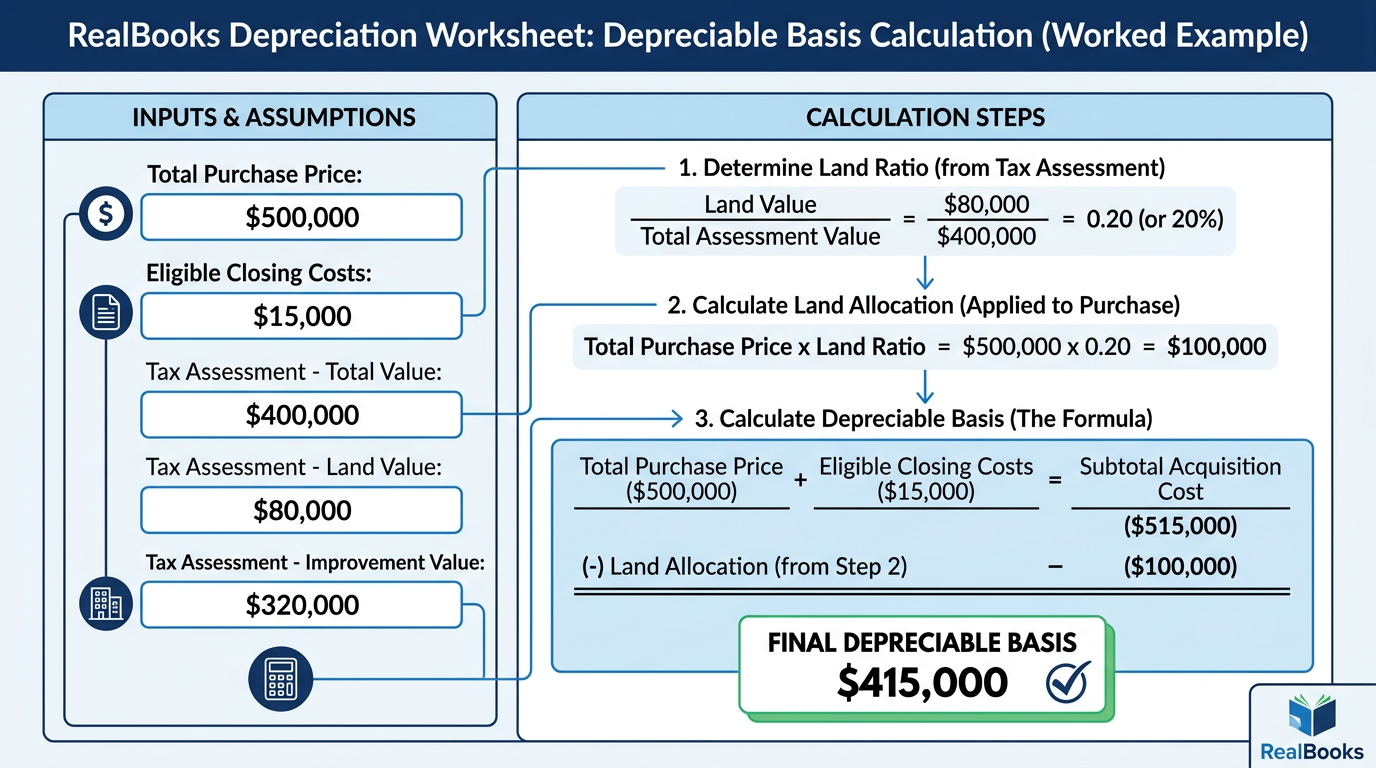
Step 3: Handle conversions from personal use carefully.
If you converted a home you previously lived in into a rental property, the rules shift. Your depreciable basis is the lesser of:
- Your adjusted basis on the date of conversion (original cost plus improvements minus any prior deductions), or
- The fair market value of the property at the time of conversion
This matters because real estate values fluctuate. If you bought a home for $500,000 during a peak market, lived in it, and then converted it to a rental after values declined to $380,000, your depreciable basis starts at $380,000 — not $500,000. The IRS doesn’t allow you to depreciate an inflated basis.
This is precisely the kind of multi-variable tracking that Penny handles automatically inside RealBooks. Through the Asset Management module, Penny maintains a complete record of every dollar that hits or leaves the basis — purchase price, eligible closing costs, capital improvements, insurance recoveries, and the cumulative depreciation taken year over year. Nothing drifts. Nothing gets forgotten.
Getting the depreciable basis right is foundational. Everything downstream — your annual deduction, your adjusted basis at sale, your recapture calculation — is only as accurate as this starting number.
Now that you understand how to calculate what you’re depreciating and how the annual deduction works, it’s time to look squarely at the rule that makes skipping it so costly.
The “Allowed or Allowable” Rule — What IRC §1016(a)(2) Actually Says
This is the rule at the center of everything. The one that turns a well-intentioned decision to “avoid” depreciation into one of the most expensive tax mistakes a real estate investor can make.
IRC §1016(a)(2) requires that your property’s adjusted basis be reduced by the amount of depreciation that was “allowed or allowable” — whichever is greater. The definitions are critical:
- “Allowed” = the depreciation you actually claimed on your tax return
- “Allowable” = the depreciation you were entitled to claim, whether you did or not
In practice: if you owned a rental property for ten years and claimed zero depreciation, the IRS still reduces your adjusted basis by ten years’ worth of straight-line MACRS depreciation. Every year you owned it, the clock ran. Every year, your allowable depreciation accrued. And every year, your basis dropped — silently, invisibly — without you receiving any tax benefit from it.
Let’s put real numbers to it.
Scenario: $200,000 depreciable basis, 10-year holding period
Annual allowable depreciation = $200,000 ÷ 27.5 = $7,273/year
10 years × $7,273 = $72,727 in allowable depreciation

Investor A (claimed depreciation):
  - Received $72,727 in deductions during ownership
  - Adjusted basis reduced by $72,727 at sale
  - Owes recapture tax on $72,727

Investor B (skipped depreciation):
  - Received $0 in deductions during ownership
  - Adjusted basis STILL reduced by $72,727 at sale (allowable rule)
  - Owes recapture tax on $72,727
Same recapture tax. Dramatically different net outcome. Investor A used the deduction to reduce taxable income for a decade. Investor B got nothing — and still pays.
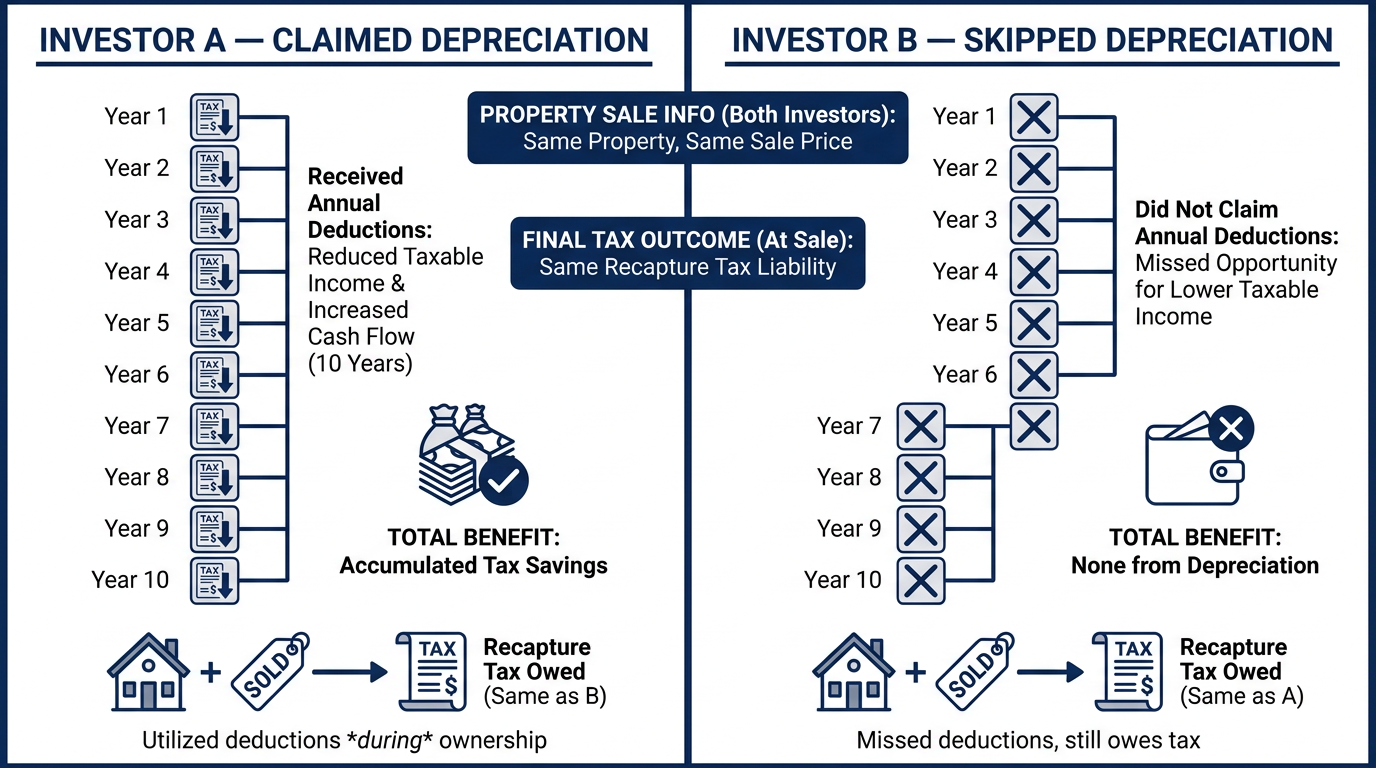
This is what IRS Publication 946 means when it states that you must reduce your basis by the depreciation “allowed or allowable, whichever is greater.” The IRS isn’t punishing you for taking depreciation. It’s penalizing you for not taking it — while still treating the depreciation clock as though you did.
Uncle Sam frames it plainly: “The IRS doesn’t care if you claimed it. They care that you could have.”
The Tax Reporting module inside RealBooks keeps depreciation schedules updated automatically, year-round, so there’s never a question about what’s been claimed, what’s been allowable, and what the adjusted basis looks like heading into a sale. Clean records going in means clean records coming out — with no nasty surprises when a buyer makes an offer.
Understanding the rule intellectually is one thing. Understanding what it actually costs you at the closing table is another. That’s where the next section goes.
Depreciation Recapture — The Tax You Pay Either Way
When you sell a rental property, the IRS separates your gain into two buckets. The first is ordinary long-term capital gain on appreciation. The second — and the one most investors underestimate — is depreciation recapture.
Any portion of your gain that is attributable to prior depreciation (allowed or allowable) is taxed as unrecaptured Section 1250 gain at a federal rate of up to 25%. This rate is capped at 25% for real property depreciated under MACRS — but it sits on top of your regular long-term capital gains tax, creating a layered tax burden at sale that surprises even experienced investors.
On top of that, the 3.8% Net Investment Income Tax (NIIT) may apply if your modified adjusted gross income exceeds $200,000 (single filers) or $250,000 (married filing jointly). That brings your effective recapture rate to nearly 29% for many investors in higher income brackets.
Now back to the core issue: the recapture is calculated on depreciation allowed or allowable — not just what you claimed. An investor who skipped ten years of depreciation doesn’t escape recapture. They simply arrive at the closing table without a decade of deductions to show for it.
Here’s a simplified comparison using the $200,000 depreciable basis scenario from the previous section:
At sale (assume $450,000 sale price, $50,000 land, $150,000 original building basis, $50,000 appreciation):
Investor A (claimed $72,727 in depreciation):
  - Adjusted basis: $200,000 - $72,727 = $127,273
  - Gain: $450,000 - $127,273 = $322,727
  - Recapture tax: $72,727 × 25% = $18,182
  - But offset by: $72,727 in prior-year deductions (value dependent on tax bracket)
  - Net position: POSITIVE — deductions provided real cash savings during ownership

Investor B (claimed $0, skipped depreciation):
  - Adjusted basis still: $200,000 - $72,727 = $127,273 (IRS reduces it anyway)
  - Gain: $450,000 - $127,273 = $322,727 (same gain!)
  - Recapture tax: $72,727 × 25% = $18,182 (same bill!)
  - Offset by: $0 in prior-year deductions
  - Net position: NEGATIVE — paid the same tax, received none of the benefit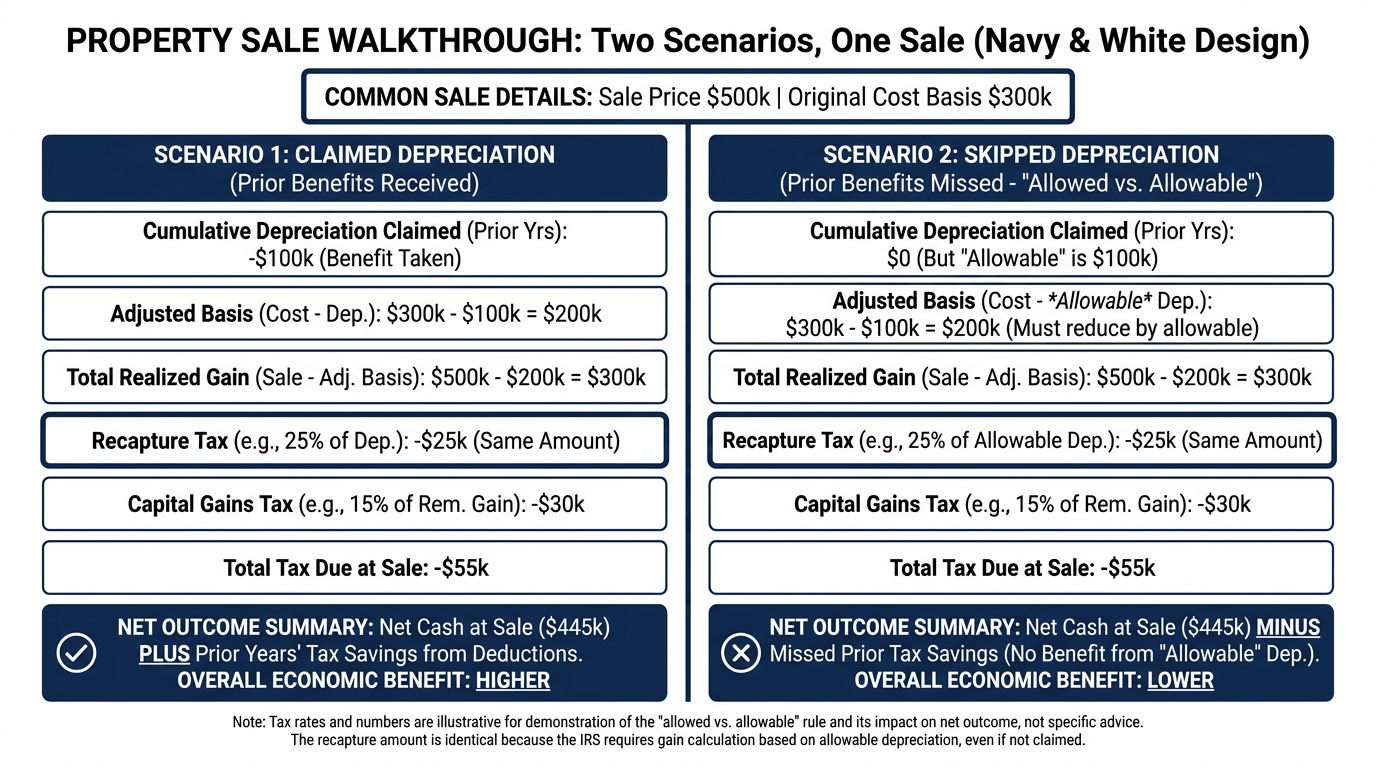
It’s worth noting that not all depreciation recapture is capped at 25%. If you’ve done a cost segregation study and accelerated depreciation on 5-year and 15-year property, that component recaptures as ordinary income under Section 1245 — not Section 1250 — and can be taxed at rates up to 37% for high-income investors. This is a critical planning detail for investors using bonus depreciation strategies.
For investors thinking about exit timing: two strategies exist to defer or reduce recapture. A 1031 exchange defers both the capital gain and the recapture tax into the replacement property — effectively kicking the bill down the road while preserving your equity for continued investment. Timing the sale to a lower-income year (retirement, a year with significant losses elsewhere) can also reduce the effective rate. These are conversations to have with a qualified CPA well before you list a property. Nothing in this blog constitutes tax or legal advice.
What RealBooks’ Tax Reporting module does is keep your depreciation schedule, adjusted basis, and CPA-ready reports current all year — so when a sale opportunity emerges, you and your advisor have accurate numbers to work with immediately, not a frantic scramble through five years of spreadsheets.
The question most investors reach at this point is: I’ve been skipping depreciation. What do I do now? The answer is more straightforward than most people expect.
How to Fix Missed Depreciation — Form 3115 and the Section 481(a) Adjustment
Here’s the good news: if you’ve missed depreciation in prior years, the IRS has a specific, approved pathway to recover it. It doesn’t require panic. It doesn’t require amending years of returns. And it doesn’t mean you’re stuck living with the consequences of a mistake that may have cost you tens of thousands of dollars.
The solution is Form 3115 — Application for Change in Accounting Method.
Before we get into how it works, it’s worth understanding why you can’t just amend old returns. The general rule for amending a tax return is that you have three years from the original filing date (or two years from when you paid the tax, whichever is later). If you missed depreciation on a property you’ve owned for eight years, most of that window is closed. You can’t go back and fix years five, six, seven, and eight through amendments.
This is where Form 3115 is brilliant. Rather than treating missed depreciation as an error on prior returns, the IRS treats it as a change in accounting method. And changes in accounting method have a different mechanism entirely: the Section 481(a) adjustment.
Here’s how it works:
The Section 481(a) adjustment is a one-time catch-up deduction. You calculate the total depreciation you should have claimed in all prior years — going back to when the property was first placed in service — and you claim the entire amount in a single lump sum on your current-year tax return. All of it. In one year. Without touching a single prior return.
- Identify missed depreciation — calculate what you should have claimed from day one
- Run a cost segregation or depreciation analysis — confirm the correct basis, recovery periods, and asset classifications
- File Form 3115 with your current-year return — one copy with the return, one copy mailed separately to the IRS National Office (this is a real requirement; don’t skip it)
- Claim the Section 481(a) adjustment — flows to Schedule E as “other expenses,” reducing your current-year taxable income
- Reset your basis going forward — future depreciation and recapture calculations are now based on correct figures
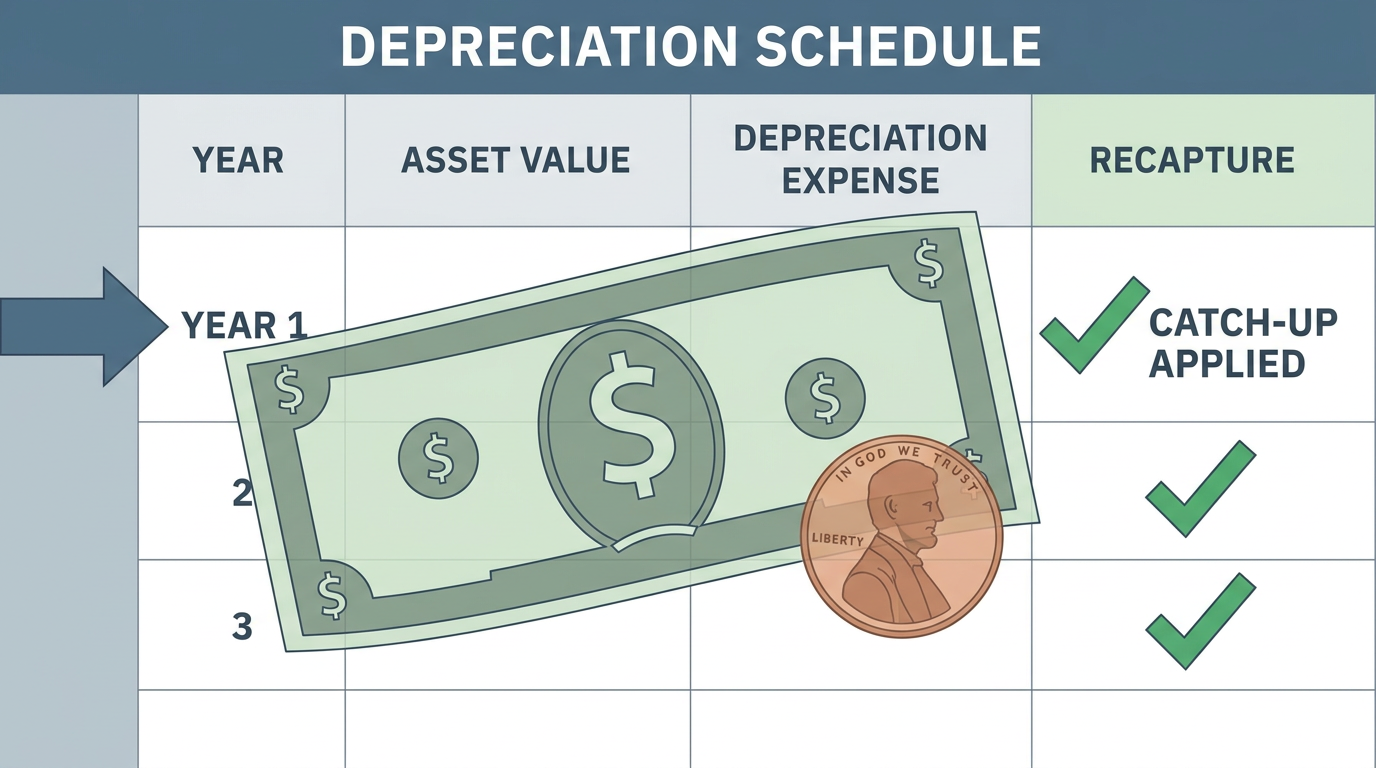
The 481(a) adjustment is a negative adjustment — it reduces your taxable income. If you’ve missed eight years of $9,000/year depreciation on a rental property, that’s a potential $72,000 deduction in the year you file Form 3115. For an investor in a 32% tax bracket, that’s roughly $23,000 in federal tax savings in a single filing.
This also resets your basis correctly going forward. Instead of arriving at a future sale with a basis that has been silently eroded by “allowable” depreciation you never claimed, your records now reflect the actual depreciation taken — which aligns the IRS’s calculation with yours.
A few important operational notes about Form 3115:
- The form requires specific DCN (Designated Change Number) codes. For taxpayers correcting missed depreciation under the automatic change procedures, the applicable DCN is typically found in Revenue Procedure guidance — this is not a form to complete without CPA involvement
- It must be filed in duplicate: one copy with your current tax return, and a separate copy mailed to the IRS National Office in Ogden, Utah
- It applies prospectively — once filed, you’re locked into the correct method going forward
Dollar Bill, RealBooks’ AI asset and project builder, approaches Form 3115 situations with a clear philosophy: build the depreciation schedule from the ground up so the foundation is right before you go any further. That means identifying every asset, every improvement, every placed-in-service date — and making sure the 481(a) catch-up reflects the full picture.
The RealBooks Cost Segregation tool is the natural starting point for this process. Before you can file Form 3115 and claim a catch-up deduction, you need a complete, accurate depreciation schedule that separates 5-year, 15-year, and 27.5-year assets correctly. Cost segregation surfaces the components you may have been under-depreciating — or not depreciating at all — and produces a CPA-ready report that feeds directly into the 3115 filing.
For investors with multiple properties who have been skipping depreciation across their portfolio, Form 3115 can be filed on a property-by-property basis, and the cumulative 481(a) adjustment can be substantial. This isn’t a minor accounting correction. It’s a meaningful financial recovery — one that required knowing the rule existed and taking action to fix it.
IRS Form 3115 instructions are dense, but the core concept is simple: the IRS would rather have you correcting your method going forward than leaving years of incorrect accounting to compound. The automatic change procedures exist precisely to make this process accessible to taxpayers who want to do it right.

The Investor Who Gets This Right Wins Quietly
Depreciation isn’t glamorous. It doesn’t have the appeal of a value-add deal or a creative financing structure. But across a multi-year holding period, correctly claimed depreciation is one of the most powerful legal tax tools available to a real estate investor — and the failure to use it doesn’t save you from recapture. It just means you paid the tax without collecting the benefit.
The “allowed or allowable” rule isn’t punitive in intent. It’s designed around a simple principle: if you owned income-producing property that was wearing out, the IRS will account for that wear regardless of what you did with your tax return. The investor who understands this — and acts on it from day one — keeps significantly more of what they earn over the life of a portfolio.
The fix for missed depreciation isn’t complicated. Form 3115 exists for exactly this situation, and the Section 481(a) adjustment can recover years of deductions in a single filing. You don’t need a wall of amended returns. You need accurate records, the right analysis, and a CPA who knows how to file the form correctly.
The system that makes this automatic — year after year, across every property, every entity, every asset — is exactly what RealBooks was built for. Clean financials aren’t just nice to have. They’re the foundation of every smart exit, every 1031, every refinance decision you’ll ever make.
Take Control of Your Depreciation — Starting Today
Uncle Sam maximizes your deductions. Penny tracks every asset on the right schedule. Dollar Bill builds the depreciation record from the foundation up. Together, they make sure you’re never paying the recapture tax without having received the deduction first.
See how RealBooks handles your depreciation, basis tracking, and tax reporting — so you’re never leaving deductions on the table.
Visit RealBooks.io to see how it works.
And if you know a rental property owner who has never run a depreciation schedule — share this with them. It might be the most valuable thing they read this year.
This blog is intended for informational purposes only and does not constitute tax, legal, or financial advice. Consult a qualified CPA or tax professional before making any decisions regarding your depreciation strategy or filing Form 3115.
Ready to maximize your tax savings?
RealBooks automatically tracks expenses, manages assets, and calculates depreciation across your entire portfolio.
Start Free Trial →