Long-Term Rentals: The Complete Guide to Buying, Managing, and Holding Rental Property for the Long Run

Long-term rentals are the least glamorous strategy in real estate investing, and also the one that’s quietly built more wealth than almost any other. No renovation drama, no nightly turnover, no algorithm to chase. A tenant signs a lease, pays rent monthly, and the property does its job in the background while equity builds and the mortgage pays itself down.
That simplicity is exactly why it’s easy to underestimate. The investors who do best with long-term rentals aren’t the ones who found a secret — they’re the ones who got the fundamentals right from the start: how to evaluate a deal, how to structure the lease and the tenant relationship, how the tax treatment actually works, and how to keep the books clean enough that none of it becomes a surprise later.
Here’s the complete picture.
Why Long-Term Rentals Remain the Default Real Estate Strategy
A long-term rental is a property leased to a tenant for an extended period — typically 12 months or longer — generating steady monthly income rather than the variable, management-intensive income of a short-term rental.
The appeal is structural. Predictable cash flow. One tenant, one lease, one rent payment a month — a fundamentally simpler operating model than coordinating cleaners and turnovers for a revolving door of short-term guests. Lower management burden. A long-term tenant who’s comfortable in a well-maintained home generates far fewer day-to-day demands than short-term guests do. Mortgage paydown as a wealth-building mechanic. Every rent payment that covers the mortgage is also quietly building equity, independent of whether the property appreciates. Depreciation deductions reduce taxable income every year you hold the property, regardless of whether it’s cash-flow positive. And financing is generally more accessible — conventional and DSCR loans are both well-established products for long-term rental purchases, with financing markets that are mature and predictable compared to some other strategies.
None of this means long-term rentals are passive in the way the phrase sometimes implies. There’s real work in finding the right deal, placing the right tenant, and maintaining the property — but it’s work concentrated at specific moments rather than spread continuously across every week of ownership.
Evaluating a Long-Term Rental Deal
The numbers that matter for a long-term rental are the same core metrics that apply across real estate investing, but a few carry particular weight for this strategy specifically.
Cash flow is the starting point — rental income minus all operating expenses and debt service. For a long-term rental, this needs to be modeled conservatively: realistic rent based on comparable properties, not the optimistic high end of a range, and a genuine vacancy allowance even in a strong market. Properties sit empty between tenants, and underwriting at 100% occupancy is the most common mistake in any rental deal analysis.
Net Operating Income (NOI) — income minus operating expenses, before debt service — is the number that describes the property itself, independent of how you financed it. It’s also the figure most lenders and appraisers anchor to.
Cap rate and cash-on-cash return tell you two different things. Cap rate measures the property’s return relative to its price, useful for comparing deals across markets. Cash-on-cash measures how hard your actual invested dollars are working, which is the number that matters most once financing is in the picture.
Appreciation potential matters more for long-term holds than for a fix-and-flip, simply because you’re exposed to it for years rather than months. Market fundamentals — population growth, job growth, new supply — are worth weighing alongside the day-one cash flow numbers.
A property that cash-flows modestly in a market with strong long-term fundamentals is often a better long-term hold than a property with excellent day-one cash flow in a market that’s stagnant or declining. The strategy rewards patience, which means the underlying market matters more here than it does for strategies with a faster exit.
Related: How to Analyze a Rental Property: The Complete Guide to Running the Numbers
Tenants, Leases, and the Relationship That Determines Your Returns

A long-term rental’s performance is determined as much by the quality of the tenant relationship as by the property itself. A well-screened tenant in a modest unit will consistently outperform a poorly-screened tenant in a beautiful one.
Screening is the highest-leverage activity in the entire strategy. Credit history, income verification (typically a multiple of monthly rent), rental history and references, and background checks all factor in — and the time spent screening thoroughly before signing a lease is time that prevents far more expensive problems later.
The lease agreement is the operating document for the entire relationship — term length, rent amount and due date, security deposit terms, maintenance responsibilities, and the specific conditions under which the lease can be terminated. A clear, well-structured lease prevents the ambiguity that turns a minor disagreement into a dispute.
Security deposits require a specific accounting distinction worth getting right from day one: a deposit you intend to return is a liability, not income — it’s money that belongs to the tenant until specific conditions are met. It only becomes income in the year you actually keep it, whether for unpaid rent or damages.
Maintenance response is where tenant relationships are won or lost. A landlord who responds quickly to maintenance requests retains good tenants longer, which matters enormously for a strategy built around minimizing turnover and vacancy.
Renewal strategy deserves real thought rather than defaulting to the same renewal process every time. A reliable, long-tenured tenant is often worth more than a modest rent increase achieved by risking turnover — vacancy, turnover costs, and the uncertainty of a new tenant frequently cost more than a year of slightly below-market rent from someone proven reliable.
How Long-Term Rentals Are Taxed
Long-term rental income is reported on Schedule E, and the tax treatment is where this strategy’s advantages become concrete.
Depreciation is the largest non-cash deduction available. Residential rental property depreciates over 27.5 years, based on the building value excluding land — a deduction that reduces taxable income every year regardless of whether the property is cash-flow positive. This is also one of the most commonly mishandled aspects of rental ownership: under the “allowed or allowable” rule, the IRS reduces your basis by the depreciation you were entitled to take whether you claimed it or not, so skipping it doesn’t protect you from anything — it just means paying recapture later on a deduction you never received.
Operating expenses — mortgage interest, property taxes, insurance, repairs, property management, and more — are deductible in the year incurred, provided they’re correctly distinguished from capital improvements, which must instead be capitalized and depreciated.
Passive activity rules generally apply to long-term rental losses by default, meaning they can typically only offset other passive income unless you qualify for the $25,000 allowance (available below certain income thresholds for active participants) or Real Estate Professional Status.
Cost segregation can accelerate depreciation on a long-term rental significantly, reclassifying building components into shorter recovery periods — and with 100% bonus depreciation permanently restored under the One Big Beautiful Bill Act, those reclassified components can often be expensed much faster than the standard 27.5-year schedule allows.
At sale, depreciation recapture applies to the accumulated depreciation taken over the hold period, taxed separately from and in addition to capital gains on appreciation — a cost that a 1031 exchange can defer if you’re rolling the proceeds into a replacement property.
Related: Rental Property Depreciation Explained · Every Tax Deduction Real Estate Investors Can Claim in 2026 · Depreciation Recapture Explained
Managing a Long-Term Rental Month to Month
The ongoing operational rhythm of a long-term rental is lighter than other strategies, but it isn’t nothing — and the investors who stay disciplined about it are the ones who avoid the slow accumulation of small problems that eventually becomes one large one.
Rent collection should be consistent and, ideally, automated. A clear process for what happens when rent is late — applied uniformly, every time — prevents both financial surprises and the perception of favoritism if you ever have multiple tenants across a portfolio.
Routine maintenance — HVAC servicing, gutter cleaning, pest control — is cheaper and less disruptive when scheduled proactively than when it’s addressed only after something fails. A property maintained consistently also tends to retain tenants longer.
Annual or periodic inspections, conducted with proper notice, catch small issues — a slow leak, a failing seal — before they become expensive ones, and they keep you informed about the property’s actual condition between tenant turnovers.
Insurance and escrow should be reviewed annually rather than left on autopilot. Replacement cost estimates change, and a policy that was adequate at purchase may not reflect the property’s current value several years later.
Reserve funds for capital expenditures — a roof, a water heater, an HVAC system, all of which eventually need replacement — are what separate a cash-flowing property from one that’s quietly building a liability nobody’s budgeted for. Budgeting 5–10% of gross rent toward a capital reserve is a standard practice worth adopting from day one rather than after the first unplanned $8,000 repair.
Scaling From One Long-Term Rental to a Portfolio
The jump from one rental to several introduces complexity that doesn’t scale linearly, and it’s worth anticipating rather than discovering under pressure.
Entity structure becomes a real question once you own more than one or two properties — whether to hold each property in its own LLC, group several under one entity, or use a holding company structure. The right answer depends on your risk tolerance, your lender’s requirements, and your long-term growth plans, and it’s a decision worth making deliberately with an attorney rather than defaulting into.
Financing shifts as a portfolio grows. Conventional lenders often cap the number of financed properties an individual can hold, which is why many portfolio builders transition toward DSCR loans — financing qualified based on the property’s own income rather than the investor’s personal income and debt-to-income ratio.
Property management becomes a genuine decision point rather than an obvious default. Self-managing one property is straightforward. Self-managing eight, especially across multiple markets, is a different undertaking — and the breakeven point where a professional property manager’s fee is worth paying for arrives sooner than most new investors expect.
Financial visibility is what determines whether a growing portfolio feels manageable or chaotic. Knowing which property is actually performing, which is underperforming, and what the whole portfolio’s combined cash flow looks like requires property-level, entity-level, and consolidated reporting working together — not a collection of individual spreadsheets that someone has to manually combine.
Related: LLC for Rental Property: The Complete Guide · How to Manage Finances Across Multiple LLCs
What Long-Term Rentals Require From Your Books
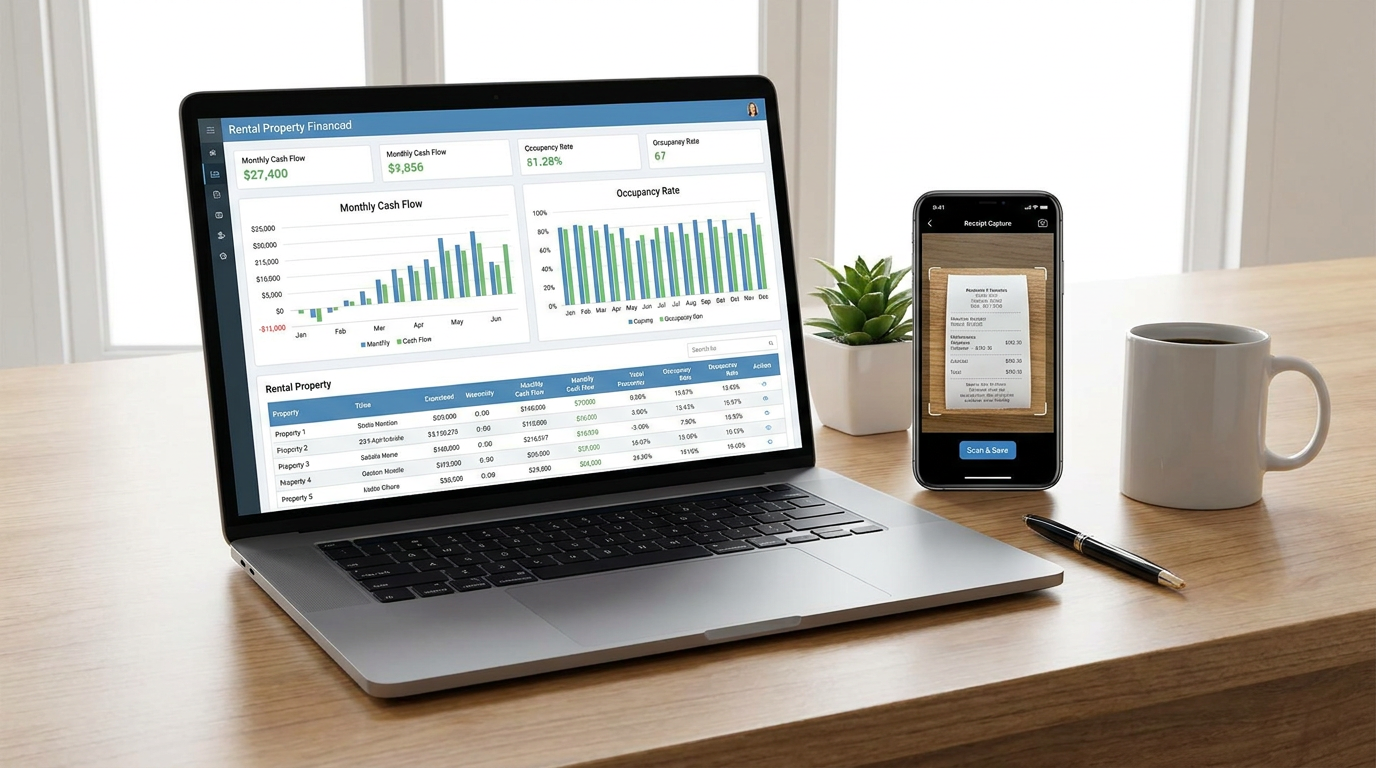
A long-term rental generates fewer transactions than an active flip or a short-term rental, which creates a specific risk: the bookkeeping feels simple enough to put off, and then a year’s worth of categorization gets reconstructed all at once in March.
Clean books for a long-term rental portfolio depend on a handful of consistent habits: rent and every operating expense tracked at the property level as it happens, the repair-versus-capital-improvement distinction made at the time of the expense rather than guessed at later, security deposits held as a liability rather than booked as income, and depreciation calculated correctly and consistently from the day the property is placed in service.
Penny, RealBooks’ AI bookkeeper, connects to your bank accounts and credit cards and categorizes every transaction — rent received, mortgage payments, repairs, insurance — to the correct property as it posts, so the books stay current without requiring a monthly sit-down session.
Dollar Bill handles cost basis at acquisition and tracks any capital improvements made over the hold period, keeping the depreciation schedule accurate even as a property evolves across years of ownership.
Uncle Sam maintains the depreciation schedule per property, applies current bonus depreciation rules, and generates Schedule E-ready reports your CPA can work from directly — turning a year of long-term rental ownership into a report you run rather than a project you survive.
For investors scaling across multiple properties and entities, each maintains its own books with a consolidated portfolio view, so the question of which property is actually performing has a real-time answer rather than a once-a-year guess.
RealBooks organizes your records. It doesn’t provide tax advice or file your return — that’s your CPA’s role. What organized books change is whether a long-term hold stays simple the way it’s supposed to, or quietly accumulates into a reconstruction project.
Related: Real Estate Bookkeeping: The Complete Guide
The Takeaway
Long-term rentals reward patience and discipline more than any clever tactic. The fundamentals — evaluating a deal honestly with conservative vacancy and real reserves, screening tenants thoroughly, maintaining the property proactively, and understanding how depreciation and the passive activity rules actually work — matter more than almost anything else in the strategy.
It’s the simplest real estate strategy to understand and, paradoxically, one of the easiest to get wrong through neglect rather than complexity. A rental that’s underwritten honestly, leased carefully, and tracked accurately tends to compound quietly for as long as you own it. One that isn’t tends to surprise you — usually at the worst possible moment.
Your numbers should work as hard as your investments do.
Clean books for every long-term rental — from the first tenant to the tenth property.
Start a Free Trial → · See How It Works →
This article is for general educational purposes and reflects general investor guidance. It does not constitute tax, legal, or accounting advice, and no particular financial or tax outcome is promised or implied. Consult a qualified CPA or attorney regarding your specific situation.
Ready to maximize your tax savings?
RealBooks automatically tracks expenses, manages assets, and calculates depreciation across your entire portfolio.
Start Free Trial →