What Landlords Need to Know About Florida Amendment 3 (2026)

If you own rental or investment property in Florida, the one fact to anchor on is this: Amendment 3 would change the annual assessment cap on non-homestead property, the category that covers most rentals and investment real estate, from 10% to 5%. That single provision is the part of the measure tied most directly to your portfolio.
Most of the headlines you have seen are about homestead changes. Those changes are real, but they mostly do not apply to rental property, because homestead benefits are reserved for owner-occupied primary residences. If you have been reading coverage and wondering whether any of it touches your rentals, you are asking the right question.
This article does three things. It explains what Florida Amendment 3 for landlords actually means, lays out both sides of the debate neutrally, and points you to official sources so you can confirm the details yourself. We will cover the non-homestead assessment cap, the homestead exemption, the five-year residency rule, the Florida property tax 2026 timeline, and the local revenue provisions that drive much of the debate.
One more thing before we begin. This is informational only. It is not financial, tax, or legal advice. We will tell you where to verify everything, including the latest status of the measure, since this concerns a question on the November 3, 2026 ballot.
What Amendment 3 Actually Is
Amendment 3 is a proposed amendment to the Florida Constitution. It would change language in Article VII, the section that governs property taxation, and it appears on the November 3, 2026 general election ballot. Voters decide whether it becomes part of the state constitution.
Here is a rule that matters for every Florida constitutional amendment, not just this one. A proposed amendment needs at least 60% voter approval to pass. A simple majority is not enough. That 60% threshold is a high bar, and it applies to Amendment 3 like any other. You can confirm this process through the Florida Department of State’s constitutional amendments page, which describes how proposed amendments reach the ballot and how they are adopted.
If voters approve it, the changes take effect January 1, 2027. Because of how Florida’s property tax calendar works, the first tax notices that reflect those changes would arrive in late 2027, for the 2027 tax year. In other words, approval in November 2026 would not show up on a bill until roughly a year later.
Amendment 3 has two headline provisions. The first is a larger homestead exemption for non-school property taxes. The second is a lower annual assessment cap on non-homestead property. The next sections break each of these down in plain terms, because they affect very different kinds of owners.
Before we go further, three terms will keep coming up, so here are quick definitions.
- Market value is what a property would likely sell for in the open market.
- Assessed value is the value a county property appraiser assigns for tax purposes, which can be limited by annual caps and is often lower than market value.
- Millage rate is the tax rate applied to assessed value, expressed in mills, where one mill equals one dollar of tax per one thousand dollars of taxable value.
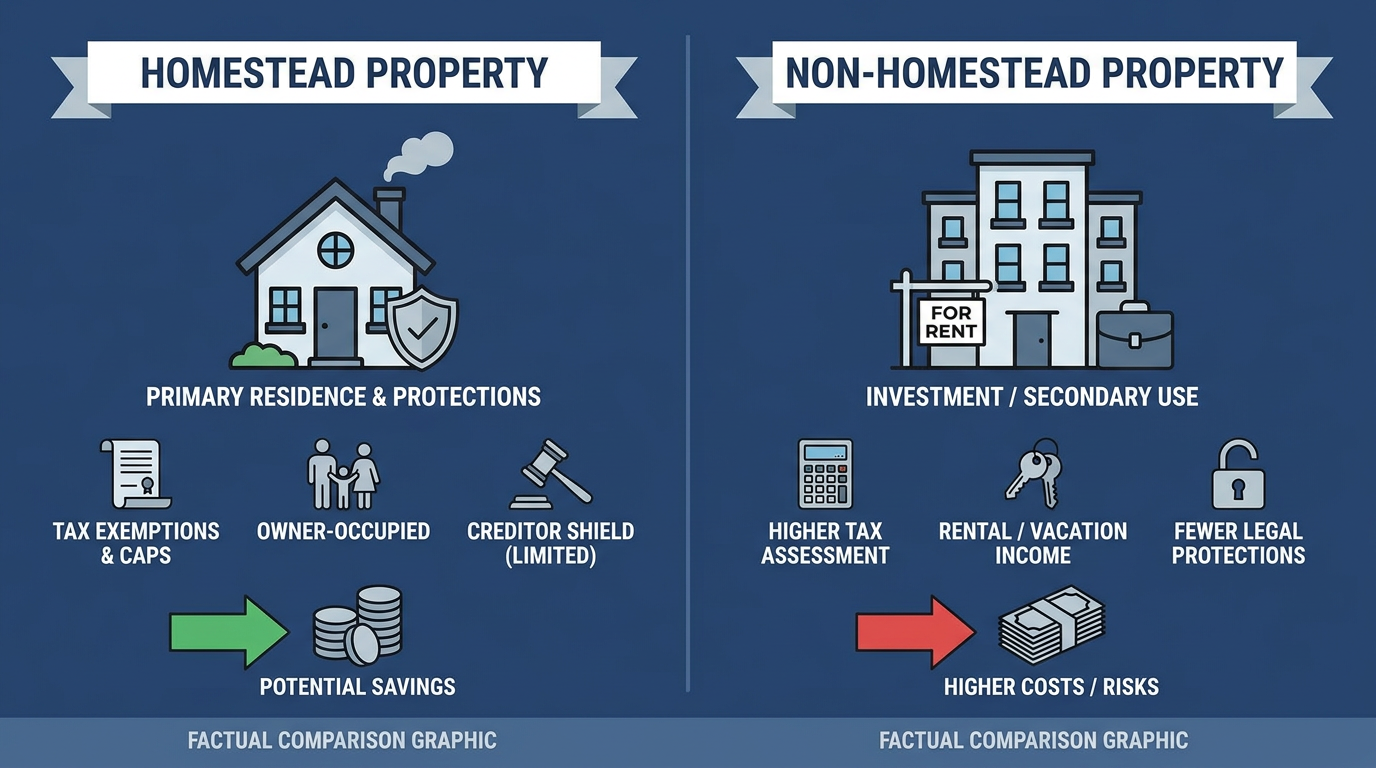
The most important distinction for this article is the one between homestead and non-homestead property. Homestead property is an owner-occupied primary residence that qualifies for homestead benefits. Non-homestead property is essentially everything else, including rentals, second homes, commercial buildings, and vacant land. That line is what determines whether a given provision touches your investment property at all.
For a neutral, well-sourced overview of the entire measure, including the 60% requirement and the full text of what is being proposed, Ballotpedia’s Amendment 3 summary is a useful starting point. It pulls together the ballot language, the provisions, and the context in one place.
With the basics defined, let’s move into the provision that matters most to investors.
The Provision That Matters Most for Landlords: The Non-Homestead Assessment Cap
This is the core of the measure for anyone who owns rental or investment property, so it is worth slowing down here.
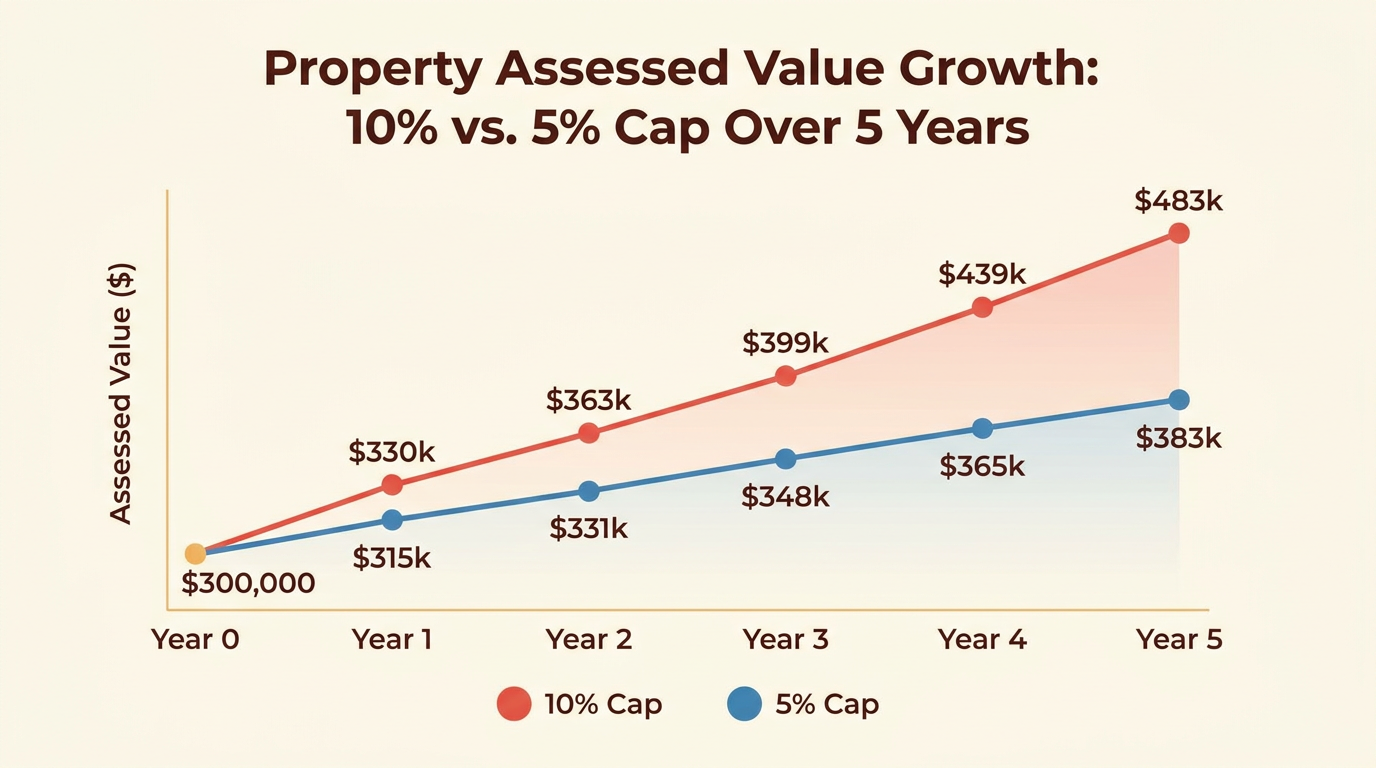
Under current Florida law, the assessed value of non-homestead real property can rise by up to 10% per year for most local taxing authorities, no matter how fast the market value climbs. The cap is an annual limit on how much the taxable assessment can grow year over year. During a hot market, that 10% ceiling is what keeps the assessed value from jumping all the way up to a soaring market value in a single year.
Amendment 3 would lower that annual cap from 10% to 5% for non-homestead property. You can see this described in plain language in the Florida TaxWatch Property Tax Resource Center, which explains that the measure reduces the assessment cap on non-homestead property from 10% per year to 5% per year.
Let’s define non-homestead property concretely, because this is the audience it speaks to directly. It includes:
- Residential rental properties, from single-family rentals to larger apartment holdings.
- Second homes and vacation properties that are not a primary residence.
- Commercial real estate.
- Vacant land.
If you own any of the above, the 5% cap is the provision to understand.
Now for the part that requires care, because it is easy to misread. The cap limits how fast the assessed value can increase each year. It does not cap your tax bill directly, and it does not cap the millage rate. Those are different levers. A lower cap can slow how quickly your assessed value climbs during a rising market, which in turn can slow how quickly the taxable base underneath your bill grows. But the final bill still depends on the millage rate set by local taxing authorities, and millage is not governed by this cap.
Think of it this way. The assessment cap controls one input, the assessed value. The millage rate is a separate input. A smaller cap narrows how much one input can grow in a year, but it does not freeze the other input, and it does not freeze your bill.
There is also an important exclusion. The cap change applies to non-school levies only. School district taxes are not subject to the same cap in the same way, so a portion of a non-homestead bill can still move under separate rules. Florida TaxWatch and county property appraisers both note this school-tax distinction, which is why your total bill is never governed by a single number.
For an official local perspective, the Volusia County Property Appraiser’s Amendment 3 explanation walks through the cap change and the timing from a county’s point of view. County appraiser pages are especially useful because they describe how the mechanics would be applied at the local level, which is where your actual property is assessed.
A lower cap does not lower your bill by itself. It slows how fast one part of the calculation, your assessed value, can grow in a single year.
The practical takeaway is simple. Of everything in Amendment 3, this non-homestead assessment cap is the provision most directly tied to investment property. If a headline says the measure helps homeowners, that is largely the homestead side of the story. The rental side runs through this cap.
Since most headlines focus on homestead, let’s clear up exactly how those changes do, and mostly do not, touch rental owners.
Homestead Exemption Changes and Why They Mostly Don’t Apply to Rentals
The homestead side of Amendment 3 gets the most attention, so it is worth explaining accurately and then explaining why it rarely helps investment property.
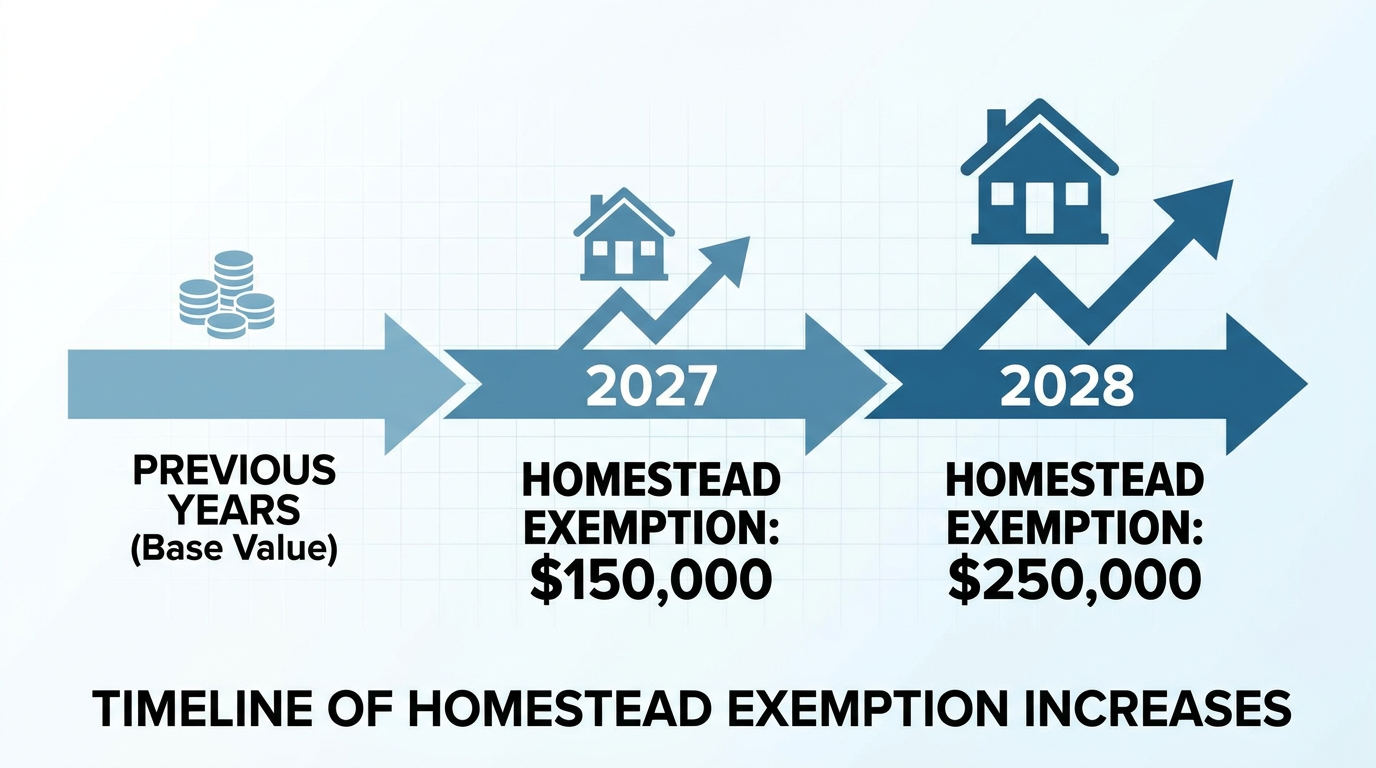
Amendment 3 would raise the homestead exemption for non-school property taxes to $150,000 in 2027 and $250,000 in 2028. After that, the exemption would be adjusted for inflation, and only when inflation is positive, meaning it would not decrease in a year of negative inflation. You can see these figures laid out through county resources such as the Alachua County property tax information portal, which presents the exemption amounts and timeline.
There is a part that stays the same. The $25,000 homestead exemption that applies to school district taxes is not changed by this amendment. So even for a qualifying homeowner, the larger exemption applies to the non-school portion of the bill, while the school-tax exemption remains where it is today.
Here is the key point for landlords. The homestead exemption applies to owner-occupied primary residences. Rental and investment property, by definition, is not the owner’s primary residence, so most of it does not qualify for the homestead exemption at all. A bigger homestead exemption is good news for a qualifying homeowner, but it is not a benefit that attaches to a rental unit.
There is one practical edge case worth naming. If you are an investor who also owns and lives in a primary home in Florida, that primary home may qualify for homestead treatment like any other owner-occupied residence. Your rental units generally would not. So the homestead changes could touch you as a homeowner while leaving your rental portfolio outside their reach.
There is also a residency wrinkle that matters for investors who are relocating to Florida. Under the measure, people who establish Florida residency around the start of 2027 would need to maintain residency for five years before receiving the increased homestead exemption amounts. In practice, the cutoff turns on whether you were already a Florida resident at the end of 2026. A plain-language media summary from WTSP’s explainer on Amendment 3 reinforces that these exemption changes are homestead-focused, which is the whole reason they sit to one side of the rental conversation.
The homestead exemption is tied to living in the home. If you do not live there, the exemption generally does not follow the property.
We will avoid predicting specific dollar savings for any individual, because the actual impact depends on your property, your county, local millage decisions, and your personal situation. The reliable, non-speculative statement is this: the homestead changes are built for primary residences, so for most rental and investment property they do not apply.
Beyond the two headline provisions, the amendment also touches how local governments handle certain revenue, which matters to the debate that follows.
The Other Provisions: Residency Rule and Local Revenue Restrictions
Amendment 3 is more than its two headline items. To give you the complete picture, two additional pieces deserve a plain, factual description, especially because they feed directly into the supporters-versus-opponents debate.
First, the measure includes provisions that address how counties and municipalities may use certain property tax revenue. Described neutrally and at a high level, the amendment contemplates directing how local property tax revenue is applied, with the Legislature involved in setting out the process. We will not characterize this as good or bad here. We are simply noting that the measure reaches beyond exemptions and caps into the relationship between the state framework and local government budgets. For a provision-by-provision description of this spending-related language, Ballotpedia’s detailed breakdown of Amendment 3 lays out the text in context.
Second, the five-year residency requirement belongs here too, because it also sits at the intersection of state rules and local administration. To restate it: new Florida residents who become eligible for the homestead exemption around the start of 2027 would need to maintain their qualifying residency for five years before receiving the increased exemption amounts, while receiving the existing exemption in the meantime. A neutral voter-guide description of the measure’s provisions, including how it addresses counties and municipalities, is available through the Florida Phoenix 2026 Amendment 3 voter guide.
Two reminders for readers who are skimming:
- If approved, Amendment 3 takes effect January 1, 2027.
- Like all Florida constitutional amendments, it needs at least 60% voter approval to pass.
If approved, effective January 1, 2027. Requires at least 60% voter approval to pass.
It is worth flagging that these revenue-related provisions are central to the opposition’s concern about a so-called tax shift, which we cover neutrally in the next section. Supporters and opponents read the same provisions and draw different conclusions, which is exactly why a fair side-by-side is useful.
Finally, a practical note. Some implementation details may be clarified by the Legislature or by local governments as the framework is applied. That is normal for a constitutional change of this kind. It is also why official sources, rather than summaries circulating on social media, are the right place to confirm specifics as they develop.
These revenue provisions are exactly where supporters and opponents disagree, so here is each side in its own words.
Both Sides of the Debate, Stated Neutrally
The points below are claims made by each side. They are arguments, not statements of fact, and both sides rely on projections and estimates. We present them with attribution and equal weight, and we do not take a position.
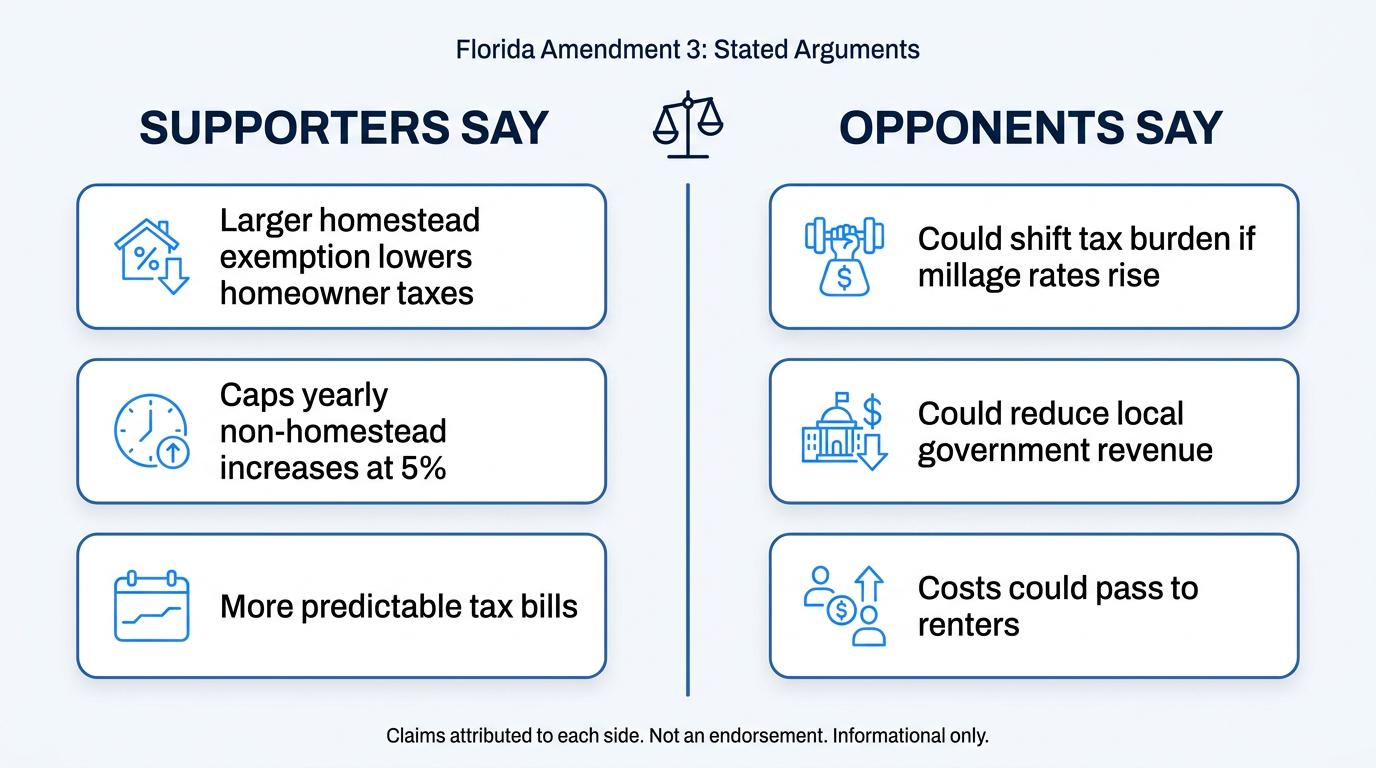
Supporters say the measure delivers meaningful property tax relief. They point to rising property tax bills as the problem the amendment is meant to address, an argument echoed by residents who have spoken in favor of it at local forums. On the investment side, supporters emphasize that lowering the non-homestead assessment cap from 10% to 5% would limit how sharply assessed values can spike during a hot market, which they argue could ease costs for small businesses and other non-homestead owners, and potentially provide some indirect relief that reaches renters. Supporters also argue that local governments have the flexibility to adjust their budgets to manage any changes in revenue.
Opponents say the measure functions more like a tax shift than a pure cut. The League of Women Voters of Florida, which has taken a formal position against the measure, frames a central concern this way: if certain owners pay less, the cost of funding local services may move elsewhere rather than disappear. Opponents argue that local governments could respond to reduced revenue by raising millage rates or adding fees to recover the difference, and that such costs could ultimately pass through to renters. Some also point to projected reductions in local revenue that funds public services.
On the millage point specifically, the neutral observation that nothing in the amendment text prevents future millage-rate changes is supported by research-oriented sources such as the Florida TaxWatch Property Tax Resource Center. We attribute that observation to those sources rather than stating it as our own conclusion. The assessment cap and the millage rate are different levers, and the cap does not freeze the rate.
For a balanced media summary that quotes voices on both sides, WTSP’s pros and cons coverage of Amendment 3 walks through the relief argument and the tax-shift argument in the same piece.
Supporters frame Amendment 3 as relief. Opponents frame it as a shift. Both sides lean on estimates, and reasonable people read the same provisions differently.
Here is a quick, evenly weighted recap so neither side gets the last word:
- On relief: Supporters say it lowers the pressure of rising assessments. Opponents say the relief may be offset elsewhere.
- On local budgets: Supporters say governments can adapt. Opponents say adaptation may mean higher millage or new fees.
- On renters: Supporters say easing owner costs could help. Opponents say recovered costs could pass through to tenants.
- On the numbers: Both sides use projections, and both acknowledge uncertainty in how local governments will respond.
Whatever a landlord thinks of the measure, the practical takeaway is the same: clean, property-level records make you ready for any outcome.
Why Year-Round, Property-Level Records Matter When Assessment Rules Change
Here is a pattern worth noticing. When assessment rules shift, the investors who stay calm are the ones who can see their numbers per property. Uncertainty feels very different when you can open your records and answer questions in minutes instead of guessing. Tax preparation is an all-year practice, not a year-end scramble, and a ballot measure like this is a good reminder of why.
So what is worth tracking per property, regardless of how the vote goes? A short list covers most of it:
- Assessed value over time, so you can see how the taxable base has moved year to year.
- Annual tax bills, so you have a clean history rather than a pile of mailed notices.
- Millage changes, since the rate is a separate lever from the cap and affects your bottom line.
- Property-level expenses, tied to the right property rather than lumped together.
Notice why per-property detail matters specifically here. The non-homestead assessment cap applies property by property. A single portfolio-wide spreadsheet hides exactly the detail you would want, because it blends properties that may be moving in very different directions. If one rental’s assessed value is climbing faster than another’s, you want to see that at the property level, not buried in a combined total.
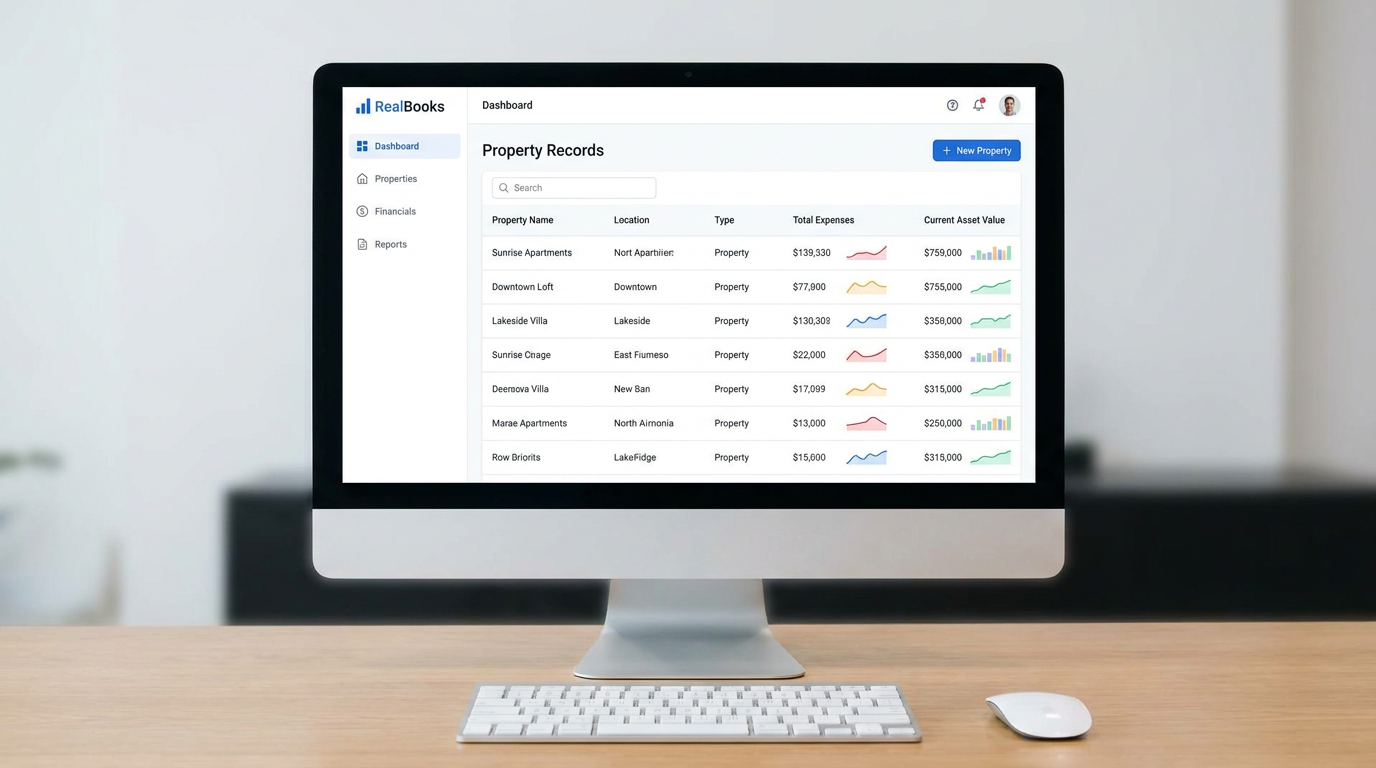
This is where RealBooks fits in, strictly as a record-keeping and organization tool. RealBooks ties each expense to the right property, tracks assets, and keeps your records organized year-round, so your data is ready whether or not the amendment passes. If you want to track assessed values and asset details per property, RealBooks asset management is built for that kind of per-property view. To keep expenses attached to the correct property throughout the year rather than reconstructed in April, RealBooks expense management handles the tagging as you go. And when it is time to hand clean, organized records to your own professional, RealBooks tax reporting produces export-ready reports, framed here as record-keeping, not as advice.
To be explicit about the boundary: RealBooks helps you keep and organize your own records. It does not provide tax or legal advice, and it does not interpret Amendment 3 for your specific situation. That interpretation is a job for your own licensed professional and the official sources.
Your numbers should work as hard as your investments do. Organized, property-level records are what let you respond to a rule change instead of scrambling after one.
The goal is to feel capable, not overwhelmed. If you want more on building that habit, the RealBooks blog has educational posts on real estate bookkeeping that go deeper into property-level record-keeping.
Before wrapping, let’s make the limits of this article explicit with a clear disclaimer.
Before You Vote: Confirm the Details With Official Sources
This article is informational only. It is not financial, tax, or legal advice.
Details and interpretations of a ballot measure can change, and this concerns a question on the November 3, 2026 ballot. Confirm the specifics and the current status of the amendment before voting day rather than relying on any single summary, including this one.
There are three source types worth going to directly:
- The Florida Division of Elections for the official ballot and the amendment’s status. Start with the Florida Division of Elections website for the authoritative record, and use the constitutional amendments and initiatives page to review the amendment process and the 60% approval rule.
- Your county property appraiser for how the measure would affect a specific property. Appraiser offices administer assessments locally, so their guidance is the most relevant to your actual parcels. Search for your own county’s property appraiser site, since each county publishes its own resources.
- Your own licensed tax professional for anything tied to your personal financial situation.
A note on RealBooks, so there is no confusion. RealBooks is a bookkeeping and record-keeping tool. It is not a licensed accounting firm and not a financial or legal advisor.
Finally, verify numbers and effective dates against primary sources rather than social media posts. Figures get rounded, dates get mangled, and provisions get oversimplified as they travel across platforms. The official pages are where the real language lives.

Conclusion
If you take one thing from all of this, make it the distinction between homestead and non-homestead. Amendment 3’s non-homestead assessment cap change, from 10% to 5%, is the provision tied most directly to investment property. The homestead exemption increases grab the headlines, but they mostly apply to primary residences, not rentals.
The decision on the November 3, 2026 ballot is yours, and this article took no side. We explained the measure, presented both the supporters’ and opponents’ stated arguments with attribution, and pointed you to the official sources where you can confirm every number and date for yourself.
Here is the practical point to land on. No matter how the vote goes, clean, property-level records keep you ready to respond with clarity instead of guesswork. Your numbers should work as hard as your investments do, and when the rules move, organized records are what let you move with them.
Keep Your Records Ready for Any Outcome
See how RealBooks keeps per-property records organized year-round, so you are ready whether or not assessment rules change. Visit realbooks.io to see how it works.
And if this helped clarify things, share it with another Florida landlord who is trying to make sense of Amendment 3, or explore more real estate bookkeeping tips on the RealBooks blog.
Ready to maximize your tax savings?
RealBooks automatically tracks expenses, manages assets, and calculates depreciation across your entire portfolio.
Start Free Trial →