What Is a 1099 for Rental Property? Everything Landlords Need to Know About 1099-NEC, 1099-MISC, and 1099-K

Every January, the same scene plays out in real estate investing forums. A landlord realizes they paid a handyman $4,000 across the year, can’t find a W-9, and has about three weeks to sort out whether they were supposed to issue a 1099 — and what happens if they don’t.
It’s one of the most common compliance questions landlords face, and one of the most confusing, because three different forms are involved, the rules depend on who you paid and how, and the reporting threshold just changed.
Here’s what each form is, who has to file what, the deadlines, and the one habit that makes January uneventful.
Verify before you file: 1099 thresholds and deadlines have changed recently and continue to be adjusted. Confirm current figures with the IRS or your CPA before filing. This article is general education, not tax advice.
The Threshold Changed — and It Matters for What You File Next
For decades the number was $600. If you paid a contractor or service provider $600 or more in a year in the course of a trade or business, you generally had a reporting obligation.
The One Big Beautiful Bill Act raised that threshold to $2,000 for payments made after December 31, 2025, with inflation indexing in later years.
The practical effect is a split that catches people:
| Payments made during | Threshold that generally applies | Forms filed in |
|---|---|---|
| 2025 and earlier | $600 | Early 2026 |
| 2026 and later | $2,000 (indexed) | Early 2027 |
So the rule you used last January is not the rule that applies to the payments you’re making right now.
This cuts both ways. Fewer small contractor payments will trigger a filing obligation going forward — genuinely less administrative work. But it also means the threshold you memorized is out of date, and anyone operating on autopilot may either over-file or misjudge who needs a W-9.
Two things that did not change: the deductibility of the expense, and your obligation to substantiate it. A payment below the reporting threshold is still fully deductible if it’s ordinary and necessary — you just may not owe a 1099 on it. Documentation still matters exactly as much.
The Three Forms, and What Each One Is For
1099-NEC — Nonemployee Compensation
What it covers: Payments for services performed by someone who isn’t your employee.
For landlords, this is the form that comes up most. Handymen, plumbers, electricians, landscapers, cleaners, painters, contractors, property managers, bookkeepers, and attorneys performing services all fall here when the other conditions are met.
When it generally applies:
- The payment was for services, not goods
- It was made in the course of a trade or business
- The total to that payee met or exceeded the threshold for the year
- The payee isn’t a corporation (with an important exception below)
The corporation exception. Payments to corporations are generally exempt from 1099 reporting — but attorneys are a notable exception. Payments to a law firm for legal services are generally reportable even if the firm is incorporated. This trips up landlords who used an attorney for an eviction or a lease review.
1099-MISC — Miscellaneous Information
What it covers: A grab bag of payment types that aren’t compensation for services. For landlords, the most relevant:
- Rent paid to an individual or unincorporated entity — relevant if you lease land, parking, equipment, or sublease space
- Gross proceeds paid to an attorney — settlement proceeds, as distinct from fees for services
- Prizes and awards
The “rents” box is the one landlords most often overlook, because most landlords are thinking about rent they receive, not rent they pay.
1099-K — Payment Card and Third-Party Network Transactions
What it covers: This one you receive, you don’t issue.
Airbnb, VRBO, payment processors, and third-party payment platforms issue 1099-Ks reporting the gross amount they processed on your behalf.
Two things to know about it.
First, the reporting threshold has been unstable for years. It was originally $20,000 and 200 transactions, then legislation lowered it dramatically, then implementation was repeatedly delayed, and the OBBBA restored the original $20,000 / 200-transaction threshold. Some states have their own, lower thresholds. Confirm what applies to you.
Second — and this is the part that causes real problems — the 1099-K reports gross, not net.
If Airbnb processed $58,000 on your behalf and remitted $49,000 to you after host service fees, the 1099-K generally shows the gross figure. The IRS sees $58,000. Your bank shows $49,000.
You don’t report the smaller number and hope nobody notices. You report gross income and deduct the platform fees as an expense. Same taxable result, but the reconciliation is visible and defensible. Landlords who report only what hit their bank account create a mismatch against an IRS-matched document — and that mismatch is exactly the kind of thing that generates a notice.
Do Landlords Actually Have to Issue 1099s?
Here’s where most articles overstate the rule, and it’s worth being precise.
The reporting obligation generally attaches to payments made in the course of a trade or business. Whether an individual’s rental activity rises to a trade or business isn’t automatic — it depends on the facts. Scale, regularity, continuity, and how actively the owner is involved all bear on it.
What this means in practice:
- An investor operating a portfolio with regularity and continuity is generally treated as engaged in a trade or business, and the reporting rules generally apply.
- A single passive rental with minimal involvement is a genuinely grayer case, and there is a real argument the obligation doesn’t attach.
- If you hold property in an LLC, partnership, or S corporation, you’re almost certainly in trade-or-business territory and should plan to file.
This is a question worth settling once with your CPA rather than re-litigating every January. And note the asymmetry: the cost of filing a 1099 you didn’t strictly owe is a few minutes of administrative work. The cost of not filing one you did owe is penalties.
Related: LLC for Rental Property: The Complete Guide
Who You Pay, and What It Usually Means
| You paid | Typical form | Notes |
|---|---|---|
| Handyman, plumber, electrician (individual or LLC) | 1099-NEC | Services in the course of business |
| Landscaper or cleaning service (unincorporated) | 1099-NEC | Common and commonly missed |
| Property manager | 1099-NEC | For their management fee |
| Attorney — fees for services | 1099-NEC | Reportable even if incorporated |
| Attorney — gross settlement proceeds | 1099-MISC | Different box, different rules |
| Bookkeeper or accountant (unincorporated) | 1099-NEC | Services |
| Rent you pay to an individual (land, parking, equipment) | 1099-MISC | The overlooked one |
| An incorporated contractor | Generally none | Attorneys are the exception |
| Materials only — lumber, appliances, supplies | None | Goods aren’t services |
| A contractor paid by credit card or a payment platform | Generally none from you | The processor reports it |
| An employee | W-2, not 1099 | Different classification entirely |
Two distinctions worth internalizing
Goods versus services. A $9,000 appliance purchase isn’t reportable. A $9,000 payment to a contractor to install and finish a kitchen is. When an invoice covers both materials and labor, the services portion is what’s generally being measured.
How you paid matters. If you paid by credit card, debit card, or through a third-party payment network, that payment is generally reported by the processor — not by you. Issuing your own 1099 on top of that creates duplicate reporting. This exception surprises landlords who pay contractors through payment apps and assume they still need to file.
Deadlines and the E-Filing Rule
Recipient copies: generally January 31. This one applies to both 1099-NEC and 1099-MISC and is the deadline that sneaks up on people.
Filing with the IRS:
- 1099-NEC: generally January 31, whether paper or electronic
- 1099-MISC: generally February 28 on paper, March 31 electronically
The tighter NEC deadline is deliberate — it’s designed to give the IRS matching data earlier.
The e-filing threshold is lower than most landlords realize. If you file 10 or more information returns in aggregate across all types, electronic filing is generally required. That’s a combined count, not 10 of any single form. A landlord with several contractors across a handful of properties can hit it without expecting to.
As always: deadlines shift when dates fall on weekends or holidays. Confirm each year.
What happens if you miss
Penalties for late or missing information returns generally scale with how late you are, with a substantially higher penalty tier for intentional disregard. There are also separate penalties for the recipient copy and the IRS copy — meaning a single missed 1099 can generate more than one penalty.
Filing late is meaningfully better than not filing. If you discover a missed 1099 in March, file it in March.
The W-9 Habit That Makes All of This Easy
Nearly every 1099 problem traces back to the same root cause: nobody collected a W-9 before issuing payment.
Form W-9 is how you collect a payee’s legal name, business structure, and taxpayer identification number. It takes two minutes when someone wants to get paid. It can take weeks in January when they have no incentive to respond — and some contractors never do.
The rule that solves this permanently: no W-9, no payment. Make it part of onboarding any new vendor, same as getting a quote or verifying insurance.
Collect it from everyone, even people you’re confident won’t cross the threshold. Circumstances change — a handyman who did one $400 job in March may do $3,000 in November, and by then you want the form already on file.
The W-9 also answers the questions you’ll need answered anyway: entity type (which drives the corporation exemption) and TIN (which you need to file at all).
If you can’t get one: backup withholding rules may apply, requiring you to withhold a percentage of payment and remit it. That’s a conversation with your CPA — and a strong argument for the no-W-9-no-payment rule.
The Common Mistakes
Assuming the threshold is still $600. For 2026 payments it’s generally $2,000. Operating on the old number means misjudging who needs a W-9.
Forgetting attorneys. The corporation exemption doesn’t cover legal services.
Missing rent you pay out. Ground leases, parking, equipment rental — 1099-MISC territory.
Double-reporting card and platform payments. If a processor handled it, they generally report it.
Reporting net instead of gross on 1099-K income. Report gross, deduct platform fees. The mismatch is what creates notices.
Chasing W-9s in January. Collect before payment, always.
Filing one 1099 per invoice. You report the annual total per payee, not per job.
Treating an employee as a contractor. Worker classification is a separate and more serious issue than 1099 filing. If someone works set hours under your direction with your tools, get advice before assuming they’re a contractor.
What Clean 1099 Compliance Requires From Your Books
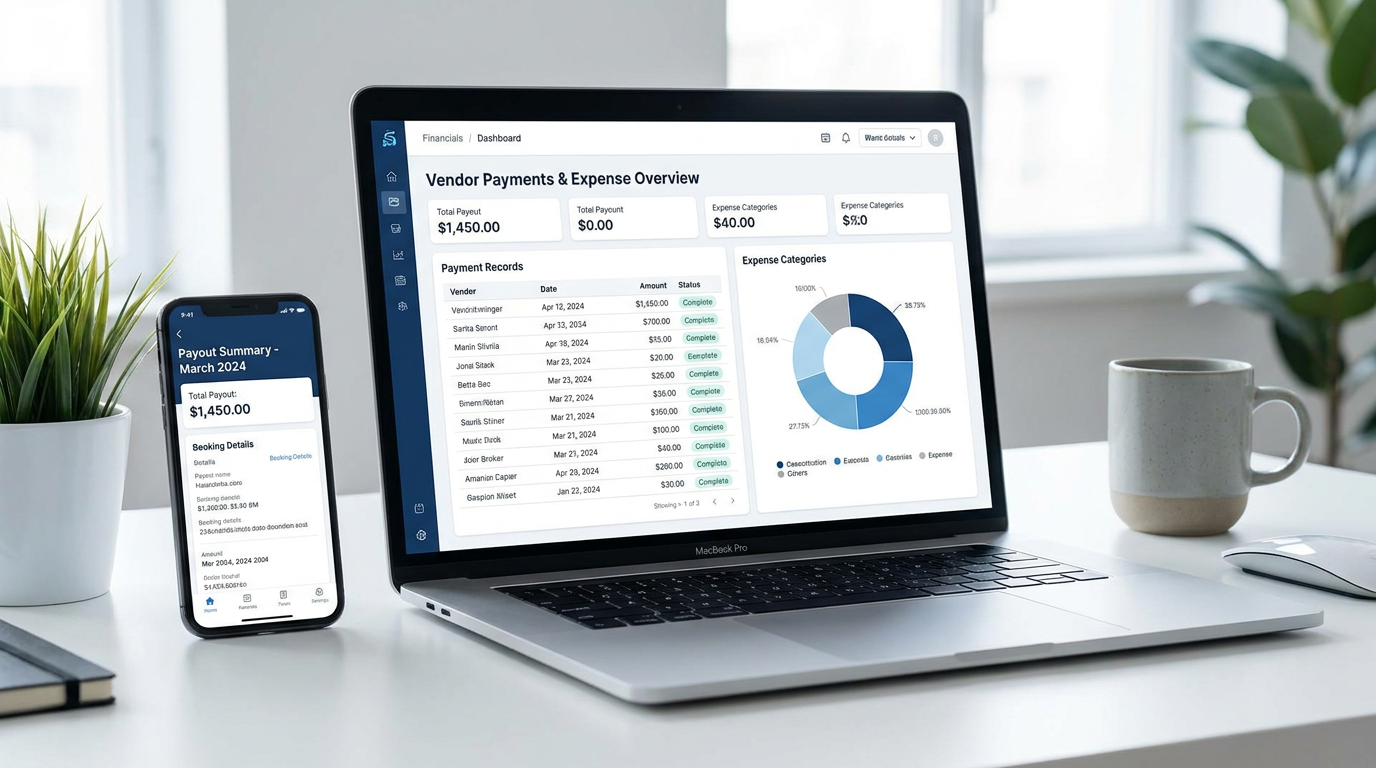
Look at what you actually need in January: a list of every payee, their annual total across all properties and entities, their W-9 on file, and how each payment was made.
That’s not a January question. It’s a question your records either answer or they don’t.
Penny, RealBooks’ AI bookkeeper, connects to your bank accounts and credit cards and categorizes transactions to the correct property, vendor, and expense category as they post — so vendor totals accumulate throughout the year rather than being reconstructed from twelve months of statements.
Dollar Bill handles asset setup and renovation projects, tracking contractor payments against specific projects and properties. On a rehab with several trades working across months, that’s the difference between a clean per-vendor total and a spreadsheet exercise.
Uncle Sam organizes records around rental reporting categories and generates per-property and portfolio reports your CPA can work from directly.
For investors holding property across multiple entities, each maintains its own books with a consolidated view — which matters here, because 1099 obligations attach at the entity level, not the portfolio level.
RealBooks organizes your records. It doesn’t file your information returns or provide tax advice — that’s your CPA. What organized books change is whether January is a lookup or an investigation.
The Takeaway
1099 compliance is administrative rather than difficult. Three forms, a threshold that just changed, a January deadline, and one habit that prevents nearly every problem.
The pieces worth remembering: the threshold is $2,000 for 2026 payments and later, not the $600 you may have memorized. 1099-NEC covers services, 1099-MISC covers rent you pay and attorney proceeds, and 1099-K is something you receive — reported gross, so reconcile it rather than reporting what hit your bank. Attorneys are reportable even when incorporated. Card and platform payments generally aren’t yours to report. Ten or more returns means e-filing.
And collect the W-9 before you pay. That one habit turns January from a scramble into a lookup.
Your numbers should work as hard as your investments do.
Vendor totals that are ready in January — because they’ve been tracked since February.
Ready to maximize your tax savings?
RealBooks automatically tracks expenses, manages assets, and calculates depreciation across your entire portfolio.
Start Free Trial →