Insights for Smarter Real Estate Investing
Tax strategies, product updates, and financial insights to help you keep more of what you earn.

Long-Term Rentals: The Complete Guide to Buying, Managing, and Holding Rental Property for the Long Run
Long-term rentals are the least glamorous real estate strategy and the one that's quietly built the most wealth. Here's the complete guide: how to evaluate a deal, the tenant and lease fundamentals that actually determine your returns, how depreciation and the passive activity rules apply, the operational rhythm that keeps a rental profitable, and what it takes to scale from one property to a portfolio.

The Look-Back Study: How to Recover Years of Missed Depreciation Without Amending Your Tax Returns
If you've owned rental property for years and never ran a cost segregation study, the opportunity hasn't passed you by. A look-back study lets you claim the full cumulative difference between what you claimed and what you were entitled to — as a single current-year deduction, with no amended returns required. Here's how the Form 3115 catch-up actually works.

Depreciation Recapture Explained: The Tax Bill Real Estate Investors Forget About Until They Sell
Depreciation reduces your tax bill every year you own a rental — and the IRS wants some of it back when you sell. Here's exactly how depreciation recapture is calculated, how it stacks with capital gains and NIIT, what cost segregation does to your exposure, and how investors legitimately plan around it with a 1031 exchange or careful timing.

Real Estate Tax Deductions You're Probably Missing: 10 Overlooked Write-Offs for Rental Property Investors
Nobody forgets mortgage interest. The deductions rental investors miss are the ordinary ones that never get captured — mileage, home office, out-of-market travel, HELOC interest, software, start-up costs. Here are 10 legitimate, commonly overlooked write-offs, what each one requires to substantiate, and the two traps that turn a deduction into a problem.

Passive Activity Loss Rules Explained: How Rental Property Losses Are Treated by the IRS
Depreciation can turn a cash-flowing rental into a paper loss — but the passive activity loss rules decide whether that loss does anything for you. Here's the machinery: why rentals are passive by default, material vs. active participation, the $25,000 allowance, how suspended losses work on Form 8582, the 1031 trap, and grouping elections. The technical companion to our Passive Income guide.

Self-Directed IRA Real Estate Investing: The Complete Guide to Using Retirement Funds to Buy Property
A self-directed IRA can hold rental property, land, and notes — but real estate's best tax advantages largely disappear inside one, because the account is already tax-sheltered. Here's what an SDIRA is, the prohibited transaction rules that can put your entire account at risk, why leverage triggers UBIT, the Solo 401(k) exception most articles bury, and who this strategy actually suits.

The Qualified Business Income (QBI) Deduction for Real Estate Investors: Do You Qualify for the 20% Pass-Through Deduction?
The QBI deduction is worth up to 20% of qualified business income — and the One Big Beautiful Bill Act made it permanent. But for landlords it turns on one question most articles skip: is your rental a trade or business? Here's how that gets answered, the IRS safe harbor that gives you a defined path, what counts toward the 250-hour requirement, and the depreciation interaction that catches investors who just ran a cost segregation study.

What Is a 1099 for Rental Property? Everything Landlords Need to Know About 1099-NEC, 1099-MISC, and 1099-K
Three 1099 forms matter to landlords, and the reporting threshold just changed — from $600 to $2,000 for payments made after December 31, 2025. Here's what 1099-NEC, 1099-MISC, and 1099-K each cover, whether landlords actually have to issue them, the January deadlines, why the attorney exception catches people, and the one habit that makes the whole thing uneventful.

Real Estate Tax Planning: A Quarter-by-Quarter Execution Guide for Rental Property Investors
Most investors know the strategies — depreciation, cost segregation, REPS, 1031 exchanges. What they don't have is a calendar. This is the quarter-by-quarter execution guide: what to close in Q1, what to review in Q2, the decisions that have to be made in Q3, and what has to happen before December 31. Because tax planning fails on timing far more often than it fails on knowledge.

What Is Schedule E? The Rental Property Tax Form Every Landlord Needs to Understand
Schedule E is where rental income and expenses live on your tax return — and where a decision gets made that can cost landlords 15.3% in self-employment tax they never owed. Here's what the form is, what belongs on each line, the Schedule E vs. Schedule C question every landlord should confirm, why your rental loss may not be deductible this year, and how to keep books that make filing it a report rather than a reconstruction project.

Passive Income Real Estate: What It Actually Means, How It's Taxed, and Why Most Investors Get It Wrong
Investors hear "passive income" and think hands-off money. The IRS means something almost opposite — a classification that restricts what you can deduct. That gap is why so many investors generate large depreciation losses they can't use. Here's what passive really means under IRC Section 469, the three legitimate paths out of it, and what happens to suspended losses when you sell.

10 Tax Mistakes Real Estate Investors Make (And How to Avoid Every One)
Most real estate investors overpay on taxes — not because the deductions don't exist, but because these 10 mistakes happen silently throughout the year in the bookkeeping, the classifications, and the systems. Here's the complete guide to every mistake, what it actually costs, and how to make sure none of them happen to you.

How to Analyze a Rental Property: The Complete Guide to Running the Numbers in 2026
Most rental property analysis guides tell you how to run the numbers before you buy. This one covers that AND what happens after — the ongoing tracking, performance monitoring, and tax optimization that determine your real returns. From NOI and cap rate to cost segregation and 100% bonus depreciation under the OBBBA, here's the complete 2026 guide to analyzing a rental property from first look to long-term portfolio intelligence.

How to Use Your Cost Segregation Losses: Passive Activity Loss Rules, the STR Loophole, REPS, the $25K Offset, and Suspended Losses Explained for Real Estate Investors in 2026
You ran a cost segregation study. You generated six figures in accelerated depreciation losses. And then you discovered the IRS won't let you use them the way you expected. Here's the complete guide to the four paths that determine how your cost segregation losses actually flow to your tax return — passive activity loss rules, the STR loophole, Real Estate Professional Status, the $25K offset, and what happens to suspended losses when you sell.

Real Estate Professional Status (REPS): The Complete 2026 Guide — What It Is, How to Qualify, and How to Document It for the IRS
Real Estate Professional Status (REPS) is one of the most powerful tax designations in the U.S. tax code — and one of the most audited. It allows qualifying investors to write off unlimited rental losses against W-2 income. But most investors who could qualify either don't know it exists or fail the documentation test when the IRS comes calling. Here's the complete 2026 guide: what REPS is, exactly how to qualify, which activities count, what the dollar math looks like, and how to build an audit-ready record that holds up.

LLC for Rental Property: The Complete Guide to Forming, Structuring, and Managing Your Real Estate LLC in 2026
Most investors set up their LLC because their attorney told them to. What comes after — the banking structure, the bookkeeping system, the entity separation, the tax treatment — is where most investors fall behind. This is the complete 2026 guide to LLC for rental property: whether you actually need one, the real advantages and disadvantages, how to form one step by step, Series LLC vs. individual LLCs vs. holding company structures, how to transfer existing property without triggering your mortgage, the tax benefits, and how to build the right financial infrastructure from day one.

You Skipped Depreciation. The IRS Still Counted It.
Most investors think skipping depreciation means saving the deduction for later. The IRS disagrees. Under the "allowed or allowable" rule in IRC Section 1016(a)(2), your property's basis is reduced by every year of depreciation you were entitled to take — whether you claimed it or not. That means you pay depreciation recapture tax at sale AND never received the deduction benefit. Here's what that costs, how Form 3115 fixes it, and how RealBooks prevents it from happening in the first place.

How to Become a Landlord: The Complete Beginner's Guide to Buying, Managing, and Profiting From Your First Rental Property in 2026
Most guides to becoming a landlord tell you how to buy a property. This one tells you everything that comes after — how to set up your finances from day one, how to find and screen tenants, how to handle landlord taxes (Schedule E, depreciation, deductions), and the financial habits that keep landlords profitable year-round. From your first property to a growing portfolio, here's the complete 2026 guide.

House Hacking: The Complete 2026 Guide — How It Works, How to Run the Numbers, and How to Manage the Finances
Most house hacking guides tell you what the strategy is. This one tells you how to run the finances through every phase of it — how to split expenses between personal and rental use, how depreciation works on the rental portion only, which tax deductions house hackers can claim, and how cost segregation plus 100% bonus depreciation under the OBBBA makes house hacking the most tax-efficient wealth-building strategy available in 2026. From FHA financing to the personal/rental expense split, this is the complete guide.

Real Estate Bookkeeping: The Complete Guide for Rental Property Investors in 2026
Most real estate investors are using bookkeeping systems that were never built for real estate. Generic tools don't understand property phases, depreciation schedules, multiple LLCs, or Schedule E. This is the complete 2026 guide to real estate bookkeeping — how to set up your system correctly, what to track monthly, the 6 financial reports you actually need, how tax strategy connects to your books year-round, and how RealBooks automates the entire thing through Penny, Dollar Bill, and Uncle Sam.

Rental Property Depreciation Explained: How It Works, How to Calculate It, and How to Maximize It in 2026
Most real estate investors are depreciating their properties the default way — straight-line over 27.5 years — and leaving tens of thousands of dollars in accelerated deductions completely on the table. This is the complete 2026 guide to rental property depreciation: how to calculate your depreciable basis correctly, how to apply cost segregation, how 100% bonus depreciation under the One Big Beautiful Bill Act changes everything, and the six most common depreciation mistakes RealBooks eliminates automatically.

The Complete BRRRR Method Guide: Buy, Rehab, Rent, Refinance, Repeat — With a Full Financial Tracking Framework for Every Phase
Most BRRRR guides tell you what the strategy is. This one tells you how to run the finances through every phase of it — cost basis at acquisition, expense classification during rehab, depreciation once the property is rented, how the refinance affects your books, and how cost segregation plus 100% bonus depreciation under the OBBBA makes BRRRR the most tax-efficient wealth-building strategy available in 2026.
1031 Exchange Rules Explained: The Real Estate Investor’s Complete Guide to Tax-Deferred Exchanges in 2026
Most 1031 exchange guides tell you the rules. This one tells you the rules AND how to track the financial side correctly — cost basis through an exchange, depreciation carry-forward, depreciation recapture implications, and the records you need to keep. Plus: why 2026 is the best year in a decade to combine a 1031 exchange with cost segregation under permanently restored 100% bonus depreciation.

Every Tax Deduction Real Estate Investors Can Claim in 2026: The Complete Guide
Most real estate investors are overpaying on taxes — not because the deductions don't exist, but because no one captured them properly throughout the year. This is the complete 2026 guide to every tax deduction real estate investors can claim — from mortgage interest and depreciation to passive activity losses and the permanently restored 100% bonus depreciation under the One Big Beautiful Bill Act — and how to make sure you never miss one again.

Still Using Spreadsheets for Your Rental Properties? Here’s What You’re Actually Risking
Spreadsheets got you to your first few properties — but they're not built to scale. From silent data errors and reconciliation nightmares to missed deductions and tax-season chaos, here's what managing your rental portfolio on spreadsheets is actually costing you.

Cap Rate vs. Cash-on-Cash Return: The Two Numbers Every Real Estate Investor Must Understand
Cap rate and cash-on-cash return are the two most important metrics in real estate investing — but most investors confuse them, misuse them, or only look at one. Here's how to use both correctly so you never miss half the picture on your next deal.

How Much Does a Renovation Cost? The Real Estate Investor’s Complete 2026 Budget Guide
Most renovation cost guides are written for homeowners. This one is written for real estate investors — fix-and-flip operators, BRRRR investors, and rental property renovators who need to understand costs in the context of deal math, ARV calculations, budget protection, and tax strategy. Get the complete 2026 investor's renovation budget guide.

How to Manage Finances Across Multiple LLCs Without Losing Your Mind
Multiple LLCs are the right structure for serious real estate investors — but most investors build the legal architecture before they build the financial system, and spend years trying to catch up. Here's the complete guide to managing finances across multiple entities without the chaos.

Cost Segregation 101: What It Is, Who Qualifies, and How Much It’s Actually Worth
Cost segregation is one of the most powerful IRS-approved tax strategies in real estate — and 90% of qualifying investors never use it. Here's what it is, who qualifies, what the real dollar savings look like at every property value, and why 2026 is the best year in a decade to act.

Repairs vs. Capital Improvements: The IRS Distinction That Can Cost You Thousands
One wrong classification on a renovation invoice can cost you thousands — either through IRS penalties or deductions deferred for 27.5 years. Here's the exact framework the IRS uses to evaluate every property expense, and how RealBooks makes sure you always get it right.

The 3-Phase Financial Framework Every Fix-and-Flip Investor Needs
Most fix-and-flip investors track their deal finances in one big bucket — and it's costing them in missed deductions, misclassified expenses, and overstated gains. Here's the three-phase framework (Acquisition, Renovation, Disposition) that the IRS uses, and how to apply it to every deal you run.
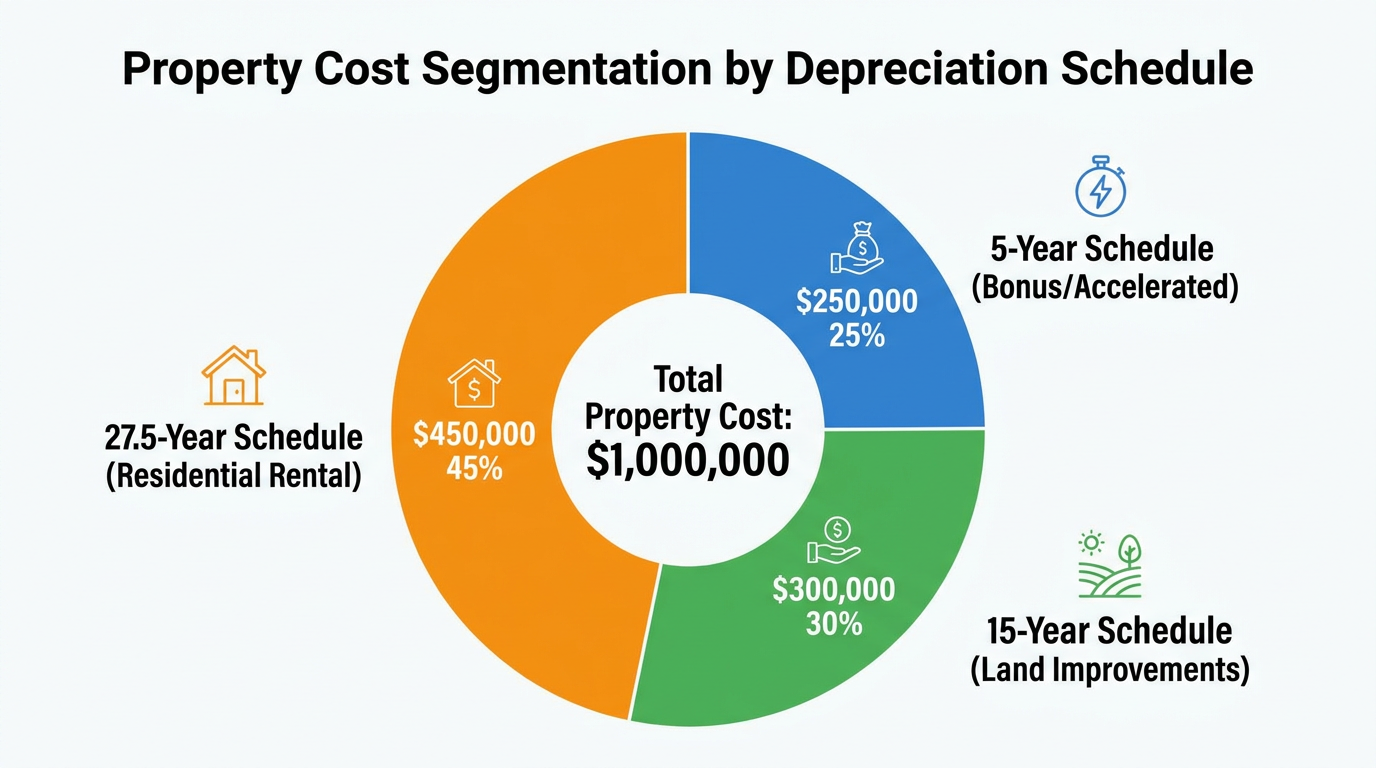
Your Mid-Year Financial Checkup: 6 Things Every Real Estate Investor Should Review Right Now
Half the year is gone — and if you haven't reviewed your numbers since tax season, you're flying blind into H2. Here are the 6 financial reviews every real estate investor should run right now, starting with the Q2 estimated tax deadline on June 16, 2026.
How the Big Beautiful Bill Changes Bonus Depreciation and Section 179 for Real Estate Investors
The One Big Beautiful Bill Act restores 100% bonus depreciation and doubles the Section 179 limit. Here's what real estate investors need to know about these game-changing tax provisions.
No posts match your search.
Ready to stop overpaying on taxes?
RealBooks automatically tracks expenses, manages assets, and maximizes deductions across your entire portfolio.